It was hell before his boots touched the ground. Karl Schulz, a paratrooper of the 3rd Battalion, 2nd Parachute Regiment, would remember the afternoon of May 20, 1941, on the north coast of Crete as a casualty report, not a figure of speech. The Junkers 52s had not even leveled out before the olive groves below erupted in fire—fire from men who had waited until the sky was full of descending parachutes. Schulz’s regiment had been told the ground was lightly held. It was not. Below him were two battalions of Australians, 1,270 men, and they were not retreating.
This is the story of Rethymno, an airfield that history forgot, and the paratroopers who jumped into a hell they were never prepared for. It is a battle told in their own words, and in the words of the men they landed on.
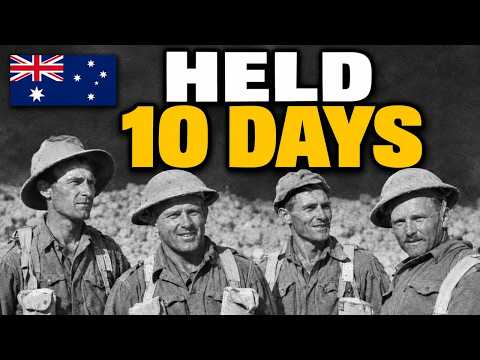
The men who jumped that afternoon belonged to the most celebrated arm of the German forces. A year earlier, their comrades had taken the Belgian fortress of Eben Emael from the air. Operation Mercury was meant to prove that an island could be conquered from the sky. General Kurt Student’s 11th Air Corps would drop on three airfields: Maleme in the west, Rethymno in the center, Heraklion in the east. At Rethymno, the task fell to Oberst Alfred Sturm and his 2nd Parachute Regiment, less one battalion—between 1,300 and 1,700 men, depending on the account.
What they had been told about the defenders was wrong. A captured German battle report later admitted that the British land forces in Crete were about three times the strength the Germans had assumed. The paratroopers were expecting a garrison in retreat. Instead, they found Lieutenant Colonel Ian Campbell.
Campbell was 41, a Duntroon graduate with the sword of honor, a veteran of the desert where he had won the Distinguished Service Order at Bardia. His battalion, the 2/1st, had come out of Greece with what they could carry. At the other end of the airstrip stood Major Ray Sandover of the 2/11th, a London-born Australian who had studied in Bonn and spoke the language of the men coming for him. And on the forward slope of the eastern hill, behind a Bren gun, lay Private James “Lofty” McKee of 9 Platoon, A Company.
The ground was simple: a coast road running east to west, the airstrip between the road and the sea, two hills dominating it. The Australians called them Hill A and Hill B. Campbell held Hill A, Sandover held Hill B. Around them stood Greek regiments and gendarmerie cadets—several thousand men in all. The Australians had eight field guns, two Matilda tanks, and Vickers machine guns with 3,200 rounds each. Nobody called that generous.
At 8:00 in the morning on May 20, far to the west, the first German assault regiment jumped over Maleme. Rethymno waited all day. At 4:00 in the afternoon, German fighter-bombers swept over the airstrip. Fifteen minutes, almost no damage. Then, at a quarter past four, the transports appeared from the sea—161 aircraft, flying low in lines.
The drop was meant to happen at 2:00. It was more than two hours late, and the air cover had already come and gone. The doors opened, and the olive groves opened fire.
Rudolf Adler, on the staff of the regimental headquarters, was inside one of those aircraft. “We spotted the island and the aircraft went down,” he later recalled. “AA fire started. Bullets were ripping through the body of the aircraft at head height. Men jump early to get out of the fuselage. They miss their drop zones. Some come down in the sea. Some come down on top of the positions they were supposed to attack.”
Lofty McKee watched them fall towards him. “I turned the Bren on the men coming down,” he said. “I got many of the first wave as they were so close you couldn’t miss.” Lieutenant Noel Craig, commanding 13 Platoon of C Company, put it more bluntly: “We hit them in the planes, in the air, and if they reached the ground alive, we kicked them.” After that afternoon, he said, he would never go duck hunting again.
Parachutes in the trees, containers in the vines, men cutting at their harnesses with bullets already arriving. The fire went both ways. Corporal John Robinson of the 2/1st was hit. “I was hit in the head,” he recalled. “The bullet entering my steel helmet. It lodges in the lining.” His scalp was badly cut. He was alive. At least seven transports were shot down that afternoon. Nine crash-landed near Hill B. One Australian later compared the noise to Empire Day with everyone firing.
On Hill A, the Germans were not finished. Major Crowe’s battalion had landed largely east of the main defenses, out of the worst of the fire. Crowe was a veteran. He gathered his men into assault groups and went straight up the hill. He reached the crest. The Australian gun positions there were overrun. Crew after crew of the Vickers guns was shot down until a German mortar bomb put the guns out of action. By nightfall, the Germans held most of Hill A. From its top, they could look down the whole length of the airstrip.
To the west, Sandover’s men had had a better afternoon. By dark, the 2/11th had taken 84 prisoners. Night fell on the olive groves. The heat went out of the ground. The dead stayed where they were. Rudolf Adler would later describe what the daylight showed: “Many of our comrades were dead still hanging from their parachutes. They were all black and swollen because of the heat.”
Inside the German lines, the picture was no better. By the end of that first day, according to Adler, Oberst Sturm was tired and incapable of giving orders. Campbell had lost the high ground. Without it, the airstrip belonged to whoever held the crest. He decided to take it back at dawn.
Before first light, the companies formed up in the dark below the hill. Rifles, Brens, grenades—every round counted because there were not many. At 5:25 on the morning of May 21, the first Australian counterattack went up the slopes of Hill A. It stalled. The Germans had used the night. Machine guns sat in the terraces. Mortars covered the approaches. Then a German aircraft made a mistake. A Dornier dropped six bombs on its own side. Sixteen Fallschirmjäger were killed.
Campbell saw the confusion and threw in everything he had left. Lieutenant Rogers went north with four platoons and took 25 prisoners. Lieutenant Craig cleared a gully the Australians had named Wadi Bardia after their desert battle. Lieutenant Mann’s group alone brought in 34 men with their hands up. Captain Channel was wounded and kept leading until a German machine gun post went silent. By about 8:00, the crest was Australian again.
Crowe did not break. He pulled what remained of his battalion back east along the coast road to a large building near the village of Stavromenos—an olive oil factory. The German report on the operation recorded that morning in a single dry sentence: “Major Crowe had been attacked again. His flank was enveloped and he was forced to retire east to the olive oil factory where he reorganized and beat off repeated attacks.” It was a German document. It read like a confession.
On the western side, the same day, Sandover’s battalion cleared the coastal ground below Hill B. Among the prisoners brought in was a colonel—Alfred Sturm, the commander of the entire German force at Rethymno. The German assault on this airfield was now split in two. Crowe’s survivors were holed up in the factory to the east. The third battalion was dug into the village of Perivolia and its church of St. George to the west. The Australians held everything in between.
For the second time in two days, the Luftwaffe had hit its own men. And the battle for Rethymno was only just beginning.
On May 22, Campbell prepared an attack on the factory. Captain Moriarty, commanding D Company, went forward to look at the ground. He was killed. The attack did not start. At 6:00 in the evening a second attempt went in—200 Greeks, 40 Australians. It failed against the factory walls. To the west, Sandover sent two companies under Captain Honner along drainage ditches towards Perivolia in the dark. They stopped 200 yards short of the German line.
May 23, 10:00 in the morning. On this battlefield, the shooting stopped. A truce—three hours to clear the wounded from between the lines. About 200 German wounded, about 100 Australians. For three hours, men who had spent three days trying to kill each other carried stretchers across the same ground. The two sides had been sharing a field hospital. Captured German medical officers worked beside the Australians of the 2/7 Field Ambulance. Campbell later wrote that the Germans were well supplied with medical equipment and medicines, and that the arrangement benefited the wounded of both sides.
Then the burial parties counted. 300 German dead on Hill A. 200 more on Hill B. In the afternoon, as the truce ended, a German officer walked out of the olive oil factory carrying a white flag. For a moment the Australians watching him thought the factory was giving up. He had come to invite Campbell to surrender. According to Campbell, the officer claimed that the German attacks on the other sectors of the island had succeeded. Campbell refused and ordered his guns to shell the factory.
Keep that officer’s claim in mind. Before the week was out, it would matter more than anything said on this hill.
The days that followed belonged to the Luftwaffe. Stukas over Perivolia, bombers over the Australian lines. The ammunition shrank, so did the food. The Australians made use of whatever the enemy left behind. Across the sector, the small fights went on. Corporal Smallwood studied a group of Greek troops under fire, then led a patrol that brought back 20 prisoners.
On the 24th, a company of the 1st Rangers arrived from the force reserve. It attacked Perivolia against an estimated 300 paratroopers. The attack failed and the Rangers were sent back west. On the 25th of May, the Australians turned a captured German 81mm mortar on a house near the factory where the enemy had been holding out. About 40 Germans pulled back.
At 3:00 in the morning on the 26th, Major Crowe slipped out of the factory with about 30 men and disappeared. He left around 40 paratroopers behind to guard his prisoners, among them the crew of a British tank. At first light, Captain Embry of B Company led a platoon at the factory wall. They went over it. 40 Fallschirmjäger surrendered with about as many wounded. The British tank crew walked free. The building that had held out for five days was Australian. The eastern half of the battle was over.
Now there was only Perivolia. The two Matildas had already tried there. On the 26th, a jammed Besa machine gun halted one attack. On the 27th, a mortar bomb disabled one tank and an anti-tank gun stopped the other. Two companies of the 2/11th were pinned in front of the village and pulled back after dark.
Night of the 27th to the 28th of May. Sandover sent in his last attack on Perivolia. Captains Jackson and Wood led it. 20 past 3:00 in the morning. The companies moved off in silence before they reached the German positions. Greek troops opened fire. Surprise gone. The paratroopers opened up. Captain Wood fell, mortally wounded. The Australians fought their way into the edge of the village. 80 German casualties by the Australian count. At 4:33, Lieutenant Scott fired green flares. Withdraw. D Company came back with 43 men. B Company was left stranded inside the village. Captain Jackson got out later by working his way around the German positions.
Perivolia held. So did Rethymno. And the German officer under the white flag had been telling the truth. Maleme airfield in the west had fallen to the paratroopers on the 21st of May—the same morning Campbell retook Hill A. Through Maleme, the Germans began flying in mountain troops by the planeload. The western front gave way. By the 28th, the British commander on Crete, General Bernard Freyberg, had ordered his army back to the south coast to be taken off by the navy. The officer from the factory had not been bluffing. He had only been early.
The message to withdraw never got through to the two battalions holding the airfield at Rethymno. So Campbell’s men went on holding an airstrip for an army that was leaving the island. They had no contact with the rest of the Allied forces. They did not know that Heraklion had been evacuated by sea. They did not know that nobody was coming.
29th of May, evening. Greek troops came in with a report. Around 300 German motorcyclists had entered the town of Rethymno from the west. The Germans had come along the coast road from Maleme.
30th of May, 6:00 in the morning. The 2/11th heard engines, then artillery, then mortars. Half past nine, three tanks came along the coast road. Behind them, motorcycle troops and light field guns.
Campbell looked at what he had left. His Greek allies were gone. His food was almost gone. His ammunition was a fraction of what it was. He considered a breakout and later wrote down why he rejected it. “The loss of many brave men was to be expected from any attempt to escape now.” Further resistance, he judged, could only end in a useless waste of lives.
He telephoned Sandover. Sandover would not surrender. He gave his men a choice—destroy their weapons and take to the mountains, or stay and go into captivity with their colonel.
Campbell gave the order to make a white flag. Then he did what the German officer had come out of the factory to ask of him a week before. He tied a towel to a stick. He walked down the track towards the airfield. Captain Embry walked with him. The battalion quartermaster carried the flag.
The first thing the Germans did was open the prisoner cages. More than 500 paratroopers walked out. Oberst Alfred Sturm among them. 934 Australians went in. 190 of them wounded. The guards of ten days became the prisoners.
What do you think history owes the men of Rethymno—the ones who won their battle and marched into captivity anyway? Let us know in the comments below.
Report this article
Select a reason for reporting:






