Imagine being ripped from your mother’s arms in the middle of the night, carried through dark corridors by strangers, and placed on a throne so enormous your tiny legs dangle off the edge. You’re two years old. You don’t understand what’s happening. You just want your mother. But no one cares what you want because you are no longer a child. You are the Son of Heaven, the Xuantong Emperor, the divine ruler of the Great Qing Dynasty. This is how the story of Puyi begins. And what happened to him after that empire crumbled is one of the strangest, most tragic, and most surreal journeys any human being has ever taken.
From emperor to puppet, from puppet to prisoner, from prisoner to gardener—this is the full story. To understand Puyi’s fate, you first need to understand the dying world he was born into. By the early 1900s, the Qing Dynasty had ruled China for over 260 years, but the empire was rotting from within. Decades of humiliation at the hands of Western powers had hollowed out its strength. The Opium Wars had exposed the military as hopelessly outmatched. The Taiping Rebellion had killed tens of millions. Foreign powers carved out concessions along the coast, extracting wealth and dictating terms. And at the center of this decline, pulling every string, was one of the most formidable and ruthless women in Chinese history: the Dowager Empress Cixi.
Cixi had started as a low-ranking concubine, but she bore the Xianfeng Emperor a son—the only person to do so. When the emperor died in 1861, she went from political obscurity to the most powerful woman in China. Through strategic alliances and sheer force of will, she dismantled the regency council and effectively took control, ruling from behind a silk screen for nearly five decades. By 1908, Cixi was 72 and dying. The Guangxu Emperor, her puppet for most of his life, was also gravely ill—many historians believe she had him poisoned. In 2008, forensic scientists found arsenic levels in his hair more than 2,000 times above normal. It was her final act of control. But she had one more move: she chose Puyi, her two-year-old nephew, as the next emperor. A toddler could not resist her. A toddler could be molded. There was just one problem—she died the very next day.
On November 15, 1908, Cixi breathed her last, leaving behind a crumbling empire and a two-year-old boy who had no idea what had just been decided for him. What followed was, by any measure, a kidnapping dressed up in imperial ritual. Palace guards arrived at Puyi’s family home in the middle of the night and informed his parents that the boy was now emperor and must come with them immediately. Puyi later wrote in his memoirs about that night: he remembered screaming, being torn from his mother’s side, carried through the darkness toward a world he could not comprehend. His wet nurse, Wang Lingshou, was the only familiar face allowed to accompany him. When baby Puyi was presented to the dying Cixi, he reportedly screamed and cried, shouting that he wanted his nanny. Cixi, with what little energy she had left, simply sneered and said, “What a naughty child. Take him away to play.”
Two weeks later, on December 2, 1908, Puyi was formally enthroned in the Hall of Supreme Harmony. His father carried the wailing child to the dragon throne while drums thundered and thousands watched in ceremonial silence. The silence terrified the little boy. He screamed and tried to climb off the throne. His father could only whisper, “Don’t cry. It’ll be over soon.” It would not be over soon. In fact, what followed was a childhood unlike anything most people could imagine—a world frozen in amber.
Outside the walls of the Forbidden City, China was changing at a dizzying pace. Revolutionaries were organizing. Reformers were agitating. The country was tearing itself apart. But inside those crimson walls, time had stopped. Puyi was surrounded by an army of eunuchs who attended to his every conceivable need. He was dressed in custom-made imperial robes, served meals of dozens of elaborate dishes, carried in palanquins. He never had to lift a finger, never had to tie his own shoes, never had to brush his own teeth. Everything was done for him. And in this cocoon of absolute dependence and bottomless luxury, Puyi grew up with no concept of how ordinary people lived. He had no friends his own age, no meaningful relationships, no understanding of the world beyond the palace gates.
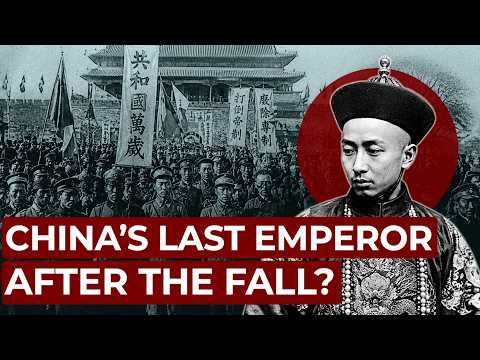
Then, in October 1911, that world came crashing in. The Xinhai Revolution erupted across China like a brushfire. Republican revolutionaries, inspired by Sun Yat-sen, rose up against the Qing in city after city. Provincial governments declared independence. Military commanders switched sides. The dynasty, already weakened beyond repair, had no answer. By early 1912, the situation was hopeless. On February 12, 1912, Empress Dowager Longyu, acting on behalf of six-year-old Puyi, signed the Imperial Edict of Abdication, formally ending over 2,000 years of imperial rule in China. The Republic of China was born.
But here is where the story takes its first strange turn. Puyi abdicated, yes. The dynasty fell, yes. But under the Articles of Favorable Treatment negotiated between the new republic and the Qing court, Puyi was allowed to keep his imperial title. He was granted a generous annual stipend of 4 million silver dollars. And most remarkably, he was allowed to continue living inside the Forbidden City, surrounded by his eunuchs, his court rituals, his parallel universe. It was as if someone had ended the movie but forgot to turn off the projector. Outside the palace walls, China was now a republic. Inside, Puyi was still being addressed as “Your Imperial Majesty.”
For the next 12 years, Puyi existed in this bizarre limbo. The Republic was in chaos—warlords carved up the country, governments rose and fell. And inside the Forbidden City, a boy grew into a teenager, completely unaware of how to live in the real world. He had tutors who taught him Chinese classics and Confucian philosophy. But it was the arrival of one particular tutor in 1919 that would change his world more than anyone before. His name was Reginald Fleming Johnston, a Scottish diplomat and scholar who had spent over two decades working in the British colonies in China. Johnston was 45 when he walked through the gates of the Forbidden City for the first time. Puyi was 13. The connection between them was immediate and deep.
Johnston was unlike anyone Puyi had ever encountered. He spoke to the boy not as a living deity, not as a sacred figure to be worshipped, but as a young man with a mind worth developing. He taught Puyi English, mathematics, geography, and Western history. He told him about the British monarchy, European political systems, the workings of modern industrial society. He introduced him to the technologies emerging from the First World War—airplanes, tanks, submarines. For the first time in his life, Puyi caught a glimpse of the scale and complexity of the modern world outside his palace walls. Johnston also did something that no one else in the court had dared: he exposed the corruption of the eunuchs. The palace had been hemorrhaging treasures for years, with eunuchs stealing priceless artworks and selling them on the black market. When Puyi, inspired by Johnston, ordered an inventory of the palace’s treasures, the eunuchs panicked. On the night of June 27, 1923, the Palace of Established Happiness erupted in flames. It was arson, deliberately set to destroy the evidence. Puyi, furious, expelled a large number of eunuchs from the palace.
Johnston also gave Puyi something unexpected but deeply symbolic: he gave him glasses. The court had refused to acknowledge that the young emperor was nearsighted because admitting physical imperfection in the Son of Heaven was considered unacceptable. Johnston simply handed him a pair of spectacles and told him to put them on. For the first time, Puyi could see the world clearly. The metaphor writes itself. Johnston also gave Puyi an English name—Henry. From that point on, the last emperor of China was known in the West as Henry Puyi. Johnston even tried to arrange for Puyi to travel to Europe to study at Oxford, to see the world beyond his gilded cage. Plans were discussed; they never materialized. And looking back, one can wonder how different things might have been if Puyi had gotten on that boat. Because what came next was not Oxford. What came next was expulsion.
In October 1924, a warlord named Feng Yuxiang seized Beijing in a military coup. One of his first acts was to tear up the Articles of Favorable Treatment that had allowed Puyi to remain in the Forbidden City. On November 5, Feng’s soldiers marched into the palace and gave Puyi an ultimatum: Leave within three hours or face the consequences. After 12 years of living in a world that pretended the dynasty still existed, reality arrived at the gates with bayonets. Puyi was terrified. He fled first to his father’s estate, then sought refuge at the Japanese legation in Beijing. It was at this moment—frightened, humiliated, and desperate to reclaim even a fraction of what he had lost—that Puyi made the decision that would define and haunt the rest of his life. He turned to Japan.
The Japanese were more than happy to receive him. They saw in Puyi something immensely valuable: a legitimate heir to the Qing Dynasty, a symbol that could be manipulated, a figurehead that could lend an air of legitimacy to their imperial ambitions in Northeast China. They provided him with a villa in the Japanese concession in Tianjin, where he would live for the next seven years in a strange twilight existence. He and his Empress, Wan Rong, lived a life of superficial luxury among the cosmopolitan elite. They attended parties. They wore Western clothes. They posed for photographs. But beneath the surface, everything was falling apart.
Puyi was restless, bored, and consumed by an obsessive desire to reclaim his throne. Wan Rong, trapped in an empty marriage with a husband widely believed to be impotent and who showed little interest in her, began smoking opium. Her addiction would eventually destroy her. It was during this period that one of Puyi’s secondary consorts, Wenxiu, did something almost unheard of in Chinese history: she divorced him. In 1931, Wenxiu filed for divorce in a modern court, citing nine years of emptiness and neglect. It was humiliating for Puyi—an emperor being divorced by his own consort. The scandal made national headlines. Puyi, enraged, directed his fury not at himself but at Wan Rong, who became the target of his cruelty and frustration.
And then, on September 18, 1931, everything changed again. Japan invaded Manchuria. The Mukden Incident, as it came to be known, was a staged explosion near a Japanese-owned railway line, manufactured by the Japanese military as a pretext to launch a full-scale invasion. Within months, the entire region was under Japanese control, and the Japanese had a very specific plan for what to do with it. They would create a puppet state—a country that existed on paper as an independent nation but which in reality was entirely controlled by Tokyo. And they needed a face for this puppet state. They needed someone with a name, a lineage, a claim to the land. They needed Puyi.
In November 1931, Japanese soldiers and intelligence agents spirited Puyi out of Tianjin and smuggled him to Manchuria. On March 1, 1932, a man who had once been the emperor of 400 million people was installed as the chief executive of Manchukuo. It was a test. The Japanese Emperor Hirohito wanted to ensure that Puyi would be a loyal and obedient puppet before granting him the title he truly craved. For two years, Puyi performed his role dutifully, signing whatever papers were placed before him, smiling for whatever cameras were pointed at him. And so, on March 1, 1934, Puyi was crowned Kangde, emperor of Manchukuo, in a ceremony held in the capital of Sinking—what we know today as Changchun. He wore imperial robes. He sat on a throne. He accepted the bows of his supposed subjects. But this was nothing like the Forbidden City. This was a cage of a very different kind.
Puyi quickly discovered that his imperial title was meaningless. Every decision of consequence was made by the Japanese. His prime minister was Japanese-appointed. His military was Japanese-controlled. His palace was surrounded by Japanese guards who monitored his every move. He needed permission to leave his own residence. His phone calls were listened to. His letters were read. Even his daily schedule was dictated by his handlers. The League of Nations sent an investigative commission to Manchuria, and their report concluded bluntly that Manchukuo was not a genuine expression of self-determination but a state directed and organized entirely by the Japanese military. The international community, with the exception of a handful of nations, refused to recognize Manchukuo as legitimate. Japan withdrew from the League of Nations in protest.
For the next 11 years, Puyi existed as a prisoner in emperor’s clothing. The state he supposedly ruled became a laboratory for some of Japan’s most horrific wartime atrocities. Unit 731, the infamous biological warfare research program, conducted grotesque human experiments on Chinese, Korean, and Russian prisoners in Manchuria. Forced labor camps were built across the territory. Anyone who was not ethnically Japanese was treated as a second-class citizen. Nine separate police and intelligence agencies operated within the state, creating an atmosphere of constant surveillance and terror. And Puyi, the supposed emperor of this nightmare, was powerless to stop any of it. It is debated how much he knew. What is not debated is that his name was stamped on all of it.
Meanwhile, the woman who had once been his empress, Wan Rong, had deteriorated beyond recognition. Trapped in the palace in Changchun, cut off from the world, addicted to opium, her mental faculties deteriorating, she lived in a state of near-total collapse. She would eventually be arrested by Chinese communist soldiers after the fall of Manchukuo and die in a prison in Yanji in 1946. She was 39 years old.
Then came August 1945. The Soviet Union declared war on Japan and launched a massive invasion of Manchuria. The Japanese military, already crumbling on every front, could not hold the territory. Manchukuo collapsed almost overnight. On August 16, 1945, Puyi read a prepared abdication statement declaring that Manchukuo was dissolved and that the territory was once again part of China. He had been emperor for the third time in his life, and for the third time it ended in abdication. Puyi attempted to flee to Japan, but he was captured by Soviet paratroopers at the airport near Mukden on August 19. He and a small entourage were flown to the Soviet Union, where they would spend the next five years in detention near Khabarovsk in the Russian Far East.
Now, here is something interesting about Puyi’s time in Soviet custody. Joseph Stalin ordered that Puyi be treated reasonably well—not out of kindness, but out of calculation. Stalin believed Puyi might be useful someday as yet another puppet, this time for Soviet interests. Puyi was given a relatively comfortable form of house arrest with better food and living conditions than most Soviet prisoners could dream of. He even enjoyed certain privileges, like eating meals separately from other detainees and being excused from forced labor. In 1946, Puyi was called to testify at the International Military Tribunal for the Far East in Tokyo, the Asian equivalent of the Nuremberg trials. He took the stand and testified that he had resented Japanese control over Manchukuo, that he had been coerced, that he was a victim rather than a collaborator. Whether this was entirely true is debatable. Years later, in his autobiography, he would partially retract some of those statements. The truth, as always with Puyi, was complicated.
In 1949, as Mao Zedong’s communist forces won the Chinese Civil War and established the People’s Republic of China, Puyi wrote a desperate letter to Stalin begging not to be sent back. He knew what awaited him in communist China. He knew that the people who now ruled his homeland had every reason to put him against a wall. But Stalin, eager to strengthen his relationship with the new Chinese government, handed Puyi over in 1950. It was a diplomatic gift. The last emperor was going home, and home had become a very different place.
Puyi arrived at the Fushun War Criminals Management Center in Liaoning Province in August 1950. This was a facility originally built by the Japanese during their occupation, now repurposed by the Communist government to re-educate war criminals. Former Manchukuo officials, Kuomintang officers, and Japanese prisoners were all held here. And now, so was the man who had once ruled 400 million people. What followed was one of the most remarkable transformations in modern history—or at least one of the most carefully constructed ones. The re-education process at Fushun was designed not merely to punish but to fundamentally reshape the way prisoners thought about themselves, their crimes, and their place in the new China. Prisoners underwent mandatory study sessions on Marxist-Leninist theory and Mao Zedong Thought. They performed manual labor—farming, factory work, basic maintenance. They participated in group criticism sessions, where they were expected to confess their crimes, examine their past behavior through the lens of class struggle, and demonstrate genuine remorse.
For Puyi, the process was especially humbling. This was a man who had never in his life performed a single act of self-care. He had never brushed his own teeth. He had never tied his own shoelaces. He had never cooked a meal, washed a dish, or made his own bed. Guards at Fushun had to teach him these basic skills from scratch. The image is almost absurd: the former emperor of China being shown by a prison guard how to hold a toothbrush. But it was real. And slowly, over the course of nearly a decade, something inside Puyi began to change. Or at least, that is the story that was told.
On December 4, 1959, Puyi was granted amnesty by a special order of Chairman Mao Zedong. He was released from Fushun and given the status of an ordinary citizen of the People’s Republic of China. He was 53 years old. He had spent the first half of his life as a god, the second half as a prisoner. Now, he was neither. Puyi moved to Beijing and took up residence in a modest apartment. His first job was as a gardener at the Beijing Botanical Gardens. Think about that for a moment. The man who had once lived in the largest palace complex in the world, who had been carried through corridors by armies of eunuchs, who had eaten from golden plates, was now tending plants and pulling weeds in a public garden. He reportedly enjoyed the work—or at least accepted it with a kind of quiet resignation. He was also assigned work at a mechanical repair shop within the gardens, doing small maintenance tasks.
There are stories from this period that border on the surreal. It is said that in his early days of freedom, Puyi would sometimes wander the streets of Beijing, stopping passersby to inform them that he was the emperor of China, and then asking them for directions home. He had spent his entire life inside walls—either the walls of the Forbidden City, the walls of Japanese palaces, or the walls of prisons. Navigating an ordinary city street was genuinely bewildering for him. And then there were his visits to the Forbidden City itself, which had been converted into the Palace Museum and opened to the public. Puyi would buy a ticket like any other tourist, walk through the same halls where he had once been carried as a living deity, and then offer himself as an impromptu tour guide to bewildered visitors, pointing out objects he remembered from his childhood, explaining what this room was used for, where that painting used to hang. It is one of the most poignant images in modern Chinese history: the emperor as a tourist in his own former home.
Eventually, Puyi was appointed to a position at the Chinese People’s Political Consultative Conference, where he worked as a literary editor and researcher in the Institute of Literature and History. It was a nominal role, partly symbolic, designed to demonstrate the Communist Party’s capacity for mercy and rehabilitation. Puyi became a kind of exhibit himself—proof that even an emperor could be reformed, that the old order could be remade into something new. During this period, Puyi wrote his autobiography. It was originally published in Chinese under the title The First Half of My Life, and later released in English as From Emperor to Citizen. The book is a fascinating document, though historians have long debated how much of it was genuinely Puyi’s voice and how much was shaped, guided, or outright ghostwritten to serve the Communist Party’s narrative of successful re-education. In the autobiography, Puyi presents himself as a man who came to see the error of his ways, who recognized the crimes of the old imperial system and the exploitation of the Japanese puppet state, and who embraced the new China with gratitude and conviction. Whether this was truly what Puyi believed or simply what he needed to say to survive is a question that can never be fully answered.
In 1962, Puyi married for the fifth and final time. His bride was Li Shuxian, a hospital nurse who was Han Chinese, not Manchu. She was 37; he was 56. By all accounts, this marriage was genuinely affectionate—perhaps the first truly happy relationship Puyi ever experienced. Li Shuxian would later spend decades working to preserve his memory and cooperating with historians and biographers to tell his story. The authorities also called upon Puyi from time to time to hold press conferences in which he would speak publicly about the benefits of living under the Communist system. He appeared to be a true believer. He praised Chairman Mao. He expressed gratitude for his re-education. He spoke about the crimes of the old feudal order with apparent sincerity. Whether this was genuine conviction, a survival mechanism honed over a lifetime of serving whatever power held him, or something in between, we will never know.
But whatever peace Puyi had found in this quiet, modest life was about to be shattered one final time. In 1966, Mao Zedong launched the Cultural Revolution, a violent and chaotic political campaign designed to purge what Mao saw as capitalist and traditional elements from Chinese society. Red Guards, fanatical young supporters of Mao, roamed the streets attacking anyone associated with the old order. Intellectuals, former officials, teachers, artists—anyone with connections to the pre-Communist past was targeted. Former aristocrats and members of the old imperial families were in particular danger. Puyi, the most recognizable symbol of the old imperial order still living, must have been terrified. And he was. He began receiving threatening letters. The Communist Party, to its credit, went out of its way to protect him and other former Qing family members during this period. But the fear was constant and real. Puyi’s health, already fragile after years of imprisonment and a lifetime of physical neglect, began to deteriorate rapidly. He checked himself into a hospital, reportedly as much out of fear for his safety as for his medical condition.
On October 17, 1967, Aisin-Gioro Puyi, the last emperor of the Qing Dynasty, the Xuantong Emperor, the puppet ruler of Manchukuo, the gardener of the Beijing Botanical Gardens, died of kidney cancer at the Peking University People’s Hospital. He was 61 years old. His ashes were first placed in the Babaoshan Revolutionary Cemetery in Beijing—the burial ground for revolutionary heroes and party officials. A final irony for the man who had been born the divine ruler of an ancient empire. Years later, his remains were moved to the Hualong Royal Cemetery, located near the western royal tombs of the Qing Dynasty, where four of his imperial predecessors are buried, including the Guangxu Emperor—the uncle whose throne he had inherited as a screaming toddler nearly six decades earlier. In death, Puyi was returned to the company of the dynasty that had shaped and destroyed his life.
Puyi left behind no children. He left behind no fortune. He left behind five marriages, each more tragic than the last. But he did leave behind one of the most extraordinary stories of the 20th century—the story of a man who lived more lives than most civilizations. He was a god, a prisoner, a puppet, a war criminal, a gardener, a tourist in his own former palace, and a citizen of a country that his ancestors once believed they owned by divine right. His story forces uncomfortable questions about power, about identity, about what happens to a person when the world they were raised to inherit simply ceases to exist.
In 1987, the Italian director Bernardo Bertolucci released The Last Emperor, a sweeping biographical film based on Puyi’s life. It was the first Western production ever allowed to film inside the Forbidden City. The film won nine Academy Awards, including Best Picture and Best Director. It introduced Puyi’s story to a global audience and cemented his place in popular culture as one of history’s most tragic figures. But here’s the thing about Puyi’s story that the film only scratches the surface of: his life was not just a personal tragedy. It was a mirror reflecting the entire violent, chaotic, transformative history of 20th-century China. Every major upheaval of that era—the fall of the Qing, the rise of the Republic, the Warlord Era, Japanese imperialism, the Second World War, the Communist Revolution, the Cultural Revolution—all of it passed through Puyi’s life like a freight train. He was not a driver of history. He was a passenger. He was pushed, pulled, used, discarded, and reshaped by every force that swept across the most populous nation on Earth.
And through it all, from the Dragon Throne to the prison cell to the botanical garden, one thing remained constant: Puyi never had control. Not as an emperor, not as a puppet, not as a prisoner, and perhaps not even as a free man. His story is a reminder that power is not always what it appears to be, that the person sitting on the throne is not always the person holding the power, that the title of emperor—the most exalted title in the oldest continuous civilization on Earth—could be stripped away as easily as it was given, leaving behind nothing but a confused, frightened, nearsighted man who had to be taught how to tie his own shoes at the age of 44.
If there’s a lesson in Puyi’s story, it might be this: empires don’t just fall on the outside—they fall on the inside first. And the people sitting at the very top are often the last ones to realize they’re already falling.
Now, if you stuck around to the very end of this one, I really appreciate you. Please do leave a comment below and let me know what you thought. If you haven’t already, make sure to subscribe to the channel—it means the world to me and it helps more than you know. And if you’re interested in stories like this, make sure to check out this video right here. I think you’ll really enjoy it. Thanks so much for watching, and I’ll see you in the next one.
But before you go—what do you think was the single moment where Puyi’s life could have gone a different way? The boat to Oxford? The night the eunuchs burned the palace? Or was he doomed from the moment those guards took him from his mother’s arms? Let me know in the comments below.
Report this article
Select a reason for reporting:






