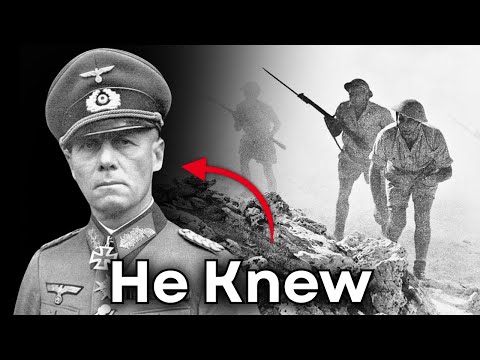
The desert sun beat down on North Africa in April 1941, relentless and unforgiving. Field Marshal Erwin Rommel, the legendary Desert Fox, stood in his command vehicle, watching his Panzer divisions slice through British defenses like paper. In just twelve days, he had driven the enemy back 500 miles, capturing 2,000 prisoners. The war in Africa seemed all but over. His tanks advanced 30 to 40 miles a day, and nothing the British tried could stop them. Their tanks were slower, their tactics outdated, their soldiers fleeing. Every battle ended the same way: the Germans won, the British retreated, then the Germans won again.
In Berlin, Hitler’s generals gathered around maps of Africa, pointing at a small coastal dot: Tobruk. A general tapped the map and declared it would fall in 48 hours. Everyone nodded. They had seen how fast Rommel moved. Meanwhile, British generals in Cairo were already planning their escape, sketching the fastest routes out. One officer suggested fortifying Tobruk, but another shook his head. “Standing and fighting would be suicide. German tanks will crush any defense.” Everyone knew it. That was simply how war worked.
But something different was happening in Tobruk. 15,000 Australian soldiers were crawling toward the city. Most had never seen real combat. They were volunteers—farmers, shopkeepers, students—far from professional soldiers. Their commander, General Leslie Morshead, had fought in World War I 23 years earlier. He knew what real fighting meant. British commanders in Cairo dismissed him and his men as colonials, believing they couldn’t understand modern warfare.
On April 8, Morshead gathered his officers under the blazing sun, sweat dripping from their faces. In the distance, they heard the rumble of German tanks approaching. Morshead looked into each man’s eyes and said, “There will be no Dunkirk here. If we must leave, we will fight to the end. No surrender, no retreat.” His officers stared. This wasn’t how things were supposed to go. When outnumbered and outgunned, you retreat. You save your army for another day. That was what the manuals said. That was what the British had been doing for 12 days straight.
But Morshead didn’t care about manuals. He looked at the map of Tobruk. The city sat on the coast. Behind them was the ocean. Ahead, the desert stretched endlessly. The Germans had tanks and aircraft. The Australians had rifles and determination. The math didn’t favor them. Everyone knew the Germans should win. The Australian soldiers began to dig. They dug holes in the rocky ground, trenches connecting the holes, tunnels underground—some extending over 60 meters. The work was brutal. The sun scorched. Their hands bled. They kept digging.
Within 72 hours of their arrival, something strange happened. At night, small groups of Australians slipped out of their defensive positions. They moved in teams of eight to twelve men, crawling through the darkness, advancing two or three miles into the desert—into territory the Germans thought they controlled. Then they attacked. German sentries suddenly found Australian soldiers right behind them. No warning. One moment the night was quiet. The next, chaos. The Australians used knives. They used bayonets. They fought with ferocity and violence. Then they vanished back into the darkness before anyone could respond.
The German soldiers had never seen anything like it. Defenders were supposed to defend. They were supposed to sit behind their walls and wait for you to attack them. They weren’t supposed to come hunting in the middle of the night. On April 13 and 14, Rommel launched his first major assault on Tobruk. He sent thousands of soldiers and dozens of tanks. The attack was massive. The noise was deafening. Artillery shells exploded, machine guns roared, tank cannons thundered, and smoke filled the air. When the smoke cleared, the Germans counted their losses: 250 killed or wounded. The Australians lost 26. The German attack failed utterly.
The Australians were still in Tobruk, fighting, holding their lines. Rommel sat in his tent that night, writing in his diary. His hand moved across the page. He wrote that the Australians fought with remarkable bravery. This was not the language of a confident commander, but of a man who had just discovered a problem. Over the next two weeks, Australian night patrols captured 800 German soldiers. 800. These weren’t casualties in battle—they were prisoners taken directly from German camps and positions. The Australians crept in, grabbed soldiers, and disappeared. Sometimes they took weapons too. Soon, the Australians were using German machine guns against their original owners.
On April 16, Rommel called a meeting with his commanders. He looked tired. He told them they must not underestimate these Australian troops. These words were recorded in the official log of the German 5th Light Division. His generals nodded politely. But deep down, they didn’t really believe him. How could they? These were colonials, volunteers, farm boys from the far ends of the earth. The German army had conquered Poland in four weeks. France fell in six weeks. These were the best-trained, best-equipped soldiers in the world. They had studied war as a science and mastered it. Surely Rommel was just being cautious. Surely he was overthinking. The Australians couldn’t really be that dangerous. Could they?
The German generals looked at their maps. They made new plans. They would crush Tobruk soon. It was only a matter of time—a matter of using the right force. But in the darkness outside Tobruk, the Australian soldiers were moving again. They carried their weapons in silence. They knew every rock and every depression in the ground. They had learned to move like ghosts. The Germans had night patrols too, but they never saw the Australians coming. What the German generals didn’t yet understand was that they weren’t fighting the kind of war they knew. The rules had changed. The Australians were making new ones. And by the time the Germans realized it, it would be too late.
But understanding the threat and stopping it were two very different things. General Morshead stood in the deep underground command bunker, its ceiling reinforced with concrete and steel. Outside, the sun set over Tobruk. He spread a map on the table. His officers gathered around. The map showed a ring around the entire city—30 miles long. Morshead traced it with his finger. Every 1,200 yards, he had ordered a strongpoint. His engineers had counted them: 56 separate positions, like fortresses in a circle. Each could see the others. Each could support the others with artillery fire. If the Germans attacked one, three others could fire on them from the flanks.
The work had been immense. Soldiers dug into the earth, piled rocks and sandbags, laid barbed wire in dense tangles. Some positions had three layers of wire. A man trying to crawl through would take ten minutes—ten minutes under a hail of Australian machine-gun fire. But defense wasn’t just sitting and waiting. Morshead explained his real plan. Between 10 p.m. and 4 a.m., his men would dominate the desert. Small teams would go out hunting. They would find German positions. They would attack. They would spread terror and confusion. Then they would come home.
A young officer raised his hand. How were they supposed to attack when they were outnumbered? Morshead smiled. He said the Germans didn’t realize how few they were at midnight when eight Australians suddenly appeared. In the dark, eight men with knives felt like eighty. The tunnels underground became a city beneath Tobruk. Some connected fighting positions 200 feet apart. Men could move from place to place without ever appearing above ground. When German aircraft flew overhead during the day, they saw nothing moving. They thought Tobruk might have been destroyed. Then night fell, and the Australians poured out like angry bees from a hive.
Supply was critical. Tobruk was besieged. The only way in or out was by sea. The Royal Navy assigned 72 destroyers to rotate. Every night, ships raced across the Mediterranean in darkness, carrying ammunition, food, and water. They had to arrive, unload, and leave before sunrise. If the sun caught them in the harbor, German aircraft would sink them. The Australians stockpiled everything: 3 million rounds of small-arms ammunition, 120,000 artillery shells. They stored these supplies in tunnels underground, hid them in cellars, distributed them so no single bomb could destroy everything.
On April 13, the first major German attack hit the Australian lines. Rommel ordered the 5th Light Division to take Tobruk. He believed overwhelming force would do the job. Tanks advanced, infantry ran behind them, artillery pounded the Australian positions. But the Australians held. They waited until the tanks came close—very close. Then they opened fire. Anti-tank guns punched holes in German armor. Tanks tried to retreat. Some got stuck in the rocky ground. Australian soldiers rushed forward with explosives. They threw grenades into tank hatches. They jammed pipes into tracks.
German infantry expected the defenders to be hiding in their trenches. Instead, Australians fired from multiple directions. Some shot from the main line. Others from hidden positions on the flanks. The Germans found themselves caught in crossfire. They tried to advance, but men kept falling. When the battle ended, the Germans counted 250 casualties. The Australians counted 26. Rommel looked at these numbers and felt something he hadn’t felt before in Africa: doubt.
The night raids became more organized. Each team had a specific mission. Some were reconnaissance teams. They crawled to German lines and watched. They counted sentries. They noted when guards changed shifts. They looked for weak points. Other teams were attack teams. They waited for reconnaissance reports, then planned their raids. They set out at exactly 10 or 11 p.m. They carried knives, grenades, and rifles. Some carried wire cutters to cut German barbed wire. They wore light boots that made less noise than standard army boots.
A typical raid went like this: 12 Australians crawled across the desert for an hour, until they reached a forward German position. There were about 20 German soldiers, sleeping in tents or sitting around a small fire. The Australians spread out—six men circling left, six circling right. On a signal, they attacked from both sides simultaneously. The Germans woke to chaos—men shouting, rifles firing, grenades exploding. It lasted about three minutes. Then the Australians vanished back into the night. They took prisoners with them, sometimes weapons, sometimes they just wanted to spread fear.
The prisoners told interesting stories. They said German soldiers were afraid to sleep at night. Men volunteered for daytime duty to avoid night guard. A captured German officer said his men had started calling them “the Rats.” The Australian troops heard this nickname from prisoners and intelligence reports. Instead of being insulted, they embraced it. They painted rats on their vehicles, joked among themselves. The nickname became a badge of honor.
On May 3, Rommel wrote another warning, this time more severe. He told his officers that the Australians were not ordinary soldiers. He wrote: “They fight like devils.” He ordered his men to take more precautions, increase night guards, build better fortifications around their camps. But the German generals in Berlin still didn’t fully understand. They sent Rommel more troops—the entire 15th Panzer Division, thousands of men and hundreds of tanks. They thought this would be enough to crush a small coastal city defended by colonials.
Rommel threw these new forces into Tobruk. The attacks came in waves, and each time the Australians held. Each time the Germans retreated with heavy losses. Each time Rommel’s diary grew more frustrated. The British in Cairo began to pay attention. At first, they didn’t believe the reports. It seemed impossible that Rommel had been stopped by Australian volunteers. They sent officers to investigate. They returned amazed. They described the underground city, the night raids, the Australian soldiers who refused to surrender. Even Winston Churchill himself sent a message: “Tobruk must hold.” The words came over the radio, encrypted. Morshead read them and nodded. He had no intention of leaving anyway.
The Royal Air Force sent Hurricane fighters—planes in desperate demand elsewhere, for Britain was fighting for its survival, and every aircraft mattered. Yet they sent some to Tobruk. The Hurricanes took off from the small airfield inside the city, fought German bombers by day, and at night landed to refuel and wait for morning. Week after week, the siege continued, and the Germans could not break through. They couldn’t starve the defenders because the navy kept supplying them. They couldn’t bomb Tobruk into surrender because the Australians lived underground during the day.
What made it work wasn’t just courage, but a combination of smart planning and fierce determination. The Australians had taken everything they knew about defense and turned it upside down. Defense was supposed to be passive—build walls and wait. But Morshead made defense active. His men defended by attacking, keeping the enemy off-balance, making the Germans worry about their own safety instead of planning new attacks.
By the end of May, 45,000 German soldiers were stuck around Tobruk, trying to capture 15,000 Australians. The numbers were reversed. The Germans had three times as many men, but they couldn’t win. Rommel needed those 45,000 soldiers for other battles. He needed to continue advancing east. But he couldn’t abandon Tobruk. The port could bring in more Allied troops, and it threatened his supply lines. So he had to stay. He had to keep trying. And every day he stayed was a day he wasn’t winning elsewhere.
The desert night exploded with chaos. German sentries heard nothing until the Australian commandos were already inside their perimeter. The sound of bayonets in the dark, muffled screams. By dawn, another machine-gun position was empty, its crew gone. Some dead, some captured, the weapons vanished. The raids became so effective that German morale began to crumble under the pressure.
By May 1941, the numbers told a story that the German High Command did not want to hear. Before Tobruk, German forces had expected victory in 48 hours. Now, weeks had passed. The siege would eventually last 241 days. It became the first major German defeat of the entire Second World War. The cost was high in blood on both sides, but the balance was striking. Over 3,000 Germans were killed, and 7,000 more wounded. Australian losses were 832 killed and 2,177 wounded. The numbers were shocking. For every Australian who died, nearly four Germans fell. This ratio was unprecedented for a defending force completely surrounded.
Rommel sat in his command tent as reports piled up. He had committed the entire 15th Panzer Division to taking Tobruk. These were his best soldiers. They had the latest tanks, experienced officers. They had everything they needed except the ability to break through the Australian defenses. The German forces had to postpone Operation Battleaxe. This operation was supposed to drive deep into Egypt and threaten the Suez Canal. But Rommel couldn’t launch it because so many of his troops were tied down at Tobruk. The delay was six weeks. Six weeks during which the British grew stronger. Six weeks during which more supplies arrived. Six weeks that changed everything.
In the first week of May, Rommel issued his second warning to his commanders. The words were stronger this time. He wrote in an official memo: “The Australians are not normal soldiers. They fight like devils.” This was recorded in the permanent German military record. His officers read it, and some finally began to believe. But for others, the belief came too late.
The German High Command made a decision: if ground forces couldn’t take Tobruk, the air force would destroy it. They sent in the Luftwaffe. German dive-bombers, known as Stukas, arrived in waves. These aircraft were equipped with sirens that wailed during their dives—the sound alone was meant to break enemy morale. Over a thousand air raids struck Tobruk during the siege. The sky filled with the scream of Stukas. Bombs fell like deadly rain. Buildings exploded, fires raged, and the port was hit again and again. Ships sank. Fuel depots exploded in huge balls of fire that lit the night.
The Australians learned to live with it. When the sirens sounded, they hid underground, where the tunnels protected them. When the bombing stopped, they came back up, put out fires, pulled wounded men from shelters, repaired what they could, and waited for the next raid. At night, while the Germans slept deeply, thinking they had crushed Tobruk, the Australians came out to hunt again. It became a pattern. Day belonged to the German air force. Night belonged to the Australian infantry.
A German prisoner was brought for interrogation. A young man, perhaps nineteen, his hands trembling. The Australian officer asked how he felt about fighting at Tobruk. The German soldier raised his pale eyes and said his unit was terrified of the dark. He said they drew lots to see who would guard at night. He said every sound in the darkness might be Australians coming to kill them. This fear spread through the German ranks like wildfire. Soldiers who had fought bravely across Europe suddenly refused to serve at Tobruk. Some claimed injury, others complained of illness. German officers noted they had to threaten severe punishment to keep their men in position.
British intelligence intercepted German radio messages. The messages were encrypted, but the British had broken the code. They listened to German commanders talking among themselves. One message mentioned Hitler himself. The Führer was furious about Tobruk’s resistance. He demanded answers and results, but none came. Week after week, the siege continued. The Germans tried different tactics. They tried massing tanks for a crushing attack. The Australians destroyed the tanks with hidden anti-tank guns. They tried night infantry assaults. The Australians were more skilled at fighting in the dark. They tried cutting off water supplies. The navy brought water tanks on nightly supply runs.
One of the most surprising things was how the Australians kept their spirits high. They were surrounded. They were outnumbered. They were bombed daily. Logically, they should have been miserable. But reports from inside Tobruk described something different. The men were proud. They knew they were doing important work. They knew the whole world was watching. Newspapers around the world began publishing stories about the “Rats of Tobruk.” In Australia, families gathered around radios to hear the latest news. In Britain, people who had lost hope began to regain faith. If Tobruk could hold, then perhaps Germany was not invincible after all.
Even Rommel himself held a strange respect for his enemy. In letters to his wife, he mentioned the Australians, describing them as tough opponents, wishing he had troops like them. After the war, he wrote in his memoirs that if he had to fight a war, he would want Australians to fight it and New Zealanders to defend it. The siege created a strange situation. The Germans were besieging Tobruk, but in a way, the Australians were besieging the Germans too. 45,000 German soldiers were stuck in the desert around one city. They couldn’t leave, and they couldn’t break through. They sat there, attacked at night, bombed by British aircraft by day, wearing down slowly.
Hitler’s invasion of Russia had to be adjusted. Resources that were supposed to go to Russia were sent to North Africa instead: aircraft, tanks, and fuel. Every effort had to be directed at solving the Tobruk problem. The delays were small, measured in weeks. But wars can be decided by small delays. British special forces studied Australian tactics. Officers visited Tobruk to observe how the night raids were conducted. They took notes and asked questions: How do you move so silently? How do you know where to attack? How do you keep men brave enough to go out night after night into enemy territory?
The answers weren’t simple. It was partly training and partly mindset. Australians had a different culture from the British. They were less formal. Officers and enlisted men spoke more freely. Plans were discussed openly. Men were encouraged to think for themselves instead of just following orders blindly. This created soldiers who could adapt. When something went wrong on a raid, they didn’t panic—they adapted, improvised, found another way. The rigid German command structure struggled against this flexibility.
One night in June, an Australian team penetrated deep into German territory. They reached nearly 8 kilometers behind the German lines. They found a supply depot: crates of ammunition, barrels of fuel, food, and medical supplies. They could have destroyed it all, but they had a better idea. They marked the location precisely, then slipped away. The next day, British artillery received the coordinates. That night, shells rained down on the supply depot. The explosions could be seen from Tobruk. The Germans lost supplies they desperately needed. And they knew it because the Australians had walked through their lines unnoticed.
Stories like this spread. Each success made the next raid easier because the Germans grew more afraid. Fear makes people careless. They jump at shadows, waste energy on tension instead of vigilance. Psychological warfare was as effective as physical combat. By the end of summer, Rommel realized he could not take Tobruk with his current forces. He wrote to Berlin requesting more troops. The answer was no. Every available soldier was needed in Russia now. Hitler had launched the largest invasion in history. The Eastern Front consumed men and machines like a hungry beast.
So Rommel had to accept a stalemate. He kept his forces around Tobruk to contain it, but he stopped trying to capture it. The siege became a waiting game. Who would run out of supplies first? Who would crack first? The Australians, dug in underground, eating canned food and drinking rationed water, or the Germans, exposed in the open desert, suffering night raids? The answer was becoming clear. The Australians would never crack. They had turned Tobruk into more than a defensive position—it was a symbol. As long as they held, Germany would not win. As long as they held, the myth of German invincibility would crumble.
In December 1941, the British Eighth Army launched Operation Crusader. Thousands of troops surged west across the desert to break the siege. Inside Tobruk, the Australians heard the news. After eight months of fighting, relief was finally coming. The siege was lifted in stages, and when the relief forces finally broke through, they found the Australians emerging to meet them—gaunt, filthy, but with spirits unbroken. 14,000 Australians survived the siege, wearing their “Rats of Tobruk” badges with fierce pride.
The tactics born in Tobruk outlived the battle. British special forces studied the night raids, the small-unit operations, the aggressive defense. American Rangers trained on Tobruk’s lessons: “This is how you defend when outnumbered.” The roots of modern urban warfare doctrine trace back to those tunnels and midnight patrols. Morshead was knighted in 1959, the year he died. At his funeral, aging men in their sixties wore their Rats badges and saluted one last time.
Rommel survived North Africa only to face Hitler’s wrath after the failed assassination plot. Forced to choose between poison and a public trial, he took the poison in October 1944. But before his death, he wrote a full chapter in his memoirs titled “The Tobruk Problem,” detailing how the Australians had forced him to rethink everything he knew about siege warfare. One former German general later said Tobruk was where the Afrika Korps learned the meaning of fear.
The lesson endures: the most dangerous enemy is not the one with the most tanks, but the one you refuse to see clearly. Fifteen thousand Australians in a small coastal city changed the course of World War II—not through superior equipment, but through tactics born of necessity and a refusal to surrender.
So here is the question: In your own life, which “enemy” have you underestimated simply because they didn’t fit your expectations—and what might that blindness be costing you?
Report this article
Select a reason for reporting:






