By the spring of 1945, the Third Army was carving a path through the heart of Nazi Germany, a relentless scythe of steel and fire. But behind the front lines, in the shadowed woods of Bavaria and the Moselle valley, another kind of horror was being uncovered—camps where American GIs, emaciated and broken, had been starved, marched, and brutalized by guards drunk on a dying Reich’s last drops of power. When word reached Patton, he didn’t wait for reports. He didn’t want sanitized truths. He rode to the front of the column himself, siren wailing, ivory-handled revolvers gleaming at his hips. He wanted the German guards to see him. He wanted them to understand that the old rules were gone.
What happened next became the stuff of legend—and of nightmare for the men who had worn the uniform of the Wehrmacht. Patton did not cite the Geneva Convention. He did not wait for lawyers. He used a weapon he had spent a lifetime honing: absolute, unadulterated psychological terror.
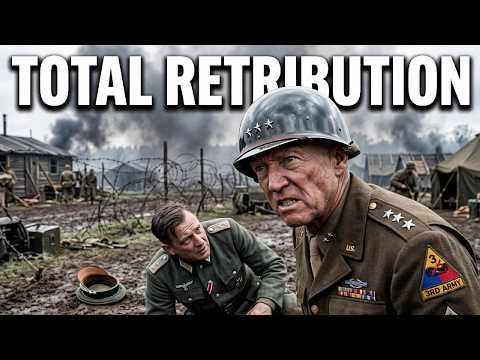
In one documented instance, a camp commandant—still clinging to a delusional sense of Prussian discipline—stepped forward, clean and well-fed, and attempted to protest the disorderly behavior of the newly freed, starving Americans. He suggested his guards needed to maintain their weapons to protect the camp’s perimeter. Patton’s reaction was explosive.
He stepped out of his jeep, his polished helmet reflecting the cold German sun, and closed the distance in a few sharp strides. He stood inches from the officer’s face, his voice—famously high-pitched but laced with venom—cutting through the chaos like a blade. He looked the commandant dead in the eye and informed him that his life and the lives of every guard in the facility were now dangling by a single, fraying thread. He made it violently clear that if he found out a single American soldier had been struck, starved, or threatened during the transition of power, the guards wouldn’t live long enough to see a war crimes tribunal.
Patton unleashed strings of vibrant, creative profanity that would make a seasoned sailor blush. He told the commandants they weren’t soldiers but murderous thugs, personally and physically accountable for every ounce of suffering his men had endured. He frequently threatened that if conditions weren’t improved within the hour, he would have the guards stripped of their uniforms and handed over to the very prisoners they had spent years tormenting—with a quiet promise that the American military police would be ordered to take a very long walk in the opposite direction.
It was never a bluff. The sheer conviction in Patton’s steel-blue eyes made the German officers realize they weren’t dealing with a standard military bureaucrat. They were dealing with a vengeful warlord. The psychological effect was instantaneous. Defiant guards who had barked orders days earlier suddenly dropped their weapons and stripped off their insignia, terrified that the general would unleash the full weight of the Third Army’s wrath upon them. Commandants who had strutted through the barracks were reduced to trembling subordinates, desperate to comply with every American demand just to survive the next ten minutes.
But Patton’s fury was matched only by his profound, often hidden empathy. After terrifying the captors into absolute submission, he would turn toward the men in the barracks. The tough, hardened cavalryman—the man who had famously slapped a shell-shocked soldier in Sicily—would walk among the starving POWs and break. Hot tears streamed down his face as he shook their bony hands. He apologized, his voice cracking, that it had taken him so long to reach them. He walked through the filth of the barracks, ignoring the stench that made his aides gag, to ensure every man knew Georgie was there.
He immediately commandeered every local German bakery, storehouse, and farmhouse within ten miles. He ordered the finest food brought to his men, forcing German civilians and captured guards to serve the prisoners they had previously abused. To Patton, this wasn’t just logistics. It was a ritual of restored dignity—and a promise that while the enemy might take an American’s freedom, they would never, under his watch, be allowed to take an American’s dignity.
Yet even as the bakeries of Bavaria were emptied to feed his boys, a darker calculation was forming behind Patton’s steel-blue eyes. Every liberated camp gave him a new list of names—men still unaccounted for, still rotting in some stalag deeper in the Reich. And at the top of one such list, written in his own hand, was a name he could not afford to lose: Colonel John Waters, his own son-in-law, held at Oflag 13B near Hammelburg.
Patton had spent the winter swallowing the humiliation of it. He had ordered no special treatment, no quiet strings pulled, because he knew the enemy read every captured American name in the papers. But by late March, with the Third Army racing toward the Danube, the window was closing. The retreating Germans were marching their prisoners west, deeper into the Redoubt, and every mile of that march was a mile toward a grave.
So he made a decision that would haunt his reputation for decades. He summoned a young captain, Abraham Baum, and gave him a mission that was, by any sober military calculus, madness. Task Force Baum: a few hundred men, a handful of tanks, and orders to punch sixty miles behind enemy lines to liberate a camp that sat squarely in the path of a German corps.
Baum reportedly asked, with a straight face, whether the general understood the odds. Patton’s reply was pure Patton—half growl, half prayer. He wanted that camp taken, and he wanted it taken now.
The raid was a slaughter. German anti-tank guns chewed the task force to pieces near Aschaffenburg. Tanks broke down, fuel ran dry, and the column was cut apart in the woods. When the survivors finally reached Oflag 13B, they found the camp’s garrison alerted and waiting. Waters himself was wounded in the fight, and most of Baum’s men were killed, wounded, or captured in a matter of hours.
When the reports reached Patton’s headquarters, his staff braced for the explosion. It came—but not the one they expected. He did not blame Baum. He did not court-martial the survivors. He sat alone with the casualty list and, by several accounts, wept again—this time for the men he had spent to reach one.
Critics would call it an abuse of power, a general risking hundreds of lives for a single family member. And in the cold arithmetic of war, they were not wrong. But Patton’s loyalists saw something else in the wreckage of Task Force Baum: proof that he would burn his own legend to the ground if it meant no American was left behind.
He never fully explained himself. When a reporter pressed him on the raid, he waved the question away with a growl about how a man does what he can for his own. But the men of the Third Army understood. They had seen him terrorize commandants into trembling obedience, and they had seen him weep over skeletal boys in the mud.
And as the columns rolled east toward the Danube, toward the last redoubts of a dying Reich, word spread down the line—the kind of word that traveled faster than any order. Georgie was coming. And God help anyone standing between him and his boys.
The road to the Danube was a river of mud and broken steel, and along its shoulders the last detritus of the Reich stumbled westward—ragged columns of Wehrmacht stragglers, Volkssturm boys with rifles taller than they were, and the occasional burned-out staff car with its eagle torn from the door. Patton rode at the head of it all, standing in his jeep like a bronze figure lashed to a mast, and the men who saw him pass swore he looked less like a general than a man chasing something.
What he was chasing, his staff soon learned, was a rumor. A whisper passed up from a cavalry reconnaissance troop: another camp, smaller than the stalags, hidden in a pine fold near the Altmühl—a work camp where American prisoners had been used as slave labor in a ball-bearing plant. The report was thin, unconfirmed, the kind of thing a tired colonel might file and forget. Patton did not forget it. He ordered the column turned twelve miles out of its way, and when a corps commander protested the delay, Patton’s reply came down the wire in a single sentence: “My boys are in that hole, and I am going to get them out.”
The camp, when they found it, was not a stalag. It was a clearing ringed by wire and a single watchtower, with a concrete shed where the prisoners had slept on bare earth. There were forty-one Americans inside, and by the time Patton’s jeep rolled through the gate, the guards had already fled into the trees—all but one, a middle-aged SS sergeant who had stayed behind, apparently, out of sheer bureaucratic habit.
He stood in the mud in his pressed tunic, and he made the mistake of saluting.
Patton looked at him for a long, terrible moment. Then he turned to the nearest officer and said, in a voice that carried across the whole clearing, “Take that man’s boots. He won’t need them where he’s going.” The sergeant’s composure cracked like ice. He began to babble about orders, about the Geneva Convention, about his own rank and his family in Stuttgart. Patton walked away without another word, and the men of the Third Army understood that the conversation was over.
But it was what happened next that the prisoners would remember for the rest of their lives. Patton walked into the concrete shed and stood among the forty-one men, and he did not speak for a long moment. One of them, a sergeant from Ohio with a face like a skull, later wrote that the general’s jaw was working as if he were chewing on something he couldn’t swallow.
Then Patton said, quietly, “I want every man here to eat before he does anything else. That’s an order, and I don’t give a damn who you are—you don’t salute me until you’ve had a hot meal.” He had brought cooks forward with the column, and within the hour the clearing smelled of bacon and coffee, and the men who had lived on sawdust bread for four months sat on the ground with tin plates in their hands and wept into their food.
Patton moved among them, crouching, asking names and hometowns. He wrote them down. He asked one boy from Kentucky whether his mother knew he was alive, and when the boy said he didn’t know, Patton turned to an aide and said, “Get a cable off tonight. Not tomorrow. Tonight.”
It was, his critics would later say, pure theater—the great showman playing the part of the father. But the men in that clearing knew the difference between a performance and a promise, and they had just been handed the latter.
By nightfall, the column was moving again, eastward, toward the Danube and the last redoubts of a dying Reich. Patton stood in his jeep with the wind cutting at his face, and behind him the forty-one men rode in trucks with blankets around their shoulders, watching the general’s silhouette against the darkening sky. Word of the little camp near the Altmühl traveled down the line before dawn, faster than any dispatch, and the men of the Third Army began to speak of it the way soldiers speak of weather and luck and the things that keep them alive.
But Patton himself was already looking at a map, his finger tracing a line toward Regensburg, and his aides noticed that his hands were not quite steady. There were more camps out there. There were always more camps. And the war, for all its dying, was not yet done with him.
The war ended, as it had to, in a spring of dust and silence. Patton’s columns ground to a halt at the Elbe, and the camps were emptied, and the men went home. But the general did not. He lingered in a conquered Bavaria, restless as a caged animal, writing letters to a wife he barely saw and pacing the halls of a peacetime command that bored him to the bone.
He had survived the war—the tanks, the mud, the endless dead—only to be killed by a fender on a cold December road. Yet the men of the Third Army never quite accepted that ending. To them, he was never really gone. He was still out there somewhere, standing in a jeep with the wind in his face, riding toward the next gate, the next camp, the next boy who needed him.
And that, perhaps, is the truest measure of a soldier: not the medals, not the victories, but the fear in the eyes of the men who tormented his own.
So here is the question I leave with you: if a general could be remembered for one thing alone, would it be the battles he won—or the men he refused to leave behind? Tell me in the comments.
Report this article
Select a reason for reporting:






