Dr. Marcus Chen had examined thousands of Civil War era photographs, but the one that arrived on his desk in January 2024 was unlike anything he’d ever seen. It was a simple wedding portrait: a couple, David and Clara Freeman, standing proudly in a studio, their expressions solemn yet hopeful. But when Marcus zoomed in on the groom’s hand, his breath caught in his throat. The ring on David’s finger wasn’t gold or silver—it was dark, hammered iron, with a texture that spoke of something far more profound.
As a chief conservator at the Atlanta History Center, Marcus had seen his share of historical artifacts, but this was different. The ring’s surface showed forge marks, and along its edge, a repeating chain pattern. His mind raced with a possibility he’d only read about in historical journals: the ring was made from slave chains, transformed by fire and hammer into a symbol of love and freedom.
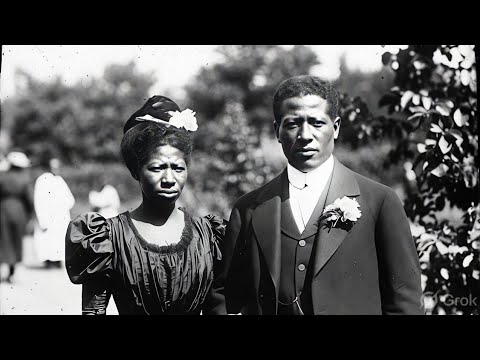
The photograph had come from the estate of Helen Morrison, a 93-year-old amateur genealogist who had spent decades collecting African-American artifacts. Her will donated everything to the museum. Marcus carefully lifted the photo from its acid-free envelope and placed it under his examination lamp. The image was remarkably preserved, mounted on thick cardboard with the photographer’s stamp: Sterling and Associates, Atlanta, Georgia, 1871.
Six years after the Civil War, during Reconstruction, this couple had stood in a photography studio, their dignity palpable even through the sepia tones. The bride wore a dark dress with lace cuffs, her hair elaborately styled. The groom, tall and dignified in a dark suit, rested his right hand on a Bible. His left hand hung at his side, the iron ring clearly visible.
Marcus reached for his magnifying glass. Under magnification, the groom’s hand revealed more than just a ring. There were scars—irregular patches of lighter tissue, likely from shackles. And the ring itself was unmistakably iron, with a rough, hammered surface and a chain-like design etched around the band. This wasn’t jewelry; it was a statement.
“My God,” Marcus whispered. “It’s made from chains.”
He knew the practice: formerly enslaved people taking the iron that had bound them and forging it into wedding bands. It was a ritual of transformation, a declaration that love could rise from the ashes of bondage. But seeing it—actually seeing it—was something else entirely.
Marcus snapped high-resolution images and enhanced them on his computer. The details leaped out: the forge marks, the deliberate imperfections, the chain pattern. This was no ordinary ring. It was a piece of history, forged in resistance.
He turned the photograph over. In faded pencil, someone had written: “David and Clara married November 18th, 1871.” Names. A date. A crack in the anonymity of the past.
Marcus’s fingers flew across the keyboard, searching the museum’s genealogical databases. David Freeman, age 28, blacksmith, married Clara Washington, age 24, on November 18, 1871, at Friendship Baptist Church. The 1870 census listed David as a blacksmith, literate—unusual for a man who had been enslaved just five years earlier. Clara was a domestic worker, also literate, living in a boarding house on Decatur Street.
Freedman’s Bureau records filled in the gaps. David, formerly enslaved by Robert Freeman in Clark County, had scars on his wrists and ankles from extended periods in chains. Clara, formerly enslaved by Thomas Washington, had been separated from her mother and brothers in 1859. She had been married before, to a man named Joseph who was conscripted by Confederate forces and never returned.
This wasn’t just a wedding photo. It was a testament to survival, to second chances, to love forged in the crucible of slavery.
Marcus discovered an 1872 article in the Atlanta Advocate: “Mr. Freeman has become known for creating wedding bands from iron that once bound us, transforming symbols of oppression into symbols of love and freedom.” By 1873, David had made rings for over 50 couples. He never charged for his service. “This is not business, this is ministry,” he wrote in a letter.
The exhibition was already forming in Marcus’s mind. But first, he needed to know more. Who were David and Clara? What had become of them? And most importantly, did Clara’s ring still exist?
The answers would lead him on a journey through archives, churches, and family histories—a journey that would uncover a legacy of resistance and love that had been hidden in plain sight for over a century.
Marcus began with the churches. Friendship Baptist had kept meticulous records, and the marriage register for November 1871 confirmed everything: David Freeman and Clara Washington, joined in holy matrimony by Reverend Isaiah Grant, witnessed by a hundred souls whose names filled two full pages. Beside the entry, a deacon had added a note in a cramped hand: “Rings forged by Brother David from chains of bondage. Never forget.”
Reverend Grant’s diary, digitized by the Atlanta University Center Archives, gave Marcus the scene in vivid detail. The bride in dark blue silk she had sewn herself. The groom in a suit he had saved months to buy. The moment David slipped the iron ring onto Clara’s finger, and the congregation wept.
But it was a Freedman’s Bureau record that stopped Marcus cold. Clara’s testimony from 1865, recorded by a bureau agent in careful script. Separated from her mother and two brothers in 1859, sold to a trader bound for Mississippi. A previous marriage to a man named Joseph, taken by Confederate conscription, never seen again. And a single line that Marcus read three times: “States she taught herself letters in secret, and was beaten for it.”
This was the woman who had stood beside David in that studio. Not merely a bride—a survivor who had clawed literacy and dignity out of a system designed to deny her both.
Marcus traced them forward. The 1880 census: David, blacksmith, and Clara, seamstress, on Decatur Street, with two children—Robert, six, and Sarah, three. The 1900 census: Robert a teacher at a colored school, Sarah a dressmaker beside her mother. David’s obituary in 1906 called him a respected blacksmith and community leader, survived by his wife, children, six grandchildren, and “the hundreds of couples whose marriages were blessed by his work.”
Clara outlived him by fifteen years. Her 1921 obituary named her a pioneer and pillar of the community, a woman born into slavery who lived to see her grandchildren educated and successful.
Then came the letter that changed everything. A 1920 note from Sarah Freeman to a museum, offering her parents’ wedding photograph and Clara’s ring. “My father told me once that every ring was an act of defiance,” Sarah had written. “He said that as long as people remembered what these rings meant, slavery would never truly win.”
Marcus sent inquiries to museums across the South. Most replied with regrets. Then Dr. Angela Price of a small Savannah museum wrote back: three rings in her collection matched his description, donated by different families, all with the same story. Rings made from slave chains, worn at weddings in the 1870s and 1880s.
He was on a plane within two days. The rings lay in a foam-lined case—dark, heavy, hammered, each one different yet unmistakably kin. A metallurgist’s analysis confirmed what Marcus had suspected: wrought iron, folded and forge-welded from multiple pieces of scrap. “Each ring probably started as three or four separate pieces,” Dr. Woo explained. “Links from chains, pieces of shackles, heated and hammered until they fused.”
Marcus held one to the light and thought of David at his forge, folding iron the way a life could be folded—pain upon pain, until it became something that could be worn as a promise.
Three months into his research, a package arrived at the museum. Inside, a letter from Dorothy Freeman Watson, great-great-granddaughter of David and Clara. Her family had preserved Clara’s ring through five generations. They had decided to donate it.
Marcus’s hands trembled as he unwrapped the tissue paper. The ring was exactly as it had appeared in the photograph—dark, irregular, beautiful. And along the inner surface, stamped into the iron, he found letters invisible to any camera: DF 1871. David Freeman’s own mark.
He called Dorothy that same afternoon. She told him the story her grandmother had passed down: David had kept pieces of his own chains for years after emancipation, unable to touch them, until the day he finally felt ready to transform them. “When he made Clara’s ring, it was both a memorial and a promise,” she said. “That their love would be stronger than anything that had tried to break them.”
Clara had worn it every day for thirty-five years of marriage, and then for fifteen years of widowhood, until her death in 1921. Five generations of women had guarded it since.
“But it’s time for it to be shared,” Dorothy said. “The story belongs to everyone who needs to understand that love can transform even the worst suffering into something beautiful.”
Marcus arranged for the ring’s formal accession into the collection. It would become the centerpiece of an exhibition he was already planning—one that would open, if he had his way, on the 153rd anniversary of a wedding that had taken place in a small Atlanta church, when a blacksmith placed a circle of hammered iron on his bride’s finger and a congregation wept to see chains become a vow.
The work was only beginning. There were text panels to write, descendants to interview, a display case to design that would hold Clara’s ring at the exact height of a visitor’s gaze—so that anyone who looked would see, up close, what transformation had cost and what it had made.
The exhibition opened on November 18th, 2024, exactly 153 years after David and Clara’s wedding. The centerpiece was their photograph, enlarged to five feet tall, with Clara’s ring beside it in a climate-controlled case under dramatic lighting. Text panels explained what visitors were seeing: the iron, the hammer marks, the chain pattern, the scars on David’s hand.
Marcus watched reactions from the corner. Many walked past at first, seeing only another old portrait. Then they read the panel, and their expressions changed. They stepped closer. Some stayed an hour.
An elderly Black woman approached him, tears on her face. “My grandmother told me stories about rings like this,” she said. “I thought it was just a story. But it was real.”
A young couple lingered together. “Can you imagine?” the woman said. “Taking something used to hurt you and transforming it into something beautiful? That’s not survival. That’s triumph.”
Media coverage spread the story nationally. Scholars began researching the practice systematically. Marcus often stood near the photograph, thinking of David and Clara—survivors who built dignified lives, raised educated children, and contributed to their community. But perhaps David’s most lasting contribution was those rings, hundreds of them, each transforming pain into beauty, bondage into freedom, chains into circles of love that would endure for generations.
One evening, after the museum had emptied, Marcus stood alone before the case. The ring caught the light—dark iron, hammered, imperfect. He thought of David’s letter: “This is not business, this is ministry.” And he understood, finally, that the ministry had never ended. It had simply passed into other hands.
What would you have asked David Freeman if you could have stood beside his forge and watched him work?
Report this article
Select a reason for reporting:






