December 25th, 1944. The wind howled through the fences of a German women’s prison camp in Montana, and the snow bit like knives. Inside the wooden barracks, dozens of German women—former nurses, teachers, and factory workers—lay awake, their breath turning to mist in the freezing air. For eight months, this had been their world: the 5 a.m. whistle, the endless roll calls, the cracked hands and empty stomachs. Christmas was just another day to survive.
But something was different this morning. The camp was too quiet. No whistle. No shouts. Only the sound of boots crunching frost and the wind whispering against the tin roof. Then, through the cold, a guard’s voice called out: “No work today. It’s Christmas.” The women didn’t move. They thought it was a trick. Mercy was dangerous to believe in.
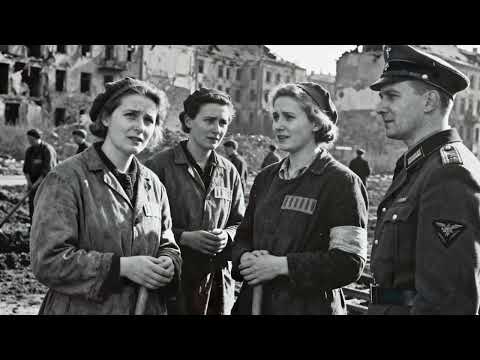
A young teacher from Leipzig translated softly. “Christmas. No work.” The words didn’t make sense together. Not here. Not now. War had taken everything—homes, husbands, brothers, trust. They waited, frozen, half expecting a cruel joke. But none came.
Then a smell drifted through the cold air: warm turkey, butter, cinnamon. It didn’t belong in a prison camp. It was the smell of a home kitchen, the kind they hadn’t known since before the bombings. One of the older women, a former factory supervisor from Düsseldorf, frowned. “They must be cooking for themselves. Not for us.” But the young teacher shook her head. “Maybe it’s for everyone.” The others laughed bitterly. “For prisoners? Don’t be foolish.”
And yet, no one went back inside. They stood in the freezing air, staring at the faint yellow light spilling from the mess hall windows. For months, they had been machines—working, surviving, never feeling. Now, for the first time, something stirred inside them, a question they didn’t dare ask aloud. Could this really be for us?
Slowly, cautiously, fifteen women began walking toward the mess hall, wrapped in mismatched coats and scarves. The ground was frozen so hard it rang beneath their boots. As they got closer, the smells grew stronger—roasted turkey, coffee, bread. The windows were fogged with heat from inside. They could see shadows moving beyond the glass: Americans carrying trays, setting plates, arranging tables. The women stopped. This couldn’t be real.
Then the door opened. A young American sergeant stood there, barely older than twenty, his face red from the cold, his eyes soft and kind. He didn’t speak German, but he smiled and waved them in. For a long moment, no one moved. The warmth from the open door reached them, smelling of food, soap, and coffee. Then the young teacher stepped forward first. Slowly, the others followed, one by one.
Inside, the light was almost blinding. Paper garlands hung along the walls in red and green. Tables were covered in white linen, each place set with a plate, a fork, and a napkin folded neatly. The women stood frozen by the doorway. They had prepared themselves for punishment, not kindness. And now, standing in front of this impossible scene, they didn’t know how to move or speak. This wasn’t propaganda, one of them thought. It can’t be real. But it was.
The American soldiers smiled as the German women slowly entered the warm hall. The heat hit their faces, and for the first time in months, they felt something close to comfort. The air was thick with smells—roasted turkey, potatoes, bread, and coffee. Some of the women’s eyes filled with tears just from the smell alone.
“Please sit,” said one of the Americans. He pointed to the tables, trying his best to sound friendly. They didn’t understand every word, but they understood his tone. It wasn’t harsh. It wasn’t the voice of a guard. It was kind.
They sat down quietly, unsure what to do. Their hands were trembling, part cold, part from disbelief. The plates were clean, the knives shiny, the napkins white. These were small things, but after months in a muddy camp, they looked almost magical.
Then came the food. One by one, American soldiers carried trays piled high with meat, bread, and vegetables. The smell of butter filled the air. There were even pies—apple, pumpkin, and something that smelled like chocolate. One soldier poured coffee into each cup, saying, “Merry Christmas!” with a shy smile.
The women looked at each other, waiting for a signal. The teacher whispered, “They mean it. It’s not a trick.” And then the first woman took a bite. Her lips shook as she chewed. Tears rolled down her cheeks before she could swallow. “It’s warm,” she whispered. “It’s warm.”
Others followed—carefully at first, then faster, as if afraid someone might take it away. For a few minutes, the hall was silent except for the sounds of forks and soft sobs.
An American officer watched from the corner. In his report later, he wrote: “Some of the women began to cry while eating. They could not understand why they were being treated as guests instead of prisoners.”
For the Americans, this meal was simple—a holiday break, a small act of decency in a cruel war. But for the German women, it felt like the world had turned upside down. Only months before, they had been told that Americans were monsters. Yet here they were, being served by them.
One soldier placed a record player on a crate. Music began, soft, crackling through the air. It was Silent Night—the same song the women had sung in their homes long before the war tore their lives apart. Without thinking, a few of them began to hum along in German. Stille Nacht, heilige Nacht.
The Americans fell quiet. Some smiled, some bowed their heads. For a moment, the two sides—enemies only yesterday—were joined by a single song. In that mess hall, there were no borders, no uniforms, no war. Only people—hungry, tired, and human.
This wasn’t propaganda, the teacher thought again. This was real. But for all its warmth, this moment also carried a strange pain, because kindness can hurt more than cruelty when it reminds you of what you’ve lost.
Then something unexpected happened. One of the women—the youngest—began to cry. Not a small tear, but a deep, shaking cry. The kind that comes from months of fear and hunger. She tried to hide her face, but the tears kept coming.
An American soldier noticed and walked over. He didn’t know what to say, so he simply took a clean napkin and placed it in front of her. She looked up at him, eyes red and wet, and said softly, “Danke.” He didn’t understand the word, but he nodded.
Soon others began to cry, too. Some cried quietly, others openly, heads down on the table. One woman held a piece of bread in her hands and just stared at it. “It’s been so long,” she whispered. “Real bread.”
Another woman said, “They are feeding us better than we fed our own prisoners.” Her voice was full of shame. A few American soldiers looked away. They weren’t used to seeing their enemies like this—not as soldiers, but as women, tired and broken.
Private Charles Anderson wrote later in a letter to his wife: “They looked like our own mothers, sisters, wives—only thinner, sadder. I never thought I’d feel sorry for Germans, but today I did.”
For the women, this moment was too much to understand. They had seen bombings, lost homes, buried family. And yet here they sat—clean tables, warm food, music playing softly—being treated with dignity. It broke something inside them, but it also began to heal something, too.
The teacher looked around at the faces of her fellow prisoners. For the first time, they didn’t look like enemies or victims. They just looked human again. A nurse among them whispered, “Maybe… maybe they are not what we were told.”
Outside, the snow kept falling. The camp’s guard towers were still there, their outlines dark against the white fields. But the air inside the hall was different—softer, warmer, filled with the scent of cinnamon and roast turkey.
As the meal ended, the Americans brought out small gifts—oranges, chocolate bars, and cigarettes. Each woman received one. Some held the fruit close to their faces, smelling it as if afraid it might disappear. The teacher turned her orange over and over in her cracked palms, marveling at its weight, its impossible color.
A young private, hardly more than a boy, pressed a chocolate bar into the hand of the woman beside her and mumbled something she didn’t catch. She looked up, confused, and he pointed at his own chest, then at hers, and smiled. “For you. For you.” It was all the English he had, but it was enough.
That night, in their barracks, no one could sleep. The smell of the food still lingered on their hands and clothes. One woman whispered, “It felt like a dream.” But another answered quietly, “No. Dreams end. This will stay.”
The next morning, the camp was quiet again. Work started as usual—guards at their posts, prisoners walking in lines, shovels in hand. But something had changed in the air. The women still wore the same torn coats, the same tired faces, yet their eyes looked different now. There was a softness, a small light of something they hadn’t felt in years.
Hope.
During the day, one of the women whispered to another, “Why did they do it? Why feed us like that?” The older one answered, “Because maybe they don’t hate us.” It was a simple answer, but a shocking one. All their lives they had been told that Americans were cruel, that they would destroy Germany and its people. Yet these same Americans had given them food, warmth, and even kindness.
A few of the prisoners talked quietly while they worked. One said, “When I saw that soldier smiling, I thought of my brother. He was the same age. Maybe he’s a prisoner, too.” Another woman said, “If my son were in their hands, I’d want someone to treat him this way.”
That afternoon, the teacher wrote a few lines in her small hidden notebook. I cannot explain what happened yesterday. They showed us mercy when we deserved none. It makes me feel smaller, but also cleaner somehow. Mercy—it was a word she hadn’t written since the war began.
In the camp office, the American commander wrote his own report. It said: “No disturbances. German female PWs received Christmas meal as gesture of goodwill. Many cried, some expressed gratitude, no discipline issues.” To him it was just a note in a file. But to the women it was something far deeper—the first proof that even in war, kindness could still exist.
That night when the lights went out, the women shared pieces of chocolate and small bits of bread they had saved. They didn’t eat them quickly. They held each bite carefully, like treasure. The nurse said, “This is what peace must feel like.” No one answered, but in the darkness, several nodded.
Outside, the cold wind howled over the camp fences. The guard towers still stood. The war was still raging far away, and many of their families were still missing. Yet for one brief moment, they had tasted something more powerful than any army.
Forgiveness.
Word about the Christmas feast spread quickly from camp to camp. Guards, drivers, and translators told the story to others—how American soldiers had shared food with German women prisoners, how they cried at the table, how the hall had fallen silent when Silent Night played. At first, no one believed it. “Impossible,” some said. “No army feeds its enemies.” But then letters and reports began to confirm it. The story was true.
In a nearby camp, another group of American guards decided to do the same. They didn’t have turkey or pie, but they pulled their own rations—cans of beans, bread, and coffee—and served them to their German prisoners on New Year’s Eve. It wasn’t much, but it carried the same spirit. A sergeant wrote in his diary: “We gave them what little we had. They looked at us like they couldn’t understand.” One woman asked, “Why?” He told her, “Because it’s the right thing.”
These small acts didn’t make headlines. No newspapers reported them. But in those frozen camps, they meant everything. For many of the German women, it was the first time they had seen the enemy’s face up close—not behind a gun, but over a table. They began to see that the men they had been told to fear were not monsters. They were young, tired, and human, too.
Months passed. The war ended in May 1945, and the camps began to empty. When the women were released, they were given a small piece of bread, a Red Cross paper, and a train ticket. As they left, a few American guards waved goodbye. “Good luck, ladies,” one called out in his rough accent. The women smiled and waved back.
On the train home, they talked quietly. “Do you think they meant it?” one asked. “Yes,” said the teacher. “They meant it. That’s what makes it so hard to forget.”
Back in Germany, life was not easy. Cities lay in ruins, food was scarce. But whenever the women saw American soldiers in the occupied zones, they no longer felt the same fear. One later told a reporter, “I used to think kindness was a trick. Those Americans taught me that even in war, people can choose to be good.”
Another kept the small napkin from that feast, old and yellowed, refusing to throw it away. It reminded her that humanity had survived when everything else seemed lost. Decades later, one woman said in an interview, “It was the first time I felt human again. They didn’t see us as enemies. They saw us as people.”
They had come as conquerors. They left as teachers. And in the end, America’s greatest weapon was not its bombs or tanks. It was its mercy.
So tell me—if a single meal could break every wall inside a person, what small act of kindness might you offer today?
Report this article
Select a reason for reporting:






