For nearly seventy years, the photograph lay hidden—wrapped in brown paper, tied with faded string, and shoved behind a wooden wardrobe in the attic of an old house. No museum had ever displayed it. No family album mentioned it. No historian had written a word about it. Then, on a rainy afternoon, a young woman named Clara opened that wardrobe. What she found inside looked like an ordinary family portrait from 1905.
Four people stood before a dark studio backdrop: a stern-looking man, a woman in a high-collared dress, a little girl holding a bouquet of roses, and behind them, standing slightly apart, a young boy. At first, nothing seemed unusual. But Clara noticed something. The boy wasn’t looking at the camera. He was staring directly at the man, and his expression wasn’t that of a child posing for a picture. He looked afraid.
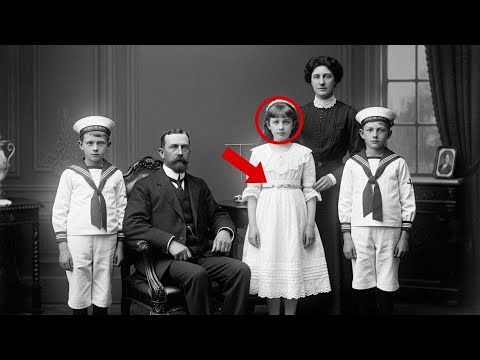
Clara carried the photograph downstairs and held it under a lamp. She studied every corner. The frame was damaged, but the image itself was remarkably well preserved. On the back, a date was written in faded ink: October 17, 1905. Below it, a single name: Elias. No surname. Clara couldn’t explain why, but that one word made her uneasy.
She turned the photo over again. The family looked wealthy. Their clothes were expensive. The studio setup suggested the portrait had been carefully arranged. But the boy didn’t belong. He stood too far back, his hands hidden. Clara called her grandfather. He was 92 years old and had grown up in the same house. When he saw the photograph, his face changed.
“Where did you find that?”
“In the attic.”
He didn’t answer. Instead, he stared at the boy. After a few seconds, he whispered, “Put it back.”
Clara frowned. “Why?”
“Because some things were hidden for a reason.”
That sentence made Clara more curious. She asked who Elias was. Her grandfather refused to answer. Then Clara noticed something else. The woman in the photo wore a brooch. Her grandfather recognized it instantly. It had belonged to his grandmother. But who was the boy? He looked away. “I don’t know.” It was a clear lie. Clara knew it, and so did he.
That evening, Clara searched through old family documents. Most records were lost, but she found a small leather diary belonging to her great-grandfather. The diary contained household expenses, appointments, and scattered names. Then Clara found an entry dated October 17, 1905. It contained only six words: “The photograph was finally taken.” Nothing else. No explanations. No names. No mention of Elias. Clara turned the page. There was another entry three days later: “It must never be mentioned again.”
Clara stopped breathing for a moment. Who was the boy? She returned to the portrait. This time she used a magnifying glass. The first thing she examined was the boy’s face. Then his jacket. Then the background. And finally, his hands. One hand was partially visible beneath the sleeve. Around his wrist was a thin dark mark. It looked like a bracelet, but it wasn’t decorative. Clara zoomed in with her phone. The mark looked like a small metal clip. Something was attached to his wrist.
She immediately called a local historical archive. A week later, two restoration experts and a photo historian examined the picture. At first, they were skeptical. There was nothing supernatural about the photo. Nothing impossible. Nothing inexplicable. But one restorer, Daniel Mercer, kept staring at the boy. “There’s something wrong with the exposure,” he said.
“What do you mean?”
“The boy is in a different position from the others.” He enlarged the image digitally. Then adjusted the contrast. A faint shape appeared behind the boy’s shoulder—a rectangular object. Clara leaned in. “What is that?” Daniel didn’t answer immediately. He enhanced the image again. The object looked like a small wooden box, and on the front was a symbol: a circle surrounding the letter E. Daniel looked at Clara. “Was this boy’s name Elias?”
She nodded. “According to the writing on the back.”
A silence fell over the room because the object wasn’t just behind him. It seemed to be attached to a chair, and suddenly the photograph looked entirely different. The boy wasn’t standing freely. He had been placed in front of something—something the family had deliberately tried to hide.
Daniel examined the original glass negative, discovered in the same attic weeks later. Then he made an unexpected discovery. The negative contained more information than the print. There was another person, standing outside the main frame. Only part of his face was visible, and that person was holding something—a document. Daniel enlarged the image. The writing was blurry, but one phrase could be made out: “Ownership transferred.”
Clara stared at the screen. “Transferred to whom?” Daniel shook his head. “We need a better scan.” For the first time, everyone understood why this photograph had been hidden. It wasn’t just a family portrait. It was evidence of something someone wanted desperately to forget. And the most disturbing part was still waiting to be discovered. Because when researchers compared the boy’s face with another photo found inside the house, they noticed something impossible. The second photo had been taken decades later, and the boy in it was a grown man—but he was wearing the same thing around his wrist. The mystery of Elias had just grown much larger, and it seemed someone had spent decades ensuring no one would ever solve it.
Daniel placed the two photographs side by side under the archive’s brightest lamp. The 1905 portrait. The 1938 train station snapshot. Same man, same metal band around his wrist—but in the later image, the plate was clearer, and the engraving read E17. Clara traced the letters with her fingertip. “It’s not a name,” she said slowly. “It’s a number. Like a tag.”
Daniel nodded. “Estate inventory. When a property is held in trust, every asset gets a code. Furniture. Livestock. Sometimes people.” He paused. “E17 would have been assigned to something the family considered part of the estate.”
Clara felt the floor tilt beneath her. A child, catalogued like a chair or a cow. She thought of the diary entry—It must never be mentioned again—and understood, for the first time, that the silence wasn’t shame. It was bookkeeping. Erasing a line item was easier than explaining one.
They returned to the folded note Clara had found beneath the diary’s loosened leather. The handwriting was a woman’s—slanted, hurried, pressed so hard the pen had torn the paper in places. The author identified herself only as M. She wrote that Elias had been brought to the estate after his mother’s death, that the family had taken him in “as a kindness,” and that the kindness had come with a price.
According to M., Elias’s mother had owned a small parcel of land and a claim to a share of the family’s timber rights. On paper, the boy was an heir. In practice, he was a problem. “They could not take what was his unless he signed,” M. wrote. “And he could not sign what he could not read.”
So they had waited. And when waiting failed, they had tried a mark instead of a signature—a thumbprint pressed into wax, witnessed by men who would swear the boy understood. Elias had refused. He had hidden his hands behind his back. And that refusal, Clara realized, was the reason he stood apart in the portrait. He wasn’t being punished for misbehaving. He was being displayed—proof to some future court that he had been present, cared for, part of the household.
The photograph was never meant to be a memory. It was meant to be a defense.
But M. had turned it into something else. The mirror in the background. The document on the table. The reflection no one had noticed. She had built a second record inside the first—a quiet contradiction, waiting for someone patient enough to look.
“She was protecting him,” Clara murmured.
“She was protecting the truth,” Daniel corrected. “There’s a difference.”
Clara read the final line of the note again: Someday he will come back for what is his. She looked up. “Did he?”
Daniel pulled a folder from the archive’s stack. “That’s what we need to find out.”
The folder was thin—embarrassingly thin for a life that had lasted seventy-nine years. Daniel opened it carefully, as if the paucity of paper might crumble under his fingers. Inside were three items: a photocopy of a death notice, a single letter in a shaky hand, and a photograph Clara had never seen before.
The death notice was from a small-town newspaper, dated March 1972. Elias Mercer, 79, retired railway clerk. It listed a wife, two children, and four grandchildren. It mentioned, almost as an afterthought, that he had donated a collection of family documents to a local archive. Clara read the line twice. He had given his evidence away. Not hidden it. Not destroyed it. Given it—as though he had finally decided the truth belonged to someone other than himself.
The letter was the last thing he ever wrote. Daniel unfolded it and read aloud, his voice slower than usual.
“For most of my life I believed they had taken everything from me. My home. My name. The years I should have spent as a child instead of a signature on a page. But I was wrong. They took the house, yes. They scrubbed me from their records. They tried to make me into a number no one would ever look up. And they failed—not because I fought them, but because one person refused to let the erasure be complete.”
Clara’s eyes stung. Margaret. The woman who had stood beside him in the portrait, smiling for a camera she had secretly turned into a witness.
The third item in the folder was the photograph Clara had never seen. It was small, creased, and clearly amateur—no studio backdrop, no careful arrangement. It showed an old man sitting on a garden bench, hands folded in his lap. Around his wrist, unmistakable even in the grainy print, was the metal band. E17.
But it was his face that stopped Clara cold. He was smiling. Not the stiff, frightened mask of the boy in the 1905 portrait—a real smile, tired and quiet, the kind a person wears when a long argument has finally ended.
On the back, in the same shaky hand as the letter, he had written a single line: “They wanted a portrait. They got a witness instead.”
Daniel set the photo down. “He knew. He knew what Margaret had done, and he spent the rest of his life making sure it survived him.”
“But why wait so long?” Clara asked. “Why not expose it while they were all still alive?”
Daniel tapped the death notice. “Because the people who did this were his family, Clara. Not strangers. His own blood, or people who raised him as though he were. Exposing them meant destroying them. He chose to outlive them instead.”
Clara sat with that for a long moment. The photograph on the table was no longer just evidence. It was mercy—the slow, patient kind that costs a person decades.
Then Daniel cleared his throat. “There’s one more thing. The archive said the donation included a sealed envelope. It was never opened. It’s still there, in storage, with his name on it.”
Clara looked up. “Addressed to whom?”
Daniel turned the folder toward her. On the envelope’s yellowed front, in careful letters, were two words neither of them had expected.
“To Clara.”
Clara’s hands trembled as Daniel retrieved the sealed envelope from storage. It was thin, almost weightless, as though it held a breath rather than a letter. She broke the seal carefully, and a single sheet of paper slid out—along with a small, tarnished key.
The handwriting was the same shaky script as the letter. “You looked. That is all I ever needed. The key opens a box in the attic, behind the same wardrobe. Inside is the deed to my mother’s land. It was never about the property. It was about being remembered as someone who existed. Now you know my name. Say it once, and I am free.”
Clara climbed the attic stairs that evening, the key warm in her palm. Behind the wardrobe, exactly where he had promised, was a small wooden box with a circle and the letter E carved into its lid. She opened it. The deed was there, brittle and faded—and beside it, a child’s drawing of a boy standing in a doorway, holding a flower.
She said his name aloud, into the quiet dark. Elias.
The photograph now hangs in the archive, the original glass negative displayed beside it. Visitors still lean in close, searching the mirror, the table, the hidden document. But Clara always watches their faces when they finally find the boy’s eyes—and she wonders.
If a photograph can outlive the silence built around it, what other truths are waiting in the background of the pictures we’ve already stopped looking at?
Report this article
Select a reason for reporting:






