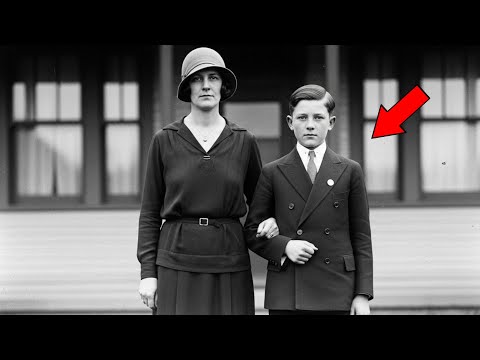
Dr. Sarah Mitchell adjusted her reading glasses, her breath catching as she examined the donated estate collection at the Smithsonian’s National Museum of American History. Among the dusty boxes from the Henderson family of Chicago, one photograph stopped her cold. A black-and-white image from 1925 showed a well-dressed woman in her thirties beside a boy of about twelve, posed in front of a modest brownstone. At first glance, it was ordinary—but something in the background made her heart race.
Behind the mother’s left shoulder, barely visible in the window, was a reflection that seemed impossibly out of place for the era. Sarah reached for her magnifying glass, her hands trembling. “This can’t be right,” she whispered. The image quality was too sharp for 1925, and the boy’s hand was deliberately placed over something on his jacket. Under the museum’s high-powered microscope, she saw it: a small metallic pin with encoded markings, and a reflection of a camera far too advanced for its time.
She called Professor James Rodriguez, a specialist in early 20th-century photography. “The camera technology visible in this reflection shouldn’t exist for another fifteen years at minimum,” he said, bewildered. The lighting suggested flash techniques unavailable until the late 1930s. They decided to contact Emily Henderson Walsh, the granddaughter of Margaret Henderson, who had donated the collection. When Emily arrived two days later, Sarah showed her the enhanced images. Emily’s face went pale. “That’s not my grandmother in the picture,” she whispered. “That’s my great-grandmother, Helen Henderson. She disappeared in 1925, along with her son Thomas—my grandmother’s brother. Margaret spent her whole life searching for them.”
The room fell silent. This wasn’t just a family portrait; it might be the last photograph of two people who vanished without a trace. Emily’s voice shook. “Margaret always believed they were in danger, but no one listened.” As the enhanced imaging revealed the pin’s symbols, James recognized them as a deliberate code. Sarah sent the images to Dr. Marcus Webb, a cryptography expert at Georgetown. Meanwhile, Emily shared more: Helen had been a seamstress, but she stayed up late writing letters and whispering on the phone. When she and Thomas vanished, all her belongings disappeared too.
Dr. Webb called back within hours. “These symbols are consistent with coded communication used by women’s suffrage and early civil rights groups in the 1920s,” he said. “But this combination is more sophisticated than typical activist codes. Helen Henderson was involved in something much more organized—and potentially dangerous.” Sarah’s pulse quickened. She dove into Chicago archives and found records of the Silent Sisters, a secretive organization that helped relocate activists and their families between 1921 and 1927. The group used complex codes to communicate safely.
Emily, meanwhile, discovered a faded note tucked behind the lining of Margaret’s jewelry box: “Helen Henderson, Chicago, 1925. Protection protocol 7. Thomas safe.” Sarah’s theory crystallized: Helen and Thomas hadn’t disappeared by choice—they had been relocated for their safety. The advanced camera in the reflection belonged to someone with access to cutting-edge equipment, perhaps law enforcement or government agents. Sarah contacted the National Archives and requested previously classified documents from the 1920s.
What she found shocked everyone. Helen Henderson’s name appeared in federal records as an informant who had provided crucial intelligence on organized crime during Prohibition. Using her seamstress position, she gathered information on illegal alcohol operations and corrupt officials. When her cover was blown in early 1925, the government made an unprecedented decision: relocate Helen and Thomas to protect them from retaliation. The photograph was official documentation of their entry into one of the earliest witness protection programs in American history.
Emily was stunned. “So Margaret was right all along,” she said, tears streaming. “Her mother didn’t abandon them—she was protecting them.” The coded pin Thomas wore contained coordinates and contact information for their new identities. But if the relocation was successful, why had Margaret never found them? Further investigation revealed a heartbreaking truth. Records showed Helen and Thomas had been moved to a small farming community in rural Montana under the names Helen and Thomas Morrison. For three years, they lived quietly—Helen as a schoolteacher, Thomas as a student. But in 1928, a fire destroyed much of the town. Helen died trying to save children from the burning school. Thomas, now fifteen, disappeared after her funeral. Some said he tried to return to Chicago to find Margaret, but he never arrived. The informal witness protection program was eventually discontinued, and their files were classified and forgotten.
The investigation took an unexpected turn when Dr. Webb used ultraviolet imaging to reveal faint writing on the back of the photograph—in Thomas’s handwriting: “For Margaret. If you find this, look for the teacher in Big Sky Country. The code will lead you home. TH 1925.” Big Sky Country meant Montana. Margaret had never seen this message because it was invisible under normal light. Sarah and Emily decided to follow the trail to Montana, where local historians helped them uncover a remarkable discovery: a small memorial for fire victims listed Helen Morrison as a beloved teacher, but there was no grave for Thomas. Instead, they found a local legend about a young man named Tom Rivers who had arrived in the late 1920s, searching for his sister in Chicago. He had settled in the area, become a teacher like his mother, and raised a family.
The breakthrough came when they found a 1950 school photograph of Tom Rivers with his students. Despite the years and the different name, Emily could see the resemblance to the boy in the 1925 portrait. They located Tom’s son, Michael Rivers, still living on the family ranch. When Emily called and explained who she was, there was a long silence. “My father talked about his sister Margaret his entire life,” Michael finally said, his voice thick with emotion. “He never stopped hoping she would find him.” Tom had kept the 1925 photograph hidden in a secret compartment of his desk, along with unsent letters to Margaret and a detailed explanation of the code on his pin.
As Emily held these precious artifacts, she realized that Margaret and Thomas had been searching for each other their entire lives, separated by circumstances beyond their control but never forgetting their bond. The photograph that had started as a simple family portrait had revealed a story of love, sacrifice, and unbreakable connections—but the full truth was still unfolding.
Michael led them into the ranch house’s study, where a rolltop desk stood against the wall, its wood worn smooth by decades of use. He pressed a hidden catch beneath the center drawer, and a slim compartment slid open. Inside lay a bundle of envelopes tied with faded twine, their paper yellowed but intact. “He wrote these every year on Margaret’s birthday,” Michael said. “Never mailed a single one. Said he didn’t know where she was, and he was afraid of putting her in danger if he tried to find her.”
Emily untied the twine with shaking fingers. The first letter was dated 1930, written in a careful, boyish hand. Dear Margaret, I am safe. Mother is gone but I am safe. I live with a family who is kind to me. I go by Tom now. Please do not worry. I will find you when I am grown. The next letter, from 1935, was longer, more confident. Tom had finished school and taken a teaching position. He wrote about the mountains, the big sky, the way the light fell across the valley in the evenings. “He was building a life,” Emily whispered, “but he never stopped looking back.”
Sarah noticed something odd about the letters’ arrangement. Each envelope bore a small mark in the corner—a dot, a dash, a tiny triangle—faint but deliberate. She borrowed Michael’s reading lamp and angled it across the paper. The marks glowed faintly under the light, revealing a pattern. “These aren’t just letters,” she said. “He encoded them. The same system as the pin.” She photographed each envelope and sent them to Dr. Webb, who called back within the hour, his voice tight with excitement.
“The marks form a secondary message,” Webb explained. “Thomas was documenting something. Coordinates, dates, names—it looks like a ledger. He was tracking the people who helped him and his mother. The Silent Sisters may have had a chapter here in Montana, and Thomas kept records of everyone who sheltered them after the fire.” Sarah’s mind raced. If Thomas had maintained contact with the organization, there might be surviving members—or their descendants—who knew more about what happened after Helen’s death.
Michael remembered something then. “Dad had a visitor once, in the early sixties,” he said slowly. “A woman from back east. She stayed for a week. He never told us who she was, but he was different after she left—quieter, like something had been settled.” He disappeared into the attic and returned with a shoebox of old photographs. Near the bottom was a picture of Tom standing beside a tall woman in a dark coat, both of them smiling cautiously at the camera. On the back, in Tom’s handwriting: E.H., 1962. The last of the Sisters.
Emily stared at the initials. “E.H.,” she breathed. “Could that be—” Sarah was already pulling up the Silent Sisters’ membership records she had copied in Chicago. There it was, buried in a list of aliases: Edith Harlow, Chicago chapter, active 1921–1927, relocated to Maryland, 1928. Edith Harlow had been Helen’s closest contact in the organization. She had survived, and she had found Thomas.
Michael’s hands trembled as he held the photograph. “She came to tell him something,” he said. “Something about his mother, maybe. Or about Margaret.” Sarah checked the date. 1962. Margaret had still been alive then, still searching. If Edith had known where Margaret was, why hadn’t she told Thomas? The answer came to Sarah in a cold rush: perhaps she had. Perhaps Thomas had known exactly where his sister was—and had chosen, for reasons they didn’t yet understand, not to reach out.
Sarah pulled the 1962 photograph closer. Something about Edith Harlow’s coat—a small pin on the lapel, identical to the one Thomas wore in 1925. “She gave him a final protocol,” Sarah said. “A way to contact Margaret safely, without exposing either of them.” But if Thomas had the means, why stay silent?
Michael opened the last letter in the bundle, dated 1963, unopened for sixty years. Tom’s handwriting was steady: Margaret, Edith says you are well and still searching. I almost wrote. But I have a family now, and so do you. If I appear, I bring the danger back to your door. Some loves are safer kept at a distance. Emily pressed the letter to her chest, sobbing quietly.
They found one final entry in Tom’s coded ledger—a name and address in Chicago, written in 1985: Margaret Henderson, nee Walsh. Confirm safe. Beside it, a single word: Confirmed. “He knew where she was the whole time,” Michael whispered. “He chose to protect her instead.”
Emily stood at the ranch window, looking out at the vast Montana sky. “They spent their whole lives loving each other from a distance,” she said. “Maybe that’s the real story here.” Sarah nodded, but something still nagged at her. She turned the 1925 photograph over one last time. Under the ultraviolet light, a new line had appeared, faint but unmistakable—written in Helen’s hand: Margaret, forgive me. The code is love.
What would you have done in Thomas’s place—reach out and risk everything, or stay silent to keep your family safe?
Report this article
Select a reason for reporting:






