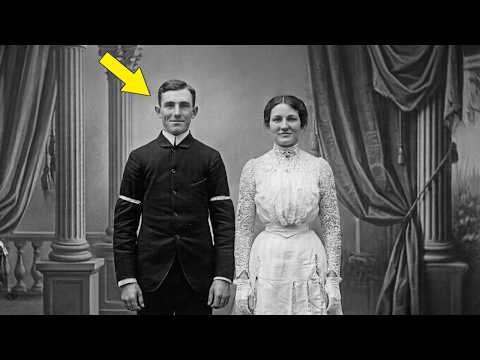
The autumn rain drummed against the windows of Harrison Estate Auctions in Boston as Dr. Emily Carter stepped inside, shaking droplets from her coat. As a curator specializing in early American photography at the Massachusetts Historical Society, she’d spent fifteen years examining thousands of images, but something about this particular auction drew her in. The room smelled of old paper and furniture polish. Elderly collectors murmured over mahogany tables while the auctioneer’s voice droned through lot numbers.
Emily moved past oil paintings and silverware until she reached a cardboard box marked “Miscellaneous photographs, early 1900s.” Her gloved hands sifted through daguerreotypes and cabinet cards until one image stopped her cold. A wedding photograph, sepia-toned and remarkably well preserved. The couple stood before an ornate backdrop, both dressed in formal attire. He wore a dark suit with a high collar, she a white dress with delicate lace at the throat. Their posture was rigid, proper for the era, but it was their smiles that caught Emily’s attention. Something felt wrong. She couldn’t explain it, just a curator’s instinct honed by years of studying faces frozen in time. The smiles were there, bright, proud even, but they didn’t reach the eyes. The couple stood too stiffly, their shoulders tense despite the formal pose expected of the period. She’d examined hundreds of wedding photographs from the early 1900s, and this one radiated an inexplicable discomfort.
Emily purchased the entire box for $200, barely hearing the auctioneer confirm her bid. Her mind was already racing with questions. Back in her conservation lab that evening, Emily placed the photograph under her digital microscope. The image filled her monitor, and she began the painstaking process of high-resolution scanning. As the software processed each layer, enhancing details invisible to the naked eye, her breath caught in her throat.
There, beneath the carefully applied makeup and the fixed smiles, she saw them. Faint bruises along the woman’s jawline. The discoloration barely visible, but unmistakable once magnified. Similar marks shadowed the man’s left temple. Subtle swelling ringed both their eyes, skillfully concealed but present nonetheless.
Emily leaned back in her chair, her heart pounding. She zoomed in on their hands next. The woman’s knuckles showed abrasions, partially hidden by her white gloves. The man’s right hand, resting on her shoulder, bore similar marks—raw, recent injuries. This wasn’t a joyful wedding photograph. This was documentation of something far darker. The smiles weren’t expressions of happiness, but masks, carefully constructed for the camera.
Emily saved the enhanced images and sat in the quiet lab, staring at the faces of two people who’d suffered more than a century ago. She had to know their story. Emily didn’t sleep that night. The photograph remained on her screen, the couple’s haunted eyes following her around the lab. At dawn, she returned with fresh coffee and a determination to understand what she’d found.
She studied every inch of the image with renewed focus. The backdrop was standard for the period, a painted scene of columns and drapes typical of professional photography studios in early 20th century Boston. But it was the details in the clothing that revealed more troubling signs. The woman’s dress, while elegant at first glance, showed clear evidence of hasty alterations under magnification. Uneven stitching along the waist suggested it hadn’t been made for her originally—perhaps borrowed, perhaps forced upon her at the last moment. The man’s suit told a similar story. The fabric appeared quality, but the fit was imperfect. The sleeves were slightly too short, exposing his wrists more than fashion would dictate. More importantly, Emily noticed what appeared to be a small tear in the shoulder seam, crudely mended with thread that didn’t quite match.
Then she found it, stamped in faint letters along the bottom right corner of the photograph: Aldrich Photography Studio, 47 Tremont Street, Boston, Mass. Her pulse quickened. A location, a starting point. Emily immediately cross-referenced the address in her historical database. Tremont Street in 1902 had been a fashionable area, home to several prominent photography studios catering to Boston’s upper classes. But Aldrich Photography Studio didn’t appear in any of her standard references. She expanded her search to city directories, business licenses, and newspaper advertisements from the period. Finally, in a digitized copy of the 1902 Boston City Directory, she found a single entry: Aldrich, Thomas J, photographer, 47 Tremont St, res Roxbury. Nothing more. No advertisements, no society mentions, no business records beyond that bare listing.
Emily felt a chill. Professional photographers of that era typically left substantial paper trails—advertisements in newspapers, society column mentions when they photographed prominent families, business transactions. The absence of information was itself information. Thomas Aldrich had operated quietly, almost invisibly. She needed to find out why. And more importantly, she needed to discover who this couple was and what had happened to them in that studio on Tremont Street over a century ago.
The Massachusetts State Archives building stood gray and imposing on Columbia Point, overlooking the harbor. Emily arrived when the doors opened at nine. Her leather satchel was filled with notebooks and her laptop loaded with the enhanced photographs. The reading room smelled of preserved paper and controlled humidity, a scent Emily had always found comforting. Today it felt oppressive.
She requested marriage records from Suffolk County for the entire year of 1902. The archivist, an older man named Robert who knew Emily from previous research visits, raised an eyebrow at the broad request but didn’t question her. Two hours later, he wheeled out three boxes of bound ledgers, their leather covers cracked with age. Emily worked methodically, photographing each page, searching for any marriage that might correspond to her mysterious couple. The names blurred together—Mary and John, Elizabeth and William, Catherine and James. Hundreds of marriages, each entry written in careful script recording names, ages, occupations, and witnesses.
Then, on page 247 of the September records, she found something that made her freeze. The entry was brief, almost dismissive. Thomas Edward, age 24, laborer, and Rosemarie, age 21, seamstress. Married September 14th, 1902. Witness, J. Pemberton Escar. No parents listed. No residence recorded beyond Boston—just the bare minimum information required by law. But it was the notation in the margin that caught her attention. A small mark, barely visible, that looked like it had been added later. A single word in different ink: arranged.
Emily’s hands trembled as she photographed the page. Arranged marriages weren’t uncommon in immigrant communities of that era, but the clinical nature of this entry, combined with the injuries visible in the photograph, suggested something far more sinister than a traditional family arrangement. She searched for Thomas Edward and Rosemarie in city directories, census records, and immigration documents. Thomas appeared in the 1900 census as a dock worker living in the North End, Boston’s densely packed immigrant neighborhood. Twenty-two years old, born in Ireland, arrived in America in 1897. Rosemarie appeared in the same census, living three streets away, a factory worker, also from Ireland, arrived in 1899. Two young immigrants, alone in a massive city, trying to survive.
Emily felt a connection to them spanning twelve decades. What had brought them to that photographer’s studio? Who was J. Pemberton, and why had he witnessed their marriage? And most disturbingly, who had hurt them—and why?
J. Pemberton. The name echoed in Emily’s mind as she left the archives. She spent the afternoon in the Boston Public Library’s research division, surrounded by leather-bound volumes and microfilm readers. She started with city directories and legal records. Jonathan Pemberton appeared repeatedly in documents from 1895 to 1910—attorney at law, office located at 125 State Street in Boston’s financial district. But he wasn’t just any attorney. Further research revealed he specialized in labor contracts and immigration cases, representing several of Boston’s largest manufacturing companies.
Emily found a newspaper article from the Boston Globe, dated March 1901, headlined “Attorney Pemberton Addresses Immigration Question.” The piece described a speech he’d given to the Boston Chamber of Commerce about the efficient management of foreign labor. The language made Emily’s stomach turn—workers described as resources to be allocated and controlled. She discovered that Pemberton had legal authority as a notary and frequently served as a witness for marriages involving immigrant workers. But the pattern disturbed her. In case after case, the marriages he witnessed involved workers employed by the same handful of companies: Lowell Textile Mills, Quincy Iron Works, and most frequently, the Blackstone Manufacturing Company.
Emily pulled up everything she could find about Blackstone Manufacturing. Founded in 1887 by industrialist Marcus Blackstone, the company operated three factories in the Boston area producing clothing, textiles, and leather goods. They employed over eight hundred workers, most of them immigrants. And they had a reputation. A series of articles from labor newspapers—publications Emily had to dig through the library’s special collections to find—painted a disturbing picture. Workers at Blackstone facilities reported brutal conditions: fourteen-hour shifts, wages paid in company script only redeemable at company stores, and housing in company-owned tenements where rent consumed most of their earnings. Several articles mentioned workers who tried to leave being pursued by company agents.
One article from 1902, published just months before Thomas and Rose’s wedding, reported on an attempted workers’ strike at the Blackstone factory in Charlestown. The strike had been broken violently. Three organizers had disappeared. The article suggested they’d been forced to sign new contracts under threat of deportation—or worse.
Emily sat back, the pieces beginning to form a horrifying picture. The arranged marriage, the attorney who specialized in labor contracts, the injuries visible in the photograph. Thomas and Rose hadn’t chosen to marry. They’d been forced into it, likely as punishment or control. But why? And what had happened to them after that photograph was taken? Emily needed access to Blackstone Manufacturing Company records—but companies from that era rarely preserved their documents.
She spent two days making calls, tracking down historical societies, and searching through business archives. Finally, she found a lead: the company had been dissolved in 1935, and surviving records had been donated to Northeastern University’s labor history collection. The collection occupied a climate-controlled room in the university library basement.
Dr. James Morrison, the collection curator, met Emily personally. He was in his sixties with the weathered look of someone who’d spent decades fighting to preserve uncomfortable histories. When Emily explained what she was researching, his expression darkened. “Blackstone Manufacturing,” he said quietly. “You’re not the first to come looking. Those records tell a story most people would prefer stayed buried.”
He led her to a series of filing cabinets containing employment ledgers, contract records, and correspondence. Emily pulled on archival gloves and began searching. The employment ledgers listed hundreds of names, recording hiring dates, positions, wages, and notations about conduct and performance. She found Thomas Edward’s name, hired July 1900 as a general laborer, wage of sixty cents per day. Then she found Rosemarie, hired March 1900 as a seamstress in the garment division, wage of forty cents per day.
But it was the notations beside their names that made Emily’s blood run cold. Beside Thomas’s entry, written in firm script: “Agitator. Suspected union sympathizer. Requires correction.” The date: August 1902. Beside Rosemarie’s name: “Witnessed incident report number 247. Potential testimony risk. Requires management.” The same month.
Emily’s hands shook as she requested incident report number 247. Dr. Morrison brought her a box of incident reports, his face grim. “These reports document workplace accidents, injuries, and what the company called disciplinary matters. Read them carefully.”
Report number 247 was dated August 12th, 1902. A supervisor named Patrick Donnelly had been accused of assaulting a fifteen-year-old worker named Anna. The report was clinical, cold. Rosemarie had been listed as a witness, having seen the attack. The report concluded: “Matter resolved internally. Witness counseled on discretion. No external action required.”
Emily felt sick. Rosemarie had witnessed a crime, and instead of justice, she’d been threatened. Thomas had been labeled an agitator for presumably advocating for better conditions. And exactly one month later, they’d been standing before a camera, bruised and forced into marriage with Jonathan Pemberton, the company’s attorney, as their witness.
This wasn’t a wedding. It was a binding—a way to control two people who threatened the company’s operations. Married workers could be more easily monitored, their families used as leverage. Emily understood now why they looked so haunted in that photograph.
Dr. Morrison watched Emily’s reaction with sad understanding. “There’s more,” he said softly. “We acquired a box of personal correspondence five years ago—letters that were confiscated by company management and never delivered. They were found in a warehouse during demolition. You should see them.”
He returned with a document box labeled Confiscated Correspondence, 1900-1905. Inside were dozens of letters, many still in their original envelopes, all bearing the same notation: “Intercepted, not delivered.” Emily’s hands trembled as she opened the first one.
The letter was dated September 20th, 1902—just six days after Thomas and Rose’s forced marriage. It was written in careful feminine script, Rose’s handwriting. The letter was addressed to a Margaret in County Cork, Ireland, presumably a sister or friend she’d left behind.
“Dearest Margaret,” it began. “I write to you though I fear you will never receive this. Thomas and I were married last week, but not as I once dreamed marriage would be. They hurt us, Margaret. Mr. Donnelly and his men beat Thomas when he spoke against the machine’s dangers. They came for me after I told what I saw him do to young Anna. They said we must marry or face deportation, but it is worse than that. We are watched constantly now. We live in company housing, work company jobs, buy from company stores. Thomas says we are prisoners dressed as workers.”
Emily read through tears, her professional detachment crumbling. She found another letter dated October 1902, also from Rose. “The marriage was meant to silence us, to make us complicit in our own captivity. Married workers cannot testify against each other in court. Mr. Pemberton explained this with a smile. Thomas grows desperate. He speaks of escape, but where would we go? They control everything.”
A letter from Thomas, dated November 1902, addressed to a brother in New York: “Patrick, I beg you not to come for us. It would only endanger you. The Blackstone Company has arrangements with police, with judges, with immigration officials. Workers who flee are hunted down and returned or simply disappear. Rose and I are trapped. The marriage they forced upon us was meant to protect them, not us. If anything happens, know that we fought as long as we could.”
Emily found more letters spanning the fall and winter of 1902-1903. Each one painted the same picture: two people caught in a brutal system, their marriage weaponized against them, their lives controlled by a company that treated human beings as property. The letters spoke of fourteen-hour shifts and dangerous conditions, of wages stolen through fraudulent accounting, of workers injured and discarded. They spoke of growing desperation.
The final letter was dated February 14th, 1903—Valentine’s Day. It was from Rose, addressed to Margaret again. “Thomas and I have made a decision. We cannot live this way. If you ever learn what became of us, please know we loved Ireland, we loved each other despite how we were bound, and we died free. Pray for us.”
The letter ended there. Emily sat in stunned silence, the implications washing over her.
Emily left Northeastern University in a daze, Rose’s final letter echoing in her mind. “And we died free.” What had they done? She needed police records, death certificates—anything that would tell her what happened after February 1903.
Back at the Massachusetts Archives the next morning, she requested death records for Boston, starting with March 1903. She found them on her second day of searching. Two death certificates, filed on the same date: March 3rd, 1903. Thomas Edward, age 25. Rosemary Edward, age 22. Cause of death for both: accidental drowning, Boston Harbor. The certificates were signed by a Dr. William Harris, and the deaths were witnessed and reported by a Blackstone Company supervisor.
Emily’s journalist instinct—honed through years of historical research—told her this was no accident. She searched newspaper archives for any mention of the drownings. Most papers ignored it entirely. Two immigrant workers were hardly newsworthy. But she found a brief mention in the Boston Evening Transcript dated March 5th, 1903: “The bodies of two factory workers were recovered from Boston Harbor near Long Wharf on Monday evening. Police report no signs of foul play. The couple apparently entered the water together during evening hours. An investigation has been closed.”
An investigation closed within forty-eight hours? Emily’s suspicion deepened. She dug further, finding a very different account in the Boston Labor Advocate, a socialist newspaper that covered worker issues. Their article, dated March 8th, 1903, told another story: “Thomas and Rose Edward, workers at Blackstone Manufacturing, were found dead in Boston Harbor last week under circumstances that demand investigation. Fellow workers report the couple had been under constant surveillance by company agents. The night of their deaths, witnesses saw them escorted from company housing by two men. The police refused to question these witnesses. We demand justice.” But justice never came.
Emily found no follow-up articles, no investigation, no questions asked. The story simply disappeared—like Thomas and Rose themselves. She contacted the Boston Police Department’s archives, requesting any surviving case files from March 1903. After a week of bureaucratic delays, she received a thin folder. The file contained almost nothing: a brief incident report noting the bodies’ discovery, the same conclusion of accidental drowning, and a notation that closed the case.
But tucked at the back of the folder was a single page that had been misfiled—a witness statement from a dock worker named Shawn O’Brien. His testimony contradicted the official narrative. “I was working late on Long Wharf that night. Around nine, I saw two men in dark coats dragging a couple toward the water. The woman was struggling, crying out. The man was unconscious or dead already—I couldn’t tell. I started toward them, but another man appeared and put a gun to my ribs. He told me to forget what I’d seen if I wanted to see morning. I ran. God forgive me, I ran.”
Emily sat with that statement for a long time, her hands shaking. Thomas and Rose hadn’t died by accident. They’d been murdered.
Emily knew she had uncovered something that powerful people had buried over a century ago, but she needed more evidence—more connections to build a complete picture. She returned to the Blackstone Manufacturing records at Northeastern, this time searching for correspondence between company management and outside entities during late 1902 and early 1903.
Dr. Morrison helped her access the executive correspondence files—boxes of letters between Marcus Blackstone and various business associates, lawyers, and officials. The letters from that period revealed a company under pressure. Labor organizing was increasing across Boston’s industrial sector. Unions were gaining ground. Workers were becoming bolder in demanding rights, safety protections, and fair wages.
A letter from Marcus Blackstone to Jonathan Pemberton, dated January 15th, 1903, was particularly damning: “The Edward situation remains problematic. Despite the marriage arrangement, both continue to influence other workers. Thomas has been overheard discussing union organization, and Rose persists in speaking about the Donnelly incident to other seamstresses. Standard disciplinary measures have failed to silence them. We cannot afford agitation in the current climate. More permanent solutions must be considered.”
Pemberton’s reply, dated January 20th, 1903: “I concur with your assessment. The legal protections of marriage have not achieved the desired control effect. I have consulted with our associates at the police department and harbormaster’s office. There are precedents for resolving such matters discreetly. Workers who disappear at sea leave no inconvenient questions. I recommend swift action before their influence spreads further.”
Emily felt cold fury reading these words. Two human beings reduced to “a situation that required permanent solutions.” She photographed every page, documenting the conspiracy. But she needed one more piece. She needed to know if anyone had been held accountable—if anyone had fought for Thomas and Rose.
She found the answer in an unexpected place: a collection of letters at the Boston Public Library’s rare manuscript division, donated by the family of a former labor organizer named Catherine O’Sullivan. Catherine had been a prominent figure in Boston’s labor movement during the early 1900s, and her correspondence revealed she’d been aware of Thomas and Rose’s fate.
A letter from Catherine to a colleague dated April 1903: “The Blackstone murders must not be forgotten, though the company and their paid police have closed the case. Thomas and Rose Edward were killed for daring to speak truth about injustice. I have gathered testimony from three witnesses, but no lawyer will take the case. Pemberton’s influence extends too far. The system protects the powerful and discards the vulnerable. But I will not let their story die. I have hidden copies of all evidence I’ve collected, including a photograph given to me by a sympathetic studio worker—a wedding photograph showing the bruises they tried to hide. Someday, when the world is ready to listen, their truth will be told.”
Emily’s breath caught. Catherine had possessed the photograph. She’d recognized its significance and preserved it as evidence.
Emily spent the next two weeks verifying every detail, cross-referencing dates, locating descendants of witnesses, and consulting with colleagues who specialized in labor history and forensic photography. She contacted Dr. Morrison, who connected her with a professor of criminology at Boston University. Together, they analyzed the photograph under forensic examination, documenting the injuries that had been concealed.
The forensic analysis confirmed what Emily had suspected. Both Thomas and Rose showed signs of recent physical trauma consistent with assault. The pattern of injuries—defensive wounds on their hands, impact bruises on their faces—suggested they’d been beaten before the photograph was taken. The makeup had been applied skillfully, but modern imaging technology revealed everything.
Emily also discovered that Thomas Aldrich, the photographer, had documented the session in a private journal that had been donated to the Photographic Historical Society of New England after his death in 1935. She tracked down the journal and found the entry for September 14th, 1902: “Photographed a wedding today that broke my heart. The couple was brought in by two company men who watched the entire session. The bride had been crying—her eyes were swollen despite the powder we applied. The groom’s hands shook when he signed the receipt. They were forced to smile for the camera, forced to play the role of happy newlyweds. I have never felt more ashamed of my profession. These were not clients, but prisoners, and I was complicit in documenting their captivity.”
Aldrich had kept the original glass plate negative, unable to destroy the evidence of what he’d witnessed. When he donated his collection to the historical society in 1934, the plate had been included. Emily requested access and found it still intact, stored in archival conditions. The glass negative showed even more detail than the paper print she’d purchased. Every bruise, every tear stain Rose had tried to wipe away, every moment of anguish behind their forced smiles.
Armed with comprehensive documentation, Emily prepared a presentation for the Massachusetts Historical Society. She’d also contacted descendants of Thomas and Rose, locating great-grandnieces and great-grandnephews in Ireland and New York who’d grown up with family legends about ancestors who disappeared in America. They’d never known the truth. When Emily showed them the evidence, their grief was profound—but mixed with something else: validation. The family stories about injustice had been true.
Emily also reached out to journalists specializing in historical investigation. The story was picked up by the Boston Globe, which ran a front-page feature: “The Wedding Photograph That Exposed a Century-Old Murder.” The article detailed the entire investigation, from Emily’s initial discovery to the evidence of corporate conspiracy and murder. It named Marcus Blackstone, Jonathan Pemberton, and the Blackstone Manufacturing Company, documenting their role in the forced marriage, surveillance, and ultimate killing of two young immigrants who dared to speak truth.
The public response was immediate and powerful. Historians, labor activists, and immigrant rights organizations demanded official recognition of this injustice. The story resonated in an era increasingly aware of systemic exploitation and corporate abuse of power.
Six months after Emily’s discovery, a memorial service was held at Long Wharf in Boston Harbor, near where Thomas and Rose’s bodies had been recovered in 1903. Over two hundred people attended: descendants, historians, labor union representatives, and members of Boston’s Irish and immigrant communities. The gray morning matched the solemnity of the occasion, but there was also a sense of justice finally acknowledged.
Emily stood before the gathered crowd, the wedding photograph projected on a screen behind her. But this time, the image was accompanied by context—the factory records, the confiscated letters, the witness statements, and the photographer’s journal. The full story was visible now, the hidden truth finally revealed.
“Thomas Edward and Rose Marie were twenty-four and twenty-one years old when they died,” Emily said, her voice carrying across the wharf. “They came to America seeking opportunity and freedom. Instead, they found a system that treated them as disposable resources. When they dared to stand up against injustice—when Thomas advocated for worker safety and Rose testified about sexual assault—they were punished through forced marriage and ultimately murdered. For 122 years, their story was buried, dismissed as an unfortunate accident. But their photograph told the truth. Their faces, captured in that moment of forced celebration, preserved evidence of their suffering and their courage.”
She paused, looking at the descendants who had traveled from Ireland and across America to be present. “Thomas and Rose’s story is not just about the past. It’s about every worker who faces exploitation, every immigrant who’s threatened with deportation for speaking up, every person whose voice is silenced by those in power. Their photograph reminds us that injustice leaves traces, and truth eventually emerges, no matter how deeply it’s buried.”
The Massachusetts Historical Society announced that the photograph would be permanently displayed with full context about Thomas and Rose’s lives and deaths. The Blackstone Manufacturing Company’s records would be digitized and made publicly accessible for researchers. A scholarship fund was established in Thomas and Rose’s names to support immigrant workers pursuing education and labor rights advocacy.
Most significantly, the Boston City Council passed a resolution officially acknowledging the murders and apologizing for the city’s complicity in allowing corporate interests to override justice. A plaque was installed at Long Wharf bearing Thomas and Rose’s names and telling their story.
Emily returned to the conservation lab late one evening, looking at the photograph one final time before it was transferred to its permanent exhibition space. The couple’s faces stared back at her, still showing those forced smiles, still bearing the hidden bruises—but now their story was known. Now their courage was recognized. Now their deaths had meaning beyond the corporate conspiracy that had tried to erase them.
She thought about Catherine O’Sullivan, the labor organizer who’d preserved evidence and promised that someday the truth would be told. She thought about Thomas Aldrich, the photographer who’d kept the glass negative because he couldn’t bear to destroy the evidence of injustice. She thought about all the people across twelve decades who had touched this story, who’d preserved pieces of truth, who’d refused to let Thomas and Rose be forgotten.
The photograph would go on display next week, but it was no longer just an image of a forced wedding in 1902. It had become something more powerful: a testament to resilience, a call for justice, and a reminder that every person’s story matters, even when systems of power try to silence them. Thomas and Rose’s smiles might have been forced, but their legacy was now freely told—their truth finally visible to anyone willing to look closely enough to see it.
But as Emily turned off the lab lights, she wondered: how many other photographs in that auction box—and in archives around the world—still hold silent witnesses to forgotten crimes, waiting for someone to look closely enough to break the silence?
Report this article
Select a reason for reporting:






