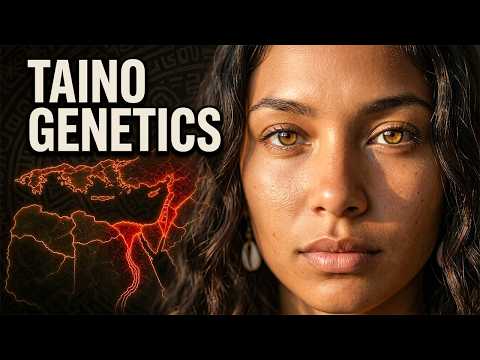
For five centuries, the official story has been carved in stone: the Taíno people of the Caribbean were extinct. Extinguished within a generation of Christopher Columbus’s arrival in 1492. Their culture erased, their language silenced, their very existence reduced to a footnote in the colonial record. Textbooks repeated it. Classrooms taught it. The world believed it. But ancient DNA has just shattered that narrative into a million pieces. The Taíno are not gone. They are not a historical curiosity. They are alive, and their genetic signature pulses through the veins of millions of people today. This is the story of how science exposed one of history’s most convenient lies—and why the truth was buried for so long.
The Taíno were the first indigenous people of the Americas to face the full force of European colonization. They greeted Columbus with hospitality, only to be rewarded with enslavement, disease, and massacre. Within decades, the Spanish declared them functionally non-existent. The encomienda system—violence with paperwork—worked them to death in mines and plantations. Smallpox and influenza tore through communities with brutal efficiency. Father Bartolomé de las Casas, an eyewitness, wrote of “rivers of blood” and villages emptied. By the mid-16th century, the colonial administration had closed the file: the Taíno were extinct. But that declaration was never a neutral fact. It was a legal tool, a way to erase a people’s claims to land, labor, and identity. Extinction, in the colonial context, was not a biological description—it was an administrative convenience.
Yet the biology refused to cooperate. In the early 2000s, geneticists began extracting ancient DNA from Taíno skeletons. What they found was nothing short of revolutionary. A 2018 study from the University of Copenhagen sequenced a complete genome from a 1,000-year-old skeleton found in a Bahamian cave. When compared to modern Puerto Rican DNA, the match was unmistakable. Present-day Puerto Ricans carry a measurable proportion of Taíno ancestry—up to 61% through the maternal line alone. The colonial record said extinct. The genome said otherwise. And the genome had no political reason to lie.
The implications are staggering. For generations, Taíno identity was dismissed as a delusion. But when DNA confirmed what families had whispered for centuries, the social permission structure shifted. In the 2010 U.S. Census, the number of people identifying as Taíno in Puerto Rico jumped by nearly 50%. Words like “hurricane,” “canoe,” and “barbecue” are Taíno—remnants of a culture so deeply woven into Caribbean life that even those who declared it extinct kept using its vocabulary. The extinction myth was never about biology. It was about power: a living indigenous population with traceable ancestry is a political problem; a vanished one is a footnote. The Taíno were never a footnote. They were a foundation. And science has now made that foundation visible to anyone willing to look.
But the genetic revelation did not happen in a vacuum. It arrived into a Caribbean that had spent generations being told, in a hundred quiet ways, that its indigenous roots were a romantic fiction. Puerto Ricans who claimed Taíno heritage were routinely accused of reaching for a past that was not theirs. The DNA did not just confirm ancestry. It granted permission to remember.
And memory, once permitted, turned out to be remarkably well-preserved. In the mountainous interior of Puerto Rico, in communities like Jayuya and Utuado, families had kept ceremonies alive through the colonial centuries—not in museums, but in kitchens and backyards. They held areytos, the traditional ceremonial gatherings, long after the Church had declared such practices pagan. They maintained the knowledge of cassava cultivation, of medicinal plants, of the sacred ball courts their ancestors had built.
This is the part the textbooks never explained. The Taíno did not simply vanish into the bloodlines of the Caribbean. They organized. They resisted. They adapted. When the Spanish census stopped counting them, they moved into the hills and became something the colonial administration could not categorize. They were absorbed into the African and Spanish populations not as a defeated remnant, but as a living thread woven into a new people.
The distinction matters more than it might first appear. A people erased passively is a tragedy. A people who survived through strategic adaptation, who married into other communities and carried their identity forward under different names, is a story of resilience that the colonial record had every incentive to suppress.
Modern scholars now argue that the very category of “extinction” was applied to the Taíno precisely because they refused to disappear cleanly. A population that dies out completely can be mourned and forgotten. A population that persists, intermarries, and keeps its ceremonies alive is a threat to the narrative of European superiority. The extinction declaration was not a description of reality. It was an attempt to make reality conform.
What the DNA age has done is strip away the administrative fiction and reveal the biological truth underneath. The Taíno genome is not a museum piece. It is a living inheritance, carried by millions of people who are only now beginning to understand what their bodies have always known.
The science that reopened the file was not designed to make a political point. It began with a simple question: who were the people who met Columbus? Researchers extracted DNA from skeletal remains across the Caribbean—from Cuba, from Hispaniola, from the Bahamas—and sequenced what remained of their genomes. What they found was not a dead end. It was a starting point.
The Copenhagen team’s work on the Eleuthera skeleton was particularly revealing. The woman whose genome they recovered had lived roughly five hundred years before Columbus. Her DNA carried markers that could be traced forward through time, through the colonial centuries, through the censuses that stopped counting, straight into the bodies of people alive today. The line was unbroken. It had simply been ignored.
But ancient DNA alone could not explain the scale. That came from mitochondrial studies—the kind that trace ancestry through the maternal line, from mother to child, unchanged across generations. When researchers sampled Puerto Ricans across the island, the results were not ambiguous. More than half carried Taíno ancestry through their mothers. On an island of over three million people, extended into a diaspora that stretches across every major American city, that number becomes something else entirely. It becomes a hidden majority.
What makes the maternal line so significant is what it reveals about survival. The encomienda system killed Taíno men in the mines and plantations. Disease killed indiscriminately. But women carried the ancestry forward—not just biologically, but culturally. The language, the ceremonies, the knowledge of plants and caves and cassava: these passed through the same line that the DNA now traces.
And the DNA was not the only evidence. Linguists had long noted that Caribbean Spanish contains hundreds of Taíno loanwords—not just the famous ones like hurricane and canoe, but words for plants, for tools, for the specific features of the island landscape. You cannot lose a language completely and still name the trees.
Archaeologists, too, had found continuity where the colonial record insisted there was none. In the mountains of Puerto Rico, in caves that had been sealed for centuries, they found offerings—ceramics, carved objects, the material remains of a spiritual tradition that was supposed to have died. These were not the traces of a vanished people. They were the signs of a people who had moved, adapted, and kept their sacred world intact in the places the colonizers could not easily reach.
The picture that emerges is not one of extinction but of transformation. The Taíno did not disappear. They became something the colonial categories could not contain. They married into African and Spanish families. They moved inland. They stopped calling themselves Taíno in the census because the census had stopped offering the option. But they kept the knowledge. They kept the blood. They kept the words.
And now, five centuries later, the science has caught up to what the families always knew. The file that was closed in the 16th century has been reopened by a generation of researchers who had no stake in the old story. The Taíno are not a footnote. They are a foundation—and the foundation is still holding.
But the science alone did not rewrite the story. The descendants did. Across Puerto Rico and the diaspora, a movement had been building long before the first genome was sequenced. Community leaders in Jayuya had been petitioning the U.S. government for federal recognition since the 1990s, insisting that the Taíno were a living people, not a historical relic. Their case rested on cultural continuity—the areytos, the language fragments, the unbroken chain of oral history—but the colonial record had always been used against them. Extinction was the legal wall they could not climb.
Then the DNA arrived, and the wall began to crack. When the Copenhagen study was published in 2018, it did more than confirm ancestry. It provided evidence that could be entered into the public record. Suddenly, the Taíno were not asking to be believed. They were asking the world to catch up with its own biology.
The response was immediate. In Puerto Rico, cultural organizations that had operated in the margins for decades saw their membership swell. Young people who had grown up thinking their indigenous heritage was a myth began to reclaim it—not as a costume, but as a birthright. The 2010 census had already shown a 50% increase in self-identification. By 2020, that number had climbed again, driven by a generation armed with genetic proof and a refusal to let the old story stand.
This is where the story turns from science back to people. The Taíno genome is not an abstraction. It is carried in the bodies of nurses in San Juan, teachers in the Bronx, musicians in Chicago. It is a living inheritance that was never lost, only denied. And the denial was never an accident. It was a policy, enforced across centuries by institutions that benefited from the erasure.
The colonial record declared the Taíno extinct because a living people with legitimate claims to land, culture, and self-determination is inconvenient. A vanished people is a footnote. But footnotes can be rewritten. The DNA age has made the old story untenable, and the descendants have made it obsolete.
What remains is the work of repair—not guilt, which is useless, but acknowledgement. Acknowledgement that the Taíno were the first to face what we now call globalization, the first to absorb its violence, and the first to survive it in ways the record refused to count. They left their biology in millions of bodies, their words in the languages that replaced their own, and a cultural memory stubborn enough to outlast five centuries of pressure to forget.
History said the Taíno vanished. The DNA said otherwise. And the descendants are here, carrying the record of a civilization that was never actually erased—only waiting for a science precise enough to find it, and a people bold enough to claim it.
So the next time you say “hurricane” or lie in a hammock or paddle a canoe, remember: you are speaking the language of a people the world was told had disappeared. They did not disappear. They became us. And the file that was closed five hundred years ago is now wide open, its pages rewritten by the very bodies that were supposed to be empty.
What will you do with this truth—and whose story will you help tell next?
Report this article
Select a reason for reporting:






