June 1944, Camp Rustin, Louisiana. The air hung thick with heat and the hum of cicadas, but inside the orientation room, sixty-three German women sat frozen. They had been prisoners for years—some for the entire war—and they knew the drill: rules were traps, privileges were bait, and authority was a weapon. So when Captain Helen Bradford, a thirty-eight-year-old American officer with a clipboard and a calm voice, began listing their rights, the silence was not respectful. It was the silence of women waiting for the catch.
“You can write letters without censorship. You can organize your own activities. You can refuse work assignments if you have valid reasons.” The words landed like grenades in the still room. Margarite Vber, a forty-two-year-old former teacher from Hamburg, felt her hands tighten in her lap. She had spent three years in detention camps where every promise was a lie. Freedoms were dangled, then revoked. Rules existed to create leverage, not order. And yet Bradford’s tone suggested she was describing something as mundane as the weather.
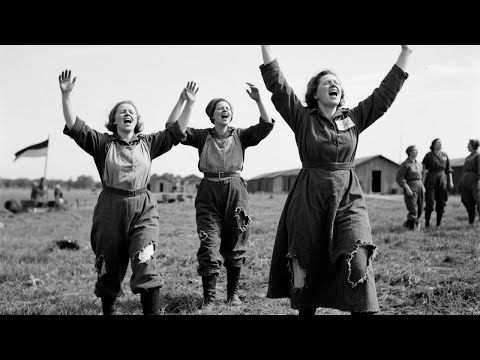
Margarite exchanged a glance with Lisa Hartman, a younger woman she had befriended during their transfer. Lisa’s eyes were wide, skeptical. They had both learned to survive by staying invisible, by never asking questions. But Bradford’s next words shattered that instinct: “You may establish your own governance structure. You may petition for changes to camp policies. You may practice your religion without restriction.”
The women had arrived in waves that spring, transferred from East Coast processing centers after being detained aboard civilian vessels when war broke out. Most were wives, daughters, or sisters of German nationals working abroad. Some were teachers, nurses, businesswomen caught in the wrong place when borders closed. All carried the same marks: weariness around authority, careful speech, the habit of seeking permission before any action. Camp Rustin housed over 4,000 prisoners, mostly military personnel, but the women occupied a separate section—segregated, yet subject to the same Geneva Convention protections.
Captain Bradford had been assigned to oversee the women’s section because of her background in social work and education. She believed that humane treatment was both a moral obligation and a practical strategy. “Humane treatment reduces resistance, improves cooperation, and undermines the ideological certainty that makes prisoners dangerous,” she had written in a memo. But to the women, her words sounded like a fantasy.
When Bradford finished and opened the floor for questions, silence answered her. The women had learned that asking questions drew attention, and attention was dangerous. Finally, Lisa raised her hand tentatively. “What happens if we break rules? What are the punishments?” Bradford consulted her clipboard. “Minor infractions result in warnings. Serious violations result in solitary confinement and possible criminal charges. But discipline is graduated and proportional. We don’t punish entire groups for individual actions, and we don’t impose collective penalties.”
The answer was revolutionary. Graduated discipline. Proportional response. No collective punishment. These concepts seemed almost fantastical to women whose entire experience of authority had been arbitrary and capricious. As they filed out to their barracks, Margarite walked beside Lisa. “Do you believe her?” Lisa whispered in German. Margarite considered carefully. “I believe she described official policy accurately. Whether that policy is implemented consistently is another question entirely. We will discover through experience whether American captivity truly differs from what we have known.”
That evening, dinner was served in the mess hall: meatloaf, mashed potatoes, green beans, bread, butter, coffee, and pie for dessert. Margarite ate slowly, analyzing the food for hidden messages. Adequate nutrition suggested the camp intended to maintain prisoner health for productive labor. The dessert was surprising—unnecessary calories that served no practical purpose except morale. After dinner, Bradford appeared again. “Tomorrow morning, we’ll hold elections for section representatives. You’ll select women to serve as liaisons between prisoners and camp administration. These representatives will have real authority to raise concerns, propose policy changes, and manage internal disputes. Nominations are open now. Elections will be conducted by secret ballot tomorrow.”
The room absorbed this information in stunned silence. Elections. Secret ballot. Real authority. These concepts existed in abstract political theory, but not in the lived experience of anyone present. The regime had held elections—carefully choreographed spectacles where outcomes were predetermined and participation was mandatory but meaningless. Bradford seemed to be describing something different: an actual democratic process where votes might matter and representatives might exercise genuine influence.
Margarite’s mind raced. If elections were genuine, representatives would face a difficult position—mediating between prisoner desires and administrative requirements, making decisions that would inevitably disappoint some constituents. If elections were performative, the process would be revealed as manipulation when representatives proved powerless. Either way, participating carried risk. But someone would be elected regardless. Better to influence the process than abstain.
She stood slowly. “I nominate myself,” she said in careful English, then repeated in German. “I have experience in education and administration. I understand how institutions function. I will represent our interests honestly and work to ensure policies serve our needs rather than simply convenient administration.” The boldness of self-nomination drew surprised glances, but several women nodded. Lisa stood and added her support. “I nominate Frau Vber also. She has shown leadership during our time in previous facilities. She knows how to navigate authority while protecting those without power.”
By the evening’s end, twelve women had been nominated for six representative positions. Bradford collected names without comment, her expression suggesting satisfaction that prisoners had engaged the process rather than refusing participation. The elections occurred the next morning. Emma Klene, a German-American staff member, distributed paper ballots. Each woman marked her choices privately, and votes were collected in a sealed box. Bradford and Klene counted ballots in full view of assembled prisoners, calling out each vote and maintaining running tallies on a chalkboard. The transparency was unusual. Most institutional processes occurred behind closed doors with results announced without supporting evidence.
Margarite won her position with strong support. The other five representatives included a former nurse, a businesswoman who had managed a textile company, two younger women who had demonstrated organizational skills, and a grandmother whose age commanded natural respect. Together they represented diverse backgrounds and perspectives within the prisoner population. That afternoon, Bradford met with the new representatives in a small office. “Your role is to represent prisoner interests,” she began. “You bring concerns to me. I bring them to camp administration and we work toward solutions. Some requests I can authorize immediately, others require higher approval. Some will be denied for security or logistical reasons, but all will be considered seriously, and you’ll receive honest explanations regardless of outcome.”
She paused, meeting each woman’s eyes. “I know you don’t trust this. You’ve been taught that authority is arbitrary, that promises are meaningless, that power exists only to be abused. I can’t change those beliefs through speeches. You’ll have to test the system and discover through experience whether it functions as described.” Margarite spoke carefully. “What are the limits of our authority? What decisions can we make independently versus what requires your approval?” Bradford consulted her notes. “You can organize the internal structure of your section—work schedules, barracks assignments, activity programs—without my approval as long as arrangements don’t violate security regulations. You can establish disciplinary procedures for minor infractions within your community. You can allocate recreational budgets and determine how shared resources are used. Basically, everything that doesn’t involve security concerns or external relations is yours to manage.”
The scope was breathtaking. Self-governance within captivity. Authority to make meaningful decisions affecting daily life. The representative group exchanged glances that communicated shared disbelief. Over the following weeks, the representatives began testing boundaries. They reorganized work schedules to accommodate prisoner preferences. They established a library using donated books and materials prisoners had brought from previous facilities. They created an education program where women with teaching experience offered classes in languages, mathematics, history, literature. They organized recreational activities—singing groups, crafts, exercise classes, discussion circles. Each initiative required negotiation with Bradford and camp administration. But negotiations where genuine authorities sometimes said no, but they explained reasons and often suggested alternatives.
When representatives proposed starting a garden where prisoners could grow vegetables to supplement rations, administration approved and provided tools, seeds, and unused land. When representatives requested permission to hold religious services, authorities agreed immediately and offered to bring in clergy from nearby towns. The pattern of request, consideration, and often approval began reshaping prisoner psychology. Margarite noticed the change in herself and others. They walked differently—less hunched, more purposeful. They spoke more freely, testing whether honest expression would trigger punishment. They took initiative rather than waiting for orders, discovering that initiative was encouraged rather than suppressed.
Lisa approached Margarite six weeks after arrival with a question that illustrated the transformation. “Can we really organize a concert?” she asked. “Several women have musical training. We could perform for the whole section. Maybe even for the male prisoners if administration permits.” Margarite consulted the regulations they had established. “Nothing prohibits it,” she said. “Propose it to Bradford and see what she says.” The concert proposal led to extended negotiation. Bradford supported it enthusiastically but required security precautions. The performance would occur in the recreation hall. Guards would be present but unobtrusive. Male prisoners could attend but would be separated by a barrier to prevent unauthorized contact. The representatives agreed, recognizing that some restrictions reflected genuine security concerns rather than arbitrary control.
The concert occurred on a Saturday evening in August. Twenty-three women performed—singers, a violinist who had managed to keep her instrument through multiple detentions, a woman who played accordion with surprising skill, several poets who recited German works from memory. The audience included women prisoners, some male prisoners separated by rope barrier, and off-duty guards who attended voluntarily. Margarite watched from the back of the hall, overwhelmed by what was unfolding. These women—prisoners, enemies, people categorized as threats requiring containment—were performing art. They were expressing themselves creatively, sharing beauty with others, doing things that had no practical utility except joy. And authorities were not just permitting it but actively supporting it, providing space and resources and audience.
After the concert, as prisoners returned to barracks in cooling evening air, Lisa found Margarite again. “This should not be possible,” she said quietly. “We are prisoners. We should be working, restricted, controlled. How can this be captivity?” Margarite had been wrestling with the same question. “I think American captivity operates from different assumptions,” she said slowly. “The regime believed that people needed constant control or they would descend into chaos. Americans seem to believe that people will generally behave reasonably if given opportunity and treated with basic dignity.” “But which is true?” Margarite smiled sadly. “Perhaps both, depending on the system. The regime created conditions that required harsh control. People who are desperate and humiliated become dangerous. Americans create conditions that allow reasonable behavior. People who are fed adequately and treated fairly have less reason to rebel.”
The insight was political philosophy developed through lived experience rather than abstract theory, and it had profound implications. If the regime’s approach created the problems it claimed to solve—if harsh control was a self-fulfilling prophecy rather than a necessary response to human nature—then everything the regime had taught about order and society was fundamentally wrong. September brought new freedoms. The representatives proposed starting a newspaper—a simple publication that would share news, announce activities, and provide space for prisoners to contribute essays and creative writing. Bradford approved with one condition: content could not advocate for the regime or contain military information. Editorial control belonged to prisoners, but administration retained the right to prevent publication of specific items that violated those restrictions.
The newspaper, titled simply The Voice, began publishing weekly. Margarite served as editor, working with a small group to collect submissions, edit for clarity and length, and produce copies using a mimeograph machine administration provided. The first issue contained announcements about upcoming activities, recipes submitted by prisoners, a poem about longing for homeland, and an essay about adjustment to captivity. The process revealed fascinating dynamics. Some women wanted to write political content—defenses of the regime, critiques of American policy, arguments about the war. Margarite had to explain repeatedly that such content would not be published, not because ideas were forbidden, but because the publication served the prisoner community rather than political advocacy. Initially some accused her of censorship and collaboration, but gradually they recognized the distinction. The Voice was a community newspaper, not a political platform.
By October, the publication had evolved into a sophisticated community resource. It included educational content, cultural pieces about German traditions and holidays, personal stories from prisoners about their lives before detention, practical information about camp regulations and opportunities. Reading submissions, Margarite saw her fellow prisoners emerging from the defensive crouch captivity had imposed. They were thinking beyond immediate survival, expressing themselves, contributing to community rather than simply enduring isolation.
The representatives met weekly with Bradford to discuss issues and proposals. The meetings became increasingly collaborative—less negotiation between adversaries, more problem-solving between people with different roles but a shared interest in making the facility function well. When heating problems emerged in October, representatives worked with administration to prioritize repairs. When food quality declined temporarily due to supply issues, Bradford explained the situation honestly rather than offering excuses, and representatives helped manage prisoner expectations.
Not everyone appreciated the cooperative approach. A small group of prisoners, led by a woman named Gertrude Fischer who had been active in regime youth programs before detention, argued that the representatives were collaborating with the enemy. They insisted that any cooperation with American authorities constituted betrayal—that prisoners should resist rather than participate in camp activities, that accepting freedoms was acknowledging the legitimacy of captivity. The tension came to a head in November. Fischer and her supporters distributed a letter criticizing the representatives and calling for non-cooperation with camp administration. The letter was inflammatory, accusing Margarite specifically of betraying German values and pursuing personal comfort at the expense of ideological integrity.
Margarite faced a choice. She could respond defensively, escalate the conflict, turn the dispute into a power struggle—or she could address concerns directly while maintaining focus on community welfare. She chose the latter, calling a meeting of all prisoners in the women’s section. The gathering filled the recreation hall. Margarite stood at the front, uneasily aware that she was exercising exactly the kind of authority the regime had taught her to distrust. But the representatives had been elected, had earned their positions through prisoner choice, and had a responsibility to address conflicts that threatened community cohesion.
“Some of you believe we are collaborating with the enemy,” she began without preamble. “I want to address that directly. We are prisoners. That is our situation. Not because we chose it, not because we deserve it, but because circumstances of war placed us here. The question is not whether we like captivity. The question is how we conduct ourselves within it.” She paused, scanning faces that displayed varying degrees of hostility and support. “The regime taught us that cooperation with any authority except itself was betrayal. That acceptance of any system except its own was weakness. I believed those teachings once, but I have learned through experience that they were designed to prevent us from thinking independently, from recognizing that systems can be evaluated based on how they treat people rather than on ideological purity.”
Fischer stood, her face flushed. “You sound like American propaganda,” she said sharply. “Justifying captivity, claiming that treating us decently makes it acceptable. We are prisoners of an enemy nation. Nothing they do changes that fundamental reality.” Margarite nodded slowly. “You are correct that we are prisoners. But being prisoners does not require us to refuse every opportunity, reject every kindness, make our situation worse through pointless resistance. The Geneva Convention guarantees us certain rights. Exercising those rights is not collaboration. It is claiming what international law entitles us to.”
The argument continued for over an hour. Fischer’s supporters raised various objections: cooperation legitimized American captivity, accepting freedoms made them forget their German identity, working with representatives meant abandoning resistance. Margarite and other representatives responded patiently, making distinctions between cooperation that served prisoner welfare and collaboration that served enemy interests. Eventually, Bradford herself appeared. She had been listening from outside, and she entered now with an expression that suggested she had heard similar debates before.
“I want to clarify something,” she said through Emma Klene. “Treating you decently is not a reward for good behavior. It is an obligation under international law. You are entitled to humane treatment regardless of whether you cooperate, resist, or maintain hostile attitudes toward the United States. Your representatives exist because allowing prisoners to organize their own community makes everyone’s life better. But if you prefer, we can eliminate the representative system and administer this section directly through military authority. That would be entirely legal. It would also be worse for everyone. The choice is yours.”
The statement reframed the entire debate. Self-governance was not manipulation—it was a privilege that prisoners could accept or reject. If they preferred traditional institutional management, authorities would provide it. But they would lose the autonomy they had gained, the ability to shape their daily lives, the dignity that came from making meaningful choices about their community. The meeting ended without formal resolution, but the momentum shifted. Most prisoners recognized that Fischer’s approach offered only the satisfaction of ideological purity purchased at the cost of practical welfare. Margarite’s approach—pragmatic cooperation focused on improving conditions rather than making political statements—served community interests better, even if it lacked dramatic resistance’s emotional appeal.
By December, even Fischer had begun participating in camp activities. She didn’t formally recant her objections, but she attended educational classes, contributed to the newspaper occasionally, and stopped actively organizing resistance. The transformation was gradual, almost invisible, but real. Christmas approached with preparations that would have seemed impossible six months earlier. The representatives organized celebrations incorporating German traditions: a Christmas market where prisoners sold handmade crafts, carols sung in German and English, special meals that approximated holiday foods. Administration supported everything, providing materials and relaxing some restrictions to allow extended family visits between male and female sections of the camp.
Margarite helped decorate the recreation hall, hanging paper ornaments prisoners had made. Lisa worked beside her, and the younger woman spoke thoughtfully. “When we arrived, I expected punishment. Instead, we received freedom—restricted, controlled, but real. I cannot reconcile that with what we were taught about American cruelty.” Margarite had been thinking about this constantly. “I think the regime needed us to believe Americans were cruel,” she said. “Because if we recognize that democracy could produce better outcomes than authoritarian control, we might question why the regime required such total power. They taught us to fear freedom because freedom reveals that their system was built on lies.” “But how many people will understand that?” Lisa asked. “How many will return to Germany still believing the propaganda?” “Some will cling to familiar narratives regardless of evidence,” Margarite replied. “Others, like us, will recognize that experience contradicted teachings. The question is whether enough people change their understanding to make reconstruction possible after the regime falls.”
The conversation captured the larger transformation occurring throughout Camp Rustin. Prisoners were not being converted to American ideology. They were simply experiencing an alternative system and discovering it produced better outcomes than what they had known. The lessons were not explicit or ideological—they emerged from accumulated small experiences. Requests honored, promises kept, freedoms granted and respected, dignity maintained even in captivity.
The war continued. News filtered into the camp about Allied advances, about the regime’s collapse accelerating, about cities falling and territories liberated. The prisoners processed this information with complicated emotions. Some felt vindicated—the regime they had doubted was indeed failing. Others felt grief—Germany was their homeland regardless of political systems, and its destruction meant personal loss. Most felt both, unable to separate love of country from recognition that its leaders had been catastrophically wrong.
Representatives began planning for repatriation even before official announcements. They established committees to help prisoners prepare for return: classes on what to expect in occupied Germany, discussions about reconstruction, practical advice about navigating postwar bureaucracy. The work was forward-looking rather than nostalgic, focused on building the future rather than mourning the past. Margarite wrote in her journal one evening in January 1945. The entry was private, honest in ways public statements could not be. “I came to America expecting captivity would be punishment. Instead, it has been education. I have learned that authority does not require cruelty to maintain order. That people given freedom generally use it responsibly. That cooperation can serve community interests without betraying principle. These lessons contradict everything the regime taught, and I do not know how to reconcile them with what I believed for so long. But I know this: I will return to Germany different from when I left. I will teach students—if I am permitted to teach again—that systems can be evaluated based on outcomes rather than ideology. That the question ‘does this serve human welfare?’ is more important than ‘does this match our traditions?’ Germany will need such thinking if reconstruction is to produce something better than what the regime destroyed.”
The entry captured what was happening throughout the camp. Prisoners were not abandoning German identity or embracing American nationalism. They were simply recognizing that political systems could be assessed pragmatically—that some approaches to governance produced better results than others. That the regime’s insistence on ideological purity had been an excuse for maintaining power rather than a path to social good.
Repatriation began in stages throughout 1945 and into 1946. Margarite’s group left in March 1946, boarding ships that would carry them back across the Atlantic to a homeland that existed now only in ruins. She carried with her the journals she had kept, the copies of The Voice she had edited, the memories of concerts and Christmas markets and weekly meetings where prisoners and authorities had worked together rather than simply confronting each other. She also carried an understanding that would shape everything that followed: that freedom—even restricted freedom within captivity—allowed people to demonstrate dignity and capability. That democratic processes, even imperfect ones, served communities better than authoritarian control. That treating people humanely was not weakness but practical strategy that produced better outcomes than cruelty.
The ship docked in Hamburg. Margarite disembarked into chaos—rubble, displaced populations, occupation authorities, survivors trying to piece together lives from fragments. She found work eventually teaching in a school the British occupation had established. She applied lessons from Camp Rustin, creating classroom environments where students could question and discuss rather than simply accepting authority. She taught that systems could be evaluated based on how they treated people, that freedom required responsibility but produced better results than control.
Other women from Camp Rustin followed similar paths. Lisa became a social worker, applying the principle that people given dignity and opportunity generally responded well. The former businesswoman helped rebuild commerce in her hometown, incorporating American approaches to organization and efficiency. The nurse worked in hospitals, teaching that patient care required attention to dignity as well as medical treatment. The impact was diffuse, impossible to trace precisely, but real. Sixty-three women had experienced an alternative approach to authority, had learned that freedom and order were not opposites, had discovered that cooperation could serve community without constituting betrayal. They carried those lessons into postwar Germany, influencing reconstruction in ways both subtle and significant.
Years later, Margarite received a letter from Bradford, who had tracked her down through careful effort. The American had returned to social work in Ohio but maintained interest in what had happened to the prisoners she had overseen. “I wanted to know if the experiment worked,” Bradford wrote. “If giving you freedom and responsibility actually changed anything, or if it was just making captivity more comfortable without addressing larger issues.” Margarite’s response took weeks to compose. She wrote about her teaching, about the students she was trying to help develop critical thinking rather than blind obedience. She wrote about reconstruction efforts and debates about how the new Germany should be organized. And she wrote directly about Camp Rustin’s impact. “What you gave us was not just comfort but proof that alternatives existed. The regime had taught us that freedom led to chaos, that people required constant control, that authority demanded total obedience or society would collapse. You proved those teachings false simply by creating an environment where we governed ourselves within reasonable limits and everything functioned well—perhaps better than under direct control. That lesson was more powerful than any political speech could have been. You changed what we believed possible, and that change matters more than you perhaps realize.”
The correspondence continued sporadically over decades. Two women, separated by an ocean and by fundamental differences in life circumstances, connected by a shared experience in a Louisiana pine forest where captivity had become a laboratory for discovering that humans treated with dignity generally responded by exercising it. The experiment had worked not because Americans had been especially kind or Germans especially receptive, but because basic truths about human nature operated regardless of nationality. People given responsibility generally accepted it. People treated with respect generally reciprocated. People offered meaningful choice generally made reasonable decisions. That was Camp Rustin’s legacy—not dramatic conversion or political transformation, but quiet recognition that the regime’s teachings about control and order had been self-serving lies. That freedom, properly structured, produced better outcomes than authoritarianism. That “we can do that”—the question German women had asked with disbelief when told they could organize activities, write freely, govern themselves—had been answered affirmatively through months of experience that accumulated into irrefutable evidence. And that answer, replicated across thousands of prisoners and camps throughout America, contributed to a reconstruction that built a different Germany on the ruins of the old. Not because prisoners abandoned their national identity, but because they learned through direct experience that systems could be evaluated based on results rather than ideology. That some approaches to governance served human welfare better than others. And that the question “we can do that?” was not expressing permission sought from authority but capability recognized within themselves.
Decades later, a graduate student in Hamburg found Margarite’s journals in a municipal archive, misfiled among reconstruction records. She read them in one sitting, then tracked down the last surviving representative—Lisa Hartman, ninety-one, in a nursing home outside Bremen.
“Did it change anything?” the student asked, recorder running. Lisa was quiet a long moment. “We stopped waiting for permission,” she said at last. “That was everything.”
The student published her thesis, then a small book. It sold modestly in Germany and not at all in America. But teachers passed it around, and one line kept surfacing in staff rooms and seminars: systems can be judged by how they treat people.
What would you have believed, standing in that orientation room in 1944—that the freedoms were bait, or that they were real?
Report this article
Select a reason for reporting:






