September 12th, 1943. The day Italy surrendered, and everything changed for thousands of Italian soldiers—including 17 women whose war was about to take an unimaginable turn. In a small compound outside Bakersfield, California, these members of the Italian women’s auxiliary service, captured during the Allied invasion of Sicily, stepped off a military truck into the bright California sunshine. They wore tattered uniforms and carried nothing but uncertainty. Among them was 26-year-old Sophia Marino, a former translator from Naples, clutching a photograph of her family’s vineyard—the only possession that had survived her journey. None of them could have guessed that this dusty ranch would become the place where they rediscovered hope, one grape at a time.
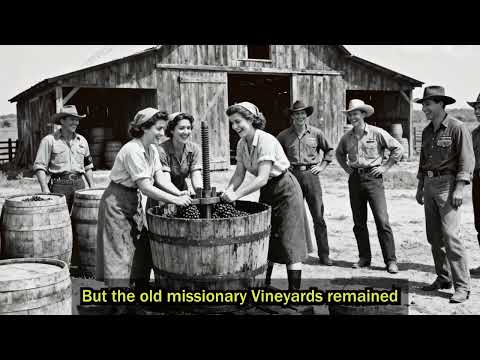
The Hansen ranch stretched across 3,000 acres of California’s Central Valley, a landscape of rolling hills, ancient oak trees, and row upon row of grapevines planted by Spanish missionaries generations earlier. The women’s compound was modest—just four wooden barracks surrounded by a single fence—almost apologetic in its simplicity. They were thousands of miles from home, with no resources and no allies, their captivity enforced less by barriers than by the simple impossibility of being anywhere else. Yet in those first weeks, something unexpected began to stir.
Each evening, the 17 women gathered in the barracks, their voices filling the wooden structure with the melodic cadence of Italian dialects from across their homeland. They shared stories of homes they might never see again, of families whose fates remained unknown. Maria Roselini, a 32-year-old widow from Tuscany, spoke softly of her family’s vineyard, her hands moving as she described the morning mist settling in the valleys between rows of Sangiovese grapes. Sophia listened, her own memories stirring. Her family’s vineyard outside Naples had been smaller, but the rhythms of that work had defined her childhood. “We sing to remember who we are,” Sophia would later tell a ranch hand. “Is hard to remember in this place.”
The ranch foreman, 53-year-old Thomas Wheeler, watched the Italian women from a distance, his weathered face revealing little. He had spent his entire life working cattle ranches and had never imagined he would be responsible for housing enemy prisoners—particularly women. Beside him often stood Captain James Richardson, the army officer assigned to oversee the facility, a man clearly uncomfortable with the ambiguity of his mission. Richardson had received orders to house the women securely but humanely, to put them to work if possible, but to avoid any situation that might create international complications. It was the most unclear set of orders he had ever received.
The ranch hands were a mixed group of older men too old for military service and younger cowboys with medical exemptions. They watched the Italian women with curiosity but kept their distance, unsure how to behave around enemy prisoners who looked more lost than dangerous. Among them was Miguel Santos, a 40-year-old cowboy whose grandfather had worked these same lands when they still belonged to a Spanish land grant. Miguel spoke some Italian, having worked alongside Italian immigrants in the vineyards during his youth. He found himself curious about these women, wondering what circumstances had brought them so far from home.
The first real interaction happened almost by accident on a cool morning in late October. Miguel was repairing a fence near the compound when he heard singing drifting from the barracks—female voices harmonizing in a melody that sounded both mournful and beautiful. He paused, hammer in hand, listening to something that reminded him of his own grandmother’s songs from her village in Mexico. When the singing stopped, he found himself standing closer to the fence than he had intended. Several women had emerged from the barracks, noticing him there. For a long moment, they simply looked at each other across the wire—two groups of people caught in circumstances neither had chosen.
Sophia approached the fence slowly, her hands clasped in front of her. “The singing, it reminds you of home,” she said in careful English, her accent thick but her words clear. Miguel nodded, surprised to be addressed directly. “My grandmother, she sang like that. Songs from the old country.” Sophia’s face softened. “We sing to remember who we are. Is hard to remember in this place.” Miguel understood more than she realized. He had grown up navigating between his Mexican heritage and American identity, never quite belonging fully to either world. These women were experiencing something similar, suspended between the country they had left and a future they could not yet imagine.
Over the following days, Miguel found reasons to work near the compound fence. He was not the only one. Other ranch hands began lingering nearby during breaks, curious about these foreign women who seemed so unlike the enemy they had been taught to fear. The cowboys were weathered men who worked with their hands, who understood the language of physical labor more than the abstractions of international politics. They saw women who looked tired and displaced, and their instincts were more protective than hostile. Wheeler noticed this gradual erosion of boundaries with mixed feelings. He was responsible for maintaining security, yet he saw no harm in these cautious conversations across the fence.
But the women grew restless with enforced idleness. They were accustomed to work, to purpose, to contributing something beyond their own survival. Maria’s hands continued their constant movement, seeking tasks that did not exist. Isabella Kanti, a 24-year-old from a wealthy Milanese family, paced the compound like a caged animal, her aristocratic composure cracking under the strain of purposelessness. Even young Lucia Benedeti, just 19 and homesick, began asking Sophia when they would be given work to do. They were prisoners, yes, but they were also women who had spent their lives being useful, and captivity without purpose felt more cruel than captivity with labor.
Something had to change, and change was coming in a way none of them could have anticipated. The change began with a conversation between Wheeler and Captain Richardson on a morning when the November air carried the sweet, fermenting smell of overripe grapes rotting on the vines. Wheeler had been surveying the hillside vineyards with increasing frustration, calculating the loss of revenue from yet another unharvested season. The war had taken most of the available labor, and the remaining ranch hands were needed for essential cattle operations. The grapes, planted by Spanish missionaries nearly a century earlier, had survived droughts, floods, and economic depressions, but they might not survive this war’s indifference.
Richardson stood beside him, following Wheeler’s gaze across the rows of sagging vines. “Shame to waste all that fruit,” the captain observed. Wheeler spat tobacco juice into the dust. “Been saying that for two seasons now. Just don’t have the hands to bring it in. And the winery that used to buy from us shut down operations last year. Even if we harvested, got nowhere to sell it.” They stood in silence for a moment before Richardson spoke again, his voice careful as if testing an idea he was not sure he should voice aloud. “Those Italian women in the compound, they’re going stir crazy with nothing to do. Several of them come from wine country, you know. I’ve heard them talking about vineyards back home.”
Wheeler turned to look at the captain, his weathered face skeptical. “You suggesting we put enemy prisoners to work on the ranch?” Richardson shrugged. “They’re not exactly enemy prisoners anymore. Italy surrendered, switched sides. These women are in some kind of legal limbo. The War Department’s latest memo said we should put Italian prisoners to useful work where practical. Good for morale, keeps them occupied, and frankly, we’re paying to feed them anyway. Might as well get some benefit from the arrangement.” Wheeler considered this, his practical nature warring with his caution. “What would we do with the grapes, even if they harvested them? Can’t sell wine during wartime with all the restrictions.” Richardson’s mouth curved in a slight smile. “But there’s nothing illegal about making wine for personal consumption or for use on a military facility. The mess halls could use it, and I imagine these Italian women might appreciate having wine with their meals—might make them feel more at home.”
Wheeler looked back at the vineyards, at the waste of fruit that represented both loss of income and an offense to his rancher’s sensibility about letting nothing go to waste. Finally, he nodded slowly. “I’ll talk to some of the women. See if any of them actually know anything about grape cultivation. But this is your responsibility, Captain. Any problems come from this arrangement, they’re on your head.”
That afternoon, Sophia was summoned to meet with Wheeler and Richardson outside the compound fence. She approached nervously, uncertain what this meeting might mean. Wheeler got straight to the point, his ranch-worn hands gesturing toward the hillside vineyards. “Those grapes are going to waste. Captain says some of you women know about wine-making. That true?” Sophia’s eyes followed his gesture, seeing the vineyard clearly for the first time, her heart suddenly beating faster with something that felt dangerously like hope. She stood very still, afraid that if she moved or spoke too quickly, this unexpected opportunity might vanish like a desert mirage.
“Yes,” she said carefully, her English precise despite her racing thoughts. “Many of us come from wine regions. Maria Roselini, her family owned a vineyard in Tuscany for many generations. I grew up working in my family’s vineyard outside Naples. Others have similar experience.” Wheeler studied her face, trying to gauge her sincerity. “And you know the actual work—not just drinking wine, but making it, growing it.” Sophia nodded, her confidence growing. “From pruning to harvest to fermentation. My grandfather taught me. Maria knows even more. Her family produced wine commercially. We could assess your vineyard, tell you what needs to be done.” Captain Richardson interjected, “We’re proposing that you and some of the other women work the vineyard, harvest what can be saved, help us make wine from it. You’d still be under guard, still technically prisoners, but you’d have meaningful work.”
Sophia felt tears pricking her eyes but refused to let them fall. When she spoke, her voice was steady but thick with emotion. “You would trust us with this?” Wheeler’s response was characteristically blunt. “Trust’s got nothing to do with it. Waste’s got everything to do with it. Those grapes are dying on the vine. You’ve got knowledge we need. Seems practical to me.” But Richardson added more gently, “It would give you something purposeful to do and perhaps remind you of home in a good way rather than a painful one.” Sophia understood what he was offering, and it was more than just work. It was dignity, purpose, connection to the life they had known before war had torn everything apart.
That evening, Sophia gathered the women in the barracks to share the unexpected proposal. Maria’s reaction was immediate and visceral. Her hands, which had been restlessly fidgeting with a loose thread on her sleeve, suddenly stilled. “Wine! They would let us make wine!” Her voice carried disbelief and longing in equal measure. Sophia explained what Wheeler and Richardson had proposed, watching as the news rippled through the group. Some women looked skeptical, wondering if this was some kind of test or trick. But others, particularly those from agricultural backgrounds, understood immediately what was being offered. Isabella, despite her aristocratic upbringing, had spent childhood summers at her family’s country estate where wine was produced. Even she felt a stirring of interest, a possibility of purpose beyond the endless empty days.
Lucia asked the question others were thinking: “But why would they trust us? We are their prisoners.” Maria answered before Sophia could, her voice firm with understanding. “Because they are practical people, these Americans, and because wine brings people together, even enemies. My grandmother used to say that no one who shares bread and wine can remain strangers. Perhaps these cowboys understand this truth without knowing they understand it.” Sophia hoped Maria was right, because this opportunity felt like the first glimpse of light after months of darkness.
The next morning, eight Italian women stood at the edge of the vineyard with Wheeler, Miguel, and two other ranch hands. Maria stepped forward first, her hands already reaching toward the nearest vine with a familiarity that transcended language and nationality. “These are Zinfandel grapes, I think,” she said in her broken English. “Some mission variety also. Very old vines. Much fruit is too ripe, but some clusters still good. We can salvage perhaps 40% if we work quickly.”
Wheeler listened, impressed despite himself. The women moved into the vineyard and rose with purpose, and Lucia began singing an old harvest song from her village. The harvest took five days, and on the sixth, the crushing began. The women removed their shoes, hiked up their skirts, and climbed into the vats to stomp grapes to a rhythm Maria called out in Italian.
“This is how wine is made for 2,000 years,” Maria declared. “Is the only way to make wine with soul.” Richardson threw up his hands. “Fine, but I’m documenting that this was done under traditional Italian wine-making protocols.”
Isabella laughed as she stomped—actually laughed—and the sound startled Sophia, who had never heard anything but aristocratic composure from the Milan woman. Even the guards smiled, recognizing that whatever they were witnessing was not dangerous or subversive. It was simply human.
The wine would take weeks to ferment, but the work had already created an unexpected bridge. That evening, Wheeler invited the women to share a meal with the ranch hands. Maria spent the afternoon cooking, and when she carried out a simple pasta with tomato sauce, Miguel was the first to try it. “This tastes like my grandmother’s cooking,” he said in wonder. “Good food is same in every language,” Maria replied. “Is about making home wherever you are.”
Sophia found herself translating less as the evening progressed, the Italian women and American men discovering ways to communicate through gesture, through shared laughter, through the universal language of breaking bread together.
What might have happened if Wheeler had never seen those grapes dying on the vine—would these women have found another way to remind a dusty California ranch what home truly means? Tell us in the comments below.
Report this article
Select a reason for reporting:






