The winter of 1941 was supposed to be the end. Adolf Hitler’s armies had smashed through Europe and stood at the gates of Moscow, the heart of the Soviet Union. But the city would not fall. In the frozen outskirts, the German war machine sputtered and died, and the tide of World War II began to turn.
The German high command had planned Operation Typhoon, a massive offensive to capture Moscow before winter. They threw everything they had into the assault: elite panzer divisions, battle-hardened infantry, and the promise of a quick victory. But as they pushed forward, the weather turned. Rain turned roads to mud, and then the mud froze solid. Tanks that had once raced across Europe now crawled at a snail’s pace.
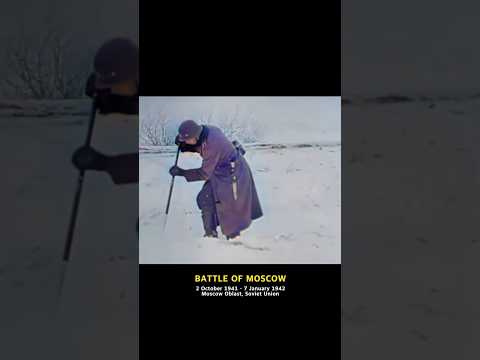
Yet the Germans pressed on. They reached the outskirts of Moscow, close enough to see the spires of the Kremlin through their binoculars. But they were not alone. The Soviet Union had not collapsed. Instead, it had rallied. Fresh divisions from Siberia, troops hardened by winter warfare, were rushed to the defense of the capital.
Moreover, it exposed the German tank armies to flanking attacks from the Soviet 49th and 50th armies located near Tula.
Tula, a key industrial city south of Moscow, had become a linchpin. The Germans needed it to secure their southern flank, but the city’s defenders held out with grim determination. The failure to take Tula further slowed the advance, stretching German supply lines to the breaking point.
As the German columns inched forward, they found themselves vulnerable. The Soviet armies near Tula, though battered, were not broken. They launched counterattacks that threatened to cut off the German spearheads. The panzer divisions, designed for rapid movement, were now bogged down in a war of attrition they could not win.
Further slowing the advance. The words were a death knell for Operation Typhoon. The German advance had stalled, and the Soviet Union was far from defeated.
But this was only the beginning. The battle for Moscow was about to enter its most brutal phase, and the German army would face a winter it was never prepared for.
The men of the German 2nd Panzer Army, led by Heinz Guderian, had been the tip of the spear. Now they were the most exposed. Guderian himself, a master of mobile warfare, understood the danger. His tanks were strung out along frozen roads, low on fuel, and their crews were beginning to suffer from the first cases of frostbite. He could not advance. He could not retreat. He could only hold.
And holding meant dying. The Soviet 49th and 50th armies, though understrength and fighting with a fraction of the supplies the Germans possessed, knew exactly where the enemy was weak. They attacked the flanks, driving wedges between the German divisions and threatening to encircle them.
One of these counterattacks, near the town of Venev, caught a German motorized division completely off guard. The Soviets, wearing white winter coats that blended with the snow, surged out of the treeline and struck the division’s supply column. Trucks burned. Fuel depots exploded. The division’s ability to fight was crippled in a single afternoon.
When news of the disaster reached Guderian’s headquarters, he had no choice but to pull back. It was a retreat that would become a rout. The panzers that had rolled so confidently toward Moscow now limped back the way they had come, leaving behind frozen corpses and burning tanks.
The Soviet commanders, sensing the turning of the tide, pressed their advantage. The 50th Army, which had been defending Tula, launched a series of relentless local offensives. They targeted the German infantry divisions that had been left to hold the flanks while the panzers had pushed ahead. These infantrymen, freezing in their summer uniforms, were in no position to resist.
The German army was now fighting for its life. The Soviet winter offensive, which had begun as a series of desperate local counterattacks, was growing into a coordinated push to drive the invaders back from the gates of the capital.
Hitler, from his headquarters far to the west, refused to allow a general withdrawal. He issued his infamous ‘stand fast’ order. The German soldiers, he commanded, were to hold every inch of ground. The man who had conquered Europe was now demanding that his men freeze to death in the Russian snow rather than give up an inch of ground.
But the winter did not care for Hitler’s orders. The temperature plunged to forty below zero. Tanks froze to the ground. Machine guns seized up. Men died at their posts, their bodies found stiff and white in the morning light. The German army was not just being defeated by the Soviets. It was being defeated by the very elements that had once seemed to promise a swift victory.
And still, the Soviet armies came. Fresh divisions from Siberia, dressed in white and equipped for the cold, poured into the line. They were not just defending Moscow anymore. They were pushing the Germans back.
The German retreat was not a clean withdrawal. It was a shambles. Roads were littered with abandoned vehicles, frozen horses, and the detritus of an army that had come within a hair’s breadth of victory and was now clawing its way back from the brink of annihilation.
Guderian, who had pleaded with Hitler to allow a retreat to a defensible winter line, was relieved of his command on Christmas Day. The man who had pioneered the blitzkrieg was sent home while his panzers froze in the snow. His replacement, a general with no illusions about the situation, found the army in a state of collapse.
The Soviet 50th Army, having held Tula against all odds, now became the hammer. It pushed north and west, driving into the gap between the retreating German armies. The 49th Army, meanwhile, struck from the east, threatening to close the pincers.
What the Soviet commanders found as they advanced was almost beyond belief. Villages that the Germans had occupied were now charred and empty. The retreating enemy had burned everything in their path—houses, barns, even the frozen bodies of their own dead, left where they had fallen. The snow was black with soot and red with blood.
And in the middle of this frozen hell, the Soviet soldiers kept moving. They had no trucks, no fuel, and barely any food. They advanced on skis and on foot, dragging their heavy guns through the drifts by hand. But they advanced.
The German soldiers they captured were a pitiful sight. Many were still wearing the thin summer tunics they had worn in July. Their boots were wrapped in rags. Some had stuffed straw into their clothing for insulation. They stared at their captors with hollow eyes, too cold and too exhausted to speak.
But the Soviet advance was not without its own costs. The Red Army was bleeding out. The divisions that had defended Moscow were shadows of their former strength. A rifle company that had begun the battle with a hundred and fifty men now counted thirty. The tanks that supported them were often obsolete models, thrown into battle because there was nothing else.
Still, they pressed on. The momentum had shifted, and the Soviet command was determined to exploit it before the Germans could dig in.
By early January, the front line had moved more than a hundred miles west of Moscow. The immediate threat to the capital was over. The German army had been pushed back, bloodied and freezing, and the myth of its invincibility had been shattered.
But the victory had come at a terrible price. The Soviet Union had lost millions of men, and the land they had liberated was a wasteland. Cities like Kalinin and Klin were ruins. The civilian population, caught between two ruthless armies, had suffered beyond imagining.
And the war was far from over. The German army, though beaten, was not destroyed. It would regroup, rebuild, and strike again. The spring would bring new offensives, new battles, and new horrors.
But for now, in the frozen fields outside Moscow, the Red Army had won something more valuable than territory. It had won time. Time to rebuild its shattered divisions. Time to move its factories east of the Urals. Time to prove to the world that the German war machine could be stopped.
The Battle of Moscow was over. The war in the East was just beginning.
The spring thaw of 1942 would reveal the true cost of the winter. In the villages west of Moscow, Soviet burial details worked for weeks, digging mass graves in the frozen ground. The bodies of German soldiers, preserved by the cold, were stacked like cordwood. Some still clutched their rifles. Others held photographs of families they would never see again.
But the Soviet soldiers who buried them did not linger. They had their own dead to honor. The Red Army had suffered nearly a million casualties in the defense of the capital. Entire divisions had been annihilated. The men who survived were hardened, silent, and ready for the next fight.
Stalin, emboldened by the victory, ordered a general offensive along the entire Eastern Front. The Red Army, still recovering from the winter battles, was ordered to push forward everywhere at once. It was a gamble that would cost them dearly in the months to come.
The Germans, though battered, were still lethal. In the spring, they would strike back at Kharkov, encircling and destroying three Soviet armies. The road to Stalingrad would open before them. The war was far from decided.
Yet something had changed. The soldiers of the Red Army who had stood in the snow outside Moscow knew it. The myth of German invincibility had been broken. The blitzkrieg, which had conquered France in six weeks, had failed to take Moscow in six months.
In Berlin, Hitler raged at his generals. He blamed the weather, the supply lines, the incompetence of his commanders. He did not blame himself. But the men who had survived the winter knew the truth. The Führer had ordered them to hold ground that could not be held, in conditions no army could endure.
The German army would never again be the force it had been in the summer of 1941. It would fight on for three more years, but the initiative had passed to the Soviets. The war in the East had become a war of attrition, and the Soviet Union had more men, more tanks, and more space to trade for time.
In Moscow, the Kremlin’s spires still stood. The city that Hitler had vowed to erase from the map was now the symbol of resistance. The people who had dug anti-tank ditches in the streets, who had endured the bombs and the cold, had saved their capital.
But the price was staggering. The Soviet Union would never fully recover from the losses of the Great Patriotic War. Twenty-seven million citizens would perish before the guns fell silent. The victory outside Moscow was only the first chapter of a tragedy that would consume a generation.
And yet, in the frozen fields where the German army had been stopped, a simple truth had been proven: the war machine could be beaten.
What do you think was the most decisive factor in stopping the German advance on Moscow—the weather, the Soviet counterattacks, or Hitler’s refusal to allow a retreat? Share your thoughts in the comments below.
Report this article
Select a reason for reporting:






