Dr. Marcus Webb had examined hundreds of antebellum photographs, but nothing prepared him for what he saw when he zoomed in on the enslaved girl at the edge of the frame. His breath caught in his throat. In her right hand, she held a folded piece of paper. In her left, a pencil. The year was 1849. In South Carolina, teaching a slave to read or write was a crime punishable by whipping, branding, or even death.
Marcus adjusted the magnifying lamp, his heart racing. The girl’s posture was rigid, her face a careful mask, but her hands—those hands—spoke volumes. She had deliberately positioned the paper and pencil for the camera to see. This was no accident. This was defiance, captured in silver and copper, hidden for over a century behind a loose brick in the basement of the Beaumont Mansion.
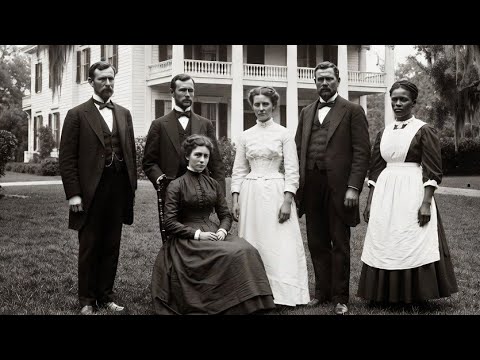
The daguerreotype had been discovered just weeks earlier, wrapped in oilcloth and tucked inside a small wooden box. The preservation society had immediately summoned Marcus, a specialist in the history of slavery. Now, as he studied the image, he realized the girl’s inclusion in the family portrait was no mere background detail. She had been positioned slightly apart, yet her presence was unmistakable. The white family—Richard Beaumont, his wife Margaret, and their three children—stood proudly before their columned mansion. But it was the girl, Hannah, who held the secret.
Marcus spent hours enhancing the digital images. The writing on the paper became clearer—lines of text in a careful, deliberate hand. She had written something, and she wanted the world to see it. But who was she? And who had taught her?
The Beaumont family papers revealed a chilling entry from June 1849: “Hannah, punishment for forbidden activity. Whipping administered, items confiscated.” Two months after the daguerreotype was taken. Marcus’s hands trembled as he read a letter from Margaret Beaumont to her sister: “We have discovered that the girl can write. Elizabeth, foolish child, has apparently been teaching Hannah her letters in secret for over a year.”
Elizabeth, the 11-year-old daughter, had defied the law to teach her servant to read the Bible. And somehow, before the discovery, they had created this photograph—a permanent record of Hannah’s literacy. But who had taken it? And why had Hannah been allowed to hold those items during the long exposure?
Marcus found the photographer’s ledger. George Cook, a prominent Charleston daguerreotypist, had noted: “Young Miss Beaumont insisted servant girl be included in frame. Unusual request, but client’s wishes accommodated.” Elizabeth had orchestrated the portrait. She had told Hannah to hold the paper and pencil. For 45 seconds, Hannah stood perfectly still, her forbidden knowledge on display for the camera.
What happened next would haunt Marcus for weeks. The punishment, the sale, the escape—it was all there in the records, waiting to be uncovered. But the daguerreotype itself was only the beginning. Hannah’s story had survived, hidden in plain sight, and it was about to change everything.
Marcus pushed back from the examination table and stared at the ceiling, letting the implications settle over him like a weight. The daguerreotype was not simply a family portrait. It was a silent act of rebellion, staged by a child who understood, perhaps better than her parents ever could, that an image could outlast any law.
But there was something else bothering him. He returned to the enhanced scan of Hannah’s hands, zooming in on the folded paper. The writing was faint, but under digital enhancement, he could make out the shapes of letters. It was not random script. It was a single word, repeated twice in careful, deliberate strokes.
He stared at it for a long moment before the realization hit him. The word was free. Hannah had not merely displayed her literacy—she had written a declaration. A promise. A prophecy.
Marcus immediately drafted an email to the preservation society, requesting access to the basement cavity where the box had been found. If Elizabeth had hidden the daguerreotype, she might have hidden other things as well. The next morning, he stood in the damp basement with a flashlight, examining the loose brick himself. The cavity was empty now, but as he ran his fingers along the interior, he felt a slight irregularity—a second recess, smaller, tucked deeper into the mortar.
Inside was a folded scrap of paper, brittle with age but intact. Marcus carried it upstairs and laid it flat on a conservation tray. The handwriting was the same as on the paper in the daguerreotype—careful, neat, practiced. It was a short note, unsigned but unmistakable.
“Miss Elizabeth says they will sell me if they find out. But I am not afraid. I know my letters now, and no one can take them from my head. If I am sold, I will write my name on every wall I pass. H.”
Marcus sat back, his throat tight. Hannah had known the risk. She had known what discovery would mean—the whip, the fields, the auction block. And still, she had held that paper and pencil for the camera. Still, she had written her defiance and hidden it where only the walls would hear.
He thought of Elizabeth, eleven years old, insisting her servant be included in the portrait. He thought of the 45 seconds of stillness, the long exposure that demanded absolute discipline. Two children had conspired against an empire, and they had won.
But the story was not finished. Marcus needed to know what happened to the note after Hannah was sent to the rice fields. Had Elizabeth found it? Had she kept it? He pulled up the digitized diary entries again, searching for any reference to a hidden note or a message from Hannah. Nothing in the early years. But in an entry from 1859, the year of the escape, Elizabeth had written something he had initially overlooked.
“I gave H the last thing I had of hers—the scrap she left in the wall when she was sent away. She wept to see it. She said it was the first thing she ever wrote that was truly her own.”
Marcus closed his laptop and looked out the window at the Charleston skyline, where the old mansions still stood and the streets still carried the weight of history. The daguerreotype had been hidden for 175 years, but the note had traveled with Hannah to freedom. She had carried her own words out of bondage.
He picked up his phone and called Grace, Hannah’s great-granddaughter. When she answered, he asked the question that had been burning in his mind since he found the scrap.
“Grace, do you still have any of Hannah’s personal papers? Anything she kept from her early years?”
There was a pause on the line. Then Grace’s voice, quiet but certain. “There’s a Bible. It came down through the family. Hannah’s Bible. There’s something tucked inside the cover—a piece of paper. We never knew what it was. It’s so old and fragile we were afraid to unfold it.”
Marcus felt the hair on his arms stand up. “Grace, I think I know what it is. And I think you need to bring it to the museum.”
The following afternoon, Grace arrived at the museum carrying a small archival box wrapped in a cloth bag. She set it on Marcus’s examination table with the reverence of someone handling a relic. “My grandmother always said this Bible was the most precious thing Hannah owned,” Grace said. “She never told us why. Now I think I understand.”
Marcus opened the box and lifted out the Bible. The leather cover was cracked and worn, the pages yellowed but intact. He turned it over gently in his gloved hands, examining the spine, the corners, the inside of the front cover. There, tucked into a small slit in the binding, was a folded piece of paper, brown with age and fragile as a dried leaf.
He used tweezers to ease it free and laid it on a sheet of acid-free tissue. Grace leaned in, her hands clasped tightly together. “Is it the same one?” she whispered.
Marcus unfolded the paper with agonizing care. The creases were deep, the edges frayed, but the handwriting was unmistakable—the same careful, deliberate script he had seen in the daguerreotype and on the scrap from the wall. It was Hannah’s note. The one Elizabeth had given her before the escape.
But there was more. On the reverse side, in the same hand but written years later, judging by the faded ink and the slightly shakier strokes, was another message. Marcus read it aloud, his voice barely above a whisper.
“To whoever finds this: I was born in slavery, but I died free. I learned my letters from a child who was brave when no one else was. I taught those letters to hundreds of children who had been told they were nothing. My name is Hannah Freeman, and I was here. I mattered. Remember that I mattered.”
Grace pressed a hand to her mouth, tears spilling down her cheeks. Marcus set down the tweezers and stepped back, giving her space. The museum’s climate-controlled air hummed softly around them, but the room felt charged, as if the past had suddenly leaned in close.
When Grace finally spoke, her voice was steady. “She wrote that for us. For all of us. She wanted to be sure we knew.”
Marcus nodded. “She knew the daguerreotype might never be found. She knew the note in the wall might crumble to dust. But this—this she could carry with her. This she could pass down.”
He thought of the exhibition, of the daguerreotype on display in its darkened room, of the schoolchildren who would come to see it and learn about the girl who held paper and pencil in defiance of the law. But the Bible and the note on its reverse changed everything. Hannah had not only survived—she had left a testament in her own hand, a message that reached across generations.
Grace carefully folded the note and placed it back inside the Bible’s cover. “What happens now?” she asked.
Marcus looked at the Bible, then at the daguerreotype case still resting on the table. “Now we add this to the exhibition. And we make sure Hannah’s own words are the first thing people see when they walk in.”
He paused, a new thought forming. “Grace, there’s something I haven’t told you yet. The daguerreotype—it’s not the only image. There’s a photographer’s ledger entry I found that mentions a second plate. Cook wrote that he made a copy for Miss Elizabeth, a smaller one, at her request. He noted it as ‘a curiosity’ and charged her half price.”
Grace’s eyes widened. “A second daguerreotype? Where is it?”
Marcus shook his head slowly. “I don’t know. But if Elizabeth kept it, it might still be with her personal effects. Her papers went to the Virginia Historical Society, but her belongings—the things she kept in her room, the things she took with her when she married—those would have passed to her children.”
He looked at Grace with renewed intensity. “Your family isn’t the only line that descends from this story. Elizabeth had grandchildren too. If that second daguerreotype survived, it could be sitting in an attic somewhere right now, waiting.”
Grace was quiet for a long moment. Then she reached into her bag and pulled out a small photograph—a portrait of Hannah from the 1880s, the same one Marcus had seen before. “My grandmother gave me this when I graduated from teachers college,” she said. “She told me Hannah would have been proud of me. I never knew why she said it like that—like Hannah was still watching.”
Marcus smiled. “Maybe she was. Maybe she still is.”
He picked up his phone and began drafting an email to the Virginia Historical Society. If Elizabeth’s belongings had been catalogued, there might be a record of a small daguerreotype. And if not—well, he had spent his career chasing fragments of the past. He wasn’t about to stop now.
The story of Hannah and Elizabeth was not finished. It was only unfolding.
Three weeks later, a reply arrived from Richmond. Elizabeth’s granddaughter had donated a box of “personal effects” in 1958—never catalogued, never opened. Marcus drove north the next morning. The box sat in a dim storage room, and his hands shook as he lifted the lid.
Inside, beneath a lace glove and a dried corsage, lay a small leather case. He opened it. There was Hannah—younger, smaller, but unmistakable—her paper and pencil held high. And on the back, in a child’s careful hand: “She learned. I taught her. God forgive us all.”
Marcus brought it home to Charleston. At the exhibition’s reopening, the two daguerreotypes hung side by side—Elizabeth’s secret and Hannah’s defiance, finally reunited after 175 years. Grace stood between them, her hand resting on her heart.
“They were just children,” she said softly. “And they changed everything.”
What would you have done, at eleven years old, with a secret that could cost a life?
Report this article
Select a reason for reporting:






