Texas, summer of 1945. A ranch hand named Jack Morrison walked into the commandant’s office at Camp Hearn with his hat in his hands and a question that would send shock waves through the War Department. He wanted to marry one of the prisoners—not a soldier, a German woman.
The commandant stared at him for a long moment, then reached for the telephone. Within hours, officers were driving in from San Antonio. By evening, men in pressed uniforms sat around a table in a sweltering administrative building, smoking Lucky Strikes and trying to figure out what in God’s name the regulations said about love.
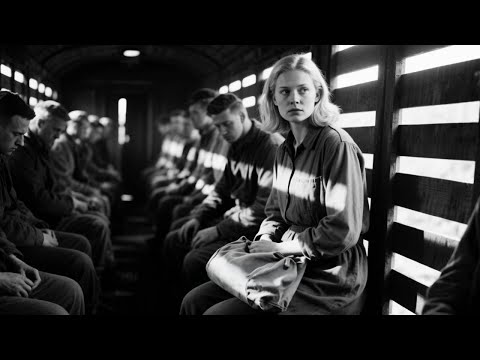
The prisoners came by rail in the spring of 1945, just as the bluebonnets turned the Texas fields into seas of purple and white. They arrived at Camp Hearn in converted cattle cars, though the army had tried to make them comfortable—wooden benches instead of standing room, water barrels at both ends. Still, the journey from the East Coast processing centers took three days.
Three days of watching America pass outside slatted windows—endless farmland, small towns with white churches, children waving from overpasses.
Anna Gerber pressed her face to the gap between boards and tried to understand this country. She was 26 years old, a native of Stuttgart, and until six months ago, she had worked as a translator for the Wehrmacht headquarters in occupied France. The Allies had captured her unit during the final push into Germany. Not fighting—she had never fired a weapon—but shuffling papers, translating documents, trying to make sense of orders that became increasingly desperate as the Reich collapsed around them.
They had told her America would be brutal. The propaganda films showed execution squads, starvation camps, cities of pure industrial ugliness where workers lived like slaves. But through the slats she saw white farmhouses with porches. She saw cattle grazing peacefully on green hills. She saw the sun set over a landscape so vast it made her dizzy.
The train slowed. Dust rose in clouds that turned gold in the late afternoon light. When the doors finally opened, heat poured in like a physical force. Anna stepped down onto Texas soil, blinking against the brightness, and saw the camp spread before her—rows of white barracks, guard towers that looked almost decorative in the gentle light. And beyond the fences, as if placed there by some cosmic joke, a working cattle ranch.
Cowboys. Real cowboys. Men in wide-brimmed hats and boots who sat on horses and watched the arrival with expressions Anna couldn’t read. One of them, a lean man with sun-darkened skin and light hair, met her eyes for just a moment before looking away.
Later, she would remember that glance—how it contained neither hatred nor pity, but something else entirely. Curiosity, perhaps. Recognition of shared humanity across an impossible divide.
Camp Hearn had been built in 1942 to house German and Italian POWs captured in North Africa, Sicily, and later in France. By 1945, it held over 4,500 prisoners on 700 acres of land leased from local ranchers. The camp sat in Robertson County, where the humid Gulf Coast met the dry Texas prairie, creating a climate that swung from pleasant springs to brutal summers in a matter of weeks.
But the women prisoners were new. The army had only recently begun transferring female POWs to American soil—and even then, in limited numbers. Most were clerks, translators, nurses—women who had worked for the Wehrmacht in administrative capacities. The Geneva Conventions were clear about treatment: no forced labor, adequate food and shelter, protection from harm. But the convention said nothing about what happened when guards and prisoners saw each other as people rather than enemies.
The camp commander, Colonel Thomas Reed, was a West Point graduate who had spent two years managing POW facilities in Texas. He was 43 years old, methodical, and deeply aware that every decision he made would be scrutinized by military lawyers in Washington. When orders came through to accept female prisoners, he spent a week preparing separate barracks, female guards where possible, strict protocols about interaction with male prisoners and civilian workers.
He had not prepared for what happened when the cowboys met the Germans.
The ranch hands worked for the Parker family, who owned 12,000 acres surrounding the camp. The Parkers had a government contract to employ POW labor for agricultural work—a common arrangement across America, where labor shortages left crops rotting in fields. The prisoners harvested cotton, repaired fences, fed livestock. In return, they received small wages deposited into accounts they could access after repatriation.
Jack Morrison had worked for the Parkers since he was 17. Now 31, he had been declared 4-F—unfit for military service due to a childhood injury that left his right leg slightly shorter than his left. He walked with a barely perceptible limp, but he could ride better than most men could walk. He knew every fence line on the Parker Ranch. He knew which horses were gentle enough for inexperienced riders and which wells ran coldest in August.
He also knew loneliness. Most of the young women in Robertson County had either left for war work in Houston or married soldiers before they shipped out. The ones who remained viewed Jack with polite disinterest. He was kind, they said. Reliable. But there was something distant about him, as if he lived slightly outside the flow of normal life.
That first evening, as the female prisoners were processed and assigned to barracks, Jack sat on a corral fence and watched. The blonde woman who had met his eyes earlier moved with careful precision, as if afraid of taking up too much space. She carried a small canvas bag—apparently her only possessions—and when a guard barked an order in English, she responded in heavily accented but grammatically perfect phrases.
“Something on your mind, Jack?” Sam Parker, the ranch owner’s son, had walked up without Jack noticing. Sam was younger, stockier, with the easy confidence of someone who had never questioned his place in the world.
“Just wondering what they think of all this,” Jack said quietly. “Coming all this way, ending up in Texas.”
Sam shrugged. “They’re Nazis, Jack. They think what they’re told to think.”
But Jack watched the blonde woman disappear into her assigned barracks, and he wasn’t so sure.
The camp settled into rhythm. Dawn brought reveille, though the German women were allowed to sleep thirty minutes later than male prisoners—a small concession that caused significant grumbling in the men’s compounds. Breakfast was served at 0700 hours in a mess hall that had been partitioned to separate male and female prisoners. The food was better than anything Anna had eaten in two years. Real eggs. Bacon that didn’t taste of sawdust. Coffee that was actually coffee.
“They’re trying to fatten us up before they shoot us,” Helga Schneider muttered in German. Helga was 42, had worked as a radio operator in Berlin, and maintained a determined cynicism about everything American.
Anna didn’t respond. She had learned in France that survival often meant keeping your thoughts private. But privately, she wondered if Helga was wrong. The guards were formal but not cruel. The food was abundant. Even the barracks, while Spartan, had real mattresses and screens on the windows to keep out mosquitoes.
By the second week, work assignments began. The female prisoners were assigned to the camp’s administrative buildings—filing, typing, basic clerical work under supervision. Anna’s English made her valuable. She translated documents, helped sort mail, occasionally assisted when German-speaking prisoners needed medical attention. But three days a week, a different detail took them outside the main camp to the Parker ranch. They worked in the vegetable gardens that supplied both the camp and the Parker household. They helped process eggs from the hen houses. Simple work, but outside—under the enormous Texas sky, with real earth under their fingernails.
Jack Morrison was assigned to supervise these details—not because he wanted the job. Sam Parker had volunteered first, but Colonel Reed specifically requested Jack. “You’re steady,” the colonel said. “You don’t rattle, and you know enough not to get friendly.”
So three mornings a week, Jack saddled his horse and rode out to meet the detail of eight women prisoners, accompanied by one armed guard and one translator. He taught them which plants were weeds and which were vegetables. He showed them how to check eggs for cracks. He maintained professional distance—and tried not to notice when the blonde woman, Anna, he learned her name was Anna, asked intelligent questions in her careful English.
“This plant—it is growing wild, or you are planting?”
“Wild,” Jack said, not quite meeting her eyes. “Pigweed chokes out everything else if you let it.”
“In Germany, we have also this problem. Different plant, same—” She gestured, searching for the word. “Same principle.”
“Yes. Principle.” She smiled briefly, as if pleased to have learned a new word, then returned to weeding.
The heat intensified as May became June. Temperatures climbed past 100 by noon, turning the earth hard as concrete and the air thick enough to taste. Jack made sure the women took frequent water breaks, moving them to shade during the worst hours. The guard, a corporal named Davis who was counting days until discharge, appreciated this. He spent most of his supervision time sitting under a cottonwood tree, rifle across his lap, occasionally glancing up to make sure no one had escaped into the endless prairie.
“You could run,” Jack said one day, surprising himself by speaking directly to Anna. They were checking the irrigation system, walking along a fence line out of Davis’s earshot. Nothing but open country for twenty miles. “By the time anyone noticed, you’d have a good head start.”
Anna looked at him with those steady gray eyes. “Run where? I am German woman in Texas. I speak with accent. I have no money, no papers. And where would I go? Germany is destroyed. My family is—” She shook her head. “Here I am safe. I am fed. Running would be stupid.”
“Smart,” Jack said.
“What?”
“You’re smart to see that.”
She studied him for a moment. “You are also smart. You do not treat us like enemies.”
“War is over,” Jack said quietly. “Or near enough. Seems foolish to keep hating just because someone tells you to.”
That evening, Anna wrote in the small journal the Red Cross had given her at processing—one of few possessions the prisoners were allowed, a way to maintain mental health, the army psychologist said. She wrote in German, careful script: The cowboy—his name is Jack Morrison—spoke to me today like a person. Not an enemy, not even a prisoner. Just a person. I had forgotten what that felt like.
Anna sat in Colonel Reed’s office, hands folded in her lap, processing information that seemed impossible. “He barely knows me,” she said finally.
Reed leaned back. “He knows enough to risk everything. Question is—do you feel the same?”
She thought of the wooden bird under her pillow, the ice water, the way Jack spoke to her like a person. “Tell him yes,” she whispered. “Tell him I will wait.”
The War Department approved the marriage on November 19, 1945—conditional, supervised, a bureaucratic miracle. Anna’s repatriation was suspended. Background checks began.
They married the following spring in the camp chapel. Jack wore his funeral suit. Anna carried the wooden bird in her pocket. Chaplain Morrison presided. Colonel Reed stood witness. Helga cried despite herself.
Outside, bluebonnets returned to the Texas fields—seas of purple and white, endless as hope.
What would you have done, in Jack’s boots or Anna’s?
Report this article
Select a reason for reporting:






