They robbed banks in broad daylight, derailed trains, broke out of prisons, and somehow convinced half the country to root for them while they did it. Jesse James, Billy the Kid, Bonnie and Clyde, John Dillinger—these were the outlaws who terrorized Americans for nearly a century, leaving behind a trail of stolen cash, dead lawmen, and legends so thick we’re still arguing about what’s true and what’s myth more than a hundred years later.
But how did these men and women become such powerful figures in American culture? To understand that, you have to understand the world that created them—a time of staggering contradiction, where the telegraph and railroad pushed civilization westward at breakneck speed, yet beyond city limits there was often no real law at all.
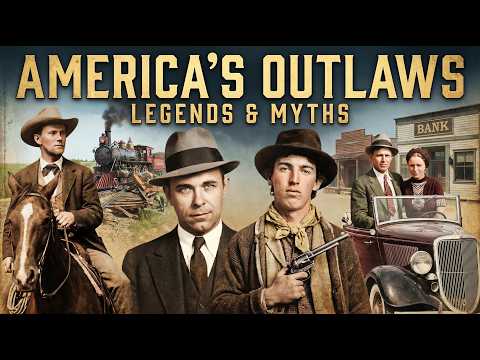
It was a vacuum where criminal gangs thrived. They robbed steam trains, hit banks, rustled cattle, and killed anyone who got in their way—including more than a few lawmen. Whether these outlaws were morally bankrupt or misunderstood rebels depends entirely on who’s telling the story. But one thing is certain: they became the defining figures of an entire era.
So let’s start with the biggest name of them all: Jesse Woodson James. Born on September 5, 1847, in Clay County, Missouri, his father was a Baptist minister who died during the California Gold Rush when Jesse was just three years old. During the Civil War, Jesse and his brother Frank rode with Confederate guerrillas under two of the most feared commanders on either side of that conflict—William Quantrill, whose raiders were known for their brutality across the Missouri-Kansas border, and “Bloody Bill” Anderson, a man so violent even other guerrillas were unnerved by him. In 1864, Jesse and Frank were accused of committing atrocities during the Centralia Massacre.
When the war ended, the James brothers didn’t exactly settle quietly into civilian life. On February 13, 1866—Valentine’s Day Eve—Jesse, Frank, and eight other men robbed a bank in Liberty, Missouri, and walked away with $57,000. That was the first daylight bank robbery in United States history, and they were just getting started. Over the next decade and a half, the James-Younger Gang pulled off more than 20 bank and train robberies, committed countless murders, and stole roughly $200,000. The Pinkerton Detective Agency—the most elite private law enforcement outfit in the country—couldn’t catch him. For over 10 years, the gang ran circles around every lawman and detective who came after them.
And that’s where the mythmaking kicked into overdrive. A newspaper editor named John Newman Edwards, who was campaigning to return former Confederates to power in Missouri, started writing about Jesse James as a Robin Hood figure—a man who stole from the wealthy Yankee banks and gave to the poor Southern farmers. It made for a terrific story. The only problem? There’s zero evidence Jesse ever shared a dime of his stolen money with anyone. The gang’s crimes hurt common folks just as much as the rich. A little girl was shot in the leg during a botched robbery at the Kansas City Fair. A train engineer was killed when the gang derailed his locomotive. Dozens of innocent bystanders got caught in the crossfire. The Robin Hood image was pure fiction.
The beginning of the end came on September 7, 1876, when the James-Younger Gang tried to rob the First National Bank in Northfield, Minnesota. It was a disaster. The townspeople fought back, and of the $12,000 sitting in that vault, the robbers grabbed exactly $26. Several gang members were killed or captured. Jesse kept going, but his circle was shrinking. In 1881, the governor of Missouri posted a $10,000 reward for the capture of Jesse or Frank James. That bounty proved irresistible to Robert Ford, a new gang member who wanted the money and the fame. On April 3, 1882, Ford shot Jesse in the back of the head while Jesse stood on a chair adjusting a picture frame. The outlaw was 34 years old.
The aftermath was almost stranger than life itself. Bob Ford toured the country like a stage show, reenacting the killing, and audiences despised him for it. Jesse’s mother started charging tourists a quarter for pebbles from her son’s grave. Rumors spread for decades that Jesse had faked his own death. It wasn’t until 1995 that scientists exhumed the body and used DNA to confirm that it was indeed Jesse James buried in that grave.
Now, let’s head to the New Mexico Territory and talk about the kid who became the most filmed individual in movie history: Billy the Kid. Born Henry McCarty in 1859, he later called himself William H. Bonney. He’s been portrayed in more motion pictures than any other single person ever, and the real Billy was nothing like most of his portrayals. He was slim, charming, fluent in Spanish, and popular with the locals. He avoided drinking and smoking but loved singing, dancing, and gambling—especially cards. He was known to use sleight of hand while dealing monte. His first run-in with the law was getting arrested at age 16 for stealing food. He escaped that jail by shimmying up a chimney. Already you can see the pattern forming, right?
Billy’s real troubles began with the Lincoln County War in 1878. His employer, a rancher named John Tunstall, was murdered by men allied with a rival faction, and Billy snapped. He joined a group of vigilantes called the Regulators, and on April 1, 1878, they ambushed and killed Sheriff William Brady right on the street. The war climaxed in a five-day battle in Lincoln that July. The legend says Billy killed 21 men, one for each year of his life. The truth is closer to four men he killed personally, with a hand in dispatching five others. Still plenty dead, but a far cry from the myth.
In December 1880, Sheriff Pat Garrett captured Billy. He was convicted of murder and sentenced to hang. But on April 28, 1881, Billy wrestled a gun away from one of his guards, shot both deputies dead, and walked out of that jail. The escape only deepened his legend, and it also sealed his fate. Garrett tracked him down and on July 14, 1881, shot him dead in Fort Sumner, New Mexico.
Before we leave the Wild West, there’s one more figure worth naming: Belle Starr, dubbed the “Bandit Queen” by the newspapers of her day. Starr ran with outlaw gangs across Indian Territory in the 1880s, harbored rustlers and bandits, and became one of the few women of the era to earn her own wanted poster. She’s often overlooked in favor of the male outlaws, but she belongs in this conversation—a direct link between the Jesse James era and the outlaw women who would follow.
Now, let’s jump forward about 50 years to the Great Depression, because that’s where a different breed of outlaw captured Americans’ attention. Bonnie Elizabeth Parker was born on October 1, 1910, in Rowena, Texas. She stood 4’11” tall, weighed 90 pounds, and had strawberry blonde curls. Clyde Barrow was born March 24, 1909, in Ellis County. They met in January 1930 when Bonnie was 19 and still married to an imprisoned murderer. Clyde was 21. Over the next two years, the Barrow Gang robbed gas stations, restaurants, and small-town banks across Texas, Oklahoma, New Mexico, and Missouri. Their biggest single haul was about $1,900—roughly $39,000 in today’s money. They likely never netted more than $1,500 from any one job. These weren’t criminal masterminds pulling off sophisticated heists; they were desperate, violent, and constantly on the run. During the 21-month crime spree, members of the gang were responsible for 12 murders, most of them law enforcement officers.
But here’s something that often gets lost in the retelling: by the time of her death, there were no outstanding warrants for Bonnie Parker alleging murder. There’s actually very little reliable evidence she ever shot anyone. It didn’t matter. Texas Ranger Frank Hamer was on the trail. And on May 23, 1934, a team of officers set up an ambush on a rural road near Sailes, Louisiana. They opened fire, and Bonnie and Clyde died in a hail of bullets. Tens of thousands of people lined up to view their bodies at separate funeral homes.
And then there’s John Dillinger, born June 22, 1903. Dillinger became the most wanted man in America during a crime spree that lasted barely 13 months—from June 1933 to July 1934. In that time, his gang robbed 24 banks and four police stations, and he escaped from prison twice. The most famous escape involved a fake gun he reportedly carved from a piece of wood shelving using a razor, then darkened it with shoe polish. He used it to bluff his way past guards and walked right out the front door. J. Edgar Hoover labeled Dillinger “Public Enemy Number One.”
It took a tip from Anna Sage, a Romanian-born brothel madam facing deportation, to finally bring him down. She agreed to accompany him to the movies and wear a distinctive outfit so agents could spot him. She became known as the “Woman in Red,” even though she was actually wearing an orange skirt that night. On July 22, 1934, FBI agents shot Dillinger dead outside the Biograph Theater in Chicago. An estimated 15,000 people filed past his body at the Cook County Morgue over the next day and a half, and his gravestone has been replaced multiple times because visitors kept chipping off pieces as souvenirs.
Now, we can’t talk about American outlaws without heading back west one more time for Butch Cassidy and the Sundance Kid. Robert Leroy Parker, born April 13, 1866, took the name Cassidy in honor of his mentor, a cowboy named Mike Cassidy. The “Butch” part came from a friend named Matt Warner who thought it was hilarious that the future outlaw once worked at a butcher shop in Rock Springs while trying to lay low. Henry Longabaugh earned the name “Sundance Kid” after a stint in Sundance, Wyoming. Together they led a gang called the Wild Bunch that included some colorful characters: Harvey “Kid Curry” Logan, Ben “the Tall Texan” Kilpatrick, and a woman named Laura Bullion, who after serving prison time lived quietly as a seamstress in Memphis, Tennessee, until 1961. She was the last surviving member of the Wild Bunch.
When the law pressed in too close, the gang retreated to their famous hideout at Hole-in-the-Wall, a remote canyon in Johnson County, Wyoming, so rugged and isolated that posses rarely dared follow them in. The gang’s robberies were significantly more profitable than most. They hit the San Miguel Valley Bank in Telluride for $20,000. A Union Pacific train near Wilcox, Wyoming, in June 1899 yielded somewhere between $30,000 and $60,000. Another train near Tipton in August 1900 brought in about $55,000. And near Wagner, Montana, in July 1901, they took an estimated $40,000—close to $1.2 million in today’s money. With “Wanted Dead or Alive” posters plastered across the country and rewards climbing as high as $30,000, Butch and Sundance made a decision most outlaws never consider: they left. In early 1901, Cassidy, Longabaugh, and Sundance’s girlfriend Etta Place sailed to Argentina and set up a ranch in Patagonia. For a while, it seemed like they pulled off the ultimate escape. But old habits die hard. On November 7, 1908, two men believed to be Butch and Sundance were killed in a shootout with Bolivian soldiers. Or were they? Members of Cassidy’s own family always insisted he survived and came home. In 1991, forensic anthropologists tried to find and test remains in Bolivia. They found nothing that matched DNA from living relatives of either man. So we’re left where we started: with a mystery that may never be solved.
And I’d be doing you wrong if I didn’t mention the Dalton Gang—the Dalton brothers: Grat, Bob, Bill, and Emmett. They started out as lawmen. Their older brother, Frank, was a federal deputy marshal who was killed by whiskey runners in 1887, and their surviving brothers pinned on badges in his honor. But somewhere along the way, they crossed to the other side of the law. By 1890, they had formed their own gang. Bob Dalton reportedly declared the gang would beat anything Jesse James ever did by robbing two banks at once in broad daylight. On October 5, 1892, they tried exactly that in Coffeyville, Kansas. It was a bloodbath. Grat and Bob Dalton were killed. Two other gang members were killed. Four townspeople died defending their city. Only Emmett survived, riddled with bullets. He was sentenced to life in prison, served 14 and a half years as a model prisoner, received a pardon, and then—in a twist no screenwriter would dare invent—moved to Los Angeles, got into real estate, wrote two books about his outlaw days, and even acted in a few movies.
So what ties all these stories together? Every single one of these outlaws lived fast, died young or spent years in prison, and left behind a legend that grew far larger than the truth. Jesse James never gave a penny to the poor. Billy the Kid killed four men, not 21. Bonnie Parker may have never fired a shot. And Butch Cassidy might have died peacefully in his bed somewhere in the American West decades after the history books said he was gone. We love these stories because they tap into something deep in the American spirit—that restless, defiant streak that says the rules don’t apply if the rules aren’t fair. But the people who actually lived through those times—the bank tellers, the train passengers, the small-town sheriffs—they didn’t see Robin Hoods. They saw danger, and they saw death. The truth, as always, is somewhere in the middle, between the legend and the grave.
So the next time you see a wanted poster reprinted on a coffee mug or a T-shirt, remember what it really represents: a century of violence dressed up as rebellion, sold to us by newspapers that needed heroes and audiences that needed escape.
Jesse James was shot in the back by a man who wanted the reward. Billy the Kid died in the dark, asking “¿Quién es?”—”Who is it?”—before the bullet found him. There was no glory in any of it, only the cold arithmetic of the grave.
But the myth refuses to die, because we keep feeding it. Every generation gets the outlaws it deserves—and the ones it invents.
So here’s my question for you: if the legends are mostly lies, why do we still root for them? Which outlaw do you think got the most undeserved reputation—and which one was actually worse than the stories admit? Tell me in the comments below.
Report this article
Select a reason for reporting:






