On June 17, 1930, Herbert Hoover sat at his desk in the White House and signed a law that would reach into the pockets of farmers in Kansas, dock workers in Hamburg, watchmakers in Geneva, and sugar growers in Cuba. The law touched over 20,000 imported products—eggs, timber, wool, pig iron, wristwatches, cheese, cotton rags, pencils, automobiles—almost anything you could ship across an ocean or roll across a border. It was pitched as a shield for the American worker, a wall to keep foreign goods out and American jobs in. On paper, it was called the Tariff Act of 1930. In history books, it carries the names of the two men who shoved it through Congress: Senator Reed Smoot of Utah and Representative Willis C. Hawley of Oregon.
For nearly a century, economists have argued about exactly how much damage this one law caused, but almost no serious scholar denies this: Smoot-Hawley turned a bad recession into a global disaster. It triggered a trade war that cut world commerce by more than half within four years. It helped unleash a banking crisis in Europe that would eventually drag Germany into the arms of Adolf Hitler. And it ruined the political careers of nearly every man who touched it. The man who signed it, the senator whose name was on it, the congressman whose name was on it—all three were out of office or out of power within 30 months of the ink drying. So the question that still haunts the ghosts of 1930 is this: 20,000 products taxed, one country’s bet. Who actually paid the price?
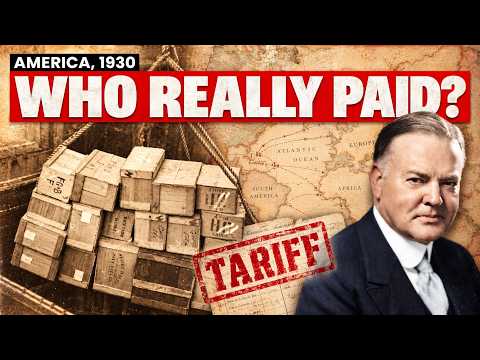
To understand how the United States ended up setting fire to its own trading system, you have to understand how desperate the American farmer felt as the Roaring Twenties roared past him. Everyone else seemed to be getting rich. Industrial workers were buying automobiles. Office clerks were buying radios. Wall Street was minting new millionaires every week. But out in the Midwest, in the cotton fields of the South, in the wheat belts of Kansas and the Dakotas, something else was happening entirely.
During the First World War, European farms had been torn apart by trenches, artillery, and conscription. American farmers rushed to fill the gap. They borrowed heavily to buy more land, more tractors, more seed. They plowed under grasslands that had never seen a steel blade. And for a few golden years, the money rolled in. Grain prices climbed, beef prices climbed, cotton climbed. Then the war ended, and so did the party. European farms came back online. American farmers now had enormous mortgages, enormous machines, and enormous surpluses they could not sell for a profit. Through the 1920s, farm prices sagged while urban prices stayed high. Across the countryside, mortgage foreclosures were becoming an epidemic years before the stock market crash made the word depression fashionable.
Washington noticed. In fact, Washington had been trying to help the farmer for a decade, mostly through a tool it understood very well: the tariff. The Fordney-McCumber Tariff of 1922 had already raised duties on dozens of agricultural imports, but it clearly had not been enough. By the end of the decade, both political parties were in a bidding war to protect the American farmer harder than the other guy.
Enter Herbert Hoover. In 1928, the Republican candidate for the White House was a mining engineer by training, a wartime food administrator by reputation, and a self-made millionaire by his own effort. He was also running against a Catholic from New York named Al Smith in an election that split along cultural, religious, and economic lines. Hoover needed to lock down the rural vote. He needed the farm states. So on the campaign trail, Hoover made a promise. He would call a special session of Congress. He would ask lawmakers to raise tariffs on imported farm products. He would protect the beleaguered American farmer from cheap foreign wheat, and cheap foreign wool, and cheap foreign sugar. It sounded clean. It sounded limited. A targeted intervention, a surgical adjustment of a few agricultural duty rates to lift the ailing farm belt out of the mud.
Hoover won the election in a landslide. He kept his promise. He called Congress into special session in April 1929 for the specific purpose of revising the farm tariff. And that was the moment the surgical knife was handed to the butchers. Because once Congress opened the tariff schedule for revision, every industry in the United States showed up with a lobbyist and a list. The textile mills of New England wanted protection. The steel makers of Pittsburgh wanted protection. The glove makers of Upstate New York wanted protection. The sugar beet farmers of Reed Smoot’s Utah wanted protection. The wool growers of Willis Hawley’s Oregon wanted protection. Every chamber of commerce, every trade association, every manufacturer, every grower seemed to arrive on Capitol Hill with the same message: Shield me from the foreigner and I will prosper. Shield me and I will hire. Shield me and America will rise again.
The House Ways and Means Committee, chaired by Willis Hawley, held 43 days and five nights of hearings beginning in January 1929. Hundreds of witnesses paraded through. The record ran to many thousands of printed pages. By the time the committees were done, what had started as a narrow farm bill had bloated into a monster that touched the duty rates on more than 20,000 different imported items. The House passed its version on May 28, 1929, by a vote of 264 to 147. Then the bill crossed the Capitol to the Senate Finance Committee, chaired by Reed Smoot, where things got even wilder. The Senate’s final bill contained something in the neighborhood of 1,253 changes from the House version. Senators quietly traded votes with each other, promising to support duties on this industry in Pennsylvania in exchange for duties on that crop in Montana. Protection for sugar beets, protection for maple syrup, protection for cherries, protection for leather, protection for violin strings.
While the lobbyists piled their paperwork in Congress, the economists of America were watching with growing horror. In the spring of 1930, as the Smoot-Hawley bill crawled toward a final vote, a group of distinguished economists decided to do something unprecedented in American academic life. They were going to speak with one voice. Paul H. Douglas of the University of Chicago, Irving Fisher of Yale, Frank Taussig of Harvard, Clair Wilcox of Swarthmore, and James T. Shotwell of Columbia drafted a letter. They sent it out to colleagues across the country. The response was overwhelming. By May 1930, the petition carried 1,028 signatures from economists at virtually every major university in the United States. The final count would eventually climb past 1,250.
The language of that petition is worth lingering on because almost every warning it contains would come true within three years. The economists wrote that higher tariffs would raise prices for domestic consumers. They wrote that construction workers, transportation workers, utility workers, bank clerks, hotel workers, retail employees—anyone whose job did not depend on protected goods—would lose because they would pay more for everything they bought. They wrote that farmers would be hit twice: once as consumers paying more for the textiles and chemicals and iron tools they needed, and once as producers watching their export markets dry up as foreign countries retaliated. The petition closed with a warning that would echo for the rest of the century: A tariff war does not furnish good soil for the growth of world peace.
What makes the petition remarkable in retrospect is not just the number of signatures. It is the unity. These were economists who, within a few short years, would be at each other’s throats over monetary policy, over deficit spending, over the proper role of big business in American life. They agreed on almost nothing. They agreed on this: the Smoot-Hawley bill, in their shared professional judgment, was reckless and dangerous.
The warning from the academic world was echoed, perhaps even more desperately, from the top floors of Wall Street. Thomas W. Lamont was a senior partner at J.P. Morgan & Company, one of the most powerful bankers in the world. He saw the retaliation coming. He understood that American industry—the real industry, the heavy industry, the steel and the cars and the chemicals—depended on global markets just as much as the farmer did. If the world closed its doors to American goods, Lamont knew, the depression that had begun in 1929 would curdle into something far worse. Lamont lobbied Hoover personally. He later recounted that he almost went down on his knees to beg Herbert Hoover to veto the asinine Hawley-Smoot tariff.
He was not alone. Henry Ford, by then one of the most famous industrialists on the planet, reportedly spent an evening at the White House denouncing the bill as an economic stupidity. Alfred P. Sloan, the chairman of General Motors, warned that the auto industry, then the fastest-growing manufacturing sector in the world, needed foreign markets to survive. Even bankers who normally stayed as far away from Washington as possible were quietly cabling the White House to urge caution. Business leaders, academics, newspaper editors, and foreign diplomats were all pulling in the same direction: Do not sign this bill.
But Hoover had made a political calculation. He had come into office on the back of a tariff promise. He had Republican majorities in Congress who wanted the bill badly. He had farm state senators who had been promised protection and who were not going to accept being told the economists knew better. If Hoover vetoed the bill, he would split his own party at the start of what everyone already understood was going to be a difficult term.
So on June 16, 1930, Herbert Hoover issued a public statement declaring that he would sign the bill. In that statement, he leaned on numbers from the Tariff Commission to downplay the increase. The average duty collected on all imports, free and dutiable combined, would rise only from about 13.8% to about 16.0%, he explained. He described the revision as moderate. He described it as responsible. He signed the bill into law the next day, on June 17, 1930.
The numbers Hoover quoted hid the real story. If you looked only at the goods that were actually taxed—the dutiable imports—the average rate jumped from 40.1% in 1929 to 59.1% at its peak in 1932. On some categories, duties doubled or tripled. The tariff on imported eggs went from 8 cents a dozen to 10 cents. The tariff on wristwatches climbed sharply. The tariff on cheese, pig iron, cotton rags, wool, and countless small manufactured items climbed, in some cases by brutal margins.
The world responded almost immediately, and often with venom. Canada moved first and moved hardest. Even before Hoover’s signature was dry, Ottawa raised duties on 16 categories of American goods accounting for roughly 30% of US exports north of the border. Then it slashed tariffs on British Empire goods—pivoting away from its southern neighbor in a single stroke.
Italy more than doubled duties on American automobiles. France imposed quotas so restrictive that US goods were frozen out. Spain, Switzerland, Germany, and Britain followed, and by 1932 London had abandoned a century of free trade to build an Imperial Preference bloc that explicitly excluded American products.
Global trade did not slow. It collapsed. Between 1929 and 1934, world commerce fell by roughly two-thirds. American exports dropped from $5.24 billion to $1.67 billion—a 68% plunge in four years. Farm exports alone fell nearly two-thirds, and the farmer who had been promised salvation got foreclosure instead.
The industrial worker fared no better. US iron and steel exports to Canada fell 85.5% by 1932. Detroit watched its European orders evaporate. By 1933, unemployment had climbed toward 23%. Then Vienna’s Credit Anstalt failed in May 1931, and the panic swept through Germany, Britain, and 1,860 American banks.
The political price arrived on schedule. Hoover carried just six states in 1932. Smoot lost his Senate seat; Hawley lost his primary. The men who drafted the tariff lost their own jobs.
So who paid? The farmer, the auto worker, the housewife, the Austrian depositor, the German family drifting toward a demagogue. The wall was never paid for by those on the other side—it was paid by those inside who built it.
Nearly a century later, in 2018, more than 1,100 economists sent a letter almost word-for-word identical to the 1930 petition. It was ignored too. The mechanics of a tariff are physics, not politics. They do not care who signs the bill.
Which country’s retaliation surprised you the most—and do you think we have truly learned the lesson of 1930?
Report this article
Select a reason for reporting:






