Imagine inheriting $50 million in 1873—a sum equal to $1.3 billion today. You could buy entire city blocks, fund private armies, and never touch the principal. Yet within a single decade, 85% of America’s wealthiest families lost it all. Not through wars or revolutions, but through the quiet machinery of economic collapse and the fatal hubris of men who believed their empires were immortal.
This is the story of how American aristocracy devoured itself from within.
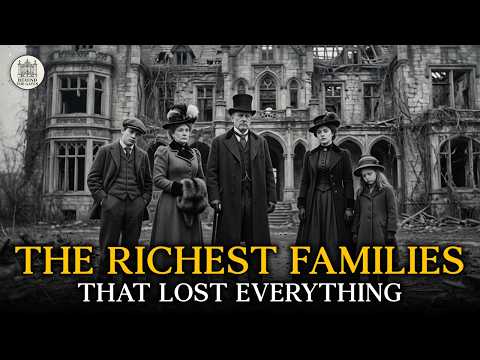
By 1870, America’s 50 richest families controlled more wealth than the bottom 45% of the nation combined. Cornelius Vanderbilt alone commanded $90 million—more than most state budgets. His railroad empire stretched 1,700 miles, every ticket and freight car feeding his coffers. He was 76 and still expanding.
August Belmont’s Fifth Avenue mansion held $2 million in European art—just the paintings, not the house. His estate employed 43 servants to maintain effortless luxury. The Astors owned 14,000 acres of Manhattan real estate, land bought when it was farmland and now the most valuable urban property in the Western Hemisphere.
These men had conquered more than business. They had conquered the concept of limitation. When Vanderbilt wanted a railroad, he built one. When Jay Gould wanted a telegraph network, he bought Western Union outright. When J.P. Morgan needed to stabilize the gold market, he arranged a private loan to the U.S. Treasury. The federal government borrowed from him. Capital commanded nations, not the reverse.
They built monuments to permanence. William Backhouse Astor commissioned a mansion that took two years just to quarry the marble. The Vanderbilts planned estates for 10 generations. These were not homes—they were dynasties made visible. Architecture as genealogy.
The assumption was implicit: this wealth would persist because it always had, because it was too large to fail, because the men who built it were too brilliant to be undone.
But concentration creates vulnerability. When 50 families control that much wealth, they depend on the same systems, the same markets, the same illusions. They all held railroad stocks. They all speculated in Western land. They all borrowed against future growth that seemed infinite. The economy was a ladder they had climbed together, and none looked down to see how far the ground had receded.
The psychological transformation was complete. These men no longer saw themselves as participants in an economy. They saw themselves as the economy itself. Vanderbilt once told a reporter he could buy any senator for $5,000 and any governor for $20,000. He was not boasting—he was stating prices. Power had become a commodity, and they controlled the supply.
What they failed to understand was that markets do not distinguish between confidence and delusion. The same mechanisms that built their empires could dismantle them. The same speculation that generated returns could generate catastrophic losses. They had mistaken a rising tide for personal genius, and when the tide turned, it would turn on everyone simultaneously.
By 1872, the American economy was a coiled spring. Railroad expansion had consumed $17 billion in investment, much of it borrowed from European banks at interest rates sustainable only if growth continued forever. 5,000 banks held deposits backed by railroad bonds that would become worthless if a single major line collapsed. The entire system rested on perpetual expansion into western territories that were running out of west.
The emperors threw parties. They commissioned portraits. They endowed universities with their names. And they never once considered that the ground beneath them was not bedrock, but sand—and that sand was already beginning to shift.
The first tremor came from a man nobody had thought to fear. Jay Cooke was not a speculator or a con artist. He was the most respected banker in America, the man who had financed the Union victory by selling $600 million in government bonds directly to ordinary citizens. He had made patriotism profitable and saved the Republic in the process. His reputation was unimpeachable—which made his failure all the more catastrophic.
Cooke’s bank had invested everything in the Northern Pacific Railway, a transcontinental line designed to open the Pacific Northwest to settlement and commerce. The project was sound in theory. The execution was ruinous. Construction costs exploded beyond every projection. European investors, burned by previous American railroad failures, refused to buy additional bonds. By September 1873, Cooke’s bank was insolvent.
On the morning of September 18th, it closed its doors.
The market reacted like a body going into shock. If Jay Cooke could fail, anyone could fail. Every bank, every railroad, every fortune built on credit became suspect. Within hours, depositors lined up outside banks demanding their money in cash. By the end of the day, the New York Stock Exchange had closed for the first time in its history. It would remain closed for 10 days—a desperate attempt to stop the hemorrhaging.
But closing the exchange only delayed the reckoning. When it reopened, the selling was relentless. Railroad stocks lost half their value in the first week. Banks that had loaned against those stocks now faced insolvency themselves. The panic spread from New York to Philadelphia to Chicago, a contagion of fear that moved faster than the railroads that had caused it.
Within two years, 18,000 businesses had declared bankruptcy. 5,000 banks failed outright, wiping out the savings of millions. Unemployment reached 14% nationally, higher in industrial cities. Factories closed. Railroads stopped construction mid-track, leaving half-built bridges rusting in fields. The entire apparatus of American growth ground to a halt.
The millionaires suffered in ways unthinkable a year earlier. Henry Clews, one of Wall Street’s most prominent brokers, lost his entire firm. He had been worth $3 million. By 1874, he was borrowing money for rent. The Drexel family banking house survived, but only by liquidating nearly all its investments at catastrophic losses. Fortunes that had taken decades to build evaporated in weeks.
What made the Panic of 1873 uniquely destructive was its duration. This was not a brief correction followed by recovery. The depression lasted six years—six years of deflation, unemployment, and stagnation. Companies that survived did so by slashing wages, which reduced consumer spending, which caused more businesses to fail. The economy spiraled downward in a deflationary loop that classical economics had no tools to combat.
For the Gilded Age dynasties, the panic was a revelation they refused to accept. Their wealth was not invincible. Markets could destroy fortunes as efficiently as they created them. And yet the lesson did not penetrate. Those who survived convinced themselves they had been smarter, more disciplined, better positioned. They did not understand that survival was often luck, not skill.
The truly dangerous assumption was that the next panic would be different—that they would see it coming, that their empires were now too established to fail. The ground had shifted beneath them once. It would shift again. But first, there would be two decades of recovery, of renewed speculation, of even greater hubris. The empires would grow larger, the mansions more extravagant, the confidence more absolute.
And when the next collapse came, it would make 1873 look like a rehearsal.
Cornelius Vanderbilt left 95% of his $90 million fortune to a single son. That decision, made in 1877, planted the seed of dynastic destruction. William Henry Vanderbilt inherited an empire overnight—more liquid wealth than most European monarchs—and he knew his own sons were even less prepared than he had been.
For decades, Cornelius had dismissed William as weak, unsuitable for leadership. Now William held the entire dynasty in his hands. He doubled the fortune to $194 million in nine years through careful management and strategic expansion. But he also understood human nature. And what he saw in his children horrified him.
Cornelius II was competent but conventional. William K. was charming but careless. Frederick was sickly. George was artistic. None of them possessed the ruthless instinct that had built the original fortune. They had been raised in luxury, educated in Europe, trained for society rather than struggle. They knew how to spend money. They did not know how to protect it.
The spending began before William was even buried. Cornelius II commissioned the largest private home in New York City—a six-story mansion on Fifth Avenue that required 400 workers and two years to complete. The Breakers in Newport cost $7 million to build, a summer cottage used three months per year. It contained 70 rooms, gilded ceilings imported from Italy, and a heating system that consumed more coal in a season than most factories used in a year.
The house was not designed for living. It was designed for display. A monument to wealth so excessive it became its own justification.
William K. Vanderbilt went further. His wife, Alva, demanded Marble House, a 50-room palace in Newport that cost $11 million—equivalent to $330 million today. The house required 40 full-time servants just to maintain. The ballroom could host 400 guests. The stables were faced with marble. Horses lived in quarters nicer than most American families.
Alva had not come from old money, and she spent new money with the fervor of someone determined to prove her arrival. But the real hemorrhaging was invisible. The mansions were fixed costs. The true drain was the lifestyle they represented. Each estate required staff, maintenance, property taxes, and constant renovation to match the escalating standards of Gilded Age excess.
The Vanderbilts were not spending income. They were spending capital—liquidating railroad stocks and industrial holdings to fund consumption that generated no return. Each dollar spent was a dollar that could never compound again.
George Vanderbilt represented the final evolution of dynastic decay. He built Biltmore Estate in North Carolina, a 250-room chateau that required $6 million and six years to construct. It was the largest private home in American history—a monument to aristocratic ambition on a continent that had no aristocracy. The estate employed hundreds. It generated nothing. George filled it with art and books, creating a cultivated sanctuary that existed purely for his own aesthetic satisfaction. It was magnificent and ruinous—beauty subsidized by capital erosion.
The mathematics were inevitable. William Henry Vanderbilt’s $194 million fortune was divided among his children. Each heir received roughly $30 million—already a dilution. Then those heirs divided their shares among their children. By the third generation, individual inheritances were measured in single millions—substantial but no longer dynastic. And each generation spent faster than the last, confusing the monument for the foundation, mistaking inheritance for achievement.
What William Henry understood, but could not prevent, was the second son’s curse. The man who builds the fortune possesses skills the fortune cannot teach. He knows scarcity, risk, failure. His children know only abundance. They see the empire as permanent because it has always existed in their lifetime. They spend freely because they have never known constraint. And their children—the third generation—inherit expectations without the resources to sustain them.
They are aristocrats by training, but middle-class by math—a displacement that destroys identity and fortune simultaneously.
The Vanderbilt dynasty lasted three generations from apex to irrelevance. Cornelius built it in 60 years. His grandchildren dismantled it in 40. The mansions stand today as museums—monuments not to success, but to the impossibility of transferring hunger across generations. You cannot inherit the instinct that created wealth. You can only inherit the wealth itself. And wealth without instinct is wealth on a timer, counting down to the day the last heir realizes the money is gone, and they possess no skills to replenish it.
But the Vanderbilt story was only the most visible crack in the edifice. Across the city, other dynasties were discovering that their own foundations were equally fragile.
The Astors watched their rental income collapse as tenants fled the depression. The Belmonts liquidated their art collection piece by piece. Every family discovered the same truth: their fortunes were not fortresses but sandcastles, and the tide was rising.
By 1940, the National Bureau of Economic Research delivered its verdict. Of the top 50 families of 1870, only three remained in the top 100. Three out of fifty. The American aristocratic experiment had failed completely.
Economic panics erased over-leveraged fortunes. Progressive taxation prevented accumulation. Generational decay eroded the discipline required to maintain wealth. Any one force might have been survivable. All three together were fatal.
The mansions stand today as museums, teaching millions about the dangers of excess. The palaces outlived their kings—that was never the plan.
What fortune would you build differently, knowing the tide always comes in?
Report this article
Select a reason for reporting:






