John Allen had spent fifteen years scanning flea markets for forgotten photographs, but nothing prepared him for the tarnished silver frame he found in a cramped Chicago shop. The image inside—a 1923 wedding portrait—was technically flawless, yet something about the groom’s face gnawed at him. Under magnification, he discovered the truth: the groom was a Black man passing as white, his skin tone carefully altered to circumvent Louisiana’s anti-miscegenation laws.
That single photograph unraveled a story of love, terror, and sacrifice that had been buried for nearly a century. John’s pulse quickened as he traced the names—Thomas Laurent and Marie Devo—through census records, marriage ledgers, and a priest’s diary. “I chose love over law,” the priest had written in 1923, knowing he risked everything. The couple had fled New Orleans after an anonymous tip threatened to destroy them, resettling in Chicago where Thomas abandoned his jazz career to live in constant fear.
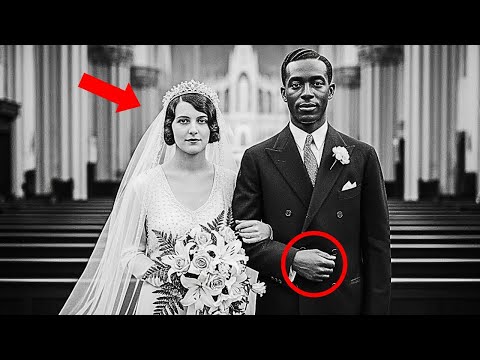
John sat back in his studio, the wedding portrait glowing on his monitor. He had restored thousands of images, but this one felt different. Thomas and Marie had risked imprisonment, violence, and the loss of family simply to marry. They had no children, no public recognition, no happy ending—only a love that endured through decades of hiding.
Now, clutching a tarnished trumpet mouthpiece given to him by Thomas’s elderly nephew, John faced an impossible choice. Should he share their story with the world, or honor the couple’s lifetime of silence? The photograph had revealed their secret, but the truth carried a weight he hadn’t expected.
He thought of Marie, dead at forty-three from exhaustion and fear. He thought of Thomas, living twenty-three more years without her, keeping her photograph by his bed. Their love had been real, but the price had been devastating.
As John carefully returned the portrait to its frame, he realized the mystery wasn’t just about race or law—it was about what we owe the forgotten. Thomas and Marie had dared to love when love was criminal. Now, a century later, their story was in his hands.
John set the frame down on his workbench and stared at it for a long moment. The decision, he realized, had already been made for him—not by Marcus’s plea for dignity, but by the photograph itself. Thomas and Marie had not hidden their love; they had hidden only the circumstances that made it illegal. The portrait was never a confession. It was a testament.
He pulled up the notes from his interview with Marcus and began transcribing them into a formal research document. If the story was to survive, it needed to be accurate, sourced, and unassailable. He would not sensationalize it—he would document it.
Over the following weeks, John corresponded with two historians at the University of Chicago and one at Tulane. Each responded with the same mixture of astonishment and gravity. “This is the kind of primary evidence we almost never get,” one wrote. “A photograph, a marriage record, a priest’s diary, and living testimony—all pointing to the same hidden life.” They agreed to include the Laurent materials in a forthcoming academic volume on racial passing in the Jim Crow South.
But John wanted something more personal. He contacted a small historical society in the Tremé, the neighborhood where Thomas had grown up. The director, a woman named Clarice Beaumont, listened to the story without interrupting. When John finished, she was quiet for a long moment.
“We have a wall,” she finally said. “Photographs of Tremé musicians from the 1920s. No names on most of them. If you can identify Thomas Laurent in any of your materials, we would be honored to hang his portrait there.”
John’s throat tightened. It was a small thing—a photograph on a wall in a neighborhood history center. But it was also everything. Thomas would be remembered not as a man who passed, but as a musician who loved.
He began searching through the Chicago Jazz Archive again, this time for any image of Thomas performing. It took three more weeks, but he found one: a grainy newspaper photograph from 1925, showing a trumpet player on a South Side bandstand. The caption read simply, “Laurent’s Serenaders.”
John studied the face under magnification. The same bone structure, the same quiet intensity he had seen in the wedding portrait. Thomas Laurent, in his own element, playing the music he had been forced to abandon.
He scanned the image at high resolution and sent it to Clarice Beaumont. Her reply came the next morning: We will hang it beside the wedding photograph. Both of them. The man and the musician.
John leaned back in his chair, the trumpet mouthpiece cold and solid in his palm. The story was no longer his alone. It belonged to the archives, to the historians, to the Tremé. And somewhere, he liked to think, Thomas and Marie finally had what they had been denied for so long—a place where their love could be seen without shame.
The call from Clarice Beaumont came on a Tuesday afternoon, three weeks after the photograph went up on the Tremé wall. “You need to come see this,” she said, her voice tight with something John couldn’t quite name. “A woman came in yesterday. She stood in front of Thomas’s picture for an hour. Then she asked who had found him.”
John drove to New Orleans the following weekend. The woman was waiting in Clarice’s office—a small, silver-haired figure in her late seventies, her hands folded around a paper cup of coffee. Her name was Elaine Boudreaux.
“Thomas Laurent was my father,” she said quietly. “My mother was not Marie.”
John’s breath caught. Elaine explained that after Marie’s death in 1945, Thomas had briefly—desperately—reached out to an old friend from the Tremé, a woman named Celestine. They had never married. But Elaine had been born in 1947, and Thomas had sent money every month until he died, signing the envelopes only with a trumpet drawn in blue ink.
“He never let me call him Papa,” Elaine said. “He said it was safer for me if no one knew. But every birthday, he sent a card with a song he’d written for me. I still have them all.”
She opened her purse and laid a stack of yellowed envelopes on the table. John recognized the handwriting from the marriage ledger—careful, upright, deliberate. Inside one was a single line: For my daughter, who is the music I could not play aloud.
John looked at Clarice, then back at Elaine. The story had not ended with Thomas’s death in 1968. It had continued, hidden in plain sight, in a daughter who had never been allowed to claim him.
“Would you like his mouthpiece?” John asked. “I think he would want you to have it.”
Elaine’s eyes filled, but she shook her head. “Keep it with the photograph,” she said. “Let people see that he was more than a secret. He was a father, too.”
John returned to Chicago with a new file in his research folder—one labeled simply Elaine. The academic volume would include her testimony. The Tremé wall would gain a small placard: Thomas Laurent, 1898–1968. Musician. Husband. Father.
He sat in his studio that night, the wedding portrait before him, and thought about how love always finds a way to leave a trace. A photograph. A trumpet mouthpiece. A daughter’s birthday cards. Thomas and Marie had been erased from every official record, yet they had written themselves into the world in ink, in music, and in blood.
Their secret was no longer hidden. Their story was no longer lost. And somewhere, in a quiet room in New Orleans, a woman finally had permission to say aloud what she had known her whole life: My father was a brave man.
What would you have done, a century ago, if loving someone meant breaking the law—and would you have had the courage to leave a trace?
Report this article
Select a reason for reporting:






