In the heart of Sangin, Afghanistan, 16 US Marines were 40 seconds from stepping into a daisy chain IED. Three would die instantly, the other 13 would lose limbs. But a calm British voice crackled through the radio—a voice no one recognized—and changed everything. “Don’t move. Don’t back up. 12 meters ahead, pressure plate.” That voice belonged to an SAS sniper who had been operating alone in the northern sector for six weeks, watching, waiting, and never firing a single shot.
In those six weeks, he had not fired once, yet he saved 16 Americans that morning. He would speak to them twice more before they ever laid eyes on him. And when they finally did, he was already standing 15 meters behind their position—in ground they had personally walked across an hour earlier and registered as empty.
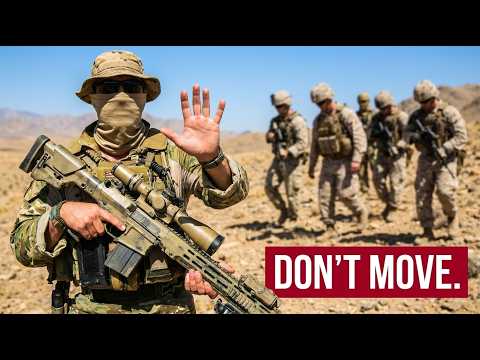
The staff sergeant asked him how long he had been there. The sniper answered with four words that would stay with that Marine for the rest of his life: “Stay with me.”
Sangin, late August 2010. The two-man SAS team inserted into the northern sector at last light. They dropped from an unmarked rotary platform that touched down for less than 90 seconds in a wadi 7 kilometers north of the nearest patrol base. The sniper carried an L115A3 chambered in .338 Lapua Magnum. His spotter carried a suppressed L119A1 carbine, two spare batteries for the rangefinder, and one radio set to a frequency the regimental headquarters in Hereford had personally cleared.
Their task was specific: deny Taliban movements along three routes carrying fighters, weapons, and IED components into Sangin. These were the kind of routes that had killed seven NATO soldiers in the previous month alone. The British had been fighting in Sangin for four years. Roughly 106 British soldiers had been killed in that single district—a third of every UK death in Afghanistan—in 1.8 square kilometers of compounds, irrigation ditches, and tree lines.
They handed Sangin to the Third Battalion, Fifth Marines on September 20, 2010, and walked out. The Marines called the place hell. The Darkhorse Battalion would record more than 520 firefights in seven months. 25 killed, around 200 wounded. It was the bloodiest deployment any single Marine battalion had taken in a decade of war. But this was the detail that everyone missed at the time: six weeks before the Marines walked in, two men with British accents and equipment that matched no standard British loadout were already on the ground. They were watching. And the Taliban had begun to feel them watching.
That was only round one. The sniper could hold a firing position for nine hours without movement. His spotter had timed it on a training exercise in Wales the previous winter. A shallow scrape in horizontal sleet, 9 hours and 11 minutes before the directing staff called it due to hypothermia risk. He came out, drank a flask of tea, and asked when the next serial began. The difference between nine hours and three is not physical. It’s a decision made so many times it stops feeling like a decision.
By late September, fighters who had crossed the northern routes freely for two months had stopped crossing them. Compound logs captured later showed Taliban commanders ordering movement restricted to daylight only, then canceling night couriers entirely, then issuing a blanket order that any man entering the upper wadis must travel in groups of no fewer than six. The empty route was the work. Not one shot had been fired to produce it. The fighters had a word for what they could feel watching them. They couldn’t say it on the radios because they didn’t know where the radios could be heard. So they whispered it in the compounds. Jinn. The spirit. The thing that is there and is not there.
Three weeks after the IED rescue at daylight, the same staff sergeant is holding a blocking position on the eastern edge of the district. With him is a 19-year-old private from El Paso named Ortiz on his first deployment, eight weeks in country. The radio comes alive. Same accent. “Seven men moving north through the tree line, 300 meters east of your position, armed. They have not seen you. They will break from the tree line in approximately 40 seconds. There is a gap in your cover at the northern end. Move your eastern fire team 20 meters right before that happens.”
The fire team moves. 42 seconds later, not 40, the fighters break from the tree line exactly where the voice said. The engagement lasts less than three minutes. In the silence after, the staff sergeant scans every piece of elevated or covered ground he can see. He cannot find the man. Ortiz is scanning beside him. That’s not a typo. The Marine is searching for a man who has just guided him through a textbook ambush from a position that simply does not exist on any reading of the terrain. That’s two now.
The staff sergeant turns. 15 meters behind their position, in a shallow depression the staff sergeant had personally looked at twice during the approach and registered as nothing, two men are arising from the earth. British DPM camouflage modified past regulation. Additional fabric sewn into the uniform in irregular shapes that broke the human outline in ways that made the eye slide off them. The sniper looked like the ground had decided to stand up.
“How long have you been there?”
“Since before you arrived.”
“I didn’t see you.”
“No, you didn’t. That was the point.”
Ortiz, the 19-year-old, lowers his rifle slowly. He has not blinked in 15 seconds. Later that night in the patrol base, he will write four sentences in a notebook he keeps inside his plate carrier. He will not show those sentences to anyone for 11 years. Within 20 seconds of moving back into the tree line, the SAS team is gone. Within 40, the staff sergeant cannot be certain of the direction they went.
Mid-October 2010. Intelligence identifies a Taliban command node coordinating IED placement across four kilometers of Route 611, the main supply line. Seven NATO soldiers were killed on that road in the last 30 days. The same ironic detail the Taliban had built their freedom of movement on—the dense cover and weathered compound walls that made Sangin impossible to clear—was about to work against them.
The SAS team takes overwatch on high ground to the northwest. The Marines approach from the south along a route the sniper has personally walked in the dark four nights running to confirm what was where. During the briefing the previous evening, the staff sergeant asks the sniper how he knows the guard rotation on the northern wall changes at 0320 every night. “Because I watched it happen from 1,000 meters four nights in a row to confirm it wasn’t coincidence.”
There is a dog in the compound, eastern side only. There is a section of the western wall where the mud brick has weathered to a point where it will take a man’s weight. He knows these things because he has spent six weeks watching and used every hour deliberately. Most of what looks like observation, he says, is just patience that ran long enough. Approximately seven hours later, the staff sergeant would understand exactly what that sentence meant.
The operation launches at 0400. The guard change comes two minutes early. The lead Marine element is still 40 meters short of the southern wall when the new Taliban guard takes position on the roof. If the guard turns and looks down, the operation is dead. The Marines are dead. The element is dead.
The sniper holds. He carries the new guard in his scope for four minutes while the Marines close the distance and press themselves flat against the wall. 840 meters in the dark, 17 meters between the guard and the lead Marine. No margin. The guard does not turn.
When the assault element breaches the compound, the IED coordinator is asleep in a back room. He is taken alive. The network goes dark within 72 hours. Three weeks later, intelligence confirms he never returns to the district. The road that had killed seven NATO soldiers in a month killed none in the next six.
The vehicle gunner watching the SAS team disappear into the darkness afterward was not a man easily impressed. He was careful with his words. He said this: “I grew up thinking we were the best in the world at this. I still think that. But that man does something we don’t even have a name for.” The Taliban had a name for it. The Marines just hadn’t heard it yet.
The SAS sniper’s six weeks in Sangin do not appear in any open-source operational record. The British Ministry of Defense does not confirm UK special forces operations. It never has. It never will. The Marines who lived because of him filed the paperwork they were allowed to file and left the rest in the kind of silence that follows you home.
The cost of his work is not measured in the rounds he did not fire. It is measured in what it takes to spend nine hours alone in a scrape, listening, breathing through your nose, deciding eleven thousand times in a row not to move. A man who can do that has trained something out of himself that civilians spend their whole lives keeping intact. Some of those men come back. Some come back partway. The empty route was the result. The empty man was the price.
When Private Ortiz finally read the four sentences in his notebook to a Veterans Affairs counselor in 2021, he started with the line he had written last. “I didn’t see him. The Taliban didn’t either. They had a word for him I only heard once. Jinn. The spirit. The thing that is there and is not there.”
Sixteen Marines went home because a man none of them ever saw decided that the ground itself would do the watching. But the story did not end with that notebook, or with the road that went quiet, or even with the six weeks that never officially happened.
Because there was one more thing the staff sergeant never put in his report—a thing he carried privately for years, turning it over in his mind on the long flights home and in the quieter hours after. It happened on the last night the SAS team was in the district, hours before they vanished for good. The sniper had looked at him across the dark, and for the first time, the voice on the radio had a face behind it. And what he said then was not a warning, or a correction, or a set of coordinates.
It was a question. One the staff sergeant has never been able to answer.
The staff sergeant waited. The sniper did not look away. “When this is over,” he said quietly, “and you’re home, and the noise is gone—what will you miss?” The staff sergeant opened his mouth to answer, then stopped. He thought of his wife, his daughter, the house in North Carolina. None of it fit the question.
The sniper nodded as if that silence was the answer he expected. “Good,” he said. “Hold on to that.” Then he was gone, and the ground closed over him, and the staff sergeant stood alone in the dark of Sangin with a question he could not shake.
Years later, in a kitchen in Jacksonville, his daughter asked him what Afghanistan was like. He thought of the IED, the voice, the empty patch of earth that stood up and became a man. “It was quiet,” he said. She laughed, thinking he was joking.
He never told her about the question. But he answers it now, every morning, when he walks outside and hears nothing but birdsong and the neighbor’s dog. He misses the silence that meant someone was watching.
What would you miss, if the war finally went quiet?
Report this article
Select a reason for reporting:






