The vault door creaked open, revealing shelves of canisters labeled with names that once lit up marquees—Monroe, Garland, Bogart. But these weren’t the glossy headshots that graced magazine covers. These were the frames studios never approved for release, hidden away for forty years. A single image could shatter the illusion of perfection that defined an era.
In a dimly lit room, a curator carefully lifts a photograph from the pile. It’s 1938, and a young starlet sits on a stool, her makeup smeared, her eyes red-rimmed. The caption on the back reads: “Not for publication—destroy.” Yet here it is, a raw glimpse behind the velvet curtain of Hollywood’s golden age.
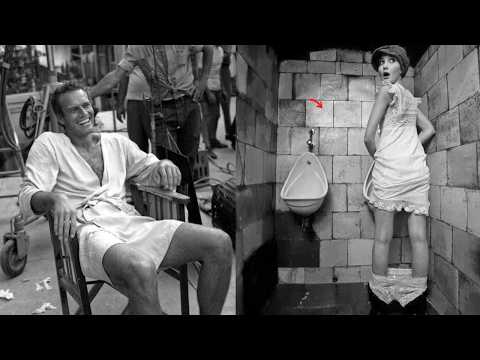
The collection spans from the 1930s to the 1950s, a time when studio publicists controlled every aspect of a star’s image. They curated perfection, airbrushing away flaws, staging romances, and burying scandals. But these photographs—candid, unguarded, sometimes heartbreaking—tell a different story. A story of vulnerability, rebellion, and the cost of fame.
One photo shows Clark Gable laughing off-camera, his tie undone, a cigarette dangling from his lips. Another captures Judy Garland in a moment of exhaustion between takes, her youthful face etched with a weariness that belied her age. “These were never meant to see the light of day,” the curator whispers. “But they’re too important to lose.”
As the curator turns to the next stack, a particular image catches the light—a silhouette of a woman, her back to the camera, standing on a balcony overlooking the Hollywood Hills. The note on the back is cryptic: “The last picture before the silence.” Who was she? And what silence? The answers lie buried in the archive, waiting to be uncovered.
The air grows thick with anticipation. Each photograph is a puzzle piece, a fragment of a larger narrative that the studios fought to suppress. But the truth has a way of surviving, even in the darkest vaults. And as the curator reaches for the next envelope, the story is just beginning to unfold.
The envelope is brittle, the paper yellowed and flaking at the edges. Inside, a single photograph, larger than the rest, mounted on a stiff card. The curator’s fingers tremble slightly as she lifts it into the light.
It’s a party—but not the polished, press-approved kind. This is a private gathering, the kind that never appeared in fan magazines. The room is crowded with faces that would become legends, but here they’re unguarded, laughing too loudly, holding glasses too loosely. In the corner, a young woman with dark hair stands apart, her expression unreadable.
“That’s her,” the curator breathes. “The woman from the balcony.” She flips the card over. This time, the handwriting is different—sharper, more urgent. “She knew too much. They made her disappear.”
The room seems to hold its breath. Disappear—the word hangs in the air like smoke. Hollywood had a long history of swallowing its own, of careers ending overnight, of names erased from call sheets and contracts burned in studio furnaces. But this felt different. This felt deliberate.
A second photograph slides from the envelope, smaller, creased down the middle. It shows the same woman, days later perhaps, standing at a train station platform. She’s wearing a plain coat, no jewelry, no glamour. Her face is turned toward the camera, and for the first time, her eyes are visible—wide, frightened, but defiant. In her hand, a small suitcase. In the background, a man in a dark suit watches from a distance.
“A studio fixer,” the curator murmurs, recognizing the type. “They were everywhere. Making problems go away.” She places the photograph down carefully, as if it might crumble. “But she got away, didn’t she? At least for a while.”
The archive holds more than images—it holds secrets. Names that were whispered in back rooms, deals struck over champagne, lives traded for silence. And this woman, whoever she was, had become a loose thread in the studio’s carefully woven tapestry.
The curator reaches for a third envelope, this one sealed with red wax. On the front, a single word is written in elegant script: “Confidential.” She hesitates. Whatever is inside, it was never meant to be opened. But the truth, once awakened, cannot be put back to sleep.
The wax cracks with a sound that seems louder than it should in the quiet room. Inside, no photograph. Instead, a single sheet of studio letterhead, dated October 1946, the ink faded to a pale brown. The curator reads aloud, her voice barely above a whisper.
“Miss Evelyn Marsh. Contract terminated, effective immediately. All materials related to said contract to be surrendered and destroyed. No further inquiries to be made. This office considers the matter closed.” No signature. No explanation. Just a name, finally given to the woman on the balcony.
Evelyn Marsh. The curator rolls the name over in her mind, trying to place it. It isn’t in any of the reference books on the shelf, not among the rising stars of the forties, not in the forgotten ingenues who faded quietly. It’s as though the name itself was scrubbed from history.
She crosses to the filing cabinet in the corner, its drawers stiff with age. “M… M… Marsh,” she mutters, fingers walking through the tabs. The folder is thin—suspiciously thin. A headshot, a single contract page, and a memo with the words “DO NOT CIRCULATE” stamped across the top in faded red ink.
The headshot tells its own story. Evelyn Marsh, twenty-three years old, dark hair swept back, a smile that doesn’t quite reach her eyes. On the back, in the same sharp handwriting as the first envelope, a single line: “She was the best of us. That was the problem.”
The curator sinks into the chair, the weight of it settling over her. A studio doesn’t erase a rising star for no reason. There were rules, unwritten ones. You didn’t cross the men who owned the town. You didn’t speak about what you saw in the back rooms. And you never, ever threatened to tell the truth.
She thinks of the man at the train station, the fixer in the dark suit. He wasn’t there to stop Evelyn from leaving. He was there to make sure she never came back. But the photographs in her hands suggest she did come back—or at least, someone made sure her story survived.
A soft knock at the door breaks the silence. The curator’s head snaps up. “We’re closed,” she calls, sliding the letterhead back into its envelope.
The door creaks open anyway. A man steps inside, gray-haired, his coat too heavy for the warm evening. He looks around the room slowly, then fixes his eyes on the envelope in her hand. “You found her,” he says. It isn’t a question.
The curator doesn’t answer. Her hand tightens around the envelope, instinct taking over before reason can catch up. The man steps closer, and the light catches his face—lined, familiar, as though she’s seen him before in some photograph she can’t quite place.
“I was the one who saved those negatives,” he says quietly. “Every frame you’re holding. I was there the night the studio burned her contract and told her to vanish. She didn’t vanish. She handed me a box and asked me to keep it safe until someone came looking.”
The curator’s voice comes out hoarse. “Who was she to you?” The man smiles, but it’s an old, tired thing. “My mother. She changed her name, moved to a small town, raised me far from the cameras. She never spoke of Hollywood. But she kept every clipping, every photograph, every letter. She wanted the truth kept alive, even if she couldn’t live it.”
He reaches into his coat and produces a final item—a small, worn diary, its spine cracked. “She wrote this before she died. She said the archive would know what to do with it.” The curator opens it gently. The first page reads: “If you are reading this, then the silence is finally broken.”
The pages that follow are filled with names, dates, and details—enough to rewrite the history books. Deals made in shadows. Careers destroyed to protect secrets. And one woman who refused to stay quiet. The curator looks up at the man, her eyes stinging. “She won.” He nods, tears glistening in his own eyes. “She always said the truth outlives the lie. It just takes longer than it should.”
The archive will never be the same. Tomorrow, the world will learn Evelyn Marsh’s name. And somewhere, in a vault of forgotten reels, a woman on a balcony finally gets her voice back.
Which hidden story from Hollywood’s past do you think deserves to be uncovered next—and would you dare to open the envelope?
Report this article
Select a reason for reporting:






