In the autumn of 1944, a German radio operator tore off his headset and turned to his captain. “Herr Hauptmann, they’re gone.” The captain didn’t look up from his map. “Who’s gone?” “Third Army, Patton, the whole net. There’s nothing.” For months, the Germans had read American radio traffic like a morning paper—chatter spiked before attacks, and the noise betrayed locations. But Patton’s army hadn’t gone quiet; it had gone silent. For nearly three days, the most famous tank general on the Allied side vanished from the German picture. Then his armor rolled out of the morning fog in a sector nobody was watching.
Months later, a captured German officer admitted to his interrogator: “They could pin down any American army in a few hours. Any army except that one.” And it wasn’t just the radio. Up and down the front, Germans who ran into the Third Army noticed things that made no sense. Clean-shaven Americans in neckties standing in the mud. A general who printed a prayer and handed it out like ammunition. Tanks showing up at 3:00 in the morning where the German timetable said they’d reach at noon. American privates who lost their lieutenants and simply kept coming. The Germans had studied every army in Europe, the story goes. They’d never met anything like Patton’s.
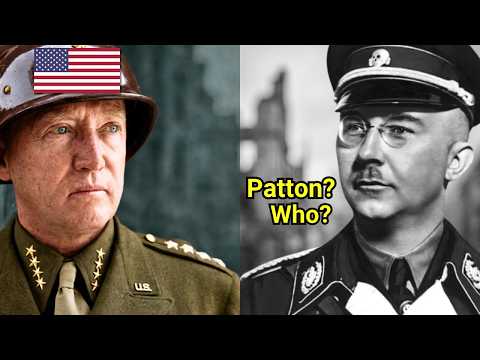
It never happened. Not like that. That version comes from a popular video, and it rests on eight German officers, two signals officers, a lieutenant colonel captured near Metz, a major taken in the Saar, a colonel, a panzer commander, a division commander, a company captain. Not one of them has a name. There are four direct quotes in that story. No unit numbers, no dates you could check, no archive file. Just a calm German voice saying exactly what an American audience wants to hear.
If you believed it, that doesn’t make you gullible. Stories like this are built to be believed. A vivid scene, a respectful enemy, a line that flatters. That’s how military legends travel. This channel exists to check them. We take the stories people share about American military history, go back to the documents, and tell you what’s actually there. And this one is worth checking because when invented Germans do the talking, the real ones get pushed out of the room.
The real ones left their words behind in a wartime letter, in German intelligence files, in reports they wrote for American historians after the war. What they said is colder than the legend. For most of the war, the Germans barely noticed Patton. When they finally did, one of their best generals decided the Americans were helping him. And the biggest compliment they paid Patton at the very end is stranger than anything in that video.
There’s also a quote at the end of this. The most famous thing a German field marshal supposedly said about Patton. And we’re going to get to it. But first, you need to see how the legend got built. Quick one before we start. If you’ve ever forwarded one of these videos to your dad, no judgement. Half of us have. Drop the Patton fact you grew up with in the comments and let’s see if it’s still standing in 10 minutes.
Here’s the funny thing. The Allies built the first version of this legend themselves. In October 1943, Army Chief of Staff George Marshall put the idea in writing. Patton’s movements, he believed, were of great importance to German reactions. So, Patton—sidelined after slapping two soldiers in Sicily—became bait. He was sent to Corsica, to Malta, to Cairo in the hope that German agents would spot him and wonder what he was planning. Then came the big one. In 1944, the Allies invented a whole army group in England, the First US Army Group, and put Patton’s name on top of it. The logic was simple. The Germans fear Patton. So, if Patton is waiting in Southeast England, the invasion must be coming at the Pas de Calais, the short crossing. So, the German 15th Army stays at Calais, guarding the wrong beach, while the real landing goes in at Normandy. An enemy so fixated on one American general that his name alone could hold an army in place. That’s the foundation everything else is built on.
After D-Day, Patton got a real army. The Third became operational on the 1st of August, 1944. Within days, it was racing across France. And on the 14th of August, Patton put the legend into his own words. His army, he claimed, had advanced further and faster than any army in history. Hold on to that line. It comes back at the end.
So, what did the Germans actually write about him? Here’s what you’d expect. A thick file, photographs, analysts arguing over his next move, like that captain with the map. Instead, the German records give him almost none of it. The historian Harry Yeide went through the files of German army intelligence for the West, and of the German armies and divisions that fought Patton. The first mention he found is from mid-May 1943. A note that Patton had taken command of the American Second Corps in Tunisia. By the time that note was written, Patton had already left Second Corps. A month later, a German report described him as “an energetic and responsibility-loving command personality, professional, polite, forgettable.” Those trips to Corsica, Malta, and Cairo? Yeide found no sign in the German records that anyone noticed.
In February 1944, a Luftwaffe Academy paper circulated short profiles of the senior Allied generals who might lead the invasion. One paragraph each. Patton was the only senior Allied general in Britain or the Mediterranean who didn’t get one. Wow. On the 1st of April, 1944, German intelligence was still guessing. “It seemed possible,” they wrote, “that Patton had taken command of the First or Ninth Army in England.” Only in mid-May did they conclude he led the Phantom Army Group, and by then, they had already made up their minds about Calais. So, the deception worked, but not for the reason the legend gives. The Germans reached Calais on their own. Patton’s name was added at the end.
Yeide’s verdict is blunt. The Germans paid Patton little attention until he swung around their flank in Normandy in August 1944. That’s when they noticed. Generalmajor Rudolf Christoph von Gersdorff, chief of staff of the German 7th Army, later wrote that once Patton’s armored spearheads reached open country, there was nothing left to do but let them roll. But in September, something happened that the Germans really did find strange. The army that had just torn across France slowed to a crawl. It shouldn’t have. The German side of the Moselle was a wreck. The German 19th Army, falling back from Southern France, had lost 1,316 of its 1,481 artillery pieces. General Otto von Knobelsdorff’s First Army was digging in with whatever it could scrape together. On the 21st of September, a new commander took over Army Group G, General der Panzertruppe Hermann Balck, a hard veteran of the Eastern Front.
Here’s what you’d expect Balck to write about the most famous armored general in the Allied camp. Fear. Respect. At least a nervous glance over his shoulder. Instead, he gives him none of it. On the 10th of October, 1944, Balck wrote to Field Marshal Gerd von Rundstedt, “The German recovery in Lorraine,” he said, “can only be attributed to the bad and hesitating command of the Americans.” Bad and hesitating about the Third Army. He wasn’t alone. Max Simon, an SS general facing the Third Army in the Saar, and a man later convicted of war crimes in Italy said the Americans attacked like men pulling down a wall one brick at a time. “Fight like that on the Eastern Front,” he said, “and every one of your tanks would have been destroyed.” So the Germans had a new theory about Patton’s army. It was timid.
The reason they were wrong is the best part of this story. If you want more history like this—the version with names and dates attached—hit subscribe. For a channel this size, it genuinely matters.
Because the Americans hadn’t lost their nerve—they’d run out of gas. On the 31st of August, the Third Army stopped short of Metz. Not because of German resistance, because the fuel was gone. Real supply didn’t start flowing again until the 4th of September, and even then it was thin. In mid-September, the supply lines were delivering an average of 3,500 tons a day to the Third Army. Bradley’s 12th Army Group estimated that a single division needed at least 600 tons for a single day of attacking. Do the math. 3,500 tons keeps fewer than six divisions on the attack.
And every ton had a long way to come. Nancy was 461 miles by rail from the port of Cherbourg. The port of Antwerp was only 250 miles away, in Allied hands, but not yet open to ships. The Germans knew none of this. So they gave the credit to themselves, to their own counterattacks. What looked like hesitation from their side of the map was an empty fuel tank on ours.
So if the German record is that thin, where does the other version come from? Mostly from Hollywood. In 1970, 20th Century Fox released Patton with George C. Scott in the title role. The screenplay drew on Ladislas Farago’s biography and Omar Bradley’s memoir, and the film won seven Academy Awards, including Best Picture. It also gave the Germans a character they never had. Captain Oscar Steiger, a German staff officer whose job is to study Patton—his history, his habits, his mind—so the high command can predict his next move. Steiger is the German obsession in human form. He’s also a screenwriter’s invention.
The same film has Patton watching his tanks beat Rommel’s at El Guettar and shouting that he read Rommel’s book. Rommel never finished that book. He wasn’t even in Africa for that battle. He’d left two weeks earlier. The image stuck so hard that a streaming service still sells the film by calling Patton the only Allied general the Nazis truly feared. The video we started with just took the last step. It gave Captain Steiger a handful of nameless cousins and sat them down in American interrogation rooms.
And it’s not the only rewrite in there. One of those nameless Germans describes the Third Army’s aggression near Saint-Lô. Saint-Lô fell in July 1944, and the Third Army didn’t become operational until the 1st of August. Another favorite—the mass surrender of General Botho Elster’s column at the Beaugency bridge—gets handed to Patton, too. By then, the 83rd Infantry Division that accepted it had been moved to the Ninth Army.
But to be fair to the legend, it didn’t come from nowhere. There was one night when the Germans really did meet the Patton from the movie. March 1945, the Rhine. On the east bank, General der Infanterie Hans Gustav Felber commanded what was left of the German Seventh Army. He was responsible for more than fifty miles of the river, from Wiesbaden down to Mannheim, with one regular corps. His only reserve, the 159th Volksgrenadier Division, had two weak infantry regiments of two battalions each, and two light artillery batteries.
Felber knew how river crossings worked. A river this size means days of preparation—boats, bridging equipment, and a massive artillery barrage before anyone gets wet. Those days were his only chance. So Felber could hope the Americans would stop and build up. But the US Army’s official history adds a dry note. Remagen, and every previous dealing with Patton, pointed the other way.
Early on the 21st of March, Major General S. LeRoy Irwin of the Fifth Infantry Division was called to Corps Headquarters. His division had already crossed twenty-two rivers in this war. The next one was the Rhine. Mid-morning on the 22nd, the Corps Commander, Major General Manton Eddy, told Irwin that Patton wanted the crossing that night. Irwin said a well-planned crossing was impossible on that schedule, but he could get some sort of bridgehead.
Late that morning at Nierstein, Colonel Paul J. Black of the 11th Infantry got his order. Cross at 10:00 p.m. Behind him, thirteen battalions of artillery were in position with orders not to fire. No preparation. No barrage. Surprise was the whole plan.
Just before 10:00, the Third Battalion crept down to the water. The moon was uncomfortably bright. Around 10:30, the first boats of Company K pushed off. Nothing. No flares, no machine guns. The first boat carried First Lieutenant Irvin Jacobs and eight men. Seven surprised Germans promptly surrendered and obligingly paddled themselves across the river without escort.
By midnight, the entire 11th Infantry was across. The whole crossing took twenty casualties. Felber later wrote for the US Army: “The enemy was now willing to take bigger chances than before.” Five months earlier, Balck had called this army bad and hesitating.
So who was the man the Germans kept misreading? A Californian who grew up on Hannibal and Napoleon, vain and profane and deeply religious, often in the same breath. And the prayer from the legend? It was real—written in December 1944 for the Lorraine mud, not the Ardennes snow.
In his memoir, Patton confessed to exactly one error in the whole campaign: the Hammelburg raid. Lorraine didn’t make the page. The man the Germans found so hard to read had real trouble reading himself.
And Rundstedt’s famous line—“Patton, he is your best”—traces back to a 2006 biography and stops. No date, no interviewer. Sixty-one years after the war.
What did the Germans really think? Guderian said Patton acted as he would have done in his place. The boy who read about Napoleon ended the war with a German general telling historians he’d improved on him.
So here’s the question: when the legend is finally stripped away, is the real Patton more impressive—or less? Tell us in the comments.
Report this article
Select a reason for reporting:






