Dr. Helen Graves almost skipped the auction that humid September morning in 2023. The Charleston auction house specialized in antique furniture, not historical documents, and she had a conference call scheduled for noon. But something in the catalog caught her eye: a collection of photographs from a demolished house in the rural low country, some dating back to the early 1900s. She arrived late, slipping into the back row just as the auctioneer held up a wooden box filled with sepia-toned images.
“Lot 47,” he announced. “Assorted photographs, circa 1910 to 1920. Unknown subjects. Starting at $50.”
Helen raised her paddle almost without thinking. She won the lot for $75.
That evening, in her cramped university office, she spread the photographs across her desk. Most were unremarkable—stiff portraits, faded landscapes, a few damaged beyond recognition. But one image made her pause. A black family of five stood on a wooden porch. The father wore a dark suit, his posture rigid but dignified. The mother sat in a chair, her hands folded in her lap, holding what appeared to be a white handkerchief. Three children surrounded them, the youngest no more than five or six.
Helen studied their faces. There was something in their expressions that didn’t match the formal pose—a tension around the eyes, a guardedness that seemed deliberate. She turned the photograph over. On the back, in faded pencil, someone had written: “The Crossing, summer 1912.”
The Crossing. Helen frowned. She knew every major black community in the low country from that era. She had never heard of any place called The Crossing.
She pulled out her magnifying glass and leaned closer. That’s when she saw it. In the father’s vest pocket, barely visible against the dark fabric, was the glint of something metallic. She adjusted her desk lamp and looked again. A compass—a silver compass. And its needle wasn’t pointing north.
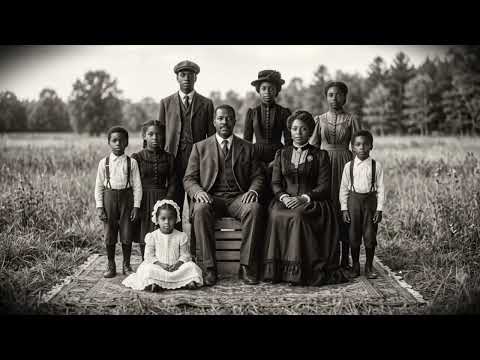
Helen spent the next three hours examining the photograph under every light source in her office. The compass was real. She could make out the delicate engravings on its casing, the thin black needle suspended behind glass. But what disturbed her was the direction. In every compass she had ever seen, the needle pointed north—magnetic north, always. This needle pointed downward, toward the bottom of the photograph, toward the youngest child.
She told herself it had to be a trick of the angle, a distortion from the old camera lens. But the more she studied it, the more intentional it seemed. The father’s body was angled slightly, his vest pulled open just enough to reveal the compass—as if he wanted it to be seen.
And then there was the handkerchief. Helen had almost missed it at first. The mother’s hands were folded so naturally, the white cloth seemed like nothing more than a decorative accessory. But under magnification, she could see that the handkerchief was folded into a precise geometric pattern. Triangles nested within triangles, forming a shape she recognized from her graduate research.
It was a quilt code.
During the era of the Underground Railroad, certain quilt patterns were believed to carry hidden messages for escaping slaves. A bear’s paw meant to follow animal trails. A north star meant to travel at night. The patterns were stitched into quilts and hung on clotheslines—visible signals that guided the way to freedom.
But by 1912, the Underground Railroad had been defunct for nearly 50 years. Slavery had ended. The codes should have been obsolete.
So why was this woman holding one in her hands?
Helen pulled up a database of census records and began searching for black families in rural South Carolina in 1912. She cross-referenced property records, church registries, and tax documents. Nothing matched. It was as if this family had never existed.
She stared at the photograph until her eyes burned. Five people frozen in time, hiding something so dangerous they had erased themselves from history.
Helen picked up her phone and called the only person she trusted with something this strange: Marcus Webb, a retired archivist who had spent 40 years preserving black southern history.
“I need you to see something,” she said. “I think I found a ghost.”
Marcus arrived at Helen’s office the next morning, carrying a thermos of coffee and a worn leather satchel filled with his own research files. He was 73 years old, with silver hair and hands that trembled slightly from decades of handling fragile documents. But his eyes were sharp, and when Helen showed him the photograph, those eyes went wide.
“Lord have mercy,” he whispered.
He held the image up to the window light, turning it slowly, studying every detail. His lips moved silently as if he were counting something.
“You recognize them?” Helen asked.
Marcus didn’t answer immediately. He set the photograph down and reached into his satchel, pulling out a notebook filled with handwritten entries.
“1986,” he said. “I was cataloging oral histories in Beaufort County. Talked to an old woman named Adella—must have been 90 years old. She told me a story I never forgot.”
He flipped through the pages until he found what he was looking for.
“She said her grandmother used to talk about a family that lived on the edge of the swamp. Said they weren’t like other folks. They came and went at strange hours. Always had visitors passing through. Strangers who arrived at night and were gone by morning.”
Helen leaned forward. “What kind of visitors?”
“Adella called them the walking wounded. Men and women running from something. Chain gang escapees. People fleeing debt contracts they couldn’t pay. Families trying to get north before the local sheriff caught up with them.”
“In 1912? But the Underground Railroad was—”
“The railroad never really ended,” Marcus interrupted. “It just went deeper underground. After Reconstruction collapsed, after the convict leasing system turned black men into slaves again, there were people who kept the old routes alive. They called themselves different things in different places. Some called it the midnight road. Others called it the freedom line.”
He tapped the photograph with a gnarled finger. “And some called it The Crossing.”
Helen felt a chill run down her spine.
“Adella’s grandmother said there was a family who ran one of the stations. A man who could read the stars and a woman who could fold messages into cloth. They helped dozens of people escape.”
“What happened to them?”
Marcus’s face darkened. “She said they vanished. One day they were there, the next they were gone. The house stood empty. Nobody ever found out what happened.”
He looked at Helen, his eyes heavy with old grief.
“If this photograph is what I think it is, you’re not just looking at a family portrait—you’re looking at evidence. And someone made very sure this evidence was never found.”
Helen spent the following week decoding the handkerchief. She consulted textile historians, quilt scholars, and experts on African-American folk traditions. Most were skeptical. The theory that quilt codes guided escaping slaves was controversial, considered by many to be more legend than fact. But Dr. Rosalind Carter, a retired professor from Howard University, looked at the photograph and went silent for a long moment.
“This isn’t a quilt code,” she said. “It’s something older—something I’ve only seen once before.”
She explained that during the antebellum period, certain communities in the Sea Islands of South Carolina had developed a secret language based on West African textile traditions. Patterns folded into cloth could convey complex messages: safe routes, danger warnings, meeting times.
“The knowledge was passed down through women,” Dr. Carter said. “Mothers to daughters, generation after generation. By 1912 most people had forgotten it existed, but in isolated communities, especially in the low country, some families kept it alive.”
She studied the photograph again. “This pattern—the nested triangles—it’s called a river door. It means there’s a water route nearby. A way to escape by boat.”
Helen thought about the geography. The low country was a maze of rivers, creeks, and swamps. If someone wanted to move people secretly, water would be the safest way. Harder to track than roads. Easier to disappear.
“But why would they put this in a photograph?” Helen asked. “Why risk being discovered?”
Dr. Carter smiled sadly. “Because photographs travel. They can be sent to people far away without raising suspicion. A family portrait mailed to a relative in Philadelphia or New York could carry instructions that no one else would understand.”
She pointed to the mother’s eyes. “Look at her face. She’s not posing for a memory—she’s sending a message. This photograph was never meant to hang on a wall. It was meant to save lives.”
Helen stared at the image with new understanding. The rigid postures, the careful positioning, the half-hidden compass. Every detail was deliberate. This family had turned their own portrait into a map—and somewhere over a century ago, someone had received this map and followed it to freedom.
The compass became Helen’s obsession. She had the photograph professionally digitized, enhancing the image until she could read the tiny engravings on the silver casing. The letters were worn but legible.
J.W. Savannah. 1898.
A silversmith’s mark. Marcus helped her search through historical records of craftsmen in Savannah, Georgia. They found dozens of silversmiths from that era, but only one with the initials J.W.: a man named James Walker, who operated a small shop on Broughton Street from 1890 to 1915.
More importantly, James Walker was black. In an era when black-owned businesses faced constant harassment and violence, Walker had somehow maintained his shop for twenty-five years. His clients included wealthy white families—but also, according to a few surviving letters, members of the black community who paid in trade rather than cash.
Helen tracked down Walker’s descendants through a genealogy website. His great-granddaughter, a woman named Patricia living in Atlanta, agreed to meet her. Patricia was eighty-one years old, with sharp cheekbones and her great-grandfather’s steady hands. She listened to Helen’s story without interruption, then disappeared into her back room and returned carrying a small wooden box.
“My mother gave me this before she passed,” Patricia said. “She told me it was great-granddaddy’s secret, and I should never show it to anyone.”
She opened the box. Inside were three silver compasses, identical in design to the one in the photograph—but these compasses were different. Each one had been modified. The needle weighted on one end, so it would point not north, but in whatever direction the maker chose.
“They’re not for finding your way,” Patricia said quietly. “They’re for sending messages. Great-granddaddy made them for people who needed to disappear. The compass would point toward the next safe house on the route. You just had to follow the needle.”
Helen’s hands trembled as she lifted one of the compasses. “How many did he make?”
“My mother said dozens—maybe more.” Patricia’s voice dropped. “He never wrote anything down, never kept records. If anyone found out what he was doing, they would have burned his shop and lynched him in the street.”
She looked at the photograph Helen had brought. “That man—the father—he was one of the guides, wasn’t he?”
Helen nodded. Patricia closed her eyes.
“Then great-granddaddy helped them. He helped them all.”
With the compass mystery solved, Helen turned her attention to tracing the actual escape routes. Marcus introduced her to a network of local historians who had spent decades documenting the hidden geography of black resistance in the South. They showed her maps marked with abandoned churches, forgotten cemeteries, and remote homesteads that had served as safe houses during the darkest years of Jim Crow.
One name kept appearing in their records: the Edisto River Corridor.
The Edisto was a blackwater maze, 200 miles of swamp and cypress where white men rarely ventured. Thomas, a local historian, showed Helen a hand-drawn map from the 1920s marked with stars, crescents, and crosses. “These were the stations,” he said. “My great-uncle ran one. At night he’d take people upstream, two or three a week.”
Then came the tragedy. A yellowed clipping from the Low Country Beacon, October 1912: “Fire destroys rural home. Family missing.” Crossing Creek Farm. Weeks earlier, twelve inmates had vanished from a convict camp forty miles away. Someone had talked.
But Josephine’s letter, found in a Philadelphia church archive, told another ending: “We are settled now… I want you to keep it safe. We were not criminals. We were not cowards.”
Gloria, Ruth’s granddaughter, wept when she saw the photograph. “Forty-seven,” she whispered. “That’s how many her parents saved.”
At Gloria’s funeral, Helen spoke of resistance hidden in plain sight. Then a young man named Marcus approached her. “I want to find the others—the 47 or their families.”
Helen smiled. “That could take a lifetime.”
He looked at the photograph. “Then I’d better get started.”
Do you believe ordinary people still carry these quiet codes of courage today?
Report this article
Select a reason for reporting:






