The roar of Junkers Ju 52 engines filled the Cretan sky as the men of the 5th Mountain Division clutched their rifles, their hearts pounding with a mix of fear and determination. Below them, the island’s rugged terrain loomed—a deadly patchwork of olive groves and rocky outcrops that would soon become a battlefield. This was Operation Merkur, the audacious German invasion of Crete, and these mountain troops were about to be thrown into a cauldron of fire.
They were not paratroopers, yet they were tasked with an airlanding role—a gamble that would test their mettle against a battle-hardened enemy. The British forces, having retreated from Greece, were dug in and waiting. The skies were filled with the drone of aircraft, and the air was thick with tension. For the men of the 5th Mountain Division, there was no turning back.
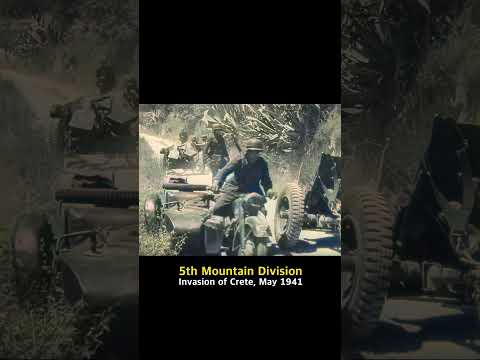
The first waves of German aircraft approached the drop zones, but the reception was anything but welcoming. Anti-aircraft fire erupted from the ground, tearing through the fragile transports. Some planes went down in flames, others veered off course, scattering the mountain troops across the island. “We were sitting ducks up there,” one survivor later recalled. The chaos of the airborne assault was just the beginning.
As the mountain soldiers landed, they found themselves in a fragmented battle, isolated groups fighting for survival against a determined foe. The British, along with Greek and Cretan fighters, contested every inch of ground. The 5th Mountain Division, trained for alpine warfare, now faced a different kind of hell—a patchwork of fields and villages where every hedgerow could hide an enemy.
Despite the initial confusion, the mountain troops began to coalesce. Their training kicked in, and they started to push back, securing key positions one by one. The battle for Crete was far from over, but the 5th Mountain Division was already leaving its mark. Their role in securing the island would become a pivotal chapter in the annals of World War II.
But as the sun set on that first day, the outcome hung in the balance. The British were far from beaten, and the mountain division knew that the toughest fights were yet to come. The invasion of Crete was a high-stakes gamble, and the men of the 5th Mountain Division were about to discover just how much they were willing to sacrifice.
By dawn of the second day, the scattered companies had established a tenuous foothold around Maleme airfield—the prize that could decide the entire campaign. Whoever held Maleme held Crete. The mountain troops understood this, and so did the British defenders, who poured artillery fire onto the airfield with relentless precision.
Colonel Ramcke’s men, clinging to the edge of the runway, dug in with whatever tools they could find—helmets, bayonets, even bare hands. The rocky Cretan soil resisted every effort, but the soldiers persisted, carving shallow trenches that offered little protection from the shrapnel raining down.
“If we lose the airfield, we lose everything,” a company commander shouted over the din of battle, his voice barely audible above the explosions. The men nodded grimly, their faces smeared with dust and sweat.
Reinforcements arrived in fits and starts, flown in aboard Ju 52s that braved the murderous anti-aircraft fire. Each landing was a gamble, each takeoff a small miracle. Some transports never made it, crashing into the sea or erupting in flames on the runway itself. Yet the mountain troops pressed on, their numbers slowly swelling despite the losses.
The British launched a counterattack at dawn, hoping to reclaim the airfield and crush the German foothold. Waves of infantry advanced across the open ground, supported by tanks that rumbled ominously toward the German lines. The mountain soldiers, many of them armed only with rifles and grenades, prepared for the onslaught.
The fighting was brutal and close-quarters. Grenades flew across the runway, and men fought hand-to-hand in the dust and smoke. The mountain troops, though outnumbered and outgunned, refused to yield. Their alpine training had taught them to endure hardship, to fight on when others would falter.
By midday, the British counterattack had been repulsed, but at a terrible cost. The airfield remained in German hands—barely. The mountain division had paid for every yard of ground with blood, and the battle was far from decided.
The stench of cordite and burning fuel hung over Maleme like a shroud. Men who had never met before now fought side by side, bound by the simple, desperate arithmetic of survival. Every hour the airfield stayed in German hands was another hour for reinforcements to arrive.
That afternoon, the first transport planes touched down under a sky streaked with smoke. Mountain troops poured out of the Ju 52s before the wheels had even stopped rolling, throwing themselves flat as British shells walked across the runway. “Move! Move! Get off the strip!” a sergeant bellowed, hauling a stunned rifleman to his feet.
The newly arrived men brought something precious beyond their numbers: heavy weapons. Mortars, machine guns, and precious ammunition were unloaded under fire, each crate a small victory. The mountain division was no longer a scattering of isolated pockets—it was becoming a fist.
But the British commander, sensing the tide turning, ordered his artillery to hammer the airfield without pause. Shells fell so thickly that the runway seemed to boil. Men pressed their faces into the dirt, counting the seconds between impacts, waiting for the one that would land too close.
Among the mountain troops was a young lieutenant from the Bavarian Alps, his uniform torn and his hands raw from digging. He had climbed glaciers and scaled cliffs, but nothing had prepared him for this—a flat, exposed airfield under relentless fire. “In the mountains, the enemy is the cold and the rock,” he wrote in his notebook that night. “Here, the enemy is everywhere.”
Yet the division held. Patrols pushed out from the airfield perimeter, clearing the olive groves and stone farmhouses one by one. Each village taken was a small triumph, each ambush a sharp lesson in the ruthlessness of the Cretan fighters, who struck from the shadows and vanished into the hills.
By the third day, the balance had shifted. German reinforcements were arriving faster than the British could replace their losses, and the defenders’ grip on the island began to loosen. But the mountain troops knew the cost of every gain—the rows of covered bodies, the exhausted faces, the men who would never climb another mountain.
The battle for Crete was entering its final, most bitter phase, and the 5th Mountain Division stood at its center, battered but unbroken, ready for whatever the coming days would demand.
The end came not with a single thunderous charge, but with a slow, grinding collapse. British rear guards, exhausted and running short of ammunition, began to slip away under cover of darkness toward the southern coast. “They’re pulling back,” a scout reported, his voice cracked with disbelief. The mountain troops, who had expected days more of bloodshed, could scarcely comprehend that the tide had truly turned.
Colonel Ramcke ordered the pursuit. Through dusty villages and terraced hillsides, the mountain soldiers advanced, no longer the desperate defenders of Maleme but the hunters. Cretan fighters still sniped from the rocks, and rear-guard actions flared and died, but the organized resistance was crumbling.
At the port of Sphakia, the last British transports waited under the cliffs, taking aboard as many men as they could hold. The mountain division pushed to the heights overlooking the evacuation, their mortars ranging in on the beach. “We could have slaughtered them,” one veteran remembered, “but the orders came down—let them go.” The British slipped away into the Mediterranean night, leaving Crete to its new masters.
When the fighting finally stopped, the men of the 5th Mountain Division stood among the ruins of victory. The island was secured—the operation that had begun in chaos and near-disaster had ended in triumph. Yet the cost was staggering. Thousands of their comrades lay buried in Cretan soil, and the division that had landed was not the division that now held the island.
The young lieutenant from the Bavarian Alps, his notebook now filled with names of the fallen, climbed to a ridge above the sea. He looked out over the water, where the last British ships had vanished, and wrote his final entry: “We have won, and I do not know what winning means anymore.” The mountain troops had secured their place in history—but history, he understood, would judge them by more than the ground they had taken.
The 5th Mountain Division would fight on through the war, but Crete remained its defining hour—a battle of audacity and agony that tested the limits of human endurance. The island was German, the airfield was theirs, and the operation was complete.
Yet for the men who survived, the question lingered long after the guns fell silent: was any mountain worth this much blood?
What do you think—was Operation Merkur a masterstroke of military daring, or a gamble that cost far more than it was worth? Share your thoughts below.
Report this article
Select a reason for reporting:






