March 15, 1945. The mess hall of Compound 7 held its breath. Fifty-three German women sat frozen as American guards wheeled in carts of glass bowls, silver spoons, and containers of something they hadn’t seen in years: ice cream. But it wasn’t the dessert that made 22-year-old Louise Richtor’s hands tremble against the wooden table.
It was the young corporal’s careful German: “Ladies, today you will each receive an ice cream sundae. You may choose your toppings.” Chocolate syrup. Caramel. Strawberry preserves. Whipped cream. Nuts. Maraschino cherries. Choose. The word hung in the air like an impossible dream.
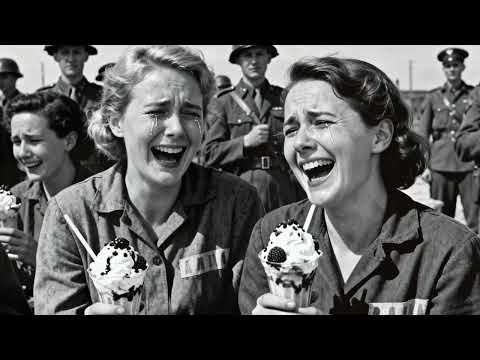
Louise looked down the long table. Mechthild Hartman, a nursing assistant from Essen, had tears streaming silently down her cheeks. Thea Schneider stared at the cart as if it might vanish. Hera Becker, the former radio operator, whispered something Louise couldn’t hear over her own thundering heartbeat.
They had been told so many things about Americans. Propaganda had been specific and relentless: Americans were cruel. They tortured prisoners. They starved captives and worked them to death. Most importantly, they had been assured that America itself was on the verge of starvation—that the German U-boat campaign had cut off supply lines, that American citizens were going hungry while their government wasted resources on a war it could not win.
Yet here stood a young man, perhaps nineteen, asking them to choose between six different toppings. Not one topping. Not a simple yes or no. An actual choice among abundance.
Louise had been captured four months earlier in Belgium as German forces retreated. She had spent those months expecting the brutality she had been promised. Instead, she had received adequate food, warm shelter, and treatment that, while not friendly, had been consistently humane. But this moment felt different. This felt like something was breaking inside her chest. Some fundamental understanding of the world that had held her together through the chaos of war and capture.
The corporal approached their table, pushing the cart slowly, his expression patient and kind. He stopped in front of Rosemary Krauss, a supply officer who had always maintained the strictest military bearing among them. “Ladies,” he repeated gently in German, “what toppings would you like?”
Rosemary opened her mouth to speak, but no words came out. Instead, she began to cry.
November 9th, 1944. The transport truck rattled through the Pennsylvania countryside under a gray autumn sky, carrying its cargo of 53 German women toward an uncertain future. Louise pressed her face against the small window, watching bare trees pass in endless succession. Four days earlier, she had been processed through a facility in New York Harbor. Before that, a week on a transport ship across the Atlantic. Before that, a holding camp in France, where she and the other women had waited for two months, wondering what would become of them.
None of them had expected to survive capture. The training they had received, the propaganda they had absorbed—all of it had prepared them for immediate execution or torture at the hands of American forces. Instead, they had been fed, given medical examinations, and treated with a businesslike efficiency that was almost more disturbing than cruelty would have been.
Mechthild Hartman sat beside Louise on the hard bench, her medical bag still clutched in her arms despite having been told repeatedly that she would not need it. She had served as a nursing assistant with the Wehrmacht Medical Corps, treating wounded soldiers as they retreated through Belgium and France. At twenty-five, she was among the older women in their group, and her face bore the tired lines of someone who had seen too much suffering in too short a time.
“We should have died,” she whispered to Louise in German, her voice barely audible over the truck’s engine. “Why are we still alive?”
It was a question many of them had asked during the long journey across the ocean. Thea Schneider, sitting across from them, had her own theory. “They are keeping us alive to make an example of us,” she had said during one of their whispered conversations in the ship’s hold. “They will parade us through their streets so their citizens can throw stones at us. They will put us on trial for the crimes of our country.”
Hera Becker, the radio operator from Hanover, had disagreed. “If they wanted to make examples of us, they would have kept us in New York,” she had argued. “They are sending us somewhere remote because they do not want their citizens to know we exist.”
The truck slowed and turned through a gate flanked by guard towers. Louise caught her first glimpse of Compound 7—a collection of wooden barracks surrounded by wire fencing. It looked nothing like the death camps they had imagined. It looked almost mundane, like a military facility that could have existed anywhere in any country. American soldiers stood at attention as the truck passed, their faces showing curiosity rather than hatred. One of them, a young man with red hair, actually nodded at the women as they drove by.
The truck stopped in front of the largest barracks. An American officer—a woman in her thirties, wearing the insignia of a captain—waited at the entrance with two other female officers beside her. This surprised Louise more than anything else so far. They had sent women to oversee women prisoners. It suggested a level of consideration that contradicted everything they had been taught about American barbarism.
The captain stepped forward as the rear gate of the truck opened. Her voice was firm, but not unkind. “Welcome to Compound 7. My name is Captain Rebecca Morrison. You will be treated in accordance with the Geneva Convention. You will receive adequate food, shelter, and medical care. You will be expected to follow camp regulations and maintain the standards of military discipline, but you will not be mistreated.”
Several of the German women exchanged glances. Ilsa Weber, one of the younger prisoners at twenty-one, whispered urgently, “It is a trick. They are lying to make us lower our guard.”
The first two weeks passed in a strange fog of expectation. Louise waited for the cruelty to begin, but it never came. The barracks were clean and heated. Each woman received two wool blankets and a foot locker. The work—laundry, kitchen duties, filing—was not the brutal labor they had feared. Louise was assigned to the camp library under a middle-aged sergeant named Patricia Hughes, who spoke no German but communicated through patience and gestures.
During meals, the women sat together speaking in hushed German, analyzing every detail for signs of deception. Mechthild insisted the Americans were fattening them up for some unrevealed purpose. Thea believed they were being studied through hidden windows. “If the propaganda about American cruelty is false,” Hera whispered one night, “what else might be false?” The question was too dangerous to answer.
December brought snow and small kindnesses that accumulated like drifts. Private Chen brought Ilsa a scarf and a tin of honey when she coughed through roll call. Corporal Mitchell taught the laundry workers English words from magazine pictures. Sergeant Hughes left a children’s picture dictionary on Louise’s table without comment. Each gesture forced them to confront an unbearable possibility: if this treatment was genuine, what did that mean about the cause they had served?
Then came March 15th. When the crying finally subsided, Mechthild was the first to speak, her voice hoarse. “Chocolate syrup and whipped cream, please.” One by one, the others chose. Rosemary asked for caramel and nuts. Louise heard herself say in halting English, “Caramel, please, and nuts.”
When all fifty-three women held their sundaes, no one ate. They stared at the glass bowls, at the care taken in their preparation. Then Johanna took the first bite, tears running down her face as she smiled. That impossible combination of weeping and joy broke the final barrier.
Later, the guilt was suffocating. “We ate dessert with choices while Germany starves,” Mechthild whispered. Hera burned her letter rather than send it. How could they write of kindness while their families scraped for bread?
April brought newspapers with photographs from liberated camps. Louise gripped the library table, trembling. This was not propaganda. This was planned, deliberate, policy. “We wore the uniform,” Hera said. “We are complicit whether we knew or not.”
When Johanna asked Captain Morrison why they were shown kindness, the answer only deepened the weight. “Because kindness is not something you have to earn. It is something we choose to give.”
On May 20th, when repatriation was announced, Louise stood on shaking legs. “What if some of us do not wish to return?” Seventeen women rose with her.
Twenty years later, Louise laid out six toppings for her children in their Lancaster kitchen. Emma chose chocolate and whipped cream; Thomas chose caramel and nuts. “Mommy, why are you crying?” Emma asked.
Louise smiled. “Because sometimes the smallest acts of kindness create the biggest changes.”
What small choice in your own life has quietly changed everything?
Report this article
Select a reason for reporting:






