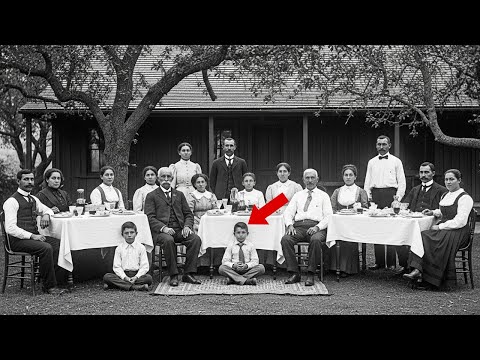
The attic smelled of cedar and secrets. Rebecca Martinez had spent three days sorting through her late great-aunt Helen’s Victorian home in Napa Valley, cataloging a century of meticulously labeled family history. Every photograph, every letter, every birth certificate—Helen had documented it all with the precision of a woman who believed that memory was a sacred trust.
Then Rebecca opened the trunk.
It was tucked beneath a window, its brass fittings tarnished green with age. Unlike the rest of the house, this trunk held no careful order. Just dusty linens, outdated household items, and a stack of photographs that didn’t appear in any of Helen’s albums.
One image stopped her cold.
July 4th, 1901. The Martinez family gathered on the grounds of their original farmhouse—fifteen faces, three generations, a table laden with food. The composition was flawless. The lighting, perfect. Every person clearly visible, every smile genuine.
Rebecca’s trained eye, honed by years as a genealogist, scanned the faces. She identified her great-great-great-grandparents, Carlos and Maria, seated at the center. Her great-great-grandfather Diego stood behind them. Cousins, aunts, uncles—all accounted for.
Then she reached the front row.
Among the Martinez children sat a boy of about eight or nine. His features didn’t match the family’s characteristic dark eyes and strong jaw. His clothing was as fine as the others. His placement—front and center—suggested belonging, not mere presence.
Rebecca checked her notes. Then she checked again.
The boy wasn’t in any of Helen’s records.
No birth certificate. No family tree entry. No caption in any album. A child, clearly loved and included, had been erased from the family’s carefully curated history.
She spent the next day cross-referencing every document in Helen’s archive. Nothing. The boy simply didn’t exist—except in this one photograph, hidden away as if the image itself held a truth too painful to display.
Why would Helen, the family’s legendary historian, omit a child who sat among her ancestors with such ease? And why had this photograph been buried in a trunk instead of framed on a wall?
Rebecca zoomed in on the boy’s face. His smile was wide, genuine. He leaned slightly toward the cousin beside him, comfortable and unguarded.
Someone had loved this child enough to include him in the family’s most formal portrait—then loved him enough to forget him.
The contradiction gnawed at her. In her career, Rebecca had learned that omissions in family records rarely happened by accident. They were choices. Sometimes shame. Sometimes grief.
She thought of the influenza epidemic of 1901–1902, a disease that had swept through California’s immigrant communities. Had this boy been a victim? Had his death been so devastating that the family couldn’t bear to see his face?
Or was there another reason—one that involved a secret the Martinez family had taken to their graves?
Rebecca closed the trunk and stood. Outside, the Napa Valley sun was setting, casting long shadows across the vineyards her ancestors had planted. Tomorrow, she would begin searching beyond Helen’s archive—into church records, census data, and the memories of relatives who might still remember a name that had been whispered but never written.
The boy in the photograph had waited 123 years to be found.
Rebecca wasn’t about to let him wait any longer.
Dr. Patricia Chen at the Napa County Historical Society recognized the Martinez name before Rebecca finished speaking it. “One of the founding families,” she said, already pulling a thick file from the archive shelf. “We have immigration papers, property deeds, school enrollments—more than most families from that era.”
Rebecca spread the 1901 photograph across the reading table. Dr. Chen leaned in, her expression shifting from professional curiosity to something quieter. “This is a remarkable image. The composition alone—whoever took this knew what they were doing.”
“That’s what bothers me,” Rebecca said. “It’s too good to have been forgotten. And the boy in the front row—he’s not in any of my family’s records.”
Dr. Chen examined the child’s face for a long moment. Then she reached for a different box. “Census records might help. Early California families took in wards, foster children, all sorts of informal arrangements. It wasn’t always written down.”
She pulled a microfilm reel from 1900—the year before the photograph. “Here,” she said, pointing to a grainy entry. “The Martinez household. Two children listed as ‘wards.’ Not sons or daughters—wards.”
Rebecca’s pulse quickened. “Names?”
“One is illegible. The other—” Dr. Chen squinted. “Thomas. No surname given.”
Thomas. A name, at last. But a first name alone wouldn’t be enough.
The school records came next. A one-room schoolhouse register from the 1901–1902 term listed a Thomas Martinez among the enrolled children. The surname was there, plain as day—the family had claimed him openly for school purposes.
“He attended for one year,” Rebecca murmured, tracing the faded ink. “Then nothing. No record after 1902.”
Dr. Chen’s voice softened. “There was an influenza outbreak that winter. We lost a great many children.”
Rebecca sat back, the pieces sliding into place. A ward named Thomas. Enrolled at school as a Martinez. Gone by 1902. “He died,” she said quietly. “That’s why he was erased—not out of shame, but out of grief.”
But grief alone didn’t explain the baptismal records she’d find next—or the letter written in Spanish, still folded in a wooden cabinet, that would give the boy his full name and reveal just how completely the Martinez family had claimed him as their own.
Father Miguel Rodriguez at St. Helena Catholic Church brought out the baptismal register almost reverently. He set it on the table between them and turned the brittle pages with careful fingers. “The Martinez family baptized several children here,” he said. “But I believe you’re looking for one in particular.”
Rebecca scanned the entries until she found it: Thomas Miguel Santos, baptized as an infant in 1892, with a notation in the margin that read, in Spanish, raised by the Martinez family as their own son.
The mother’s name was listed as Elena Santos, deceased. The father was unknown.
“An orphan,” Father Rodriguez explained. “The church often arranged placements like this. Informal adoptions were common in immigrant communities. Legal paperwork was expensive, and families simply took children in when they were needed.”
Rebecca felt the weight of the discovery settle over her. Thomas Santos. A child with no parents, taken in by her ancestors and given their name. He had been loved. He had belonged.
But the next register told a different story.
Father Rodriguez found the death record without being asked. He had known, Rebecca realized, what she would find before she found it. Thomas Miguel Santos died in February 1902 of influenza. He was nine years old. The record noted that he was buried in the Martinez family plot and mourned as a beloved son.
“Eight months,” Rebecca whispered. “Eight months after that photograph.”
The priest nodded. “The epidemic was brutal that winter. We lost so many children. Families who had already suffered often found it easier to stop speaking of their losses. It was a way of surviving.”
Rebecca thought of the trunk. Of the photograph, hidden away rather than displayed. Not erased out of shame—erased because looking at his face was too painful.
She spent the following days searching Helen’s collection with new eyes. In a filing cabinet she had previously skimmed, she found a bundle of condolence letters, tied with faded ribbon. One was from Thomas’s schoolteacher, describing a bright boy who translated for other Spanish-speaking children. Another came from a family friend who recalled Thomas’s talent for music and his gift for making others laugh.
Then she found the letter from Maria Martinez to her sister in Mexico, written six months after Thomas’s death.
I cannot look at photographs of our happy days without feeling heartbroken. Thomas is in all our most precious memories, but seeing him so joyful and full of life makes his absence hurt more deeply.
Rebecca read the passage twice. There it was—the reason the photograph had been buried. Diego Martinez had argued to keep the images, insisting that future generations should know about all the children they had loved. But Maria’s grief had won in the end, at least publicly.
She found the annual journal entries Maria had kept on the anniversary of Thomas’s death. Prayers. Memories. Updates about family events Thomas would have experienced had he lived. The family had set a place for him at gatherings for years after he was gone.
Thomas had not been forgotten. He had been mourned so fiercely that his name became a private language of grief, spoken only in whispers.
Rebecca set down the journal and looked out the window at the vineyards her ancestors had planted. Somewhere beneath that soil lay a boy who had been loved completely and lost too soon. He deserved more than a trunk and a silence.
Rebecca found the photographer’s records in a box donated to the California Historical Society. William Morrison, a traveling portrait artist, had logged every session. The entry for July 4th, 1901, read: ‘Martinez family—special commission. Include all children, including adopted son Thomas Santos. Father requests prominent placement. Multiple exposures taken.’
Morrison’s notes revealed more. Diego Martinez had ordered extra prints to send to relatives in Mexico. ‘Family wants the boy remembered,’ Morrison had written. ‘He is treated as their own.’
Then came a follow-up entry from early 1902: Diego Martinez requests additional prints. Young Thomas has passed. Wants copies for family as memorial.
Rebecca sat back, stunned. Thomas hadn’t been hidden. He’d been celebrated—then mourned so deeply that the photograph became a relic of both joy and grief.
She reached out to her great-uncle Roberto, 91, the youngest son of Diego. His voice cracked when she mentioned Thomas’s name. ‘I wondered when someone would finally ask,’ he said. ‘My father talked about him sometimes, always with such sadness.’
Roberto revealed a wooden toy horse Diego had carved for Thomas’s eighth birthday. And a letter in a child’s handwriting: Dear Mama Maria and Papa Diego, Thank you for making me your son. I am happy to live with you and my brothers and sisters. I love you very much. Your son, Thomas.
Rebecca’s eyes blurred. Thomas had known he was loved. He had called them Mama and Papa. He had been a Martinez in every way that mattered.
She returned to Helen’s house and spread every piece of evidence across the dining table. The photograph. The baptismal record. The death certificate. The letters. The toy horse.
Then she did what Helen never could. She wrote Thomas’s story into the family history—not as a footnote, but as a chapter.
She contacted relatives across California and Mexico. Many had copies of the 1901 photograph, passed down without explanation. Now they had a name. Thomas Miguel Santos Martinez, beloved son, 1892–1902.
On July 4th, 2024, exactly 123 years after the original photograph, the Martinez family gathered in Napa Valley. They placed a new headstone on Thomas’s grave. They framed the photograph with a caption identifying every face—including the boy who had waited a century to be remembered.
Rebecca stood before her relatives and read Thomas’s letter aloud. When she finished, no one spoke. Then Roberto, leaning on his cane, said softly, ‘Welcome home, Thomas.’
The family decided to honor him at every reunion. His name would be spoken. His story would be told. The trunk that had hidden him for so long would hold no more secrets.
Rebecca closed the lid one last time and looked at the photograph on the wall. Thomas smiled back at her, front and center, exactly where he belonged.
What forgotten face in your own family album might be waiting for you to ask the right questions?
Report this article
Select a reason for reporting:






