You’ve probably heard the story: a pope delivers a fiery speech, and the Christian world rises as one to reclaim the Holy Land. Knights take up the cross, peasants abandon their fields, kings empty their treasuries. For two centuries, wave after wave of European armies crash into the Middle East in the name of faith. That’s the version most of us learned. But when you pull back the curtain and follow the money, a very different picture emerges. The Crusades were never really about the Holy Land—not at their core.
Oh, sure, religion was the packaging, the branding. But underneath that shiny exterior was something far more familiar: power, profit, and a ruthless game of political survival that stretched from the Vatican to the merchant docks of Venice, from the feudal estates of France to the counting houses of the Knights Templar. The Crusades were, in many ways, the first great corporate merger of faith and finance. And the dividends were staggering.
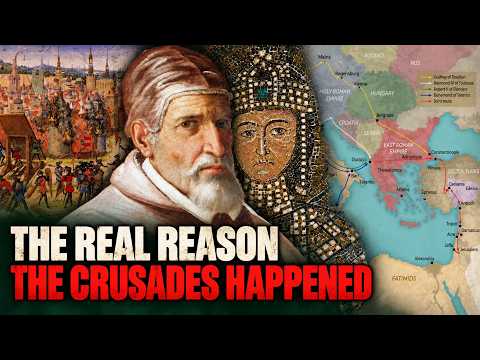
To understand why they really happened, you first need to understand the world just before them. Europe in the late 11th century was an absolute mess—a patchwork of feudal kingdoms and warring nobility, loosely held together by two competing forces: the church and the crown. And these two forces were at each other’s throats.
For decades leading up to 1095, the papacy had been locked in a brutal power struggle with the Holy Roman Emperor. This conflict, known as the Investiture Controversy, was about something that sounds mundane but was actually the central question of medieval politics: Who gets to appoint bishops? In the medieval world, bishops weren’t just religious figures—they controlled land, collected taxes, ran courts. A bishop was often more powerful than a local lord. So whoever controlled the appointment of bishops effectively controlled the political infrastructure of Europe.
For centuries, that power had belonged to kings and emperors. But then came Pope Gregory VII. He ascended to the papacy in 1073 with a radical vision: the church should be independent of secular rulers entirely. He issued a document declaring the pope to be the supreme authority on earth. According to Gregory, the pope had the right to depose emperors, to absolve subjects from their loyalty to unjust rulers. The pope answered to no one.
You can imagine how well that went over with the Holy Roman Emperor Henry IV, who promptly told Gregory to step down. Gregory responded by excommunicating Henry. Henry responded by marching on Rome. And so began a decades-long conflict that tore the fabric of European Christendom apart.
By the time Pope Urban II took office in 1088, the papacy was in a precarious position. The Investiture Controversy was still simmering. The pope had been forced out of Rome by a rival antipope backed by the emperor. Urban was essentially a pope in exile, operating from southern France, trying to rebuild the credibility of an institution that had been humiliated. He needed a win. He needed something that would rally all of Christendom behind him, something that would make kings and emperors defer to his authority. Something that would make the papacy the undisputed center of the western world.
And he found it. On November 27th, 1095, at the Council of Clermont in central France, Pope Urban II delivered what would become one of the most consequential speeches in human history. We don’t have a transcript—no one wrote it down word for word at the time. The accounts we have were written years later, each shaped by the political interests of the writer. But the general thrust is well established. Urban painted a vivid picture of Christian suffering in the east. He described the persecution of pilgrims, the desecration of holy sites. He called on the knights of France to stop fighting each other and turn their swords toward a common enemy. And the crowd reportedly erupted with the famous cry: “Deus vult! God wills it!”
But here’s what’s critical to understand: Urban’s speech was not some spontaneous outpouring of religious conviction. It was a calculated political move—and it worked brilliantly. By launching the crusade, Urban accomplished several things at once.
First, he positioned himself as the leader of all Christendom, not just the Western church but potentially the Eastern Church as well. In 1054, just 41 years before Clermont, the Christian world had been split in two by the Great Schism. The Roman Catholic Church in the West and the Eastern Orthodox Church based in Constantinople had formally severed ties. Urban saw the crusade as an opportunity to heal that rift—or more accurately, to absorb the Eastern Church under papal authority. If he could send a western army to rescue the Byzantine Empire from the advancing Seljuk Turks, the Eastern Church would owe him. The patriarch of Constantinople would be in his debt, and gradually the pope could reassert his claim as the supreme head of all Christianity.
Second, and perhaps even more important, the crusade gave Urban a weapon against the Holy Roman Emperor. By rallying the nobility of Europe under the banner of the cross, Urban was building a power base independent of any king or emperor. The crusaders swore their oaths to the Pope, not to their feudal lords. They wore the cross, the symbol of papal authority. And when they conquered territory in the Levant, those new crusader states owed their existence to the Pope’s call, not to any European monarch. In one stroke, Urban had created a parallel power structure that bypassed the traditional feudal hierarchy entirely.
And third, the Crusade solved a very practical problem that had been plaguing Europe for decades: violence. Europe in the 11th century was drowning in it. The feudal system had created a warrior class of knights and minor nobles whose entire identity was built around combat. When they weren’t fighting external enemies, they fought each other. They raided villages, burned crops, terrorized peasants. The church had tried to contain this violence through initiatives like the Peace of God and the Truce of God, which attempted to limit warfare on certain days and protect certain classes of people. But these efforts had largely failed. The knights kept fighting.
Urban’s genius was to redirect that violence outward. Instead of fighting your Christian neighbor, go fight the infidel in the east. Instead of burning down your rival’s castle, go liberate Jerusalem. It was elegant. It was ruthless. And it had nothing to do with saving souls.
Now, let’s talk about the people who actually answered Urban’s call, because their motivations tell us even more about what the Crusades were really about. The traditional narrative suggests that crusaders were driven primarily by religious devotion. And for some of them, that was undoubtedly true. Medieval Christianity was a deeply immersive, all-encompassing worldview. The promise of eternal salvation and the remission of sins was a powerful motivator. But when you look at the demographics of who actually went on crusade, a different picture emerges.
There was a widely held theory popularized by French historian Georges Duby that the Crusades were largely populated by the younger sons of European nobility. By the 11th century, the practice of primogeniture was spreading across parts of northern France and England. Primogeniture meant that the eldest son inherited the entire family estate—the land, the title, the wealth. Younger sons got nothing. They were trained as knights, educated in warfare, and then essentially told to fend for themselves. This created a massive class of well-armed, well-trained, and deeply frustrated young men with no land, no income, and no future. For these men, the crusade was not a spiritual pilgrimage. It was an exit strategy. It was a chance to carve out a territory of their own in the rich lands of the east, to become lords and barons in a place where the old inheritance rules didn’t apply.
Now, more recent scholarship has complicated this picture somewhat. Historians like Jonathan Riley-Smith have shown that many crusaders were actually firstborn sons, men of means who mortgaged their estates and made enormous financial sacrifices to go on crusade. And it’s true that southern France and Germany, two of the regions that produced the largest numbers of crusaders, didn’t actually practice primogeniture at the time. So the younger son’s theory doesn’t explain everything. But what it does capture is a fundamental truth about the Crusades: economic opportunity was always part of the equation. Whether you were a landless knight looking for your first fief or a wealthy baron hoping to expand your holdings, the east represented possibility. It represented wealth. And that wealth was very, very real.
Because here’s something that often gets overlooked in the religious framing of the Crusades: the Eastern Mediterranean was one of the richest regions on Earth. The trade routes that connected Europe to Asia—the famous Silk Road and the maritime spice routes—all passed through this territory. Spices, silk, sugar, precious stones, perfumes—these were luxury goods that fetched astronomical prices in European markets, and they all flowed through ports and cities that were now under Muslim control. For European merchants, the Crusades weren’t just about liberating holy sites. They were about liberating trade routes.
And no one understood this better than the Italian city-states: Venice, Genoa, Pisa. These three cities would become the great beneficiaries of the Crusade era. And their involvement reveals the true economic engine behind the entire enterprise.
Let’s start with Venice, because Venice’s role in the Crusades is perhaps the most revealing example of how commerce and holy war became inseparable. Venice in the 11th century was already a powerful maritime republic. It sat at the crossroads of east and west, and its merchant fleet was one of the largest in the Mediterranean. The Venetians had long traded with the Byzantine Empire and with Muslim merchants in the Levant, and they had grown wealthy doing so. But they wanted more. They wanted to cut out the middlemen. They wanted direct access to the source of the goods that made them rich. And the Crusades gave them the perfect opportunity.
From the very beginning, the Italian city-states provided the logistical backbone of the crusade movement. Crusaders needed ships to cross the Mediterranean. And Venice, Genoa, and Pisa had ships—but they didn’t provide them for free. They charged enormous fees for transportation. And more importantly, they negotiated trading privileges in every city the crusaders conquered. When the crusaders took a port city, the Venetians got a quarter of it. Literally. They received entire neighborhoods—warehouses, docks, and markets—all tax-free, all under Venetian jurisdiction. These trading enclaves became the foundation of a commercial empire that would dominate Mediterranean trade for centuries.
And as the Crusades progressed, the Italian city-states became more and more brazen in pursuing their commercial interests. The most stunning example of this came during the Fourth Crusade, which began in 1202. This crusade was supposed to target Egypt, which was seen as the key to retaking Jerusalem. But the crusaders needed ships, and once again they turned to Venice. The Doge of Venice at the time was a man named Enrico Dandolo. He was in his 90s, nearly blind, and absolutely ruthless. Dandolo agreed to provide a fleet of ships to transport the crusaders. But the price was staggering: 85,000 silver marks.
When the crusaders couldn’t come up with the full amount, Dandolo proposed an alternative. Instead of heading straight to Egypt, the crusade would first stop at Zara, a Christian city on the Adriatic coast that was a commercial rival of Venice. The crusaders would attack Zara, hand it over to Venice, and that would cover part of the debt. Now, keep in mind, Zara was a Christian city. It was under the protection of the King of Hungary, who was himself a crusader. Attacking it was an act of war against a fellow Christian. Pope Innocent III, who had called the Crusade in the first place, was horrified. He excommunicated the entire crusade army. But the attack went ahead anyway, because the Venetians held the ships, and without the ships, the crusade was dead in the water. Literally.
But it gets worse. After sacking Zara, the crusade was diverted again. An exiled Byzantine prince named Alexios approached the crusaders with an offer. If they helped him retake the throne of Constantinople from his usurping uncle, he would pay them 200,000 silver marks, provide 10,000 Byzantine soldiers for the crusade, and submit the Eastern Orthodox Church to papal authority. It was too good to refuse. And so in 1203, the Fourth Crusade, which was supposed to be fighting Muslims in Egypt, instead laid siege to Constantinople, the greatest Christian city in the world.
When Alexios was installed on the throne and couldn’t pay what he’d promised, the crusaders attacked Constantinople a second time. On April 12th, 1204, they breached the walls and unleashed three days of unrestrained looting, destruction, and violence that shocked the medieval world. Churches were desecrated, priceless relics were stolen, libraries were burned. The accumulated wealth of centuries—the gold and silver and art of the Byzantine Empire—was carted off to Venice, Genoa, and the treasuries of French barons. Historian Savvas Neocleous has argued that the real reason for the diversion to Constantinople was neither religious nor chivalric but financial. It was, at its core, about the payment of outstanding debts.
The sack of Constantinople in 1204 is perhaps the single most damning piece of evidence against the idea that the Crusades were primarily about faith. Here was a crusade that never reached the Holy Land, that attacked two Christian cities, that was excommunicated by the very pope who called it, and that ultimately served the commercial interests of Venetian merchants. The gold and silver carried off from Constantinople provided the economic fuel for the prosperity of the Italian city-states. Venice’s golden age as a commercial and maritime power was born directly from this event. And the Byzantine Empire, which had been the bulwark of Christendom against Muslim expansion for centuries, never recovered. It limped along for another 250 years as a shadow of its former self before finally falling to the Ottoman Turks in 1453. Some historians have argued that by destroying Constantinople, the Fourth Crusade actually made the eventual Ottoman conquest of southeastern Europe possible. The crusaders, in their pursuit of profit, may have done more damage to Christendom than any Muslim army ever did.
But Venice was not the only party that got rich from the Crusades. Let me tell you about an organization that took the fusion of faith and finance to an entirely different level. I’m talking about the Knights Templar.
The Templars were founded around 1119 by a French knight named Hugh de Payens. Their original mission was simple and genuinely noble: protect Christian pilgrims traveling to the Holy Land. The roads between the port of Jaffa and Jerusalem were dangerous, crawling with bandits, and pilgrims were frequently robbed or killed. A small group of warrior monks sworn to poverty and chastity would patrol these roads and keep the pilgrims safe. That was the idea. What actually happened was something entirely different.
Within a few decades, the Knights Templar had transformed from a small band of bodyguards into one of the wealthiest and most powerful organizations in the medieval world. And they did it not through warfare, but through banking. A pilgrim or a crusading lord who wanted to travel to the Holy Land faced a serious practical problem: you couldn’t carry large amounts of gold or silver across thousands of miles of hostile territory. So instead, you would walk into a Templar preceptory in London or Paris, deposit your money, and receive in return a coded letter of credit. You then traveled to the Holy Land, presented the letter at the Templar House in Jerusalem, and withdrew an equivalent sum. No coins had crossed the Mediterranean. This was, by most historians’ reckoning, the first functioning international banking transfer in western history—and it was invented by men who had each individually sworn a vow of poverty.
The Templars charged a fee, typically 1 to 2% of the deposited amount. They managed estates for absent crusaders, provided loans to kings and nobles, collected rents and taxes, and even managed the French crown’s treasury for a time. At their peak, they had a network of preceptories stretching from London to Jerusalem, from Portugal to the borders of Poland. They owned farms, vineyards, mills, entire villages, and their own fleet of ships. They were, in everything but name, a multinational financial corporation operating under a religious charter. One estimate suggests that by the mid-13th century the Templars were managing assets worth roughly the equivalent of what major European banks handle today, adjusted for the size of the medieval economy.
But here’s the thing about accumulating that much power: eventually someone is going to want to take it from you. By the early 14th century, the crusader states had fallen. The Templars’ original military mission was over, but their wealth remained, and it made them a target. King Philip IV of France, who was deeply in debt to the Templars, decided to solve his financial problems by destroying the order. On Friday, October 13th, 1307, Philip ordered the simultaneous arrest of every Templar in France. They were charged with heresy, blasphemy, and a catalog of other offenses. Under torture, many confessed. In 1312, Pope Clement V, who was largely under Philip’s control, formally dissolved the order. Their assets were seized, their leaders burned at the stake, and the most sophisticated financial institution of the medieval world was wiped out virtually overnight.
But the banking innovations they created survived them. The letters of credit, the deposit systems, the international transfers—all of these concepts were adopted and refined by Italian banking houses, particularly the Medici, and eventually evolved into the modern banking system we know today. In a very real sense, the Crusades didn’t just reshape the map of the medieval world. They reshaped the architecture of global finance.
Now, I want to zoom out for a moment and talk about the broader economic transformation that the Crusades set in motion, because this is where you really start to see how profoundly these campaigns changed the world in ways that had nothing to do with religion. Before the Crusades, European trade was largely local and regional. The Mediterranean was dominated by Muslim and Byzantine traders, and European merchants were mostly confined to their own coastlines. The Crusades blew this open. For the first time, large numbers of Europeans traveled to the east and experienced firsthand the wealth and sophistication of the Islamic world. They tasted spices they’d never encountered, wore silks they’d never seen, used sugar, which was virtually unknown in Europe before the Crusades. And when they came home, they wanted more.
This surge in demand for Eastern goods transformed the European economy. It created new trade routes, enriched the Italian city-states, stimulated the growth of towns, and gave rise to a new merchant class that would eventually challenge the feudal aristocracy for power. It created new financial instruments—letters of credit, bills of exchange, joint stock ventures—all designed to facilitate the increasingly complex business of long-distance trade. The wealth that flowed into Venice and Genoa during the 12th and 13th centuries would eventually fund the Renaissance. The artistic and intellectual explosion that transformed Europe was built in significant part on profits from crusade-era commerce.
And then there’s the question of land. The crusader states established in the Levant—the Kingdom of Jerusalem, the County of Tripoli, the Principality of Antioch, and the County of Edessa—were not just military outposts. They were feudal territories complete with lords, vassals, and peasants. European nobles who conquered these territories became rulers in their own right, with their own courts, armies, and sources of revenue. For a younger son who had no hope of inheriting back home, a lordship in the Holy Land was a life-changing opportunity. And even for those who already had estates in Europe, the crusader states offered a chance to expand their holdings and increase their wealth.
But the economic motivations behind the Crusades weren’t limited to the people who went on them. The monarchs who stayed home also had their own reasons for supporting the enterprise. When a powerful noble left on crusade, he often had to mortgage his estates to fund the journey. Who did he mortgage them to? Usually the crown or the church. If the noble died on crusade—and many did—that land might never be redeemed. The Crusades were, in this sense, a mechanism for the centralization of royal power. As the feudal nobility spent itself into bankruptcy fighting in the east, the monarchies of Europe quietly consolidated their control over the land and resources that the departing lords left behind.
Let’s also talk about something that rarely gets discussed in popular accounts of the Crusades: the role of debt. Crusading was phenomenally expensive. A knight going on crusade needed armor, weapons, horses, servants, provisions, and enough money to sustain himself for years. The cost of participating in the First Crusade has been estimated at roughly four to five times a knight’s annual income. Most crusaders had to borrow heavily to finance their participation. And who lent them the money? The church, the Italian city-states, and eventually the Templars. This created a web of financial obligations that shaped the politics of the crusade movement in profound ways. Crusaders who couldn’t repay their debts became dependent on their creditors. Cities and territories that were conquered with borrowed money often ended up under the effective control of the lenders, not the warriors who had actually done the fighting. The entire structure of the crusade movement was, in many ways, a debt-driven enterprise. And like all debt-driven enterprises, it enriched the financiers far more than the fighters. The Italian merchants who transported the crusaders got paid whether the crusade succeeded or failed. The bankers who lent the money collected their interest regardless. The church, which offered spiritual rewards—indulgences and remission of sins—in exchange for participation, received very real material benefits. Crusaders donated land, money, and valuables to the church before departing, often as a condition of receiving the spiritual benefits of crusading. The papacy’s wealth and influence grew enormously during the crusade era, and that was not an accident.
And this brings us to something that I think is really important to understand about the Crusades. They were not a single event with a single cause. They were a system—a complex, self-reinforcing system in which religious fervor, economic opportunity, political ambition, and social pressure all worked together to produce wave after wave of military expeditions over the course of two centuries. Each crusade generated its own momentum. The first created the crusader states, which then needed to be defended, which required more crusades, which created more economic opportunities, which attracted more participants, which generated more debt, which enriched more bankers, which funded more expeditions. It was a cycle. And like all cycles, it served the interests of those at the top far more than those at the bottom. The peasants who marched barefoot to the Holy Land, the common soldiers who died of disease and starvation on the road, the ordinary people who were swept up in the fervor of crusading preaching—they were the raw material of the enterprise. Their faith was genuine. Their sacrifice was real. But the people who benefited most from their devotion were not the ones carrying crosses through the desert. They were the ones sitting in boardrooms in Venice, counting gold in Templar vaults, and issuing proclamations from the papal throne.
Now, I don’t want to suggest that religion played no role whatsoever. That would be going too far. The medieval world was a profoundly religious place. Faith was not just a personal belief but a social structure, an economic system, and a political framework all rolled into one. People genuinely believed in the spiritual rewards of crusading. They genuinely feared for their souls, and they genuinely believed that God had commanded them to liberate Jerusalem. To dismiss this dimension entirely would be to misunderstand the medieval mind. But what I am saying is that religion was never the only factor, and in many cases it wasn’t even the primary one. The Crusades were called by popes who needed political leverage. They were funded by merchants who wanted trade routes. They were fought by nobles who wanted land. They were financed by bankers who wanted interest. And they were sustained by a system that turned faith into a currency and holy war into a business model.
Consider the later crusades, particularly those of the 13th century. By this point, the initial religious enthusiasm had largely faded. The Fourth Crusade, as we discussed, attacked Constantinople instead of any Muslim target. The Fifth Crusade ended in disaster in Egypt. The Sixth Crusade was led by Frederick II, the Holy Roman Emperor, who was actually excommunicated at the time he went on crusade. He recovered Jerusalem not through warfare but through negotiation with the Sultan of Egypt—a diplomatic achievement that was promptly condemned by the Pope because Frederick had accomplished it without papal blessing. The Seventh and Eighth Crusades, led by King Louis IX of France, were catastrophic failures that accomplished nothing beyond the death or capture of thousands of crusaders. By the time the last crusader stronghold at Acre fell in 1291, the movement had been drained of its religious energy. What remained was the commercial infrastructure it had built—the banking systems, the trade networks, the political alliances—and the precedent that European powers could project military force into distant lands in pursuit of economic interests wrapped in ideological justification.
And that precedent, I would argue, is the Crusades’ most enduring legacy. Because the model they established—the use of moral and ideological rhetoric to justify military campaigns that primarily serve economic and political interests—didn’t die with the fall of Acre. It lived on in the Age of Exploration, when European powers colonized the Americas, Africa, and Asia under the banner of spreading Christianity while extracting enormous wealth. It lived on in the imperial projects of the 19th century, when European nations carved up the globe in the name of civilization while exploiting resources and labor. And some would argue it lives on today, in modern conflicts where ideological justification is used to mask economic and strategic interests. The Crusades were, in many ways, the prototype for this kind of enterprise. They showed that you could mobilize entire societies by appealing to their deepest beliefs and then channel that energy toward goals that had very little to do with those beliefs. They demonstrated that faith could be monetized, that piety could be leveraged, and that the line between holy war and hostile takeover was thinner than anyone wanted to admit.
So the next time someone tells you the Crusades were about religion—about reclaiming the Holy Land for Christendom, about the glory of God—remember the Venetian merchants haggling over trading rights in conquered cities. Remember the Templars inventing international banking in their stone fortresses. Remember Pope Urban II, a man in exile, using a speech about salvation to rebuild his political empire. Remember the sack of Constantinople, where Christians slaughtered Christians for gold. Remember the debts, the mortgages, the letters of credit, and the joint stock ventures that made the whole thing possible. The Holy Land was the destination, but it was never the reason. The reason was what it always is: power and money. And the people who understood that best were the ones who profited most. Two hundred years of warfare, hundreds of thousands of lives lost, entire civilizations disrupted. And at the end of it all, the biggest winners weren’t the pilgrims who prayed at the Church of the Holy Sepulchre or the knights who planted their banners on the walls of Jerusalem. The biggest winners were the bankers, the merchants, and the politicians who had figured out something that the world has never quite forgotten: that there is no force on earth more powerful or more profitable than a population that believes it is fighting for God.
If you made it this far, I’d love it if you could leave the word Deus vult in the comments. I’d love to see how many of you stayed until the very end. And if you haven’t already, please do subscribe to the channel—it would mean the world to me. I’ll see you in the next one.
Report this article
Select a reason for reporting:






