Rebecca Chan had spent eight years as a genealogist, but the mahogany desk at the estate auction felt different. The seller, Mrs. Dorothy Walsh, was liquidating a Victorian home in Boston’s Beacon Hill that had belonged to her family for over a century. “Most of these items were my great-grandmother’s,” she explained, watching Rebecca examine a leather satchel hidden in a secret drawer. “She was very secretive about her past. We never knew much about her early life.”
Inside the satchel, Rebecca found documents and a studio photograph that made her pause. Three young women, likely sisters, stood elegantly in what appeared to be an expensive Boston studio. The inscription read: “The Whitmore Sisters, June 1912.” Mrs. Walsh peered over her shoulder. “I’ve never seen this photo before. They look familiar, but I can’t place them.”
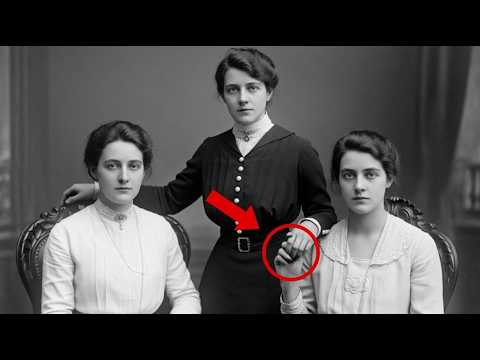
Rebecca studied the image closely. The eldest stood in the center, about 25, in a dark dress with pearl buttons. The middle sister, around 22, sat solemnly on a carved wooden chair. The youngest, perhaps 18, stood on the right in a light-colored dress. All wore serious expressions, typical of formal portraits of the era. But something caught Rebecca’s expert eye: the youngest sister’s left hand was positioned strangely, closed protectively around something small. Her fingers curved unnaturally, as if hiding an object in her palm.
“Mrs. Walsh, do you have a magnifying glass? I think there’s something hidden in this photograph.” The elderly woman fetched a lens from her late grandmother’s sewing kit. Under magnification, Rebecca could barely see the edge of a small metallic object peeking between the girl’s fingers.
Dr. Amanda Foster, a photography historian at Harvard, adjusted her professional equipment to examine the 1912 image. Rebecca had brought it to her lab the next morning, driven by curiosity about what the youngest sister might be hiding. “The photograph is definitely original,” Dr. Foster confirmed after studying the paper quality and printing techniques. “It was taken at Morrison’s Studio on Newbury Street. You can tell by their distinctive backdrop and lighting style.”
Rebecca leaned forward. “Can you see what she’s holding?” Dr. Foster placed the photo under a high-resolution microscope and carefully adjusted the lighting angles. Her expression grew more curious as details became clear. “This is really unusual. She appears to be holding a small piece of jewelry. It looks like a pendant or locket.” The object was now clearly visible: an ornate gold locket with intricate engravings, clutched tightly in the young woman’s palm. But what made it striking was a dark stain on the chain, which looked unmistakably like dried blood.
“Dr. Foster, why would someone hide a blood-stained locket in a family portrait?” Rebecca whispered. Dr. Foster removed her glasses thoughtfully. “That’s exactly what we need to find out. In 1912, formal portraits were expensive and carefully planned. Everything in the frame was intentional. If she’s hiding this locket, there’s a very important reason.” Dr. Foster had seen thousands of historical photographs but had never encountered one where someone so clearly concealed evidence of potential violence. “Rebecca, we need to identify these sisters. If there’s blood on that locket, it could be connected to a crime.”
The innocent family photo suddenly turned into something darker. Whatever the youngest Whitmore sister was hiding, she had chosen to preserve it in the most enduring way possible—in a photograph that would outlive her.
Two days later, Rebecca found herself in the basement archives of the Boston Public Library, surrounded by city directories, newspaper collections, and genealogical records. Dr. Foster had connected her with James Morrison, a local historian specializing in prominent Boston families of the early 1900s. “The Whitmores were well known in Boston society,” Morrison explained, pulling thick volumes from the shelves. “They owned several textile mills and had large estates in Beacon Hill and Back Bay.” His fingers traced the pages of 1912 social registers. “Here we are. Edward Whitmore, widower, with three daughters: Margaret, the eldest; Katherine, the middle; and Eleanor, the youngest. They lived at 47 Marlborough Street.”
Rebecca studied the photo again. Eleanor, the youngest sister holding the locket, would have been about 18 in 1912. “Do you have any records of the family after this time?” Morrison reached for another folder. “Here’s where it gets interesting. The family appears to have left Boston suddenly in late 1912. Their homes were sold, their business interests transferred elsewhere. It was highly unusual for a prominent family like this.”
Hours of searching newspaper archives revealed fragments of a story. In the Boston Globe of July 15, 1912, Rebecca found a small news item buried in the society pages: “Concern Grows Over Missing Businessman. Local authorities are investigating the disappearance of Mr. Charles Pemberton, a business associate of the Whitmore textile interests. Mr. Pemberton was last seen leaving the Whitmore residence on Marlborough Street on the evening of June 20. The family and business partners express growing concern, but strangely, no follow-up articles ever appeared.” The story of Charles Pemberton’s disappearance simply faded from the newspapers as if it had never happened.
June 20, Rebecca noted, checking the date of the photograph. The picture was taken just days before this man vanished from the Whitmore home. Morrison looked disturbed. “Missing persons cases involving prominent families were often handled very quietly in that era. Too much publicity could damage reputations and business interests.”
The next morning, Rebecca stood outside 47 Marlborough Street in Boston’s Back Bay, contemplating the elegant Victorian mansion that had once belonged to the Whitmore family. The building was now divided into luxury condominiums, but its original architectural details remained intact.
She met Mrs. Elizabeth Santos, who had lived in the building for 30 years and served as its unofficial historian. “I’ve always been fascinated by this building’s history,” she said, leading Rebecca to a small archive room. “Past residents collected quite a bit of information about the original owners.”
Mrs. Santos produced a file of documents, photographs, and newspaper clippings. The Whitmores’ sudden departure in 1912 was still talked about when she moved in during the 1990s. Neighbors said they left in the middle of the night, taking almost nothing with them.
Rebecca examined floor plans from 1912 and interior photographs. “Do you know anything about a man named Charles Pemberton who disappeared from this house?”
“Ah, yes.” Mrs. Santos pulled out a faded newspaper clipping. “This is from a much later article, 1952 I believe. A construction crew renovating the basement found something disturbing.” The article was brief but chilling: “Human Remains Found in Back Bay Home. Construction workers discovered human remains while renovating a basement on Marlborough Street. Police identified the remains as those of Charles Pemberton, a businessman who disappeared 40 years ago. The case has been reopened.”
Rebecca felt her pulse quicken. “And what happened with the investigation?”
“Here’s where it gets strange again,” Mrs. Santos replied. “Within days, the story vanished from the papers. The police file was sealed, and the case was closed without any public resolution. But neighborhood rumors persisted for decades.” She lowered her voice. “The story was that Charles Pemberton had been involved with one of the Whitmore daughters. When her father found out, there was a confrontation that ended badly.”
The family had covered up a murder and fled Boston to avoid scandal. Rebecca looked at the photograph again, examining Eleanor Whitmore’s hidden hand. The blood-stained locket suddenly seemed far more significant—a potential piece of evidence in a 40-year-old murder that had been kept secret until now.
Dr. Foster’s office at Harvard was crowded with Rebecca, James Morrison, and Detective Maria Rodriguez, a Boston police investigator specializing in cold cases. Rebecca had contacted Detective Rodriguez after discovering that the Pemberton case files, though officially closed, still existed in the police archive.
“Murder cases in that era were handled very differently,” Detective Rodriguez explained, studying copies of the original police reports. “Prominent families had significant influence over investigations, especially when scandal was involved.” She spread out documents from the sealed file. Charles Pemberton was a textile broker who worked closely with Edward Whitmore’s business interests. He was single, well-educated, and according to witnesses, courting one of the Whitmore daughters.
Dr. Foster was researching the social context of the era. In 1912, relationships between business partners and family members were closely scrutinized. An inappropriate romance could destroy business partnerships and family reputations alike.
Morrison found additional information about the Whitmore family dynamics. “Edward Whitmore was known to be extremely protective of his daughters after his wife’s death. Several society columnists mentioned his refusal of various suitors.”
Rebecca studied the police file more carefully. “This witness statement says Charles Pemberton was seen arguing with someone outside the Whitmore house the night he disappeared. The witness couldn’t identify the person he was arguing with, but described hearing raised voices and what sounded like a woman crying.”
Detective Rodriguez pointed to another document. “The initial investigation focused on Edward Whitmore as the primary suspect. But look at this. Two days into the investigation, the case was suddenly transferred to another detective and all progress stopped.”
“Political influence,” Morrison observed. “The Whitmores had connections throughout Boston’s power structure. They could easily have arranged for the investigation to be buried.”
Dr. Foster was re-examining the photograph under different lighting conditions. “There’s something else here,” she said, adjusting her equipment. “Look at Eleanor’s expression compared to her sisters. She looks terrified, while they look calm.”
Rebecca studied the faces more closely. Margaret and Katherine Whitmore appeared serious but composed. Eleanor’s eyes were wide, her expression strained with what looked like fear or guilt. “What if Eleanor witnessed what happened?” Rebecca asked. “What if she was holding evidence of her father’s crime?”
The forensic lab at the Massachusetts State Police in Sudbury felt sterile and modern compared to the historical archives Rebecca had been exploring. Detective Rodriguez arranged for them to meet Dr. Patricia Kim, a forensic expert specializing in historical evidence analysis. “This is highly unusual,” Dr. Kim explained, preparing to examine high-resolution images of the locket in Eleanor’s hand. “We rarely get to analyze potential evidence over a century old, especially when preserved in a photograph.”
Using advanced digital enhancement techniques, Dr. Kim created detailed images of the locket and its chain. The results were stunning and disturbing. “The stains on the chain are consistent with dried blood,” Dr. Kim confirmed. “But more importantly, I can make out an engraving on the locket itself.” The enhanced images revealed delicate engravings: “To dearest Eleanor, C.P., June 1912.”
Rebecca felt her breath catch. Charles Pemberton had given this locket to Eleanor Whitmore just before his death. Dr. Kim continued, “I see something else. The locket appears partially open, and there’s something visible inside. It looks like a small piece of paper or a photograph.”
Detective Rodriguez leaned forward. “Is it possible Eleanor hid evidence inside the locket?” “It’s possible,” Dr. Kim replied. “Lockets were commonly used to conceal personal mementos. If Eleanor witnessed Charles Pemberton’s murder by her father, she might have taken the locket as evidence and hidden proof of the crime inside.”
Dr. Foster was studying the technical aspects of the photograph. “Eleanor’s posture suggests she’s trying to preserve the locket without her father or sister noticing. The way she holds it, protectively, she knew its importance.”
Rebecca realized they weren’t looking at just a family portrait. Eleanor Whitmore was creating evidence. She couldn’t go to the police, but she could ensure that someone would eventually discover the truth. The innocent studio portrait had become a calculated act of justice by a young woman who witnessed a murder and found a way to preserve proof for generations.
Back in Boston, Detective Rodriguez made disturbing discoveries through her contacts in the historical records division of the police department. The Pemberton case was part of a larger pattern of crimes involving Boston’s elite families that had been systematically covered up. “It wasn’t just one murder,” Rodriguez explained when they met again in Dr. Foster’s office. “The early 1900s were full of scandals involving wealthy families that were quietly swept under the rug. Domestic violence, financial fraud, even suspicious deaths. All handled discreetly to protect reputations.”
Rebecca studied the enhanced images of Eleanor’s locket. “How many people were involved in covering up Charles Pemberton’s murder?” “According to these files, at least six police officers, two judges, and several city officials received bribes to ensure the case disappeared.” The Whitmores had enough money and influence to buy silence at every level.
Morrison was researching what happened to the Whitmore sisters after they left Boston. “I found shipping records showing the family traveled to California in August 1912. They settled in San Francisco under slightly different names—Whitmier instead of Whitmore.”
Dr. Foster discovered additional photographs from California newspapers. “Look at this. The sisters appeared in San Francisco society pages months after their arrival, but Eleanor was conspicuously absent from most social events.” The California photographs showed Margaret and Katherine Whitmore blending into San Francisco society, while Eleanor rarely appeared in public. When she did, she looked withdrawn and troubled.
Detective Rodriguez suggested she was suffering from survivor’s guilt. “She witnessed her father commit murder, took evidence, but couldn’t prevent the cover-up. That kind of trauma can affect a person for life.”
Rebecca found Eleanor’s death certificate from 1923. She died at 29 in a San Francisco hospital, officially of pneumonia. But a marginal note, written by the attending physician, stated: “Patient exhibited signs of severe psychological distress and spoke frequently of events in Boston that continued to haunt her.” Rebecca realized: “She never got over what she saw.” Eleanor spent 11 years carrying the secret of Charles Pemberton’s murder, with only a locket as proof it had happened.
The photograph hadn’t just preserved a moment—it preserved the last testimony of a young woman who desperately tried to ensure justice would eventually be served. And now, a century later, that justice was finally within reach. What secrets might still be hidden in the photographs we inherit, waiting for the right person to look closely enough?
Report this article
Select a reason for reporting:






