The Russian steppe stretched endlessly under a sky the color of gunmetal. Somewhere beyond the horizon, the greatest armored clash in history was about to erupt—and at its heart would stand a division born from the most sinister of origins: Adolf Hitler’s personal bodyguard.
They were called Leibstandarte SS Adolf Hitler—the LSSAH. What began as a regiment of loyal guards had metastasized into an elite panzer division, hardened by years of war and bound by an oath that would lead them into the inferno of Kursk.
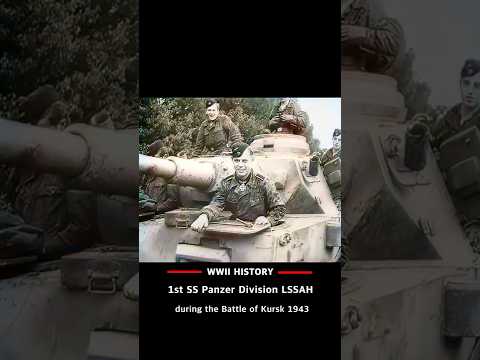
The summer of 1943 baked the earth to a brittle crust. Dust devils danced across the fields where, in mere hours, thousands of tanks would collide. For the men of the LSSAH, the coming battle was not merely another engagement—it was a test of whether their fearsome reputation could survive the meat grinder of the Eastern Front.
General Hermann Hoth’s Fourth Panzer Army had been entrusted with the southern pincer of Operation Citadel. The plan was audacious: slice through the Kursk salient, trap the Soviet armies, and deliver a blow from which the Red Army might never recover. At the tip of that spear stood three SS divisions—Totenkopf, Das Reich, and the Leibstandarte.
Inside the cramped turrets of their Panzer IVs and Tigers, the crews sweated through the pre-dawn darkness. Engine oil mingled with the smell of stale sweat and nervous anticipation. Many of these men had fought from Poland to France to the gates of Moscow. They believed themselves invincible.
But the steppe had a way of humbling even the proudest warriors. Soviet minefields stretched for miles, and behind them, row upon row of anti-tank guns waited in ambush. The LSSAH’s commander, Josef ‘Sepp’ Dietrich, knew the stakes. His division would have to punch through layers of defense that grew deeper with every mile.
The first light of July 5th crept over the horizon, revealing a landscape scarred by trenches and bristling with steel. Engines roared to life. Tracks clanked against the earth. The LSSAH surged forward—straight into the teeth of the Soviet defense.
What followed would be etched into the annals of military history: a cauldron of fire, blood, and shattered metal where the fate of nations hung in the balance. And for the men of the Leibstandarte, the battle for Kursk would become a defining chapter in their dark and storied legacy.
The initial advance went according to plan—or as close to a plan as war ever permits. The LSSAH’s panzers rolled over the first line of Soviet trenches, crushing wire and bunkers beneath their treads. For a brief, intoxicating moment, the men believed the salient would crack open like an egg.
Then the earth itself seemed to explode. Soviet anti-tank guns, concealed in haystacks and ruined farmhouses, opened fire at point-blank range. Panzer IVs brewed up in columns of black smoke. The air filled with the screams of burning crews and the hammering of machine guns.
Sepp Dietrich, cigar clamped between his teeth, watched the carnage from his command halftrack. He had seen war in its rawest forms—but Kursk was something else entirely. “Forward! Keep moving forward!” he bellowed into the radio, knowing that to stop was to die.
The division’s engineers worked under murderous fire, clearing minefields lane by lane while Soviet artillery rained down from the heights. Every yard of ground was bought with blood. By midday, the LSSAH had advanced barely five kilometers—a distance that would have taken minutes in open country.
Among the spearhead units was the division’s reconnaissance battalion, probing ahead for weak points in the Soviet line. They stumbled upon a village bristling with T-34s, their sloped armor gleaming dully in the smoke-hazed sun. The fight that erupted was savage and close—tank against tank at ranges so short that every shot was a guaranteed kill.
Grenadiers of the Leibstandarte fought house to house, lobbing grenades through windows and clearing cellars with flamethrowers. The village changed hands three times before nightfall. When the sun finally sank, the fields around it were littered with the wreckage of both armies.
That evening, Dietrich received a message from Hoth’s headquarters. The advance was behind schedule. The Soviets were pouring reinforcements into the salient from every direction. Operation Citadel was already bleeding out.
But the Leibstandarte was not yet done. Ahead lay the village of Prokhorovka—and beyond it, the largest concentration of Soviet armor ever assembled. The men of the LSSAH cleaned their guns, loaded fresh shells, and waited for dawn. They did not know that the greatest tank battle in history was about to swallow them whole.
Dawn on July 12th broke clear and hot, the kind of morning that promised a furnace by noon. The LSSAH’s panzers formed up in wedge formations, engines idling, commanders standing in their hatches scanning the horizon through binoculars. Somewhere beyond the rolling fields and the smoldering wreckage of the previous days, the Soviets had massed their armor.
They did not have to wait long. The first T-34s appeared on the ridgeline like a tide of steel, and behind them came more—hundreds more. The ground itself seemed to tremble as the Soviet tanks surged forward, their engines howling, their crews screaming battle cries over the radio.
Dietrich’s voice crackled over the command net: “All units, engage! Engage!” The order was almost unnecessary. Every gunner in the division had already found his target.
The engagement that followed was not a battle in any orderly sense—it was a maelstrom. Panzer IVs and Tigers traded shots with T-34s at ranges so close that the muzzle blasts seemed to touch. Armor plates split like tin cans. Turrets flew into the air, spinning end over end before crashing back to earth. The wheat fields caught fire, and the smoke rolled across the battlefield in choking waves.
A Tiger commanded by a young SS lieutenant found itself surrounded by four T-34s. Instead of retreating, the lieutenant ordered his driver to charge. The Tiger’s 88mm gun tore through two of the Soviet tanks before the other two broke off and fled. Such moments of audacity were the LSSAH’s currency—and they spent it freely.
But the Soviets did not break. They came on in wave after wave, their commanders driving them forward with ruthless disregard for losses. The air above the battlefield filled with the drone of IL-2 Sturmoviks, swooping low to strafe the German columns with rockets and cannon fire.
By mid-afternoon, the LSSAH’s advance had stalled. The division had destroyed dozens of Soviet tanks, but for every one that burned, three more seemed to take its place. The fields around Prokhorovka were becoming a graveyard of armor—and the Leibstandarte was fighting for its very survival.
Dietrich, his face smeared with soot, climbed from his halftrack to survey the carnage. He had seen enough war to last a hundred lifetimes, but even he was shaken by the scale of the slaughter. The radio crackled with reports of ammunition running low, of crews exhausted beyond reason, of men fighting on despite wounds that should have sent them to the rear.
Then came the message that changed everything. Hoth’s headquarters reported that Soviet forces had broken through the German lines to the north. The trap was closing—but not on the Soviets. On them.
Dietrich read the message twice, his jaw tightening around his cigar. The Leibstandarte had fought its way into the heart of the Soviet defenses, only to find itself staring into the abyss. The order that followed was the one every soldier dreads: hold at all costs.
As the sun began its slow descent toward the horizon, the men of the LSSAH dug in among the burning wrecks of their enemies. They reloaded their guns, checked their ammunition, and prepared for what promised to be a long and bloody night. The greatest tank battle in history was far from over—and the Leibstandarte stood at its very center.
The night brought no relief. Soviet artillery thundered through the darkness, and flares burst overhead like cold, white suns, casting the wreckage-strewn fields in stark relief. Men who had fought for days without sleep slumped in their foxholes, only to be jolted awake by the shriek of incoming shells.
Dietrich moved among his troops, his voice hoarse but steady. “We hold here. We hold, or we die here. There is no other order.” The words were not inspirational—they were simply true, and the men of the Leibstandarte understood truth better than glory.
By first light on July 13th, the Soviet attacks resumed with undiminished fury. But something had shifted. The T-34s came on with less coordination, their formations ragged, their commanders seemingly as exhausted as the Germans. The LSSAH’s gunners, hardened by days of slaughter, met them with cold precision.
Then came the news that sealed the fate of Operation Citadel. The Western Allies had landed in Sicily. Hitler ordered the SS panzer divisions pulled out of the Kursk salient and rushed to Italy. The greatest armored offensive in history was being abandoned.
Dietrich received the order with a mixture of relief and bitter anger. “So we bleed for nothing,” he muttered, crushing his cigar beneath his boot. The Leibstandarte had destroyed hundreds of Soviet tanks, had fought to the edge of annihilation—and now it was being told to pack up and leave.
The withdrawal began under cover of darkness. The men who had charged into the salient with such confidence now crept out, leaving behind their burned-out tanks and the bodies of their comrades. The steppe swallowed them silently.
Kursk was over. The LSSAH would fight again—in Italy, in Normandy, in the frozen hell of the Ardennes—but it would never again be the same division. The myth of invincibility had cracked on the Russian steppe, and no amount of later glory could mend it.
Years later, historians would argue about what Kursk meant. For the men who survived, it was simpler: they had stared into the abyss and walked away. Whether that made them lucky or damned, none of them could say.
What do you think—was Kursk the turning point that doomed the Third Reich, or had the tide already turned long before the first panzer rolled into the salient?
Report this article
Select a reason for reporting:






