June 1970, Tan Son Nhut Air Base, Vietnam. An Air Force colonel froze in the corridor, his eyes locked on the weapon slung around a Navy SEAL’s neck. It was small, ugly, with something resembling a crushed metal lip welded to the barrel. “What is that?” the colonel demanded.
Senior Chief James Watson met his gaze without blinking. Three combat tours. Sixteen medals. “That’s my sweetheart,” he said. “My 12-gauge.”
The colonel informed him that shotguns violated the Geneva Convention. Watson didn’t flinch. “Colonel, if I’m ever sent to Geneva, I’ll leave her at home. But until then, she and I don’t separate.”
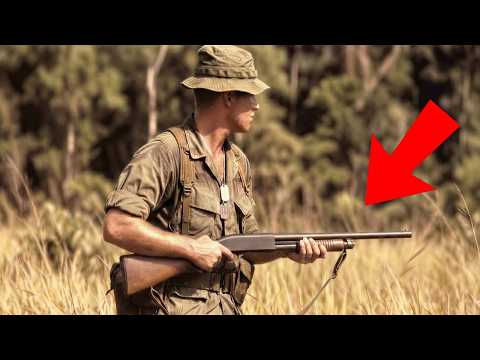
That shotgun—an Ithaca Model 37—could put 72 buckshot pellets into a kill zone in under three seconds. Submerge it in a muddy canal, pull it out, and it fired immediately. It weighed less than a water bottle and a sack of rice combined.
This isn’t the story of Vietnam’s most popular weapon. That was the M16. It’s not even the story of the most-used shotgun, the Stevens 77E—which the Pentagon bought 60,000 of because each cost $5 less. This is the story of the shotgun the best operators chose when their lives depended on it.
By 1965, every weapon in the American arsenal had been built for a war that never started—a war on open European plains against the Soviets. Fast jets. Long-range rifles. Thousand-yard battles. Vietnam was ten yards.
The Mekong Delta’s air pressed against your chest like a wet sandbag. Everything smelled of canal rot, burned diesel, and vegetation that never dried. The jungle was never quiet—until it was. And when it went silent, someone was about to die.
More than 80 percent of firefights began at 30 meters or less. Over half of ambushes erupted inside 15 meters—the length of a school bus. At that range, the fight ended before your brain fully registered the first shot.
The M14 was too long for the jungle. The M16 jammed when it got dirty. And everything got dirty.
Into this void came a weapon most officers dismissed as obsolete—a police riot gun. But the point man knew better. He walked first. His job was to find the ambush by walking into it. He needed a weapon that forgave bad aim and put down whatever it hit.
Only one shotgun in the armory had been built for these conditions. The Ithaca Model 37 had three things no other combat shotgun had. All three mattered in Vietnam. And the third turned it into something the factory never intended.
First, its sides were sealed. Every other pump shotgun ejected shells through a port on the right side of the receiver—a hole that let mud and water into the action. The Ithaca loaded and ejected through the same bottom port. Both sides were solid milled steel. No gaps. Watson could dunk his Ithaca in a canal, shake out the mud, and fire it on the spot. Nobody said that about the Stevens.
Second, the weight: 6.3 pounds, the lightest combat shotgun of its era. The Remington 870 weighed over seven. The Winchester 1897 pushed eight. When you’re carrying 85 pounds through triple canopy, a pound and a half means another magazine of ammunition.
Third—the thing the factory never fixed. The Ithaca 37 had no trigger disconnector. On a Remington, a Stevens, a Winchester 1200, you pull the trigger, fire, release, pull again. The Ithaca didn’t work that way. Hold the trigger back and pump the action. The instant the bolt locked forward, the gun fired. No pause. No reset. They called it slam fire.
Five rounds of 00 buckshot in under three seconds. Forty-five pellets. With the extended eight-round tube the SEAL armorers welded onto Watson’s gun, seventy-two pellets—each .33 caliber—all landing in a door-sized space.
A joint services report found that a shotgunner was 45 percent more likely to hit a man-sized target than a submachine gunner firing a burst—twice as likely as an assault rifleman. The Savage 77E couldn’t slam fire. Its aluminum trigger guard shattered under recoil. Its birch stock, stained to look like walnut, cracked at the receiver.
In late ’68, with the 25th Infantry Division, a rifleman named Specialist Fourth Class Danny Keo was walking second in the column when the point man’s Stevens came apart in his hands. The point man racked the pump and the forend slid off into his palm. While he scrambled for a sidearm that wasn’t there, Keo had to fill the gap with his M16.
That night Keo told his platoon sergeant, “Next shotgun that comes, I want an Ithaca.” Three weeks later he had one—and carried it until he caught a round and rotated home.
Bruce Canfield, the leading expert on American military firearms, wrote that the Stevens was plagued by reliability issues. The Ithaca, by contrast, generally gave excellent service. The government bought the Stevens at $31.50 a unit. The Ithaca cost $36.61. Five dollars and eleven cents. That was the difference between a gun that broke and a gun that never stopped.
Senior Chief James “Patches” Watson III was a founding member of SEAL Team Two. From 1967 to 1970 he walked point on deep interdiction missions in the Delta—every single time. Three tours earned him four Bronze Stars and a Combat Action Ribbon.
After his first tour with a stock Ithaca, Watson went to the Frankfurt Arsenal and had the armorers build him something specific: an extended magazine, a duckbill spreader choke welded to the muzzle, a stock cut down to a pistol grip, and the whole thing hung from a sling around his neck.
The duckbill changed the geometry of killing. A normal buckshot pattern spreads in a circle—half the pellets hitting dirt or branches. The duckbill flattened that circle into a horizontal blade, four times wider than it was tall. It was made to catch three men walking abreast down a narrow trail. It didn’t just hit the target. It cleared the path.
Watson used number-four buckshot. Twenty-seven pellets per shell instead of nine. At twenty yards—what he called long range in the Delta—there was no gap in that horizontal cloud. Whatever stood in front of it did not remain standing. His assessment of its effect: the VC didn’t argue.
The Navy also issued him a Remington 7188, a select-fire automatic shotgun. He called it temperamental and fragile. It jammed in the mud. The Ithaca never did.
Watson could slam-fire the Ithaca at automatic speed, then clear a jam with one rack of the pump. No batteries, no gas system—just milled steel, a spring, and the fastest hands in SEAL Team Two.
Three tours took their toll. Watson didn’t talk much about those nights. Decades later, in an interview, he admitted he still slept with a weapon within reach—not because he thought someone was coming, but because his hand didn’t believe the war was over, even when the rest of his body did.
Sweetheart now sits behind glass at the UDT-SEAL Museum in Fort Pierce, Florida. But Watson was one of the elite. Most shotgun carriers in Vietnam weren’t SEALs. They were nineteen-year-old draftees who walked point because it was their turn.
At five meters, in a tunnel entrance, on a jungle bend—when a patrol stepped into an ambush, nine pellets of 00 buckshot arrived like a fist. Ballistic gelatin penetration exceeded eighteen inches. At ten meters, the wound track spread eight to ten inches. At twenty-five meters, sixteen inches—every pellet still inside the body.
Captured Viet Cong documents revealed that enemy soldiers sometimes stopped shooting and withdrew at the sound of a pump-action shotgun. They knew the jets overhead might leave. The shotgun wouldn’t.
The Germans had learned this first. September 15, 1918: Germany protested American shotgun use in the trenches—unnecessary suffering—and threatened to execute any captured American carrying one. The U.S. Judge Advocate General noted the protest came from a nation using chlorine gas, flamethrowers, and serrated bayonets. Germany never replied.
The myth followed the shotgun to Vietnam. Watson’s colonel wasn’t alone. The Army’s own law-of-war desk book states plainly: no international treaty ever banned the shotgun.
But the story always omits one thing: the point man carried five rounds. The M16 carried twenty. A hundred shotgun shells weighed over ten pounds; a hundred rifle rounds, under three. In sustained combat, the shotgunner ran dry in seconds—loading one shell at a time. No magazine. No speed loader. Just fingers and pockets.
Inside twenty yards, the Ithaca 37 was the deadliest weapon in Vietnam. Beyond that, it was six pounds of dead weight.
Roughly 700 men served as tunnel rats, crawling into two-foot holes with 45 pistols and 38 revolvers, led by Medal of Honor recipient Sergeant Major Benny Adkins. During the four-day battle of A Shau in March 1966, he carried a sawed-off 12-gauge. Of it, he said only: “I used it. I really did. And a lot of hand grenades.”
47,000 Ithaca 37s went to Vietnam. Alongside them, 60,000 Stevens 77s—each five dollars cheaper. The Remington 870, which eventually replaced everything, arrived just before the war ended; its military contract wasn’t signed until May 1969. Almost none saw combat.
After the war, the Army adopted the Remington and Mossberg as standard. The Ithaca was expensive to make. Its slam-fire mechanism worried peacetime safety officers. The gun that worked was quietly retired for costing too much.
That pattern hasn’t changed. Fifty years later, procurement still picks the lowest bidder. Soldiers still carry gear built to minimum specs and pray it survives contact.
Today, a Vietnam-era Ithaca 37 with an “S” prefix serial number between 1,000 and 23,000—”US” stamped on the receiver—is one of the world’s most sought-after military collectibles. And if you stand before the glass case at the UDT-SEAL Museum in Fort Pierce, you’ll see Sweetheart: extended tube, duckbill choke, pistol grip—the one Watson cut down himself. It isn’t pretty. It looks like a man built it in a hurry because what the government gave him wasn’t enough to keep him alive.
Five dollars and eleven cents. That was the difference between the gun that broke and the gun that never did. In a jungle where fights happened at fifteen meters in the dark and the rain, that was the distance between walking out and being carried out.
Watson carried Sweetheart around his neck for three years. Asked once why he never swapped it for something new, he said the same thing he’d said since 1967: “She and I never separate.”
So here’s the question for you: if your life depended on it, would you trust the weapon that costs five dollars more—or the one the procurement office swears is just as good?
Report this article
Select a reason for reporting:






