Dr. Amara Johnson had restored hundreds of 19th-century photographs, but none had ever made her hands tremble. The image arrived on a cold Tuesday in February 2024—a simple family portrait from 1897 Petersburg, Virginia. Six faces, stiff Sunday clothes, a wooden porch. Routine work for a photographic restoration specialist. Nothing could have prepared her for what the scanner revealed.
Under high-resolution enhancement, the youngest child—a girl of seven—was holding something. A small brass compass, its surface engraved with symbols Amara recognized instantly from her research on the Underground Railroad. Not decorative flourishes. Directional codes. A portable map for conductors leading people to safety.
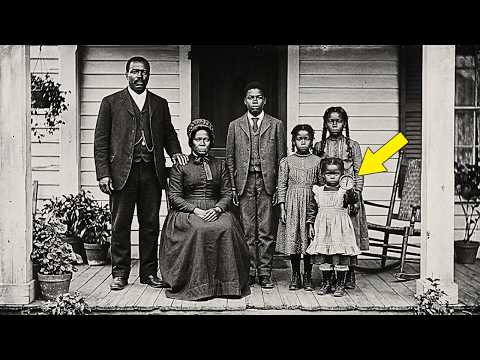
“This wasn’t a toy,” Amara whispered, zooming in until the compass filled her screen. “This family was running a station.” But the Civil War had ended 32 years earlier. Why would anyone still need the Underground Railroad?
She called her colleague at the Virginia Historical Society. Within three days, a team assembled: Dr. Marcus Webb, a historian of post-Reconstruction Virginia, and Lauren Chen, a genealogist who traced Black family lines through fragmentary records. Marcus examined the enhanced photograph for twenty minutes before speaking.
“Petersburg, 1897,” he said slowly. “That’s significant. The Virginia Constitutional Convention of 1901 would codify Jim Crow, but the groundwork was already laid. Poll taxes, literacy tests, violence. Lynchings were common. Black property owners were being driven off their land.” He zoomed in on the father’s face—a man in a dark suit, standing before his own house with quiet pride. “That alone was an act of resistance. But if he was also running an underground route?”
“Thirty-two years after the war?” Amara interrupted. “Why would anyone still need it?”
Marcus pulled up a newspaper clipping from 1899: Black farm workers held in debt peonage, trapped on plantations under conditions barely distinguishable from slavery. “Because freedom on paper didn’t mean freedom in practice,” he said. “Some people helped them escape. People like this family, perhaps.”
Lauren entered the lab carrying a folder. “I found Dorothy Hayes in the 1940 census,” she announced. “Born 1918, Petersburg. Maiden name Garrett. I think I know who they are.”
The census records told the story in fragments—scattered documents, incomplete names, the way most Black family histories from that era survived. The family in the photograph was almost certainly the Garretts: Joseph, a carpenter; Dinah, who took in laundry; their children Samuel, Ruth, Esther, and Clara—the girl holding the compass.
Lauren pointed to a property deed. “Joseph bought his house and two acres in 1889. Paid cash. A hundred and forty dollars—a substantial sum for a Black carpenter in Virginia then.” Marcus leaned forward. “How did he accumulate that much?”
Lauren pulled out a church ledger. “First African Baptist Church. 1888: ‘Anonymous donation for a travelers aid fund, fifty dollars.’”
“The travelers aid fund,” Marcus said slowly. “That was code. Churches used that language to describe money for helping people escape.”
Amara looked at the photograph again. The Garretts stared back—serious, composed, as subjects always were in long-exposure portraits. But now she saw something else. Not just dignity. Defiance.
“They were running a station,” she said. “The house was a safe house on a post-war underground route.”
Marcus pointed to the compass in Clara’s hands. “And that was how they navigated it.”
Over the following weeks, Marcus mapped what he called the invisible railroad—a network of safe houses and guides that operated long after most people assumed such networks had disbanded. The routes didn’t cross legal lines; they moved people from extreme danger to relative safety. From rural Alabama to Birmingham. From plantation country to Memphis, Richmond, Washington.
“It wasn’t about crossing a legal line anymore,” Marcus explained. “It was about getting people out of situations where they were trapped—by debt, by violence, by systems designed to keep them in place.”
Amara sent detailed photographs of the compass engravings to Dr. Helen Washington at Howard University, a historian of resistance networks. Helen’s response arrived three weeks later: “The symbols match a coding system I’ve seen referenced in two other sources, but I’ve never seen an actual physical example. This compass is extraordinary. Can we meet?”
Helen arrived in Richmond on a rainy Saturday in March. She examined the enhanced photographs for nearly an hour before speaking. “I need to tell you about the Lantern Bearers,” she finally said.
Helen opened a worn leather journal and spread its pages across the table. “In the 1890s, a loose network of Black families across Virginia and the Carolinas kept safe routes for people escaping debt peonage and violence. They called themselves the Lantern Bearers—carrying light in dark places. No membership rolls. No written records. Only codes.” She pointed to a symbol shaped like a tree with three branches. “Follow the creek north until you reach the triple oak. A circle with a dot meant safe house with food and shelter.”
Marcus stared at the compass. “This contains a complete route. Whoever made it encoded an entire journey north.” Helen nodded. “This family didn’t just help people occasionally. They were experienced conductors. Someone trusted them enough to give them this.”
“Why pose with it?” Amara asked. “Wasn’t that dangerous?”
“Extremely,” Helen agreed. “Which is why I think it was never meant to be seen by white people. It was documentation for the network itself—proof of who the Garretts were and what they did.”
Lauren’s research uncovered something remarkable about Clara Garrett. She had lived to ninety-four, dying in 1984 in Philadelphia—and left behind an oral history recorded in 1979. Lauren obtained the tape from the University of Pennsylvania archives.
Clara’s voice came through clearly, an elderly woman speaking about events eight decades past. “My father used to take me with him when he traveled. We would walk at night through the woods. He carried a lantern and I carried the guide—a small brass compass. Father taught me to read those markings before I could read words.”
The interviewer asked where they were going. There was a long pause. “We were meeting people. People who had walked for days to get away from places where they couldn’t live free. My father would meet them at certain places. A hollow tree two miles from our house. A clearing where three paths met. Codes, all of it.”
Near the end of the recording, Clara spoke of the photograph. “It was the summer of 1897. Father paid the photographer to come to the house. He told me to hold the compass so it showed. I didn’t understand why. Years later, my mother told me the truth. That photograph was made the day before my father’s last mission. He was guiding twelve people at once. He knew he might not come back. So he had the photograph made as a record—proof that we’d done this work.”
There was a long silence on the tape. “Father did come back. All twelve made it to safety. He took me aside and said, ‘Clara, you held that compass steady as a stone.’ And I knew then that I was part of something bigger than our family.”
Lauren traced Clara’s line forward: a daughter named Dorothy, born 1918—the same Dorothy Hayes whose estate had donated the photograph. Lauren located Dorothy’s daughter, Joyce Holloway Patterson, in Silver Spring, Maryland. When Lauren explained what researchers had found, Joyce paused. “The photograph with the compass. I know the one. My mother kept it in a box. She never talked much about it.”
Lauren asked if Joyce had the compass itself. Another pause. “I think I might have it. After my mother died, I found an old brass compass with strange markings. I kept it because it looked interesting.”
Three days later, Joyce drove to Richmond with the compass in a velvet pouch. Helen unwrapped it and placed it under the examination light. Same markings. Same tool Joseph Garrett had placed in his daughter’s hands. Joyce touched it gently. “All these years, I had something my grandmother held when she was seven. I wish I’d known.”
The photograph was accessioned into the Virginia Museum of History and Culture in September 2024, displayed alongside the compass. The exhibition opening drew more than three hundred people. Descendants of the Garrett family came from across the country, gathering around faces they’d never seen, learning stories hidden for generations.
Joyce gave the final speech. “For most of my life, I didn’t know this story. I didn’t know my great-great-grandmother stood on that porch holding a compass that represented a promise to keep guiding people toward freedom.” She paused, looking at the room. “That little girl couldn’t have imagined her photograph would be in a museum, that researchers would decode those symbols. But I think she would be glad—because the whole reason they had the photograph made was to create a record, to make sure that someday when it was safe, the truth could be told.”
She touched the glass case protecting the photograph. “The promise my great-great-grandfather made—to help people find freedom—that promise has been kept. Not just by him, but by everyone who worked in secret, by everyone who kept these stories alive even when they couldn’t speak them aloud.” She looked at the compass, its brass surface gleaming under the museum lights, its symbols finally understood. “Now we all carry the light. Now we all know the way.”
What forgotten object in your own family’s attic might be holding a story that’s been waiting a century to be told?
Report this article
Select a reason for reporting:






