There is a tree in a forest in North Carolina. An American Green Beret stopped at that tree. He leaned against it. He relieved himself. And on the other side of that tree, less than one meter from his boots, an Australian commando lay in a ghillie suit he had stitched over three weeks. The Australian did not move. He held his breath until the man finished. He watched him adjust his rifle sling. He watched him walk away. The American never knew. Neither did the three other men in his patrol who had passed within ten meters of three other Australians lying along the same trail.
This is not Vietnam. This is Robin Sage. Modern-day. And the men in those ghillie suits had a name for what they were doing to their American hosts. The same name a different enemy had given their grandfathers in a different jungle sixty years earlier. Ma Rang, the jungle ghosts.
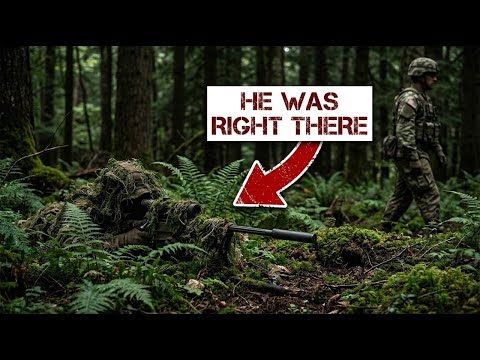
That tree was not the only incident. Less than a hundred meters away, a special forces candidate met his guerrilla auxiliary at a prearranged linkup point. He believed the position was secure. His patrol had cleared it twice. The meeting was photographed in full from a hide site the Americans had walked through both times.
Inside the same multi-day window, an entire patrol stopped to rest in a clearing. They were inside the kill radius of an Australian observation post for forty minutes. Not one of them turned their head in the right direction.
By the time the exercise closed, evaluators had recorded a number that by every operational standard the United States Army uses is supposed to be impossible. 100% target observation, zero detection events, 24 men in a forest the United States Army has owned for half a century against patrols led by some of the most rigorously selected soldiers America produces.
And the math came out one-sided enough that a senior instructor reportedly used the word humiliation in a closed-door meeting.
By the time those 24 flew home, evaluators had quietly written a single sentence into the Robin Sage after-action summary that triggered the first review of the special forces qualification course curriculum in over a decade. By the end of this story, you are going to know what that sentence said. And you are going to understand why the men who run the gold standard test of American unconventional warfare suddenly could not see the people standing six feet in front of them.
It was a clear morning in the pine forests of Moore County, North Carolina, and Robin Sage was already running. The exercise has been operating in some form since 1974, named after Colonel Jerry Sage, an Office of Strategic Services officer in the Second World War. It is the litmus test, the final phase, the thing standing between a soldier and the Green Beret.
The fictional country is called Pineland. Tens of thousands of candidates have walked through it. The United States government spends roughly $400,000 to train each one of them. They’re sent in to link up with guerrilla forces, conduct reconnaissance, and evade the opposing force across 130,000 square kilometers of rural North Carolina.
On this rotation, the opposing force was not American. The opposing force was 24 men from Australia’s first commando regiment. The selection course they had cleared to be there runs roughly 18 months. It washes out somewhere between 80 and 90% of every man who attempts it. They were not candidates. The candidates were the prey.
What happened in those woods over the next several days is the part that does not make sense the first time you hear it. Inside the Robin Sage cadre, there were quiet conversations about whether the Australians had somehow been given the patrol routes in advance. The cadre checked. They had not. They’d been given the same intelligence packet every opposing force gets.
There were further conversations about whether the Americans had been issued degraded equipment. They had not. They were running the same kit they would carry on a real deployment. There were even conversations briefly about whether the Australians had cached observation posts in the area before the exercise officially started. They had not. They had inserted on the same timeline as the opposing force always does.
Every external explanation that would have made the result comprehensible was checked. And every one of them came back negative. The math was clean. 24 men were doing something to 100 American special forces candidates that nobody could account for in any of the usual ways.
In one debrief, an Australian patrol leader was able to describe the rank insignia, the weapon configurations, and the brand of the energy bar one of the candidates had been eating. The candidate in return could not produce a single piece of intelligence about the Australian opposing force. None. They were not being tracked. They were being studied. The Australians were not avoiding detection. They were choosing when to be invisible.
And if you are sitting there asking how this is possible, you are asking the right question. Because the answer is the part nobody at the John F. Kennedy Special Warfare Center wanted to put in writing. But somebody did.
To understand what those Australians were doing to those Americans, you have to go to a different forest in a different country sixty years earlier. Phuoc Tuy province in South Vietnam. Five-man Australian Special Air Service patrols routinely spent two weeks in the bush without making contact. They moved in centimeters per minute. They hid in positions for 72 to 96 hours before relocating a single meter.
The Viet Cong who tried to hunt them and could not find them started using a phrase among themselves in radio intercepts and captured documents. Ma Rang, the phantoms of the forest, the ghosts. The name was not given as a compliment. It was given the way you name a thing in the dark you cannot see and cannot kill.
That tradition runs further back than Vietnam. It runs back to Z Special Unit operations in Borneo in 1944 and 1945 when small teams of Australian operators were doing the same thing to Imperial Japanese garrisons. It is a craft tradition that has been written into Australian doctrine for two generations. Their own training pamphlets call it patient observation. The cultural assumption every man in those 24 had absorbed before he ever made the team is that being seen meant the mission had already failed.
The men in those Moore County woods were running the same craft the Viet Cong had named in 1968. The same craft the Japanese had failed to counter in 1945. They had simply brought it across the Pacific.
Now, compare that to what American special forces doctrine looks like today. It is built on speed, rapid infiltration, target action, rapid exfiltration. It is doctrine that was sharpened after September 11th in the tempo of operations in Iraq and Afghanistan, where minutes on a target could be the difference between a successful raid and a dead team. It works. It has won wars. But it is built on a clock. A clock can atrophy a skill.
Twenty years of high-tempo direct action means twenty years of patrols that did not need to sit motionless for 96 hours. Twenty years of operators who could move fast and shoot well, but who had not been forced institutionally to learn how to disappear for four days. The Australians were not better men. They were operating on a tradition the Americans had quietly stopped practicing.
The men in those ghillie suits in Moore County were running a sixty-year-old craft against a force that had spent the last twenty years learning a different one. And that is why a Green Beret leaned against a tree.
So here is the line the evaluators ended up writing. The line that triggered the first internal review of the Q course curriculum in over a decade. The candidates were not poorly trained. Robin Sage candidates are by every measure elite. The institutional emphasis on speed had quietly atrophied the slower skills.
The Americans were not outfought in those woods. They were unseen. That sentence reportedly prompted discussions at the John F. Kennedy Special Warfare Center about reintroducing extended-duration static surveillance into the pipeline. The first such review in over ten years.
And the most uncomfortable detail is not what happened in those pine forests. It is the pattern this exercise sits inside. This was not an anomaly. It had been happening for years.
During Talisman Sabre exercises, Australian Special Air Service elements have consistently outperformed partner reconnaissance units on the same detection metrics. During the Afghanistan campaign, joint task forces in Uruzgan province between 2007 and 2013 documented Australian special operations task group patrols running fourteen-day surveillance operations on Taliban compounds without compromise.
Those results became the basis for shared doctrine briefings at NATO special operations headquarters in Mons, Belgium. Two thousand two hundred personnel served across the entire Australian special operations command. Roughly seventy thousand served across the American special operations enterprise. The smaller force has preserved the craft the larger force, by the sheer pressure of operational demand, has had to deprioritize.
Nobody in any of the partner militaries that have run exercises against them has figured out how to stop it.
Here is the part that should keep somebody at Fort Liberty awake. The review the Robin Sage exercise reportedly triggered has not visibly closed. The doctrine has not visibly changed. The pipeline still runs on the clock it has run on for two decades.
The men in green berets are still some of the most rigorously selected soldiers on earth. But the skill that lost out in those North Carolina woods is the same skill that decides who walks out of a real war. The patient one. The slow one. The one measured in centimeters per minute. The one a different enemy named sixty years ago in a different forest because they could not find the men hunting them.
Ma Rang. The jungle ghosts.
Twenty-four of them stood in a forest in North Carolina. They watched a Green Beret lean against a tree. The tree was the only thing between him and a tradition his own army had quietly forgotten how to practice.
But the story does not end with that tree. Because what the evaluators wrote in that after-action summary was only the first document. There was a second one. And the second one was not written by the Americans at all.
It was written by the Australian patrol commander, filed through his own chain of command, and it landed on a desk in Canberra with a distribution list that did not include anyone at Fort Liberty. It described, in precise and unsentimental language, exactly how the exercise had been won. Not the tactics. The Americans already understood the tactics. It described the thing underneath the tactics, the thing the Australians had been quietly testing for years against every partner force that would agree to play the game.
And it contained a recommendation that, if adopted, would have changed the shape of the American special forces qualification course more profoundly than any review the Americans had ever run on themselves.
The recommendation was not about ghillie suits. It was not about hide sites. It was about time.
The Australians recommended that the pipeline be rebuilt around patience as a tested, scored, non-negotiable attribute — that candidates be graded on how long they could remain undetected, not merely on how fast they could strike. The proposal reportedly sat in Canberra for months before anyone in the American chain of command learned it existed.
By the time it surfaced, the rotation was already a memory. The pine forests of Moore County had returned to silence. The ghillie suits were packed away. The tree stood exactly where it had always stood.
But somewhere in the paperwork of two allied armies, a question had been asked that neither could fully answer: whether a force built to win the next war on a clock could ever relearn the craft of a war measured in centimeters per minute.
The jungle ghosts had already given their answer. The question is whether anyone was still listening.
What do you think — can an institution built on speed ever truly relearn patience, or does the clock always win in the end? Tell me in the comments.
Report this article
Select a reason for reporting:






