The Texas sun burned white that April day in 1945, and Greta Hoffmann stood near the camp fence, watching dust swirl around the guard towers. She had been at Camp Seville for six months—long enough to know the sound of every truck, the pattern of every guard’s boots, even the smell of the midday wind that carried both diesel and dry grass. The war in Europe was ending, but here, the hours still moved like sand through glass.
Then the drone of an aircraft grew louder, lighter than the bombers that sometimes passed overhead. A silver twin-engine plane dipped low and landed on the nearby airstrip. From behind the barbed wire, Greta shaded her eyes and squinted. The pilot stepped down—and her heart stopped.
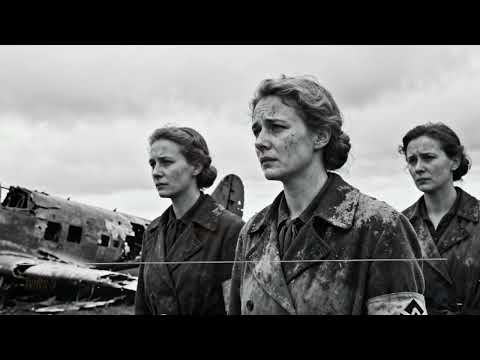
It wasn’t a man. It was a woman in a leather jacket, goggles around her neck, hair tied back under a cap. Another woman followed, laughing, her boots leaving sharp prints in the dust.
“Women piloting? Impossible,” a prisoner whispered. But the guards didn’t laugh or pose for photos. They simply waved and went back to work. It wasn’t a performance—it was routine.
Greta’s mind froze. In Germany, the very idea of women flying military planes was laughable, against every rule she had been taught. “Your place is on the ground,” her father had told her when she dreamed of gliders. Now she stood on that ground behind a fence, watching women do what she had been forbidden to imagine.
That night, lying in her wooden bunk, she whispered to herself, “If they can fly, what else have we been lied to about?”
The next morning, the same engines returned. Greta hurried to the fence, pretending to fetch water. Dust stung her eyes, but she kept watching. This wasn’t a dream or propaganda reel. It was real life—women flying for an army that didn’t fear their strength.
She began to notice details: how the female pilots walked with the same confident stride as the men, how ground crews treated them as equals. One guard said proudly, “The Wasps have ferried over 12,000 aircraft already. Thirty-eight lost their lives doing it.”
Greta did the math in her head. These women weren’t symbols. They were workers, fighters, pilots in every sense but name.
One afternoon, a small yellow plane landed, and the pilot stepped out—she smiled toward the tower, brushing dust from her sleeves. Greta felt her chest tighten. That smile didn’t look proud or rebellious. It looked free.
Inside the barracks that night, an argument broke out. “They fly because America has too many men to waste on deliveries,” one prisoner said. “No,” another argued. “They fly because they can. The Americans don’t care about old rules.”
Greta lay awake long after lights out, her mind racing. She remembered propaganda posters back home—painted women with gentle smiles, waving goodbye to husbands who never returned. What would those same women think if they saw this camp, this airfield, these pilots?
Days passed, and the airfield’s rhythm became part of the camp’s heartbeat. Greta found herself timing her chores to the sound of takeoffs. The guards noticed but said nothing. Maybe they understood.
One day, a piece of paper blew against the fence, caught in the wire. She picked it up carefully—a maintenance checklist with smudged pencil notes and a faint perfume scent. The handwriting was neat, confident, unmistakably female. She held it like a relic.
In that small moment, Greta understood that the old rules of the sky had already been rewritten. The world outside the fence was larger than she had ever been told. And each passing day, the sound of those engines made her believe that maybe she could belong in it, too.
But belief is a dangerous thing in a prisoner’s camp, because once it takes hold, it demands action. What Greta did next would change her life forever.
Every afternoon around two, the steady hum of engines filled the air. Prisoners dropped their tools, squinting toward the airfield just beyond the fence. Greta was always one of them, her hands rough from garden work gripping the wire as she counted the small silver dots in the sky. One, two, three. The planes glided down in perfect formation, wheels kissing the runway, dust rising like smoke in the sun.
The guards didn’t even look up anymore. But Greta never missed a landing. Each time she searched for a flash of sunlight on a leather jacket, a pale braid under a flight cap—a sign that one of the pilots was a woman.
“Still dreaming, Greta?” one prisoner teased. “You’ll get blisters from staring at that fence.” But she didn’t answer. She couldn’t stop watching. The sight of those women moving so calmly, so sure of themselves, had become her only escape from the endless routine of camp life.
She began to notice patterns. One pilot, a tall woman with auburn hair, always touched the wing of her plane before walking away, as if saying thank you. Another, smaller and darker-haired, carried a metal lunchbox with a painted blue star. Greta started calling her the star lady.
At night, Greta wrote about them in a small notebook, a few pages torn from a supply ledger. She described their planes, their movements, their smiles. She didn’t know why she wrote. Maybe she just wanted proof that what she saw was real.
One evening, she heard the guards talking near the barracks. “Those Wasps are something,” one said. “Can you believe they logged over sixty million miles? Ferry flights, test flights, even towing targets for live gunnery.” Greta couldn’t even imagine that distance. It was as if these women had circled the whole planet a hundred times.
The next morning, she saw the star lady again. The woman waved briefly toward the guards, then walked close to the fence to pick up a fallen rag. For a second, her eyes met Greta’s. It wasn’t a long look, but it felt like the fence between them melted away.
After that, Greta’s obsession grew. She began sneaking closer whenever she could, pretending to collect firewood or check tools. From there, she could hear the laughter of the pilots, the whir of engines cooling, the clatter of metal on concrete. The air smelled of oil, grass, and heat—strange, comforting scents that made her forget she was a prisoner.
Once, while washing clothes near the guard post, she overheard two Americans talking about a pilot named Nancy Corbett. “She flew three AT-6 Texans in one week,” one said proudly. “Got grounded for flying through a storm. Said the clouds were just too beautiful to avoid.” The men laughed. Greta smiled without meaning to. There was something wild and brave in that name. Nancy.
That night, Greta whispered to her bunkmate, Elsa. “Do you think it’s true that women can fly these planes?” Elsa rolled over, half asleep. “I think anything is true here. The world doesn’t make sense anymore.” But to Greta, it was finally starting to make sense. Maybe strength didn’t mean shouting orders or carrying rifles. Maybe it meant doing what you were told you couldn’t.
Every day, the planes came and went. Every day, the same thrill burned inside her chest. She began sketching rough diagrams of aircraft parts she remembered from before the war—wings, propellers, control levers. She wanted to understand them, not as distant miracles, but as machines built by hands like hers. The camp’s routine no longer felt like a cage. It felt like a waiting room for something greater.
One evening, a gust of wind carried laughter across the field. Greta stood at the fence, the setting sun bright behind her. On the other side, Nancy Corbett turned for a brief moment and smiled. It was then Greta decided—somehow, she would meet her. The sky was calling, and she couldn’t pretend not to hear it anymore.
The chance came on a quiet afternoon two weeks later. The sun was soft and the guards seemed half asleep. Greta had been assigned to carry tools from the storage shed to the fence line, where prisoners repaired broken crates. Beyond the wire, she could see the yellow training plane parked on the edge of the airfield, and near it stood the woman she had come to know by name—Nancy Corbett.
Nancy wore her usual leather jacket, sleeves rolled up, hair tied in a simple knot. She was laughing with a mechanic, holding a clipboard and a pencil. Her confidence made everything around her seem lighter. Greta paused, watching, heart racing. This was the woman who had become the center of her thoughts, the one who proved that everything she’d been told back home was a lie.
A guard shouted at her to hurry up. Greta obeyed, but her hands trembled as she worked. Later, when the day’s tasks were done, she lingered by the fence longer than usual. The air was cooling, turning gold. Nancy was walking toward the small hangar, holding her flight gloves. She looked up, saw Greta standing there, and for a second hesitated.
Then Nancy did something unexpected. She waved. Greta froze, looking around to see if anyone had noticed. A guard nearby was smoking, not paying attention. Greta lifted her hand slightly in return. That small gesture sent a rush of warmth through her chest. It was the first time in years that someone had seen her not as an enemy, not as a number, but simply as a person.
The next day, Greta found a scrap of paper near the fence. It must have fallen from the hangar. It had pencil drawings of engine parts and English words she didn’t fully understand. At the bottom was a quick sketch of an airplane wing and a short note: “For your collection.”
Greta gasped softly. The handwriting was neat, feminine. It had to be Nancy’s. She hid the paper inside her uniform, heart pounding. That night, she stared at it by candlelight, tracing the curves of the letters with her finger. For the first time in months, she smiled.
Days later, she dared to leave something back—a small drawing she had made of the same yellow plane, folded neatly and tucked into the same spot by the fence. She didn’t expect anything in return, but when she came back after morning roll call, there was a leather-bound logbook lying there, old, scuffed, smelling faintly of oil and sun.
Inside were pages filled with flight notes, numbers, and small messages. On the first page, Nancy had written, “Every pilot starts by watching the sky.” Greta could hardly breathe. The book became her treasure. At night, she studied every line, every word. She didn’t understand all of it, but she learned altitude, throttle, lift—the language of freedom.
Elsa noticed her whispering these words in her sleep and shook her head. “Be careful,” she warned. “Dreams can be dangerous here.” Greta only smiled. She knew.
For weeks, their secret exchange continued—small sketches, pages, bits of conversation across the wire. When no one was near, Nancy spoke slowly using gestures. Greta picked up new words. Engine. Flight. Sky. Sometimes Nancy would tap her chest and say, “Courage.” Greta would nod, repeating softly, “Courage.”
But secrets don’t stay hidden long in a place full of watchful eyes. One afternoon, a guard noticed Greta lingering too close to the fence. He barked an order, and she stepped back quickly, pretending to fix her shoe. That night, her hands shook as she tucked the logbook beneath her mattress. She didn’t want to lose it—or the fragile friendship that had somehow crossed a war.
Still, she knew one thing for certain now. Whatever came next, she would never again believe that the sky belonged only to men. And soon, she would risk everything to touch that truth for herself.
The chance came one windy afternoon. The guards were unloading supplies, and the airfield stood quiet. Greta slipped through a gap in the fence and climbed into Nancy’s yellow AT-6. The smell of leather and gasoline hit her like a wave.
Then a shout. Guards ran toward her. “Wait—it’s all right,” Nancy called, running from the hangar. “She’s just curious. My fault.” They let Greta go.
That night, Nancy pressed a silver button into her palm. “For luck.”
When the war ended and the Wasps were disbanded, Greta returned to a broken Hamburg. But she never forgot. She earned her pilot’s license, taught girls to fly, and kept the button close.
“The sky belongs to anyone brave enough to reach for it,” Nancy had said. And Greta believed it—forever.
What would you have done, standing at that fence?
Report this article
Select a reason for reporting:






