Dr. Emma Richardson had seen thousands of old photographs in her fifteen years as a conservator, but the moment she zoomed in on the young man’s neck, her breath caught. There, just above his crisp white collar, was a scar—a deliberate brand in the shape of a P with a line through it, burned deep into his skin. The photograph was dated 1920. Slavery had been abolished fifty-five years earlier. Yet the mark told a different story.
Emma’s hands trembled as she flipped the envelope over. In faded pencil, someone had written: “Thomas and Margaret, married Detroit, June 1920. Do not show family.” The warning only deepened the mystery. Who were they? And what crime had been buried with this image?
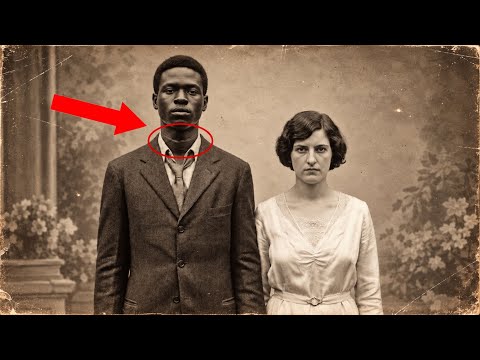
The wedding portrait showed a young Black man, perhaps twenty-five, in an inexpensive but carefully pressed suit. Beside him stood a white woman of similar age, her hand resting lightly in his. Their expressions were serious, almost defiant—no manufactured joy for the camera. In 1920, interracial marriage was illegal in over thirty states. The couple’s union was an act of courage, but the brand on Thomas’s neck hinted at a darker truth.
Emma spent the next three days lost in archives, her stomach turning as she uncovered the loophole in the 13th Amendment: “except as a punishment for crime.” That phrase had been weaponized to recreate slavery under new names—convict leasing, debt peonage, and labor camps that trapped thousands of Black Americans, including children, in perpetual servitude.
She found a 1903 report by journalist Mary Grace Quackenbos, who had investigated turpentine camps in Florida. One passage made Emma’s blood run cold: “Children as young as five bore marks burned into their skin, letters or symbols indicating which company owned their family’s debt.” The brand on Thomas’s neck was not a random scar. It was a company mark—a brand of ownership.
With the help of Dr. Marcus Webb, an industrial historian, Emma identified the symbol as belonging to the Piedmont Lumber Company, which operated labor camps in Georgia and Florida from 1898 to 1912. Federal raids had found over 200 workers, including 43 children, living in conditions “worse than slavery.” Yet no one was ever convicted. The company continued until a fire killed 37 workers locked inside a barracks.
Emma’s search led her to a 1911 Florida Bureau of Labor report. Among the workers found at a Piedmont camp was a boy of about sixteen who gave his name as Thomas. “He bore a brand mark on his neck indicating ownership by the company,” the report read. He had been brought to the camp at age seven by his mother, who died in 1906. When asked why he didn’t leave, he said, “They said if I run, they’ll find me and hang me.” After the raid, Thomas vanished from official records—until he reappeared in Detroit in 1920, married and working in a factory.
But who was Margaret? Emma traced her to a working-class Irish immigrant family. Her father had died, her mother worked as a laundress, and by 1920, Margaret was a secretary at an auto parts company—the same company that had hired Thomas a year earlier. They had met at work, a forbidden love in a city rife with racial hostility.
Emma’s research revealed that Thomas had escaped the labor camp in 1913 during a fire, fleeing through swamps for three days before a Black minister helped him board a train north. He changed his last name from Washington to Freeman—“It felt like claiming something that had been stolen from me.” In Detroit, he found work at a Quaker-owned factory that paid Black workers equally. There, he met Margaret, who noticed his high collars and, one hot day, saw the brand. When he told her the truth, she didn’t recoil—she got angry. She wanted justice, but Thomas knew better. “Who would believe a black man with a slave brand over white men with money?”
Instead, they married. Margaret’s family disowned her; her priest refused to officiate. But she wrote a letter to her mother that was returned unopened: “If you cannot see his worth because of the color of his skin, then it is you who have disgraced yourself, not me.” She kept that letter her whole life.
Emma tracked down their grandson, David Freeman, who had been waiting thirty years for someone to ask about his grandparents’ story. He shared Thomas’s handwritten testimony, written in the 1950s: “Slavery didn’t end in 1865. It just changed its name.” Thomas described the branding, the deaths of children, the unmarked graves. He had survived by becoming invisible—until he ran.
David also shared the wedding photograph that had been hidden for generations, marked “Do not show family.” Now, Emma knew what she had to do. She began planning an exhibition—one that would finally tell the truth about the brand on Thomas’s neck and the thousands of others like him.
But as she delved deeper, a new question emerged: How many more photographs like this one were out there, waiting to be found?
The answer, it turned out, was more than anyone had imagined. Within weeks of the exhibition’s opening, Emma’s inbox filled with messages from families across the country—descendants who had inherited photographs of their own, tucked away in attics and safe deposit boxes, marked with the same cryptic symbols. A woman in Mississippi sent a portrait of her great-uncle bearing a crescent-shaped brand on his forearm. A man in Ohio mailed a tintype of his grandmother with a number tattooed inside her wrist.
Each photograph arrived with a story, often fragmentary, passed down in whispers. “My mother said never to show this to anyone outside the family,” one letter read. “She said it would only bring trouble.” Emma began cataloguing them all, cross-referencing symbols against the ledgers Marcus had unearthed from defunct lumber and turpentine companies.
But it was a call from a retired archivist in Alabama that changed everything. The woman, Ruth Calloway, had spent forty years quietly collecting records from county courthouses across the Deep South—ledgers that had never been digitized, files that had been left to rot in basements.
“I have something you need to see,” Ruth said, her voice thin but steady. “It’s a register from the Piedmont Lumber Company. A payroll book, but it’s more than that. They kept a separate list—names, ages, debts, and the marks they burned into each worker. It’s all here.”
Emma’s heart hammered. A ledger of the branded. A record of the forgotten.
She flew to Birmingham two days later. Ruth met her at the archives with a cardboard box wrapped in twine. Inside, bound in cracked leather, was the register—its pages yellowed but legible. Ruth opened it to a section marked Property Acquired, 1902–1911.
The entries were chilling in their bureaucratic calm. Names, dates, debts inherited from parents. Beside each name, a column headed Mark listed the brand burned into flesh. Emma’s eyes raced down the page until she found it.
Washington, Thomas. Age 7. Debt inherited from mother, Sarah Washington (deceased). Mark: P with strike. Registered 1902.
She stared at the entry, her vision blurring. Here was the proof—not a memory, not a testimony, but the cold accounting of a child reduced to property. And below Thomas’s name were dozens more, children and adults whose stories had never been told.
Ruth touched her arm gently. “There’s something else,” she said. “Turn to the back.”
Emma flipped to the final pages. Tucked into a sleeve was a folded document, brittle with age—a letter on Piedmont company stationery, dated 1912, addressed to the county sheriff. It read: Regarding the recent fire and the loss of certain workers, we request that no inquest be held. The deceased were transients with no known kin. We have enclosed the usual consideration for your cooperation.
Emma looked up, her throat tight. “They paid the sheriff to bury the truth,” she whispered.
Ruth nodded. “And for a hundred years, it worked. Until you found that photograph.”
Back in Detroit, Emma added the ledger to the exhibition—a new section titled The Accounting. Visitors stood before the open pages, reading the names aloud. David Freeman came to see it and stood for a long time before his grandfather’s entry.
“He was never just a name in a book,” David said quietly. “But seeing it here—seeing that they wrote him down like a piece of equipment—it makes what he built afterward even more remarkable.”
Emma nodded, but her mind was already racing ahead. The ledger listed over three hundred names. Three hundred people whose descendants might still be alive, unaware of what their ancestors had endured. She pulled up her email and began drafting a new message—to Ruth, to Marcus, to Dr. Washington.
We need to find them all, she wrote. Every name in that book. Every family.
She hit send and turned back to the photograph of Thomas and Margaret, still watching her from the wall. The brand on his neck no longer looked like a mark of shame. It looked like a signature—one that had waited a century to be read.
The search for those three hundred names became Emma’s quiet obsession. Ruth sent scanned pages week by week; Marcus built a database; Dr. Washington reached out through church networks and genealogical societies across the South. Slowly, the ledger’s silent column of the forgotten began to fill with voices.
One name led to a great-granddaughter in Memphis who had inherited a family Bible with a page torn from its center—the missing leaf, she discovered, had recorded a birth and a brand side by side. Another led to a man in Oakland who had always wondered why his grandfather refused to wear short sleeves, even at the beach.
“They thought erasing the records would erase us,” David Freeman said at the exhibition’s one-year anniversary, standing before the ledger with his own grandchildren beside him. “But paper burns, and memory doesn’t. We’re still here.”
Emma returned to the wedding portrait one last time that evening, after the gallery had emptied. Thomas and Margaret looked back at her, hands joined, jaws set, defying a world that had marked him and disowned her. The brand on his neck had outlived the company that burned it—not as a scar of ownership, but as evidence that could no longer be hidden.
She turned off the lights and locked the door, the photograph still glowing faintly in her mind. Some stories end with a grave; this one ended with a question passed forward, generation to generation, waiting for someone brave enough to answer it.
If a single photograph could survive a century of silence, how many more are still waiting in your family’s attic—and who will be the one to finally ask what they mean?
Report this article
Select a reason for reporting:






