Imagine a car so advanced, so impossibly futuristic, that when audiences first saw it gliding across a Hollywood movie screen in 1938, they genuinely believed it was a prop—a special effect dreamed up by a studio designer who had read too much science fiction. No door handles, no fenders, no running boards—just a long, low, ink-black shape that looked less like an automobile and more like a weapon fired from the future.
It had electrically operated doors that opened at the push of a hidden button. An instrument panel ripped straight from the cockpit of a military aircraft, complete with compass, altimeter, and warning lights. Triple-layer bulletproof glass tinted green to kill the sun’s glare. Thermostatically controlled air conditioning and heating at a time when most cars didn’t even have a heater. It could seat six passengers—four across the front bench alone—and hit 115 mph on the open road in 1938, while the rest of America was still driving upright bread boxes with chrome teeth.
This was the Phantom Corsair, and the man who built it was 23 years old.
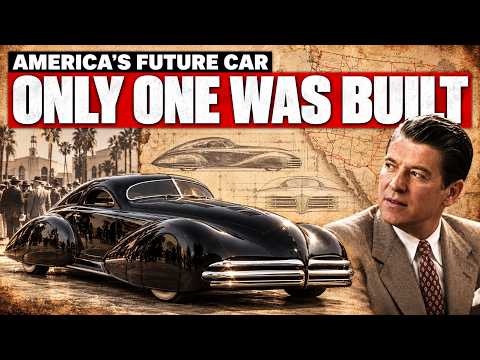
His name was Rust Heinz, and if that last name sounds familiar, it should. He was the grandson of Henry John Heinz, the founder of the H.J. Heinz Company—the empire that put ketchup on every table in America and stamped the words “57 varieties” into the consciousness of the Western world.
Rust was born into a family that had more money than most people could comprehend, a dynasty built on bottled horseradish and tomato sauce that stretched back to 1869, when Henry Heinz was just a young man in Sharpsburg, Pennsylvania, peddling produce from his family’s garden. By the time Rust came along on October 18, 1914, the Heinz Company was a global operation with factories on multiple continents, thousands of employees, and a reputation as one of the most recognized brands on Earth.
So when people talk about Rust Heinz, they often start with the money—the ketchup money. The assumption being that he was just another bored rich kid playing with expensive toys. But that misses the story entirely.
Because Rust Heinz wasn’t playing. He was building something that no one had ever seen before—something that, had fate not intervened in the cruelest possible way, might have reshaped the entire American automobile industry decades before its time.
And the tragedy of the Phantom Corsair isn’t just that only one was ever made. It’s the reason why.
To understand what Rust built and why it mattered, you have to understand the world he was building it in. The late 1930s in America were a strange and contradictory time. The country was still dragging itself out of the Great Depression—unemployment was brutal, breadlines still snaked through city blocks. And yet, at the very same time, there was an explosion of optimism about the future.
You could see it everywhere—in architecture, in advertising, in industrial design. This was the era of Streamline Moderne, a design movement that took the machine aesthetic of Art Deco and stripped it down, smoothed it out, made everything look like it was moving forward even when it was standing still. Refrigerators looked like they could break the sound barrier. Radios were shaped like ocean liners. Trains were wrapped in sleek aluminum shells that made them look like silver bullets screaming across the plains.
The message was clear: the future was coming, and it was going to be fast, clean, and beautiful. And nowhere was this philosophy more visible than in the automobile industry.
Cars in the 1930s were undergoing a radical transformation. The boxy carriage-style vehicles of the previous decade were giving way to longer, lower, more aerodynamic shapes. Engineers were starting to understand that wind resistance mattered—that a car’s shape could affect its speed, its fuel efficiency, its stability. Designers were experimenting with enclosed wheels, integrated fenders, teardrop forms. The whole visual language of the automobile was being rewritten in real time.
It was in this world—a world hungry for tomorrow—that a 21-year-old Rust Heinz abandoned his formal studies in naval architecture at Yale and moved to Pasadena, California. He wasn’t on vacation. He was on a mission. Pasadena was home to Bohman & Schwartz, one of the most celebrated custom coachbuilding firms in America, and Rust wanted to be close to the people who could turn his vision into reality.
The firm had a pedigree few could match. Founded in 1932 by Christian Bohman and Maurice Schwartz—both former employees of the legendary Walter M. Murphy Company—they specialized in creating custom bodies for the most exotic chassis in the world: Duesenbergs, Packards, Lincolns. Their clients included Hollywood royalty. Clark Gable had his Duesenberg restyled by them. They built the famous car used in the 1937 film Topper, starring Cary Grant.
And it was Maurice Schwartz who became Rust’s primary collaborator—a master metalworker, a perfectionist, deeply skilled in wood, brass, and aluminum. Together, they began working on what would become the Phantom Corsair.
The first thing they did was radical. They didn’t just modify a car—they essentially took it apart and rebuilt it from the ground up. They started with a 1936 Cord 810 sedan, keeping its front-wheel-drive subframe and Lycoming V8 engine, but mated these to a completely custom chassis from the A.J. Bayer Company, constructed from chrome molybdenum steel. On top of this, they erected an upper frame of electrically welded aviation-grade steel tubing. And over all of this, they draped an entirely new body, hand-hammered and rolled from aluminum and steel, creating a shape that looked like nothing else on the road.
Nothing else that had ever been on any road.
The Phantom Corsair was enormous. It measured 237 inches long—about 20 feet from nose to tail—nearly 77 inches wide, and stood just 57 inches tall. That’s under five feet. To put that in perspective, a modern sedan typically stands about 57 to 60 inches tall, but remember: this was 1938. Cars back then were upright, formal, tall. The Phantom Corsair was hugging the ground at a time when most automobiles still looked like they were standing at attention.
It weighed a hefty 4,600 pounds, yet its aerodynamic profile and the upgraded Lycoming engine—reportedly modified by the legendary racing mechanic Andy Granatelli to produce 190 horsepower—allowed it to reach a claimed top speed of 115 mph. But the numbers alone don’t capture what made this car so extraordinary. It was the details, the philosophy behind every single design decision.
Start with the exterior. There were no separate fenders, no running boards, no visible door handles. The wheels were fully enclosed, skirted within the body, so the entire silhouette was one unbroken flowing line from the razor-sharp nose to the tapering tail. The front end featured a cluster of sculpted air vents and integrated fog lights that blended organically into the bodywork, with chrome reserved only for the triple-blade bumpers front and rear. There was no traditional radiator grille—the car breathed through carefully placed louvers in the nose, though this minimal opening would later prove to be a weakness.
The split windshield was dramatically low and raked, and the side windows—teardrop-shaped and elegant—extended slightly into the roofline. The overall effect was of a car that had been designed not in an automotive studio, but in a wind tunnel. It looked like speed made solid.
And then you open the doors. Or rather, you didn’t open the doors—not in the traditional sense—because there were no door handles. Instead, you pressed a small hidden push button on the exterior of the car, which sent an electrical signal to the latch mechanism, releasing the door. You could also open them from the instrument panel inside. When the door swung open, a section of the roof opened automatically with it, lifting upward to provide easier access to the low-slung cabin.
This was in 1938. Think about that. Electric doors with no handles, sixty years before luxury car manufacturers would start experimenting with similar ideas.
Inside, the cabin was unlike anything in any production car of its era. It seated six people in a layout that was genuinely unusual—four across the wide front bench, including the driver, who sat second from the left, and two in the rear. The rear seats faced backward, flanked by built-in beverage bars, giving the car the feel of a luxury lounge on wheels.
The entire interior was padded with thick layers of cork and rubber—not just for insulation and soundproofing, but for safety. At a time when automotive safety was barely a concept, when dashboards were made of hard metal and wood and steering columns were essentially spears aimed at the driver’s chest, Rust Heinz had covered every interior surface with soft, energy-absorbing material. This was decades before padded dashboards became standard, decades before anyone in the industry was thinking seriously about crash protection.
The instrument panel was pure aviation. A flush-mounted cluster of a dozen gauges included all the standard automotive instruments—oil temperature, manifold vacuum, fuel economy, battery charge level—but also a compass, an altimeter, and a barometer. Above the windshield, a separate console carried warning lights that illuminated when a door was ajar, when the car’s lights were on, or when the radio was active. The car featured a multi-wave radio with twin speakers and a thermostatically controlled climate system that could heat or cool the cabin automatically.
All of the glass—every window, every pane—was triple-layer safety glass, tinted green to reduce glare, and reportedly bulletproof. You have to remember the context. In 1938, the average American car had a bench seat, a manual transmission, a heater if you were lucky, and an AM radio if you were wealthy. The Phantom Corsair had electric doors, climate control, an aviation-grade instrument cluster, safety padding throughout the interior, and bulletproof tinted glass.
It was as if someone had reached fifty or sixty years into the future, grabbed a handful of features, and crammed them into a single machine.
Now, it’s important to understand that Rust wasn’t just building this car in a vacuum. He was also testing it. He drove the Phantom Corsair on the streets of Pasadena. He took it on highways. He lived with it, experienced its strengths and its flaws firsthand. He knew about the overheating. He knew about the visibility problems. He was already working on solutions.
Rust Heinz was not the kind of designer who built something and declared it perfect. He was an engineer, an iterative thinker. The prototype was the first step, not the last. He had plans for improvements, refinements, second-generation designs that would address the shortcomings he had identified. The Phantom Corsair, as it exists today, is essentially a first draft—a proof of concept. And for a first draft, it was astonishingly accomplished.
And then came Hollywood.
Because the Phantom Corsair didn’t just sit in a garage—it became a movie star. In 1938, producer David O. Selznick was filming the romantic comedy The Young in Heart, and he needed a car that looked beamed down from another century. He found it in the Phantom Corsair.
On screen, it was renamed the “Flying Wombat”—a self-driving, accident-proof vehicle that practically thought for itself. Audiences ate it alive. A Popular Science segment followed, and Rust announced plans for limited production at $12,500 each—roughly $450,000 today—even though each car cost $24,000 to build.
He wasn’t trying to get rich. He was trying to prove that automobiles could be safer, faster, and more beautiful. He was trying to prove the future was real.
Then, on July 24, 1939, Rust Heinz was riding home from a dance across the George Westinghouse Memorial Bridge when his friend’s trilby hat blew off. The driver reached for it. The car swerved. Rust was 24 years old.
The Phantom Corsair project died with him—immediately, completely. Today it sits behind glass in Reno, perfectly restored, utterly silent. The future was here. It was real. And the only reason you’ve never driven one is because the world is sometimes as random as a hat blowing off a bridge.
What if Rust Heinz had lived just one more year—would the American car industry have looked completely different? Let me know your thoughts in the comments below.
Report this article
Select a reason for reporting:






