The darkness was absolute, broken only by the distant crack of gunfire and the low hum of engines. For the first hour, everything went perfectly. They moved like ghosts, penetrating Australian defenses, cutting through wire, and inching closer to their targets. September 13, 11:45 p.m. The raid began. He chose 200 Fallschirmjäger—these guys conquered Crete. They’re legends. Germany’s absolute elite.
But conventional attacks weren’t working. Marshall Rommel had a problem. His once-aging full combat force had been repeatedly defeated by Australian defenders. Now, he was betting everything on this midnight strike, a desperate gamble to break the stalemate. The men moved with practiced precision, their hearts pounding in the eerie silence. Every step brought them closer to glory—or to doom.
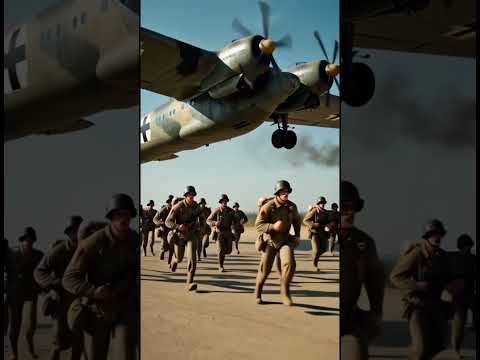
The first sign of trouble came as a whisper, then a shout. “They’re here!” An Australian sentry’s cry shattered the night. Suddenly, the darkness erupted with muzzle flashes and the deafening roar of gunfire. The elite soldiers, caught in the open, scrambled for cover. The raid was no longer a secret.
Rommel’s plan hinged on speed and surprise, but the Australians were ready. They had learned from previous assaults, fortifying their positions and laying traps. The Fallschirmjäger, once the hunters, were now the hunted.
As the first wave faltered, the second pushed forward, only to be met with a wall of lead. “Fall back! Fall back!” The order came too late. The night turned into a chaos of explosions and screams. The elite force, the pride of Germany, was being decimated.
In the midst of the carnage, one soldier, a veteran of Crete, found himself pinned behind a fallen comrade. He could hear the Australians advancing, their voices cold and determined. “No prisoners!” someone shouted. He gripped his weapon, knowing that surrender was not an option.
The raid was supposed to be a turning point, a demonstration of German superiority. Instead, it was becoming a disaster of unprecedented proportions. The question now was not whether they would succeed, but whether any of them would survive.
The veteran’s name was Klaus. He had stormed the airfields of Crete, survived the drop into Maleme, and had never once doubted the invincibility of the Fallschirmjäger. But here, in this godforsaken desert, that certainty was bleeding out of him with every round that cracked past his helmet.
He rolled sideways, brought his MP40 up, and fired a short burst into the dark. A shadow fell. He didn’t stop to check. “Klaus! Left flank!” a voice screamed—it was Weber, his old squadmate, crouched behind a shattered crate. Klaus scrambled toward him, boots slipping on sand turned slick with blood.
The Australians weren’t just defending. They were hunting. Small groups of them darted between cover, using the terrain with a familiarity the Germans couldn’t match. Every time the Fallschirmjäger tried to regroup, a new volley tore through their lines.
Then came the sound that froze every man’s blood—the deep, mechanical rumble of engines approaching from the rear. “Tanks!” someone bellowed. But these weren’t German panzers. The Australians had brought up armored cars, their headlights cutting through the smoke like searchlights in a prison yard.
Klaus grabbed Weber by the collar. “We’re cut off. The whole raid—it’s a trap.” Weber’s eyes were wide, his face pale beneath the grime. He nodded, not trusting his voice.
Rommel’s gamble had failed. The Australians had anticipated the assault, and now the elite force was trapped in a shrinking pocket of desert, their backs to the wire they had so confidently cut hours before. Klaus looked up at the stars, the same stars that had watched over Crete, and wondered if they would watch him die here instead.
A whistle blew—shrill and unmistakable. The Australians were signaling the final push. Klaus tightened his grip on his weapon, his breath shallow. Whatever happened next, he would not be taken alive.
The armored cars advanced in a wide arc, their engines growling like beasts closing in for the kill. Klaus pressed himself flat against the sand, feeling the vibration through his chest. “Weber, on my mark, we run for the ditch!” he hissed, pointing toward a shallow depression barely visible in the gloom.
Weber didn’t answer. Klaus turned to find his friend slumped against the crate, a dark stain spreading across his tunic. “Weber!” Klaus crawled to him, pressing a hand against the wound. Weber’s eyes fluttered open, glassy and unfocused. “Tell my wife… I didn’t…” The words dissolved into a wet cough. Then silence.
Something cold and hard settled in Klaus’s chest. He had seen men die before—too many to count—but Weber had been there since the beginning. Since the training grounds in Germany. Since Crete. Klaus closed his friend’s eyes and rose to his knees, ignoring the bullets whipping past.
A new sound cut through the chaos—a high-pitched whistle, followed by a blinding flash to the east. The Australian armored cars hesitated, their headlights swinging toward the explosion. “What the devil is that?” an Australian voice shouted.
Klaus didn’t waste the moment. He grabbed his MP40 and sprinted toward the ditch, diving in just as a burst of fire chewed up the ground behind him. Two other Fallschirmjäger landed beside him—young, terrified, their faces streaked with soot and tears.
“What’s happening?” one of them stammered. “Is it reinforcements?” Klaus shook his head, scanning the horizon. The explosion hadn’t come from the German lines. It had come from the far side of the Australian position—from the direction of the coast road.
Then he saw it: a column of trucks, headlights blazing, racing toward the Australian flank. But they weren’t German either. The silhouettes were wrong, the markings unfamiliar. “Italians,” Klaus breathed, recognizing the insignia on the lead vehicle. “The Italians are attacking.”
It made no sense. The Italian forces had been routed days ago, their positions overrun. Yet here they were, guns blazing, driving straight into the Australian rear. The armored cars swung around, their crews shouting in confusion, their fire shifting away from the trapped Fallschirmjäger.
Klaus didn’t need to understand why. He only needed to act. “Everyone, on your feet! Now!” he roared, rising from the ditch. “We push forward—toward the objective! Move! Move!”
The surviving Fallschirmjäger, perhaps forty of them now, staggered out of cover and followed him. The Australians, caught between the unexpected Italian assault and the renewed German push, faltered. For the first time that night, the tide seemed to turn.
But Klaus knew better than to hope. As they advanced through the smoke, he saw the truth in the eyes of the men around him. They were exhausted, bloodied, and far from the invincible force that had landed on Crete. Whatever happened next, this night would be written in blood—and he had no intention of letting Weber’s death be in vain.
The Italian trucks smashed into the Australian flank like a drunken fist, all noise and chaos and no finesse. Klaus and his forty survivors drove through the gap, boots pounding the sand, weapons barking at shadows. For a moment—just a moment—the raid lived again.
Then the Italian lead truck exploded. A shell from an Australian anti-tank gun tore through its engine block, and the vehicle flipped onto its side, spilling men and ammunition into the night. “They’re shelling the Italians! Keep moving!” Klaus screamed, shoving a young soldier forward.
The Australians recovered fast. Their armored cars pivoted, machine guns chattering, cutting down the Italian infantry before they could dismount. The diversion was collapsing. Klaus saw the coast road ahead, the objective—a supply depot—still half a kilometer away, now ringed with fresh muzzle flashes.
“Klaus! The radio!” A corporal crawled up beside him, blood streaming from a gash on his forehead. “Rommel’s on the line. He’s ordering a full retreat.” Klaus stared at him. Retreat. The word tasted like ash. After Crete, after everything, they were being told to run.
He looked back at the men crouched in the ditch—boys, mostly, their faces hollow with fear. Weber’s blood was still wet on his hands. “Tell him we’re too deep,” Klaus said quietly. “Tell him we can still reach the depot.” The corporal hesitated, then nodded and scrambled away.
But the radio crackled again a minute later. This time it was a different voice—calm, cold, unmistakably Rommel’s. “All units. Break contact. That is an order. The raid is over.”
Klaus closed his eyes. The stars were still there, indifferent as ever. He thought of Weber’s wife, of the words that would never reach her. Then he opened his eyes and looked at the men who were still alive. “You heard the man,” he said, his voice flat. “We’re leaving.”
They pulled back in small groups, melting into the darkness, leaving the dead where they fell. The Australians didn’t pursue far—they had their own wounded, their own fires to put out. By dawn, the desert was quiet again, the only sound the distant drone of trucks carrying the survivors back to German lines.
Klaus sat in the back of a halftrack, his MP40 across his knees, watching the sun rise over the wire they had cut just hours before. A sergeant beside him offered a cigarette. “What happened out there?” the man asked. Klaus took a long drag and exhaled slowly.
“We thought we were legends,” he said. “Turns out legends die just like everyone else.”
The halftrack rumbled on, carrying him away from the desert, away from Weber, away from the night that broke the Fallschirmjäger. And somewhere in the back of his mind, a question lingered, sharp as a bayonet: if the elite could be shattered so easily, what hope was left for the rest of them?
What do you think—was Rommel’s gamble doomed from the start, or did one wrong call cost him everything? Let me know in the comments.
Report this article
Select a reason for reporting:






