Dr. Sarah Mitchell had spent fifteen years in the dusty catacombs of the Smithsonian archives, but she had never seen a box like this one. It was a Tuesday morning in March 2024 when she found it—a sealed wooden crate marked with a single warning: RESTRICTED ACCESS. AUTHORIZATION REQUIRED. The box sat on a forgotten shelf, buried under decades of dust. Her curiosity pulled her closer. She checked the catalog number against the database. Nothing. No record, no description—just a reference number that led nowhere.
With trembling hands, she cut through the old seals. Inside, wrapped in acid-free paper, lay a single large photograph mounted on board. The image showed a group of well-dressed men standing on the steps of a government building. The date was clear: November 1872. Sarah studied the faces carefully. Most were unfamiliar, but one stood out immediately—the distinctive beard, the piercing eyes. She recognized him from countless historical texts. Senator William Crawford. But that was impossible. Crawford had died in April 1870.
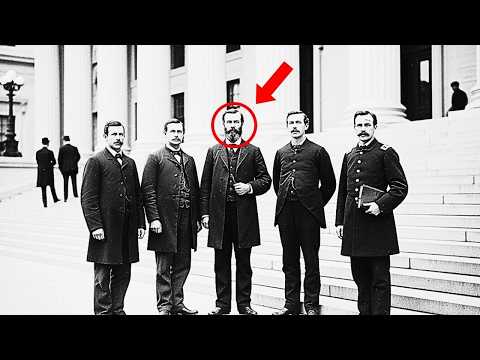
Her heart raced as she pulled out her phone and searched Crawford’s biography. Born 1821, died April 1870. Yet here he was, two and a half years after his supposed death, standing among other men. Sarah called out to her supervisor, Dr. James Chen, her voice urgent. “James, can you look at this for a moment?” He approached, setting down his files. As he examined the photograph, his expression shifted from casual interest to deep concern. “Where did you find this?” he asked quietly. “In a restricted box. There’s no catalog entry.” James straightened up, glancing around the archive room. “Sarah, put this away right now. We need to talk to the director before anyone else sees this.”
His tone made her stomach tighten. This wasn’t just an interesting historical find. This was something that had been deliberately hidden. The director’s office felt smaller than usual. Dr. Patricia Whitmore sat behind her desk, examining the photograph through white cotton gloves, her face unreadable. Sarah and James stood across from her, waiting. “How many people have seen this?” Patricia asked without looking up. “Just us,” Sarah replied. “I found it this morning.” Patricia set the photograph down carefully and removed her gloves. She walked to her window, gazing out at the National Mall. The silence stretched uncomfortably. “This photograph has been sealed since 1923,” Patricia finally said. “There’s a reason for that.”
Sarah exchanged a glance with James. “What reason?” Patricia turned back to face them. “Senator William Crawford was one of the most influential politicians during Reconstruction. His death in 1870 was a national tragedy. Newspapers covered it extensively. He was buried in Congressional Cemetery with full honors.” “But he’s in this photograph from 1872,” Sarah insisted. “Yes,” Patricia acknowledged, “which means either this photograph is a fraud or something far more complicated happened.”
She returned to her desk and opened a locked drawer, pulling out a thin folder. “There have been rumors for over a century—whispers among historians who knew better than to publish. Stories about Crawford faking his death.” James leaned forward. “Why would a senator fake his own death?” Patricia opened the folder, revealing old correspondences and newspaper clippings. “In 1870, Crawford was investigating massive corruption in the Grant administration. He had evidence linking high-ranking officials to the Whiskey Ring scandal—two years before it officially came to light. He was receiving death threats.”
Sarah’s mind raced. “So he faked his death to continue investigating in secret.” “That’s the theory,” Patricia said. “But it’s never been proven. This photograph might be the first real evidence.” She looked at both of them seriously. “If we pursue this, we’re challenging accepted history. We’re suggesting that government officials, journalists, and Crawford’s own family participated in an elaborate deception.” “Isn’t that what historians do?” Sarah asked. “Uncover the truth.” Patricia smiled slightly. “Sometimes the truth is dangerous. Families still carry Crawford’s name. Reputations are built on established narratives.” She paused. “But yes, we investigate carefully.”
Sarah spent the next week buried in research. She requested every document related to Senator Crawford from multiple archives, cross-referencing dates, locations, and eyewitness accounts. The more she discovered, the more questions emerged. Crawford’s death certificate listed the cause as heart failure. His personal physician, Dr. Edmund Hartley, had signed it. The funeral was attended by hundreds, including President Grant himself. Crawford’s wife, Margaret, was photographed at the burial, grief evident on her face. But small inconsistencies began to surface.
Sarah found a shipping manifest from November 1872—the same month as the photograph. A William Harris had booked passage from Washington to Philadelphia. The signature on the manifest looked remarkably similar to Crawford’s handwriting. She showed her findings to James in the archives research room. He had been investigating the photographer who had taken the portrait. “The studio belonged to Theodore Walsh,” James explained, spreading out documents. “He was known for photographing government officials. But here’s what’s interesting: Walsh closed his studio abruptly in January 1873 and moved to San Francisco. No explanation—just disappeared.” “Right after this photograph was taken,” Sarah noted. “Exactly. And I found something else.” James pulled up a digitized newspaper article from 1873. “Walsh died in a fire six months after arriving in California. The fire destroyed his studio and all his photographic plates.”
Sarah felt a chill. “That’s convenient. Too convenient.” James agreed. “Someone didn’t want evidence to survive.” They worked late into the evening, building a timeline. If Crawford had faked his death, he would have needed help from multiple people—his doctor, his family, government officials willing to look the other way, and a photographer to document his secret life. “Why would he let himself be photographed at all?” Sarah wondered aloud. “If you’re hiding, why create evidence?” James considered this. “Maybe it wasn’t meant to be evidence. Maybe it was insurance—proof that he was alive in case something happened to him during his investigation.”
Sarah pulled up the photograph on her computer, zooming in on the faces surrounding Crawford. “We need to identify everyone else in this picture. If Crawford was there, who were these other men?” The answer would unravel a conspiracy that had remained hidden for over a century—and lead Sarah down a path darker and more dangerous than she ever imagined.
Identifying the other men in the photograph took three days of painstaking work. Sarah used facial recognition software to compare the images against known photographs from the 1870s. One by one, the identities emerged. Standing to Crawford’s left was Daniel Pierce, a Treasury Department investigator who had officially resigned in 1871. Next to him was Robert Langford, a journalist for the New York Tribune who had written extensively about government corruption before mysteriously stopping in 1870. On Crawford’s right stood a man Sarah couldn’t immediately identify, but his bearing suggested military background.
She brought her findings to James and Patricia in a secure conference room. Patricia had invited one additional person: Dr. Marcus Reynolds, a historian specializing in Reconstruction-era politics. Marcus studied the photographs and documents spread across the table. “This is extraordinary,” he said quietly. “If authentic, this rewrites a significant chapter of American history.” “Do you think it’s authentic?” Patricia asked. Marcus examined the original photograph under magnification. “The paper stock is consistent with 1872. The photographic process matches the period. The mounting board has appropriate aging.” He set down his magnifying glass. “Technically, this appears genuine—but we need more context.”
Sarah presented her research on the other men. Each person in the photograph had connections to Crawford’s corruption investigation. Each one either died, disappeared, or stopped their work around 1870 to 1872. “They went underground together,” James said. “A whole network.” Marcus nodded slowly. “The Whiskey Ring scandal officially broke in 1875, but investigations had been ongoing secretly for years before that. If Crawford and these men were working covertly, they would have needed protection. Faking deaths or disappearances would provide that.”
Patricia stood and walked to the window. Outside, tourists moved along the Mall, unaware of the historical revelation unfolding above them. “We need to find more evidence—correspondence, financial records, anything that proves these men continued operating after their supposed deaths or disappearances.” “I have a lead,” Sarah said. “Crawford’s wife, Margaret, lived until 1894. Her personal papers are held by the Library of Congress. I’ve requested access.”
The Library of Congress reading room was quiet except for the soft rustle of archival pages. Sarah sat at a desk with six boxes of Margaret Crawford’s personal papers spread before her. She had started with correspondence, hoping to find letters that might reveal the truth. Most were mundane household accounts, social invitations, letters from relatives. But in the third box, Sarah found something unusual—a leather-bound journal with no dates on the exterior.
She opened it carefully. The first entry was dated May 1870, one month after Crawford’s supposed death. Margaret’s handwriting was elegant but shaky. “The hardest part is maintaining the grief in public. I must be the mourning widow while knowing William lives. He visited last night, entering through the garden as we arranged. He looks different with the beard shaved. I hardly recognized him. He says the investigation progresses, but it’s dangerous. They’re watching everyone connected to him.”
Sarah’s hands trembled as she turned the pages. Entry after entry documented secret meetings, coded messages, and Margaret’s struggle to maintain the deception. In July 1870, Margaret wrote: “Dr. Hartley came today with news. The men who threatened William have grown bolder. Two more investigators have been found dead. Their deaths ruled accidents.” “William wants to send me away, but I refuse. If I leave now, it will raise suspicions. We must maintain appearances.”
Sarah photographed each page, her heart racing. This was proof—direct evidence—that Crawford’s death had been staged. But it was also evidence of something more troubling: a conspiracy involving murder and intimidation. She found the entry corresponding to November 1872, around the time of the photograph. “William took a great risk today. He insisted on having a photograph made with the others. He says they need proof of their existence should anything happen to them. I fear his confidence makes him reckless. Walsh the photographer can be trusted, but every person who knows the truth is another vulnerability.”
Sarah continued reading until 1873. Margaret’s entries became shorter, more cryptic. In March 1873: “Walsh is dead. William is devastated. The fire was no accident. They’re eliminating witnesses.” The final entries from 1874 were brief: “William says it’s almost over. The evidence is compiled. Soon he can return.” But there was nothing after that. Sarah checked the remaining boxes but found no more journals. She sat back, processing what she had discovered. Margaret’s journal proved Crawford had faked his death, but it raised new questions. Did he ever return? What happened to the evidence he collected?
Sarah returned to the Smithsonian with copies of Margaret’s journal entries. Patricia immediately called an emergency meeting with James and Marcus. The revelations from the journal transformed their investigation from speculation to documented fact. “This changes everything,” Marcus said, reading through the entries. “We have direct testimony from Crawford’s wife. This is primary source evidence.” “But we still don’t know what happened after 1874,” James noted. “The journal stops and Crawford never publicly reappeared.”
Sarah had been thinking about this. “The unidentified man in the photograph—the one with military bearing. I think finding him is key. If we can identify him, we might understand how Crawford’s investigation ended.” Marcus took another look at the photograph. “Military records from that era are extensive. If he was an officer, there will be documentation.” Patricia nodded. “I’ll reach out to the National Archives military records division. Sarah, can you create a detailed description for them to work with?”
Over the next week, Sarah worked with a forensic artist to develop a comprehensive profile of the unknown man: age approximately 40 to 45 in 1872, height estimated at six feet, distinguished scar above left eyebrow, military posture and bearing suggesting officer rank. The response from the National Archives came faster than expected. The description matched to Colonel Thomas Bradford, who had served in army intelligence during and after the Civil War.
Bradford’s service records showed he had been assigned to Washington from 1869 to 1873, working in a division responsible for investigating corruption in military supply contracts. But Bradford’s record contained a curious gap. In December 1872—just one month after the photograph was taken—Bradford was reassigned to special duties with no further details. His service record after that date was heavily redacted.
Sarah requested unredacted documents through official channels but was denied. The documents were still classified under national security protocols, even after 150 years. “Why would a record from 1872 still be classified?” James asked when she told him. “Because whatever Bradford was investigating never fully went away,” Marcus suggested. “Some corruption scandals have tentacles that reach forward through generations. Families, corporations, political dynasties—they all have interest in keeping certain truths buried.”
Patricia made a decision. “We need to file a Freedom of Information Act request. It’ll take time, but we have grounds. This is historical research, not a threat to current national security.” Three months later, a package arrived at the Smithsonian. Inside were 47 pages from Colonel Bradford’s service record, though heavily redacted. Still, what remained was illuminating.
Bradford had been tasked with investigating corruption in military supply contracts during Reconstruction. His reports detailed a network of contractors, government officials, and military officers who were systematically defrauding the government of millions of dollars—money meant for rebuilding the South. One unredacted passage stood out: “Evidence suggests conspiracy reaches the highest levels of government. Recommend establishing secure investigative unit operating outside normal channels. Subjects under investigation have demonstrated willingness to use violence to protect interests.” The date of that report was March 1871—one month before Crawford’s supposed death.
Sarah compared the timeline with Margaret’s journal entries. Bradford’s report preceded Crawford’s faked death by weeks. The connection was clear. Crawford hadn’t been investigating in isolation. He’d been part of a coordinated effort with military intelligence. More pieces fell into place. Daniel Pierce from the Treasury Department would have provided financial records. Robert Langford, the journalist, would have had sources and contacts. Bradford brought military intelligence and protection. Crawford, as a senator, had political access and authority.
“They created an unofficial task force,” Sarah explained to the team, “outside normal government channels, so the corrupt officials couldn’t track their investigation.” Marcus was reading through the redacted pages. “Look at this notation from January 1873. Bradford writes, ‘Primary asset has been compromised, relocating to secondary position.’ That’s right after Walsh, the photographer, died.” “Crawford,” James said. “Bradford is referring to Crawford. After Walsh’s murder, they moved Crawford somewhere safer.” Patricia studied the documents. “But where and for how long?”
Sarah had been cross-referencing dates with historical events. The Whiskey Ring scandal broke publicly in 1875. Multiple officials were prosecuted, including President Grant’s personal secretary. The prosecutions were based on extensive documentation that supposedly came from a Treasury Department investigation. “But what if it actually came from Crawford’s secret investigation?” James suggested. “Exactly,” Sarah said. “Crawford and his team gathered the evidence, but it had to be introduced through official channels to be used in court. They would have needed to transfer their findings to legitimate investigators.”
Marcus nodded slowly. “That makes sense. By 1875, the political climate had shifted. Enough honest officials had been appointed that prosecution became possible. Crawford’s group could have handed over their evidence and faded away.” “But Crawford never returned publicly,” Patricia noted. “Why not? If the investigation was over and the criminals were being prosecuted, why stay dead?”
The answer came from an unexpected source. Sarah received an email from a genealogy researcher named Elizabeth Morrison, who had seen a news article about the Smithsonian’s investigation into Crawford’s photograph. Elizabeth explained that she had been researching her family history and found something unusual. Her great-great-grandfather, William Harris, had appeared in Philadelphia in 1873 with no prior history. He’d established himself as a legal consultant, married in 1875, and lived quietly until his death in 1903. Family stories suggested he’d had an important life before Philadelphia, but he never discussed it.
Sarah’s pulse quickened. William Harris—the same name from the shipping manifest she’d found months earlier. Elizabeth had included photographs of William Harris from the 1880s and 1890s. Sarah opened them with trembling hands. The man in the photographs was older, heavier, with different facial hair, but the eyes were the same. The distinctive shape of the ears, the way he held his shoulders. She ran the images through facial recognition software, comparing them to known photographs of Senator Crawford from before 1870. The match probability was 94%.
Sarah called Elizabeth immediately. “I need to see any documents your family has related to William Harris. Letters, business records—anything.” “I have boxes of material,” Elizabeth said. “I’m in Baltimore. I could bring them to Washington.” They met two days later in the Smithsonian secure research facility. Elizabeth brought three boxes of documents spanning William Harris’s life from 1873 to 1903.
Sarah started with personal correspondence. Most letters were unremarkable business matters, family concerns. But one letter, dated 1889 and addressed to William, caught her attention: “William, I know you’ve built a new life, and I respect your decision to remain removed from the past. But our children deserve to know their father’s true legacy. Not the fiction the world believes, but the truth of what you sacrificed and accomplished. Consider allowing them to know, even if the world cannot.” The signature was simply “M.” But the handwriting matched Margaret Crawford’s journal.
“Your great-great-grandmother,” Sarah said to Elizabeth. “What was her name?” “Margaret,” Elizabeth replied. “Margaret Harris. Though family stories say she’d been married before and was widowed.” Sarah showed Elizabeth the journal entries and explained the full scope of their discovery. Elizabeth sat in stunned silence. “You’re telling me William Harris was actually Senator William Crawford? That my entire family descended from a man who faked his death?” “Yes,” Sarah said gently. “And that man probably prevented a constitutional crisis by exposing corruption that might have destroyed Reconstruction entirely.”
With Elizabeth’s permission, Sarah’s team examined the Harris family documents thoroughly. They found business records showing William Harris had worked as a legal consultant for various anti-corruption reform groups throughout the 1880s and 1890s—always behind the scenes, never seeking public recognition. Harris had died in 1903, with his obituary describing him as a respected legal mind and devoted family man. Nothing suggested his previous life as Senator Crawford.
But Marcus made a crucial discovery in Harris’s estate papers. Among the legal documents was a sealed envelope marked: “To be opened only by family 50 years after my death.” “That would be 1953,” James calculated. Elizabeth explained that her grandmother had found the envelope in the 1950s but had been afraid to open it, thinking it might contain family secrets better left buried. She kept it sealed, passing it to Elizabeth’s mother, who’d eventually given it to Elizabeth. “I’ve had it for ten years,” Elizabeth admitted. “I always meant to open it, but never found the right moment. Maybe this is it.”
With everyone watching, Elizabeth carefully broke the seal. Inside was a letter in Crawford’s handwriting, dated 1902—one year before his death.
“To my descendants, if you’re reading this, enough time has passed that truth can no longer harm the living. I was born William Crawford, served as United States Senator, and in 1870 made the decision to fake my death in order to continue investigating corruption that threatened our republic. With the help of loyal friends—Colonel Thomas Bradford, Daniel Pierce, Robert Langford, Dr. Edmund Hartley, and especially my beloved wife Margaret—I spent four years gathering evidence that ultimately led to the prosecution of over one hundred corrupt officials. This evidence helped preserve the integrity of Reconstruction and prevented what might have been a complete collapse of governmental authority.”
“I could never return to public life because doing so would have compromised everyone who helped me and possibly invalidated the prosecutions based on our evidence. The price of truth was my identity, my career, and my public legacy. But I gained something more valuable: the knowledge that I served my country in the deepest way possible, and a quiet life with Margaret and our children, who knew me as the man I truly was—not the senator I had been.”
“The photograph taken in November 1872 was our insurance policy—proof that we existed and worked together. Should our evidence ever be questioned, I entrusted it to a colleague who sealed it in government archives with instructions not to be opened for fifty years. I hope future generations will understand that sometimes sacrifice means giving up glory, not life. I have no regrets.”
Signed, William Crawford, who became William Harris six months later.
The Smithsonian hosted a special exhibition titled “The Hidden Investigation: Senator Crawford and the Secret War on Corruption.” The 1872 photograph was displayed prominently alongside Margaret’s journal, Bradford’s reports, and Crawford’s final letter. Sarah stood in the hall on opening day, watching visitors absorb the story that had consumed her life for nearly a year. Elizabeth Morrison stood beside her, eyes glistening before a family portrait of William Harris from 1895, hung next to his Senate portrait from 1868.
“How do you feel?” Sarah asked. “Proud,” Elizabeth said simply. “My great-great-grandfather was a hero, even if no one knew it. Maybe especially because no one knew it.”
In Congressional Cemetery, a new marker was placed beside Crawford’s original gravestone: “Senator William Crawford, 1821–1903. Public servant in life and in secrecy. Truth revealed 2024.”
But one question still haunted Sarah. Who had sealed the box in 1923—and did that last conspirator’s family ever learn what Crawford truly sacrificed? What do you think really happened to the evidence after 1875?
Report this article
Select a reason for reporting:






