Dr. Michael Torres had always been drawn to forgotten stories. As a labor historian at Boston University, he spent his career uncovering the hidden narratives of working-class Americans. But nothing prepared him for what he found in March 2024, buried in the basement archives of the Massachusetts Historical Society.
He was researching textile industry records when he noticed a gap in the photographic collection. The catalog listed a photograph dated 1885, taken at the Pemberton Mill in Lawrence, Massachusetts. But the photograph itself was missing. In its place was a single notation: “Confiscated by order of state authority. Access restricted.”
Michael’s curiosity ignited. In fifteen years of research, he had never encountered a confiscated photograph from the industrial era.
He brought the catalog entry to the head archivist, Dorothy Chen, a woman in her sixties who had worked at the historical society for over thirty years. “Do you know anything about this?” Michael asked, showing her the entry.
Dorothy studied it carefully, her expression shifting. “I’ve seen this reference before. Years ago, when I first started here, I asked about it. My supervisor told me never to pursue it. Said some historical materials were better left alone.”
“Why would a photograph from 1885 need to be restricted?”
“I don’t know, but the restriction was placed by the Massachusetts Attorney General’s Office in 1886. It’s been sealed ever since.” She paused. “Though technically, restrictions over one hundred years old require judicial review to remain in effect. This one might have expired.”
Michael felt his pulse quicken. “Can we request it?”
Dorothy considered this. “We can file a formal inquiry with the state archives. They maintain records of all confiscated materials. But Michael, if this was sealed for nearly 140 years, there’s a reason. Are you prepared for what you might find?”
He thought about his grandmother, who had worked in garment factories as a child in the 1920s. She had told him stories that haunted him. Stories of friends who lost fingers to machines, of fourteen-hour days, of wages that barely covered rent. Those stories had driven his entire career.
“I need to know the truth,” he said. “Whatever it is.”
Dorothy nodded slowly. “Then let’s find out what they were hiding.”
Two weeks later, Michael received a response from the Massachusetts State Archives. His request had been approved with conditions. He could view the photograph in a secure facility but could not photograph it or remove it from the premises without additional authorization. A hearing would be scheduled to determine if the historical restrictions should be lifted.
Michael drove to the state archives building in Boston on a cold April morning. He was met by an archivist named Steven Park, who led him through security checkpoints to a climate-controlled viewing room.
“The photograph has been stored in sealed conditions since 1886,” Steven explained as he unlocked a vault. “Very few people have seen it. According to our records, it was viewed three times. Once in 1923 during a labor reform inquiry. Once in 1957 by a state historian. And once in 1989 by a graduate student researching child labor laws.”
“What happened to those researchers?” Michael asked.
Steven pulled out a sealed container. “The 1923 inquiry was shut down before completion. The 1957 historian published nothing about the image. The graduate student changed her dissertation topic.” He set the container on the examination table. “Make of that what you will.”
Steven opened the container carefully. Inside, protected by acid-free materials, was a large photographic print mounted on board. He lifted it out and placed it under the examination light.
Michael leaned forward, and his breath caught.
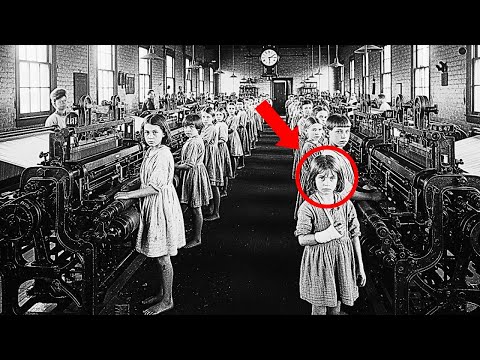
The photograph showed the interior of a textile factory. Rows of massive looms filled the frame, their mechanisms visible in remarkable detail. But what made Michael’s stomach turn were the workers operating them.
Children. Dozens of children, none appearing older than twelve. Some looked as young as six or seven. They stood at the machines in threadbare clothes, many barefoot despite the industrial floor. Their faces were gaunt, exhausted. Several had visible injuries—bandaged hands, scarred arms.
In the foreground, a small girl with dark hair looked directly at the camera. She couldn’t have been more than eight years old. Her right hand was wrapped in dirty cloth, blood seeping through. Her eyes held an expression Michael had never seen in a child’s face. A hollow exhaustion that spoke of suffering beyond her years.
“My God,” Michael whispered.
Steven stood beside him, his own face pale. “Now you understand why it was confiscated.”
Michael studied every detail. The lighting was harsh, showing the grim reality without mercy. In the background, adult supervisors stood watching, some holding long sticks. The factory windows were barred. A clock on the wall showed 6:47—morning or evening, impossible to tell.
“Who took this?” Michael asked.
Steven consulted the documentation. “A photographer named Jacob Reese. No, wait, that’s not right.” He checked again. “The photographer’s name has been redacted. All we know is that the photograph was taken in August 1885 at the Pemberton Mill and was immediately seized by factory owners who filed a complaint with the attorney general.”
“On what grounds?”
“Trade secrets and defamation. They argued the photograph misrepresented working conditions and would damage Massachusetts’s industrial reputation.” Steven pointed to a notation. “The attorney general agreed and ordered it confiscated. It’s been sealed ever since.”
Michael stared at the image, particularly at the small girl in the foreground. “This wasn’t defamation. This was documentation. They banned it because it was true.”
Michael couldn’t stop thinking about the photograph. That night, he lay awake seeing the girl’s face—the bandaged hand, the hollow eyes. He needed to know who she was, what had happened to her.
The next morning, he went to the Lawrence Public Library, which housed records from the city’s industrial period. Lawrence had been a textile manufacturing center in the late 1800s, home to dozens of mills employing thousands of workers. The Pemberton Mill had a particularly dark history. In 1860, the original factory building had collapsed, killing 145 workers and injuring hundreds more. The mill had been rebuilt and reopened in 1862, operating until 1901.
Michael requested all available records—employment logs, accident reports, newspaper articles. The employment records were fragmentary but revealing. The Pemberton Mill had employed over 800 workers in 1885. Nearly 400 were listed as “juvenile operators”—the euphemism for child workers. Ages ranged from seven to fifteen.
Michael cross-referenced the records with the city directory from 1885, trying to identify workers who might have been in the photograph. Many names were accompanied by tragic notations: “deceased, industrial accident,” “dismissed, injury,” “relocated, unknown.”
He found accident reports filed with the state labor bureau. In August 1885 alone—the month the photograph was taken—the Pemberton Mill reported seventeen injuries to juvenile workers. Most were listed as minor: crushed fingers, lacerations, burns. Three were classified as severe: amputations. And one death.
One report caught his attention. August 14, 1885. Anna Kowalski, age 8. Right hand injury from loom mechanism. Treatment provided. Returned to work. August 16. Anna Kowalski, 8 years old. Right hand injury. The timing matched the photograph.
Michael requested immigration records next. The Kowalski family had arrived from Poland in 1883. The father, Joseph, was listed as a mill worker. The mother, Maria, had died in 1884 of consumption. Three children: Anna, born 1877; Thomas, born 1879; and Catherine, born 1881.
He found Joseph Kowalski’s death record from 1887—killed in a factory accident at age thirty-four. The children had been sent to an orphanage.
Michael sat back, overwhelmed. Anna would be in her late 140s now if she had survived. He searched death records, hoping not to find her name too early. He found it in 1889. Anna Kowalski, age 12. Cause of death: infection following industrial accident. She had died at the Pemberton Mill four years after the photograph was taken.
Michael knew he needed to identify the photographer. Whoever had taken that image in 1885 had deliberately documented conditions that mill owners wanted hidden. That photographer had risked everything to create evidence. The redacted name in the state archives haunted him. Why remove the photographer’s identity? What were they protecting? Or whom were they punishing?
He reached out to colleagues across the country, asking about photographers who had documented industrial conditions in the 1880s. Most responses mentioned Jacob Riis, whose work exposing New York tenement conditions was famous. But Riis had focused on urban poverty, not factory conditions, and his major work didn’t begin until the 1890s.
Then Michael received an email from Dr. Sarah Chun, a photography historian at the Smithsonian. She had found a reference in an obscure journal article from 1925 about suppressed industrial photography. The article mentioned a photographer named David Walsh who had worked in Massachusetts textile mills in the 1880s, documenting working conditions for labor reform advocates. Walsh had disappeared from historical records after 1886. No death certificate, no further publications—nothing. He had simply vanished.
Michael searched for any trace of David Walsh. He found a brief biographical entry in a photographers’ directory from 1884. Walsh had operated a studio in Lawrence specializing in portraiture and documentary work. He was described as “an artist of social conscience.” In the Lawrence City Directory from 1885, Walsh’s studio was listed at 47 Essex Street. But in the 1886 directory, the address was occupied by a different business. Walsh’s name appeared nowhere.
Michael visited the Lawrence Historical Commission, hoping they might have more information. The director, Margaret O’Brien, was a retired schoolteacher who had spent decades preserving local history.
“David Walsh,” she said thoughtfully when Michael asked. “That name sounds familiar. Let me check our vertical files.”
She returned with a thin folder containing newspaper clippings and a few documents. Inside was a brief article from the Lawrence Daily Eagle, dated September 12, 1885.
“Local photographer David Walsh was arrested yesterday on charges of trespassing and theft of proprietary information. Walsh allegedly entered the Pemberton Mill without authorization and created photographic images of the interior operations. Mill owner Harrison Pemberton has filed charges. Walsh is being held pending trial.”
Michael’s hands trembled as he read. This confirmed Walsh had taken the photograph. But what happened after his arrest?
Margaret found another clipping, dated October 3, 1885.
“Photographer David Walsh has agreed to a settlement in the case brought by Pemberton Mill. All photographic plates and prints created during his unauthorized entry will be surrendered to mill ownership. Walsh has agreed to leave Massachusetts and will face criminal charges if he returns. The case is considered closed.”
“They forced him out,” Michael said. “And they took his photographs.”
“All except one,” Margaret noted. “The one that ended up in state custody.”
Michael couldn’t shake the phrase “all photographic plates and prints.” If Walsh had taken one photograph that was confiscated, he might have taken others. Where were they?
He returned to the state archives and asked Steven if any other materials had been confiscated along with the photograph. Steven checked the records. “There’s a reference to associated materials being held separately,” Steven said. “But they’re not cataloged. They might be in the uncataloged storage facility.”
“Can we look?”
Steven hesitated. “That facility isn’t climate controlled. Materials there are considered low priority or unprocessed. It would take time to search.”
“I have time,” Michael insisted.
Two days later, Steven called. “I found something. Can you come in?”
Michael drove to the archives immediately. Steven led him to a storage room filled with boxes and crates, many covered in dust. On a table in the center were several sealed envelopes and a metal box.
“These were filed with the 1885 confiscation,” Steven explained. “The envelopes contain legal documents—arrest warrants, settlement agreements, correspondence. The metal box is labeled ‘Evidence: Walsh photographic materials.’”
Michael opened the box carefully. Inside were four glass plate negatives, each protected by wrapping. He held one up to the light, and his breath caught. It was another photograph from inside the Pemberton Mill, showing a different angle. More children at the looms. In this image, a supervisor stood over a small boy, stick raised.
The second negative showed children eating lunch on the factory floor, sitting among the machinery. Their food looked meager—bread and water. The third showed the factory entrance at dawn. A line of children waited to enter, their parents beside them. Many of the adults looked as exhausted as the children.
The fourth negative was the most damning. It showed a child who had collapsed beside a machine. Two supervisors were dragging the unconscious child toward a door while other children continued working, not even looking up.
“Walsh documented everything,” Michael whispered. “This wasn’t just one photograph. He created a complete record of what was happening.”
Steven examined the negatives. “The settlement agreement says Walsh surrendered all his materials, but these were in state custody, not returned to the mill. Someone in the attorney general’s office must have kept them as evidence.”
Michael looked at the envelopes containing legal documents. “Evidence of what? If they were going to prosecute the mill, why seal everything instead?”
Steven opened one envelope and began reading the correspondence. His expression darkened. “Because they weren’t planning to prosecute the mill. They were planning to protect it.”
He showed Michael a letter from the attorney general to Harrison Pemberton, dated September 1885.
“Your concerns regarding the Walsh photographs are understood. Massachusetts industry cannot afford negative publicity that might encourage federal labor regulation. The materials will be secured and restricted. Walsh will be removed from the state. This matter will be considered resolved.”
Michael felt sick. They weren’t hiding evidence of Walsh’s trespassing. They were hiding evidence of child exploitation.
Michael stared at the letter, the words burning into him. “They didn’t just silence Walsh. They silenced the truth for generations.” He thought of Anna, her bandaged hand, her hollow eyes—and knew he had to finish what Walsh started.
With Steven’s help, he petitioned the state archives for full release. The hearing was contentious, but the evidence was undeniable. In July 2024, the photographs were unsealed, and Anna’s face appeared on front pages nationwide.
At the memorial dedication a year later, Michael placed a copy of the 1885 photograph at the base of Anna’s sculpture. An elderly woman approached—Catherine Sullivan, Anna’s niece. “Grandma Catherine never forgot her sister,” she said, handing him a faded photo of the three Kowalski children. “She’d want Anna remembered as more than a victim.”
Michael held the photo, seeing Anna’s ghost of a smile. The truth, buried for 139 years, had finally spoken. What forgotten stories will you uncover?
Report this article
Select a reason for reporting:






