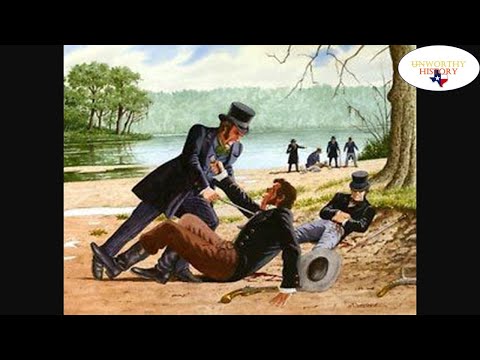
The Mississippi River sandbar was slick with blood and mud. Twelve men had come to settle a score, but only one would walk away with a legend forged in steel. Jim Bowie, shot four times and cut five, lay bleeding in the dirt—until his enemy, Major Norris Wright, charged in for the kill. With a final surge of strength, Bowie raised himself and drove his knife deep into Wright’s heart. That blade, a simple hunting knife given to him by his father, would never miss fire. And from that moment on, the Bowie knife became the most feared weapon in the Southwest.
But the story didn’t start on that sandbar. It began years earlier, in the swamps of Louisiana, where the Bowie brothers rode wild cattle and learned that a pistol could fail—but a blade, if held right, never would.
James Bowie was born in Tennessee in 1795, the son of a hard-riding, hard-headed Scotsman who once broke out of jail with his wife’s help, both of them armed with pistols. The Bowie men were fighters, and Jim was no exception. By the 1820s, he and his brother Rezin owned a sprawling sugar plantation on Bayou Lafourche, but their real passions were land speculation and adventure.
Rezin Bowie was the first to envision a knife that wouldn’t slip from a man’s grasp. After a hunting accident nearly cost him his hand, he sketched a design: a blade ten inches long, two inches wide, with a guard to protect the fingers. He handed the drawing to the plantation blacksmith, Jesse Clifft, and said, “Make this.” The result was so effective that Rezin kept it locked in his desk, a prized possession.
But when Jim found himself in a deadly feud with Major Norris Wright—a man who had already tried to kill him once—Rezin didn’t hesitate. He unlocked the desk, handed the knife to his brother, and said, “Here, Jim, take old Bowie. She never misses fire.” Those words would echo through history.
The Sandbar Duel of September 19, 1827, was not a formal affair. It was a brawl among twelve men on a sandbar near Natchez, and when the smoke cleared, two were dead and three were wounded. Bowie, despite his injuries, had killed his man with that knife. The blade that saved his life became an instant legend. Copies spread like wildfire across Louisiana, Arkansas, and Texas—each blacksmith adding his own touch, but all bearing the name Bowie.
Yet the true origin of the knife remains a tangle of tall tales and conflicting accounts. Some say Jim himself whittled the pattern from wood while recovering from his wounds. Others insist it was a New Orleans cutler named Pedro who forged the first blade from a file. And in Arkansas, they tell a different story altogether—of a blind blacksmith named James Black who alone possessed the secret of tempering the steel, a secret that died with him.
But that is a story for another time. For now, all that matters is this: on a bloody sandbar, a knife earned its name, and a man earned his legend.
Word of that legend traveled faster than any riverboat. In Natchez, men began ordering copies of the knife from local smiths, each demanding a blade “like Bowie’s.” The phrase caught on, and soon the weapon had a name that needed no explanation.
But the story of the Bowie knife is not one story—it is many, tangled together like roots in a swamp. In Arkansas, they tell of a blacksmith named James Black, a man who could temper steel in a way no one else could replicate. According to Governor Dan W. Jones, who knew Black personally, the smith made two knives for Bowie in 1831—one to Bowie’s pattern, and one of his own design. Bowie chose Black’s, and the rest became legend.
Black’s skill was said to be almost supernatural. He would cut hard hickory for half an hour to test a blade, and if it couldn’t shave hair from his arm afterward, he threw it away. No one ever learned his secret. He took it to his grave.
The end of James Black is as tragic as any frontier tale. His wife died in 1838, and while Black lay ill with fever, his jealous father-in-law beat him over the head with a stick, leaving him blind. A quack doctor in Cincinnati finished the job. Black returned to Arkansas penniless, an object of charity.
For years, he promised to reveal the secret of his steel to young Daniel Jones, the governor’s son. On May 1, 1870—his seventieth birthday—Black finally called for pen and paper. But as he sat rubbing his brow, trying to remember the ten or twelve processes he once knew by heart, the secret slipped away. “My God, my God, it has all gone from me,” he wept. “I have put it off too long.” The skin on his forehead had been rubbed completely away.
He lived two more years, an imbecile, and was buried in the old graveyard at Washington, Arkansas. With him died the true Bowie knife.
Yet the knife itself lived on. In Texas, a young blacksmith named Noah Smithwick saw Bowie’s blade in 1828—polished, set in an ivory handle, mounted with silver. “The blood-christened weapon,” he called it. When word spread that Smithwick was making genuine Bowie knives, demand exploded. He cut a pattern and started a factory, charging five to twenty dollars a blade.
Even Davy Crockett admired the knife. In the Alamo, Bowie drew it to cut a strap, and Crockett later wrote that the bare side of it was enough to give a man of squeamish stomach the colic. “You might tickle a fellow’s ribs a long time with this little instrument before you make him laugh,” Bowie told him.
But the knife was not just for show. In the hands of a skilled frontiersman, it could split a man’s skull like starred glass, or drop a deer at midnight with a single throw. It could grind coffee, hack limbs, and settle disputes that no court would touch.
And in the dark rooms of Texas, men stripped to the waist and fought with knives by lantern light—duels so silent that seconds outside heard nothing until a voice cried, “Come in.”
That was the world the Bowie knife made. And it was a world that would soon end, as a new invention—the revolver—rose to take its place.
It was in that fading world that a judge named Robert M. Williamson—better known as Three-Legged Willie—made his stand. A disease in his youth had left his right leg bent permanently at the knee, but he wore a wooden leg and rode and shot better than most whole men alive. He had fought at San Jacinto, and he carried the authority of the Republic of Texas in his pocket.
When President Sam Houston sent him to hold court in a county that had refused the law for years, the feudists met him with a resolution. A lawyer rose in the crowded courtroom, read it aloud, and sat down. Williamson asked if he could cite any statute to justify adjourning court on such grounds.
The lawyer stood again, drew his long Bowie knife, and laid it flat on the table. “This is the statute that governs in such cases,” he said.
Three-Legged Willie leapt from his chair, drew one of the new Colt revolvers, and leveled it at the man. “And this is the Constitution that overrides the statute,” he roared. “Open court, Mr. Sheriff, and call the witnesses in the first case.”
It was, by many accounts, one of the first times a Colt settled a dispute in Texas—perhaps the very first. The knife had ruled the Southwest for a generation, but in that courtroom the balance of power shifted forever. The revolver did not need a steady hand and a strong arm; it did not care whether a man had trained since boyhood to throw and thrust. It simply fired.
Yet the Bowie knife did not vanish. It hung at the belts of Rangers and settlers, rode in saddlebags, and found its way into the hands of men who still believed that a blade never misses fire. In the Alamo, Bowie died with one clasped in his hand—or so the stories say—and around his cot lay a heap of Mexicans whose ribs had been tickled by that awful point.
Some said he gave the original knife to the actor Forrest. Others swore a Louisiana descendant lost it in a bayou forty years on. Old Cephas Ham told how Bowie left it on the ground near Goliad Road after butchering a deer, rode back miles to find it gone—and supposed a wolf had packed it off, blood and all.
Perhaps that is fitting. The truest Bowie knife was never a single blade at all. It was an idea passed from hand to hand, from blacksmith to blacksmith, each one swearing his was the genuine article. Judge Pope of Arkansas insisted no true Bowie knife was ever made outside his state. The Texans laughed at that. The Louisianans laughed at them both.
And somewhere in the old graveyard at Washington, Arkansas, beneath a stone that time has all but worn smooth, lies a blind man who knew the truth and could not speak it. The secret of the steel was never written down. It was never taught. It simply slipped away, one forgotten process at a time, while the world moved on to powder and lead.
But on a sandbar near Natchez, in the muddy September of 1827, a wounded man rose from the dirt and drove a blade through his enemy’s heart. That much is certain. That much is history. And history, unlike steel, does not rust.
So the Bowie knife was never one blade but a hundred—each smith swearing his was the true one, each story growing taller with every retelling. What remains certain is that a wounded man on a Mississippi sandbar rose up and would not die, and the weapon in his hand took his name forever.
The frontiersmen who carried it are long gone, and the world that made them—of land frauds and midnight duels and blind blacksmiths—has vanished as surely as Black’s secret. Yet the legend endures, passed down like a blade from hand to hand, sharper with each telling.
Perhaps that is the real inheritance: not the steel, but the stories we refuse to let rust. And so the question passes to you, reader—if a legend can outlive the truth that made it, which one would you choose to carry forward?
Report this article
Select a reason for reporting:






