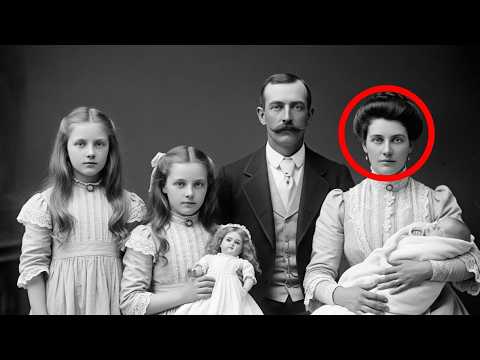
In the dusty attic of a century-old house in Valadelid, Spain, a worn wooden box awaited to reveal its mysteries. It was 2024, and Carmen Rodriguez had just inherited the family property after the death of her great-aunt. Among the belongings accumulated over decades, she would find a photograph that would forever change the understanding of her family history.
The image, dated 1911, showed five people: a stern patriarch with a thick mustache, a young woman holding a baby, and two small girls. According to the elegant handwritten calligraphy on its reverse, it was a formal portrait of Grandfather Tomas, his wife Mercedes, and their three children. For over a century, the photograph had been filed away, seemingly ordinary. But something about the woman identified as Mercedes caught Carmen’s eye. She seemed extraordinarily young to be the mother of three children, her posture betraying a subtle discomfort.
Driven by curiosity, Carmen sought out Dr. Miguel Herrera, a specialist in historical photography at the Museum of Valadelid. In his cluttered office, surrounded by magnifying glasses and digital measuring equipment, Dr. Herrera began a meticulous analysis. The first anomaly emerged from anthropometric measurements: the woman’s facial bone structure and skin texture placed her between 16 and 18 years old—far too young to have an 8-year-old child. But the most revealing discovery came from facial recognition software: the supposed mother shared striking structural similarities with the two older girls, suggesting a fraternal rather than maternal relationship.
This technical breakthrough raised a fundamental question: If Mercedes wasn’t the mother, who was she? And what circumstances had led a teenager to assume the maternal role in an official family photograph?
The investigation moved to the parish archives of San Martin de Alani, where Sister Espiransa, the archivist, had preserved records dating back centuries. The baptism books revealed that Tomas Rodriguez had married Francisca Jimenez in 1889 and had four children: Isabel in 1890, Mercedes in 1893, Carmen in 1899, and Antonio in 1911—the same year as the photograph. But a disturbing fact emerged: Francisca had died in February 1911, barely three months after Antonio’s birth, from complications of childbirth.
In rural Spain of 1911, a widower with four children faced a crisis. Social structures dictated that orphans be cared for within the extended family, and the public image of stability had to be maintained at all costs. The photograph, taken in September 1911, six months after Francisca’s death, showed Mercedes—the eldest available daughter at 18—posing as the mother. Presenting her as the mother instead of the older sister was a strategy to preserve the appearance of family normality.
The documentary evidence confirmed Dr. Herrera’s suspicions: Mercedes was not the mother, but the older sister who had sacrificed her youth to keep the family together after the maternal tragedy.
The investigation then expanded toward oral testimonies from living descendants. Family memory, transmitted through stories told in kitchens during long winter afternoons, contains elements of historical truth that complement official records. The first interview was conducted with Remedios Rodriguez, 89 years old, Mercedes’s granddaughter and the last survivor of her generation. Her memories about her grandmother were imbued with deep admiration mixed with an inexplicable sadness that now began to make sense.
“My grandmother Mercedes never married,” Remedios recalled with a trembling voice. “She said she had already raised enough children. We thought she was referring to her brothers, but now I understand she was referring to something deeper. She sacrificed her own life to keep the family united after my great-grandmother Francisca died.”
The testimonies revealed touching details about Mercedes’s later life. She had remained single throughout her life, dedicating herself completely to caring for her younger brothers and later her nephews. Her renunciation of marriage and biological motherhood had been a conscious decision motivated by a sense of family duty that Spanish society of the early 20th century imposed especially on older women in orphaned families.
Another revealing testimony came from Aurelia Rodriguez, 76 years old, Tomas’s great-granddaughter. Aurelia remembered stories told by her grandfather Antonio—the baby in the photograph—about how Mercedes had been more than a sister. “My grandfather Antonio always said that Mercedes had taught him to walk, to read, and had given him all the maternal love he had lost with his biological mother’s death.”
These family testimonies confirmed that Mercedes’s sacrifice had transcended the simple pose in a photograph. It had implied the complete renunciation of her own personal life to assume the maternal responsibilities that circumstances and society had imposed on her.
To fully understand the implications of Mercedes’s sacrifice, it was necessary to examine the social and cultural context of Spain in 1911. This historical period, known as the Bourbon Restoration, was characterized by rigid social structures, especially in rural areas of Castilla y León, where conservative traditions maintained strict control over family and social behavior.
In rural Spain of the early 20th century, the family constituted the fundamental economic and social unit. The death of the family mother represented a crisis that threatened not only the survival of younger children, but also the reputation and economic stability of the entire family unit. The options available to a family in this situation were limited, and all implied significant sacrifices.
The first option would have been for Tomas to remarry quickly. However, finding a woman willing to assume responsibility for four children—including a newborn—at a time when infant mortality was high and economic resources limited, would have been extremely difficult. Additionally, a new marriage so soon after Francisca’s death would have been seen as a lack of respect toward the deceased’s memory.
The second option would have been to disperse the younger children among extended family or religious institutions. This practice was common but would have meant the complete disintegration of the family unit and would have marked the children with the social stigma of being dispersed orphans—a condition that would significantly limit their future opportunities for marriage and social advancement.
The third option, the one the Rodriguez family finally chose, was for Mercedes to prematurely assume the maternal role. This decision allowed them to keep the family unit intact and preserve social reputation, but required the complete sacrifice of an 18-year-old teenager’s personal aspirations.
In this context, the 1911 photograph acquires a deeper dimension. It was not simply a family portrait, but a public declaration of stability and normality. By presenting Mercedes as mother instead of older sister, the family communicated to the community that they had overcome the crisis and maintained their traditional structure intact.
The detailed analysis of Mercedes Rodriguez’s later life reveals the magnitude of the sacrifice she had assumed at 18 years old. Municipal records and family testimonies construct the portrait of a woman whose existence was completely defined by her dedication to the family, renouncing all personal aspirations typical of a young woman of her era.
Mercedes never married—a decision that in rural Spain of the early 20th century had profound social implications. In a society where marriage constituted the only path to personal and economic fulfillment for women, remaining single was considered an anomaly that generated speculation and often social pity. However, family testimonies suggest that this decision was completely conscious and motivated by her commitment to raising her younger brothers.
Parish records show that Mercedes rejected at least three documented marriage proposals between 1912 and 1920. One of them came from Evaristo Hernandez, son of a prosperous merchant family from Medina del Campo, which would have represented an exceptional opportunity for social advancement. Her rejection of this proposal confirms that her decision to remain single was not the product of lack of opportunities, but a deliberate choice to prioritize her role as substitute mother.
Mercedes’s daily life was structured completely around her brothers’ needs. She rose before dawn to prepare breakfast and organized the children’s clothes for school. During the day, she managed the domestic economy, supervised minor agricultural tasks, and in the afternoons taught her younger brothers to read and write—particularly Antonio, who had lost his biological mother as barely a baby.
Her sacrifice also implied renunciation of her own biological motherhood. At a time when having children was considered the natural destiny and fundamental purpose of every woman, Mercedes channeled all her maternal instinct toward her brothers. Family testimonies describe how Antonio, the baby in the photograph, called her “Mama Mercedes” well into his adolescence, and how she responded to this title with a mixture of pride and melancholy.
Mercedes’s personal correspondence, partially preserved in the family archives, reveals moments of deep loneliness and reflections on the path not taken. In a letter addressed to a cousin who lived in Madrid, she wrote, “Sometimes I wonder what my life would have been like if circumstances had been different. But when I see Antonio smile, or when Carmen hugs me, I know I made the right decision.”
Mercedes’s sacrifice had profound repercussions that extended through subsequent generations of the Rodriguez family, creating behavioral patterns and family values that would endure for decades. Her decision to assume the maternal role not only saved the immediate family unit, but established a precedent of personal sacrifice for collective well-being that would influence her descendants’ decisions.
Antonio Rodriguez, the baby in the photograph, who had grown up under Mercedes’s maternal care, developed a complex relationship with the feminine figure and the concept of motherhood. Family records show that he married late—at 35 years old—to Maria Fernandez, a woman seven years older than him, in what current family psychologists would interpret as an unconscious search for the maternal figure he had lost prematurely.
His marriage was characterized by extraordinary devotion to his wife and an almost obsessive protection of his own children. Antonio ensured that his children never experienced the maternal loss he had suffered, developing a hyperprotective parental style that compensated for the unprocessed trauma of his early childhood.
Isabel Rodriguez, Mercedes’s older sister, developed a different behavioral pattern, but equally influenced by the family experience. She married young—at 19 years old—apparently motivated by the desire to establish her own family and avoid the fate of personal sacrifice she had observed in Mercedes. However, she maintained throughout her life a feeling of guilt for having escaped the family responsibilities that Mercedes had completely assumed.
Carmen Rodriguez, the middle sister, adopted a mediation position between these two extreme reactions. She married at a conventional age but maintained a deep commitment to caring for Mercedes during her old age, considering that she had a moral debt to the one who had sacrificed her youth for family well-being.
Mercedes’s grandchildren inherited fragmentary stories about their grandmother who never married, but the true magnitude of her sacrifice had been softened by family narratives. They had been transmitted the image of a strong and independent woman, but not necessarily that of a teenager who had renounced her own life to keep the family united. This partial romanticization of Mercedes’s sacrifice created in subsequent generations an admiration for feminine self-sacrifice that paradoxically also generated pressure on family women to prioritize family needs over personal aspirations.
In 2024, when Carmen Rodriguez shared the investigation’s findings with surviving family members, the revelation generated complex reactions that reflected how family secrets—even those maintained for noble reasons—can alter generations’ understanding of their own history and identity. The first family meeting to discuss the discoveries was held at Remedios’s house, with twelve family members attending, representing four generations of descendants.
The presentation of technical, documentary, and testimonial evidence created an initial silence followed by a series of intense emotional reactions. Some members experienced a sense of validation—they had intuitively perceived that something in traditional family stories didn’t fit completely, and the revelation finally explained those subtle inconsistencies they had noticed in photographs, dates, and orally transmitted accounts.
Other family members experienced a sense of loss. The image they had constructed about their ancestors based on decades of family narratives required complete restructuring. The independent grandmother who never married was transformed into the teenager who sacrificed her life for the family—a more complex and, in a certain sense, more tragic narrative.
The most intense reaction came from the young women in the family. Maria Carmen Rodriguez, Mercedes’s great-granddaughter, 28 years old, expressed a mixture of admiration and indignation. “It’s incredible what our ancestor did, but it’s also terrible that a society forced an 18-year-old girl to renounce her entire personal life. It makes me reflect on the pressures that we as women continue to face to sacrifice ourselves for the family.”
The men in the family experienced reactions of retrospective guilt. Although they rationally understood they had no responsibility for decisions made decades before their birth, they felt an emotional burden for the sacrifice Mercedes had made to maintain the family lineage of which they were direct beneficiaries.
The revelation also generated questions about other possible family secrets. If the 1911 photograph had hidden such a significant truth for more than a century, what other family stories might require re-examination? This uncertainty created both anxiety and curiosity among descendants.
The recontextualization of Mercedes Rodriguez’s story transformed not only the family understanding of her legacy, but also the valuation of her contribution to the survival and cohesion of the family lineage. Her sacrifice, now completely documented and understood, acquired heroic dimensions that transcended previous romantic narratives.
The complete genealogical analysis revealed that Mercedes’s decision had had a decisive impact on the Rodriguez family’s survival. Without her intervention, the dispersion of younger brothers would have been inevitable, and the family line would have fragmented irrecoverably. Antonio, the baby she raised as her own son, became the patriarch who kept the family united during the Spanish Civil War and post-war periods, when family cohesion was fundamental for economic and social survival.
The family decided to restore the photograph professionally and create copies for each household. An annual tradition was born: every September 15th, descendants gather to honor Mercedes’s story and reflect on the meaning of sacrifice.
“When I look at this photograph now,” Carmen said at the first gathering, “I don’t just see five people posing formally. I see a story of family love and the extraordinary strength of a very young woman.”
Dr. Herrera published the case in the Spanish Journal of Photography History, and the Museum of Valadelid organized an exhibition titled Hidden Stories in Family Photographs. Visitors arrived with their own albums, sparking new discoveries about the region’s social history.
The new tombstone in San Martin de Alani read: Mercedes Rodriguez Jimenez, 1893–1967 — sister, mother, guardian of the family.
Mercedes finally received the recognition her sacrifice deserved—a sister who became a mother, a teenager who saved an entire lineage.
What untold stories might be hiding behind the ordinary photographs in your own family album?
Report this article
Select a reason for reporting:






