Dr. Linda Morrison had spent weeks cataloging the Ashford family estate, but nothing prepared her for the leather trunk hidden in the attic’s farthest corner. As she lifted the heavy blanket, a stack of photographs spilled out—all featuring the same young woman, a face she had never seen in any published family history. Linda’s breath caught. The Ashfords were Boston royalty, a dynasty of senators and ambassadors, and she knew every branch of their carefully documented tree. But here was a ninth child, a daughter erased from the record.
The formal 1938 portrait showed Richard and Catherine Ashford surrounded by their children, all impeccably dressed and confident. But one young woman, seated to her father’s right, looked shy and uncertain, as if trying to make herself invisible. On the back, in faded ink: “Ashford family Christmas 1938. Complete.” Complete—yet published genealogies listed only eight children. Who was this missing daughter?
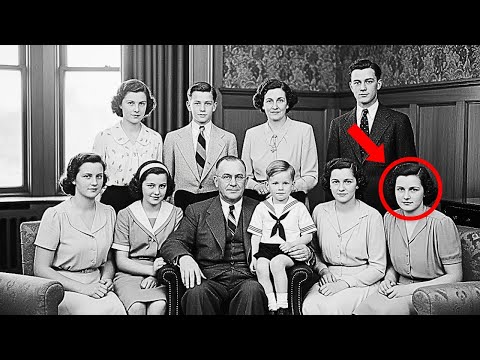
Linda’s hands trembled as she dug deeper. She found a birth certificate for Elellanar Marie Ashford, born March 15, 1918. School records, letters, piano recital programs—all meticulously preserved, then abruptly cut off in 1941. The last item was a medical invoice dated November 1941. The procedure listed made her blood run cold: “Prefrontal lobotomy. Patient: E. Ashford. Referring physician: Dr. James Watts. Consulting: Dr. Walter Freeman.”
Freeman and Watts—the pioneers of lobotomy in America. Elellanar Ashford had been lobotomized at age 23, then erased from history. Linda sat back, the 1938 photograph shaking in her grip. This wasn’t just a missing piece of the Ashford legacy. It was evidence of a deliberate, brutal act to protect a powerful family’s reputation.
She called her supervisor at the Kennedy Library, her voice barely a whisper. “I found something. Something the Ashfords never wanted anyone to see.” The investigation into Elellanar’s forgotten life was about to begin.
Linda spent the next week assembling the Ashfords’ public image from the 1930s and 1940s—a carefully crafted narrative of American perfection. Richard Ashford, a banking magnate, had political ambitions; Katherine, from old Boston money, brought respectability. Together, they created what newspapers called “America’s most promising family.” Their children were raised to be exceptional: sons at Harvard and Yale, daughters trained in languages and social graces. Every appearance was orchestrated, every photograph composed.
But Elellanar appeared in very few of these articles. When she did, descriptions were brief and vague. A 1936 society column mentioned the Ashford daughters at a debutante ball but didn’t list Elellanar by name. A 1937 photograph showed the family at their Cape Cod estate, Elellanar positioned at the edge of the frame, partially obscured by her sister. Linda contacted Dr. Harold Jennings, a medical historian at Boston University, who specialized in the history of psychiatric treatment. She showed him the invoice and photographs.
“This fits a pattern I’ve seen before,” Harold said, his expression grim. “Wealthy families in the 1930s and 1940s were obsessed with eugenics and genetic perfection. Any child who showed signs of intellectual disability, mental illness, or behavioral problems was seen as a threat to the family’s reputation and genetic legacy.”
Linda felt sick. “They mutilated a young woman to protect their reputation?”
“And it was legal, even considered progressive medicine at the time,” Harold replied. “The Ashfords would have been praised for seeking the most modern treatment available.”
Linda returned to the archives, now searching specifically for Elellanar. She found private letters between Katherine Ashford and her sister. One from 1938 read: “Elellanar continues to struggle with her studies. The tutors say she tries hard but simply cannot grasp concepts her siblings master easily. Richard worries about her future. What marriage prospects does a slow girl have?” Another from 1940 was more troubling: “Elellanar’s episodes have become more frequent. She grows agitated easily, sometimes violent with the staff. Richard insists we cannot send her to an institution. The scandal would be unbearable. We must find another solution.”
The solution came in November 1941. After the lobotomy, Elellanar disappeared from all family records. Linda found a property deed from 1942: Richard Ashford purchased a private estate in rural Vermont, transferring ownership to a trust managed by a psychiatric care facility. The deed specified that one resident would live there permanently, all expenses paid by the Ashford family trust. Elellanar hadn’t died—she had been hidden away, institutionalized for life after the lobotomy destroyed her personality and cognitive abilities.
Linda needed to understand who Elellanar had been before the lobotomy. She contacted the historical societies of schools Elellanar attended. A 1928 teacher’s note read: “Elellanar is a sweet, gentle child with a kind disposition. She struggles with mathematics and reading comprehension but shows talent in music and art. She requires extra time and patience.” By middle school, the gap between Elellanar and her siblings had widened. A 1932 report card showed C’s and D’s across all subjects except music, where she earned an A.
Linda found a heartbreaking letter from Elellanar to her mother, dated 1933, when Elellanar was 15: “Dear Mother, I’m trying my very best at school, but the work is so hard. Miss Peterson says I’m not trying hard enough, but I am. Truly, I am. Patricia says I am stupid and that Father is ashamed of me. Please tell me you’re not ashamed. I love you. Elellanar.” Catherine’s response was brief: “Dearest Elellanar, your father and I love you always, but you must try harder. The Ashford name requires excellence. We cannot accept less from any of our children.”
Linda interviewed Margaret Sullivan, 94, a former housemaid at the Ashford estate. “Elellanar was the sweetest of all those children,” Margaret said, her voice trembling. “She wasn’t like the others. They were all so sharp, so clever with words. Elellanar was slower, gentler. She’d spend hours in the music room playing piano, the same simple pieces over and over. She loved the garden, loved animals. She’d talk to the dogs like they were people.”
Margaret wiped her eyes. “As she got older, things got worse. She’d have these episodes—frustration, crying, sometimes throwing things. Not violent, just overwhelmed. But Mr. Ashford saw it as embarrassing behavior that needed to be controlled.” Linda showed her the 1938 family photograph. “Look at Elellanar’s face. See how she’s sitting? She’s trying to make herself smaller, less noticeable. That’s how she lived—trying to disappear.”
Linda found correspondence between Richard Ashford and Dr. James Watts. The first letter, dated March 1941, was chillingly clinical: “I write regarding my daughter Elellanar, aged 23, who suffers from intellectual deficiency and increasing behavioral difficulties. I would like to discuss whether Elellanar might be a suitable candidate for this procedure.” Watts replied enthusiastically: “The procedure is brief, recovery is quick, and results are generally quite satisfactory. Patients become more manageable.”
Katherine Ashford’s diary entry from November 1941, written the day before the surgery, revealed her conflict: “Tomorrow we take Elellanar to the hospital. Richard assures me this is for the best. But my heart is heavy. She is my daughter. Am I betraying her by allowing this? God forgive me if I am wrong.”
The lobotomy was performed on November 12, 1941. Dr. Watts wrote to Richard two weeks later: “She’s docile and cooperative, showing none of her previous emotional outbursts. As anticipated, there is some reduction in initiative and spontaneity, but this should be acceptable given the elimination of her problematic behaviors.” A reduction in initiative and spontaneity—medical euphemism for the destruction of Elellanar’s personality.
Linda traced Elellanar to a private psychiatric facility in Vermont, where she spent the remaining 64 years of her life. The director confirmed: “She was admitted in December 1941 and remained here until her death in 2005. She was 87.” For the first 20 years, no one visited. Then, starting in 1961, Robert Ashford—Elellanar’s younger brother, the decorated Navy officer and senator—began visiting regularly.
In Robert’s diary, Linda found an entry from June 1961: “Finally found Elellanar today. Seeing her was the hardest thing I’ve ever done. She’s 43, but seems ancient, blank. She looked at me without recognition. What did we do to her? What did father do? I can never forgive this.” He visited her at least three times a year until his death in 1998.
Linda discovered minutes from a family meeting in January 1942, where Richard declared: “Elellanar’s situation will not be discussed publicly. When asked about family composition, we will refer to our eight children. Elellanar’s name will not appear in any public family documents or photographs going forward.” All siblings agreed, though Robert’s agreement was marked with an asterisk: “Robert expressed reservations, but will comply with family decision.”
When Kathleen published her memoir in 1968, Elellanar was completely absent. Patricia gave an interview in 1975, discussing “my seven siblings” and family dinners where “all eight of us children gathered around the table.” Elellanar had been erased so thoroughly that Patricia didn’t even have to consciously lie.
Linda contacted Richard Ashford III, Robert’s son. “I never knew about Elellanar until I was in my 30s,” he said. “Dad mentioned her once after he’d been drinking. He said terrible things had been done to her, that the family had agreed to forget her. He was crying. I’d never seen my father cry before.” Richard continued: “Dad visited her regularly, but never told anyone else. He said they’d made a pact of silence, and he was the only one who broke it.”
Robert’s final diary entry about Elellanar, written in 1998, reflected his resignation: “I tried one last time to bring Elellanar back into our family story. My siblings refused. When I die, Elellanar will be forgotten completely. Unless someone finds these papers and tells her story, she will disappear from history as if she never lived. That seems the cruellest fate of all.”
Linda realized she was that someone. She had the power to restore Elellanar to history. The question was, should she? She convened a meeting with the library’s ethics board. Dr. Thomas Richardson argued for publication: “Elellanar was a victim of both medical malpractice and family abuse. Hiding her story perpetuates the very erasure that victimized her.” Professor Janet Caldwell raised concerns about living descendants, but Richard Ashford III supported telling the story: “My father wished he’d spoken up. Elellanar deserved to be remembered as a real person, not erased like she never existed.”
Linda’s article, The Forgotten Ashford: How One Family Erased Their Disabled Daughter, was published in November 2024. The response was overwhelming. Disability rights activist Jennifer Harris wrote: “Elellanar’s story is every disabled person’s nightmare. She was deemed imperfect, so they eliminated her personality, hid her away, and pretended she never existed.” A lobotomy survivor, Dorothy Chen, contacted Linda: “Seeing Elellanar’s story, seeing it called what it was—abuse, medical torture—it’s the first time I felt like maybe I was the victim, not the problem. Thank you for telling her story.”
In May 2025, a new memorial was installed at Elellanar’s grave. The inscription read: “Eleanor Marie Ashford, 1918–2005. Daughter, sister, victim of medical injustice, erased by her family, forgotten by history, now remembered with love and sorrow. May her story ensure such injustice never happens again.” About thirty people attended—Ashford descendants, historians, disability rights activists, and lobotomy survivors. Dorothy Chen spoke: “I never met Eleanor, but I feel like I know her because what happened to her almost happened to me. Elellanar couldn’t tell her story, so we must tell it for her.”
Linda was the last to speak. “Elellanar Ashford was lobotomized because she didn’t fit her family’s definition of perfection. For 83 years, that erasure worked. But now we know. Now Elellanar’s story has been told. And because of that, conversations are happening. Survivors are coming forward. Families are confronting difficult truths.” She looked at the grave, surrounded by flowers and mementos. “Elellanar’s life mattered. Her suffering mattered. And her story matters—not despite being dark and painful, but because it’s dark and painful. These are the stories we most need to tell and remember.”
As Linda walked back to her car, she thought of Robert Ashford’s fear that Elellanar would disappear from history. He had been wrong. The dark photo that revealed the Ashford family’s secret had become a symbol of historical injustice and the importance of remembering those society tries to forget. Elellanar Marie Ashford would never be forgotten again.
But the story doesn’t end here. Across the country, thousands of other lobotomy victims remain hidden—their stories buried in family secrets, their suffering unacknowledged. Linda’s work has only just begun. How many more Elellanars are waiting to be found?
Report this article
Select a reason for reporting:






