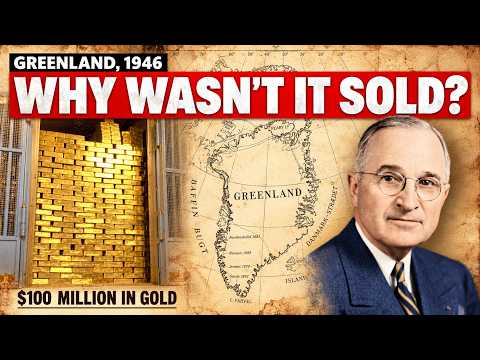
In the winter of 1946, a battered Denmark—still recovering from five years of Nazi occupation—was handed a golden ticket. The United States, through Secretary of State James Byrnes, offered $100 million in gold for Greenland. That was nearly 89 metric tons of the metal, worth over $11 billion today. The price? Less than 20 cents an acre for the world’s largest island.
Denmark didn’t say no. Not at first. Foreign Minister Gustav Rasmussen said he’d study it. And Washington didn’t give up. Within five years, America had almost everything it wanted—without buying a single acre. This is the story of how the deal fell apart, and why the price was paid anyway.
On December 14, 1946, Byrnes sat down with Rasmussen in New York. Byrnes stressed Greenland’s vital importance to American security and laid out three paths: a long-term basing arrangement, a defense treaty, or outright purchase. He suggested buying might be the best solution of all. Rasmussen, according to State Department records, was shocked but promised to study the memo. He initially thought a purchase was too drastic—he’d had something like the recent Iceland deal in mind.
The $100 million figure came from internal planning documents, not necessarily the memo itself. But it was America’s price. And Washington wanted the island badly.
To understand why, go back to April 1940. When Germany occupied Denmark, Greenland was cut off. A Danish diplomat in Washington, Henrik Kauffmann, signed a secret agreement letting the U.S. defend Greenland—without approval from Copenhagen. Denmark charged him with treason. Yet after liberation, Parliament approved the deal anyway. The legal foundation for America’s presence was signed by a man his own government called a traitor.
The war made Greenland’s value obvious. Over 10,000 Allied aircraft refueled there. After the war, the Pentagon saw its bases as the front porch of North America. In 1946, a Joint Chiefs committee concluded Greenland was “completely worthless to Denmark” but indispensable to U.S. safety. Another official proposed the $100 million in gold.
But this wasn’t the first time Americans had eyed Greenland. In 1867, Secretary of State William Seward considered buying it—but a report written without visiting the island was laughed out of Congress. In 1910, a four-way swap was floated. And in 1916, Denmark sold the Virgin Islands to America for $25 million, with a side declaration: the U.S. would not object to Denmark extending its interests to all of Greenland. Denmark had sold one colony and got America to bless its claim to another.
Then, in 1933, the Permanent Court of International Justice ruled that Denmark held valid title to all of Greenland. Barely 13 years later, the country that had signed that treaty was asking to buy the place.
So when Rasmussen returned to Copenhagen, he faced a dilemma. Denmark was small, exposed, and next door to the Soviet sphere. Selling Greenland—or even discussing it—was the opposite of neutral. “The proposals had come as a shock,” the American minister reported. Rasmussen felt the U.S. overemphasized Greenland’s strategic location. And he agreed to keep it quiet.
But the secret didn’t last. In early 1947, Time magazine reported Washington’s interest. Gallup polled Americans: 33% favored spending a billion dollars to buy Greenland, 38% opposed. A third couldn’t say what Greenland was good for. In Copenhagen, the leak had a more serious effect. The Soviet minister asked Rasmussen if a sale was being considered. Rasmussen called the proposal absurd and said publicly that Greenland was not for sale.
By summer, it was official in private, too. “There was no possibility of a sale,” Rasmussen confirmed. But he floated something else: perhaps America could control and maintain the Greenland airfields. Rent, not purchase. Washington’s thinking had already moved from owning Greenland toward using it.
That shift came with a price nobody in Washington or Copenhagen would pay themselves. The people who’d pay it lived on the ice.
In April 1948, the Danish foreign minister told the American envoy that Denmark would not serve notice to end the 1941 agreement while consultations continued. Five Danish parties had approved that policy—it would survive a change of government. The communists weren’t consulted. Denmark asked only that new American projects stay small, so the Soviets couldn’t point to them as proof of a military alliance.
That caution didn’t last. On April 4, 1949, the North Atlantic Treaty was signed. Denmark and the United States became NATO allies. Neutrality was over.
And on April 27, 1951, the two countries signed a new defense agreement for Greenland. It confirmed Danish sovereignty in writing. It also created defense areas for American use—including one at Thule in the far northwest—placed no restrictions on American use of the airspace, and would stay in force as long as NATO existed. A State Department official later summed it up: the United States was permitted to do almost anything, literally, that we want to in Greenland.
That’s the second half of the answer. America didn’t get Greenland because by 1951, it didn’t need to. It had the runways without the deed.
It had actually started building before the paperwork was finished. The decision to build at Thule was taken in 1950 under a secret program called Operation Bluejay. On June 16, 1951, the French explorer Jean Malaurie was traveling by dog sled along Greenland’s northwest coast when he came upon an enormous new base that hadn’t existed three months earlier. He described it as a city of hangars, tents, and aluminum. Around 120 ships and 12,000 men had been sent north in a single summer. According to one account, the base went up in 104 days.
Later, about 150 miles from Thule, the U.S. military built Camp Century—an under-ice base that served as a test bed for a plan described as a network of under-ice railroad tracks for moving nuclear missiles. That network was never completed. At the peak of the Cold War, Thule housed around 10,000 American troops, and bombers from there could reach Moscow within hours.
For the people who already lived there, the base was not an abstraction. Thule was home to the Inughuit, an Inuit community of Greenland’s far north. In 1953, to secure the perimeter and radar installations, Danish authorities moved the local community—87 people according to Cultural Survival—to Qaanaaq, roughly 100 kilometers further north. They were given four days’ notice. The historian Daniel Immerwahr writes that they were dropped off unceremoniously with blankets, tents, and the very best of wishes.
Decades later, when survivors and their descendants organized to fight for a return, they named their group Hingitaq 53. The word means the discarded.
That same year, 1953, Denmark changed its constitution. Greenland stopped being a colony and became a Danish county. Greenlanders gained formal equality as citizens—but Greenland’s own tourism describes it as a change Denmark made unilaterally.
And still, the Pentagon kept coming back to the idea of buying. On January 21, 1955, the chairman of the Joint Chiefs, Arthur Radford, told the Secretary of Defense it was axiomatic that sovereignty gave the firmest guarantee that a territory and its resources would be available in war. The Chiefs admitted there were political and economic problems they weren’t in a position to judge. The memo went to President Eisenhower, but no offer was made. In 1956, the Chiefs floated buying Greenland or leasing its northern part for 99 years. In 1957, the State Department and the American ambassador in Copenhagen answered that a purchase proposal could well be regarded as an insult by the Danes.
And there was a quieter reason the sale became unnecessary. In 1957, Danish Prime Minister H. C. Hansen said publicly that Denmark wouldn’t accept nuclear weapons under the present conditions. But in a secret reply that November, he gave the American ambassador a vague answer that U.S. officials read as a green light for Greenland. According to research cited by the National Security Archive, Strategic Air Command deployed four nuclear weapons there in 1958, and air defense units at Thule had 48 nuclear warheads available into the mid-1960s.
Denmark’s official policy said one thing. Greenland was treated as another.
That double standard broke open in January 1968, when an American B-52 carrying four thermonuclear bombs crashed on the sea ice roughly 10 kilometers from Thule. The conventional explosives detonated and scattered plutonium across the ice. About 1,500 Danish workers took part in the cleanup, and their claims for compensation dragged on for decades. Barely a week later, the Danish government declared that there were no nuclear weapons in Greenland. On February 8, 1968, Parliament demanded absolute American guarantees. The two governments exchanged notes on May 31, 1968. That arrangement was itself kept secret, and according to the National Security Archive, it still allowed overflights in a grave and sudden threat.
Even the fix had a back door.
So who was right? One way to read it is that both governments were. Denmark protected something it valued and couldn’t put a price on. America got the security it wanted. The people who lost most were the ones who weren’t in the room.
Greenland has spent the decades since getting itself into that room. Home rule arrived in 1979. In 2004, when the 1951 defense agreement was updated at the village of Igaliku, Greenland signed as a party for the first time. Thule itself was handed to the U.S. Space Force in 2020 and renamed Pituffik Space Base.
In a 2008 referendum, 75% of voters backed self-government, which took effect on June 21, 2009, and recognized Greenlanders as a people with the right to self-determination—including the option of independence. That is why, when the purchase idea came back, it landed so badly.
In August 2019, President Donald Trump said he was interested in buying Greenland. Danish Prime Minister Mette Frederiksen called it an absurd discussion, and Trump called off a planned trip to Denmark. In December 2024, as president-elect, he called ownership and control of Greenland an absolute necessity. Greenland’s Prime Minister, Mute B. Egede, answered that “we are not for sale and will never be for sale.”
In March 2025, Vice President J.D. Vance visited Pituffik and accused Denmark of underinvesting in Greenland’s security. That December, Trump named Louisiana Governor Jeff Landry as a special envoy to Greenland, and Landry said he was honored to serve to make Greenland a part of the U.S.
Then, in January 2026, it turned into something closer to a crisis. Frederiksen warned that an American military takeover would mean the end of NATO. The White House said using the military was always an option. Greenland’s new Prime Minister, Jens Frederik Nielsen, said that if Greenland had to choose between the United States and Denmark here and now, it would choose Denmark.
Trump threatened tariffs on European countries that opposed him, then dropped them after announcing a framework of a future deal with NATO’s Secretary General. And on September 22, 2026, almost 80 years after Byrnes handed Rasmussen his memo, Trump, Frederiksen, and Nielsen signed an agreement in New York during the United Nations General Assembly. It allows a larger American military presence in Greenland. It stops short of making Greenland American territory.
Trump said it gave the United States permanent control over security and all other needs on that territory. Frederiksen called it a deal that can last forever and said it respects Greenland’s right to self-determination. If that sounds familiar, it should. It’s 1951 all over again. Washington asks for the island and ends up with access.
So why didn’t America get Greenland in 1946? Because Denmark wouldn’t sell the one thing Washington asked for, which was sovereignty. The reasons were partly pride, partly a hard-won legal title, and partly the fear of looking like an American outpost with the Soviet Union watching. And because America worked out within five years that it didn’t need the deed. A treaty, a runway at Thule, and a great deal of Danish discretion gave it almost everything ownership would have.
The $100 million in gold never moved. But the price got paid anyway—in a relocated village, in plutonium on the sea ice, and in a political question that is still open today.
So here’s what I’d like to know from you: if the people of Greenland had been asked in 1946, what do you think they would have said? And should anyone, anywhere, still be able to buy a place where people live? Let me know in the comments.
Report this article
Select a reason for reporting:






