April 1, 1934. Easter Sunday. Two young motorcycle cops in crisp uniforms, badges gleaming, enjoy the spring sun on a dirt road off Highway 114 near Grapevine, Texas. They pull up beside a black Ford V8 parked on the shoulder. One of them, H.D. Murphy, is 22 years old. It’s his first day on motorcycle patrol. His fiancée, Marie Tullis, has a wedding dress hanging in the closet and an apartment they’ll move into next week. He hasn’t even loaded his gun today. His bullets are still in his pocket. Neither officer would make it back to the paved road.
Two bodies on Easter Sunday. One of them on his first day. And this double murder isn’t even the biggest event. Five days later, another body is found. A 61-year-old constable and father of eight in Commerce, Oklahoma, shot dead in a muddy ditch. Three murders in less than a week. The American public blamed two people, you know their names. Bonnie Parker and Clyde Barrow, the Depression-era outlaw duo. A duo Hollywood romanticized so much they dedicated an entire 1967 film to them starring Warren Beatty and Faye Dunaway. And sure, they were violent and reckless. They killed at least nine lawmen together. No one’s going to sit here and tell you Bonnie and Clyde were misunderstood. But the myth gave you a fairy tale. Here’s what actually happened.
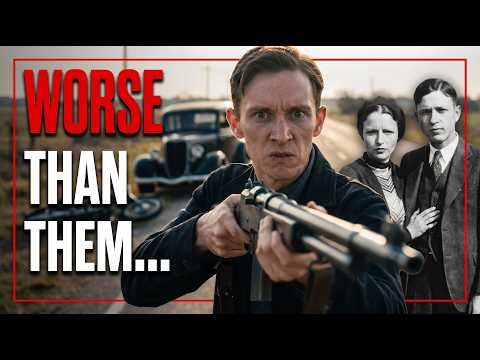
There was a third person in that car on Easter Sunday. A third person in the mud outside Commerce. A man who most likely pulled the trigger first both times. And when it was all over, when justice finally caught up, this man traded the two people who got him out of prison, the two people who gave him his freedom, and traded their lives for his. Then he walked away.
His name was Henry Methvin. Born April 8, 1912, in rural Louisiana. A farm boy, skinny and unremarkable, the kind of guy you wouldn’t remember even if you pumped his gas. By nineteen, he’d slit a man’s throat in a Texas oil field. By twenty-two, he was riding with America’s most wanted couple. By thirty-six, he was drunk on railroad tracks in Salford, Louisiana, where the Southern Pacific train cut him in half.
This is the story of how a Louisiana farm boy became the most dangerous member of a gang the public didn’t even know he belonged to. How he took part in at least three murders in six days and left two others to take the blame for ninety years. And how he betrayed them. The only people who trusted him collected a pardon like a paycheck, yet they ended up torn bodies on railroad tracks.
Here’s what I want you to understand. If Henry Methvin was the one who pulled the trigger first in Grapevine, if he killed Cal Campbell in Commerce, if he orchestrated the ambush that ended Bonnie and Clyde, was he the worst of them all? Does anyone even care?
Henry Methvin grew up on a family farm outside Ashland, Louisiana, in Bienville Parish. If you’ve ever passed through there, you know exactly what that means. Pine trees, red dirt, a place where your nearest neighbor is fifteen minutes by car, and your entertainment options are church or trouble. Henry chose trouble.
The family was poor. His father, Ivy Methvin, whom everyone called “Ivy,” ran a small operation. The kind of place where everyone works and no one gets ahead. Henry was the middle son. And if you’ve ever been a middle child, you know that’s a formative experience in itself. You’re not the oldest who carries responsibility, and you’re not the youngest who gets attention. You’re just sort of there. And I think Henry decided very early on that he wasn’t going to settle for just being there.
By 1930, he was eighteen and working in the oil fields of Rusk, Texas. One night, he got into some dispute with a 59-year-old oil field worker named Charles Hughes. It wasn’t about money or cards. Well, maybe one of them looked at the other the wrong way, but Henry Methvin’s solution was to slit Hughes’s throat like he was gutting a deer. Hughes miraculously survived. The headline read: “Throat Slash Victim Will Live.” They arrested Henry two hours later driving Hughes’s own car, because in addition to being violent, Henry wasn’t very smart. Like robbing a bank and stopping at a Dairy Queen next door to count the money. He was sentenced to twelve years in the Texas prison system.
And here’s something worth remembering. Drinking, impulsiveness, and an absolute inability to think beyond the next five minutes. That’s the end of the story, hidden in its beginning.
So Henry ends up at Eastham Prison Farm in Huntsville, Texas. There he got his teacher, whether he deserved one or not. Also locked up at Eastham was a young man from Dallas named Clyde Barrow. Clyde had already been in and out of the prison system. He knew the guards, he knew the routes, and most importantly, he had Bonnie Parker on the outside with a plan.
On January 16, 1934, Bonnie and Clyde showed up at Eastham Prison Farm to smuggle out a specific inmate, Raymond Hamilton. They smuggled weapons inside. A guard was killed and another wounded. In the chaos, five prisoners escaped. Henry Methvin wasn’t on the invitation list. He just saw the door open and ran through it. In fact, Hamilton told the extra escapees to go back, but Clyde—and this is the important part—welcomed him. He looked at Henry Methvin and said, “You can ride with us.” Three of the other escapees fled on their own. Henry stayed.
Clyde Barrow gave Henry Methvin his freedom. Gave him a place in the car, gave him a life outside those walls. Remember this, because Henry will repay that debt in the most spectacular way, and as we know, once Henry joined, the operation went like this.
Clyde ran a fast and disciplined gang, hitting small-town banks and armories across rural Texas, Oklahoma, and Louisiana—places with one guard maybe, or two. Clyde knew every back road, every river crossing, every hideout between Dallas and the Louisiana state line. The man navigated those highways like your uncle who’s been hunting the same deer lease for thirty years and knows every dirt path by heart. The strategy was speed. Plan. Raid. Get the money. Escape. Switch cars. Drive until the tires wore out. But the inherent flaw in the whole system was that they could never stop moving. Every night was a different ditch, a different motel, a different stretch of highway. You can’t build anything while running that fast; you’re burning fuel until it runs out.
On February 19, 1934, barely a month after the prison break, Henry joined Clyde and Hamilton to rob the National Guard armory in Ranger, Texas. They stole military weapons, specifically Browning automatic rifles, the kind of firepower that should not be in the hands of three men living out of a Ford. Eight days later, on February 27, they used those same weapons to rob a bank in Lancaster, Texas. They walked out with $4,138, which today is, you know, about $60 or $70 thousand. Divided by three, that’s roughly the price of a good used truck. They committed a federal crime and risked their lives for the price of a truck. Investigators never could pin down exactly how much the Barrow gang stole. What they confirmed is that it was never much. They weren’t criminal geniuses amassing fortunes. They were desperate people collecting gas money one robbery at a time.
Two things were closing in on Henry Methvin at the same time. One was a man named Frank Hamer, a former Texas Ranger, six-foot-three, built like a fence post that learned how to fight. Hamer was hired specifically to track down Bonnie and Clyde. He was patient in a way that was unsettling. He once said, “A officer must know the habits of outlaws, how they think, how they will act in different situations. When I began to understand Clyde Barrow’s mind, I felt I was making progress.” This isn’t just a cop. This is a man watching you like a wolf watches a chicken coop.
The other threat was coming from inside the car. Raymond Hamilton and Clyde had a falling out, and Hamilton split. Only three remained: Bonnie, Clyde, and Henry. And Henry was about to make things much worse.
On Easter Sunday, April 1, 1934, on Highway 114 near Grapevine, Bonnie and Clyde stopped to rest. Edward Bryan Wheeler, 26, four years of service, and H.D. Murphy, 22, on his first day of motorcycle patrol, spotted the car and pulled over thinking someone needed help. And here the story splits. In his documented FBI statement, Henry Methvin claimed he was asleep in the car all day while Bonnie played in the grass with a pet rabbit. A pet rabbit. Yes, that’s what he said. That’s what he claimed. But witnesses told a different story. Witnesses said Methvin panicked and shot Wheeler first with a Browning automatic rifle they had stolen. Then Clyde shot Murphy, whose bullets were still in his pocket. The kid never had a chance to load his gun. Murphy’s fiancée, Marie Tullis, wore her wedding dress to his funeral five days later.
On April 6, the car got stuck in the mud near Commerce, Oklahoma. They tried to flag down a passerby at gunpoint. The driver hit the gas and called the police, and Constable Cal Campbell, 61, father of eight, and Police Chief Percy Boyd arrived to investigate. A gunfight erupted. Campbell was killed. Boyd was shot in the head but survived. Some accounts say Bonnie fired the shots that killed Campbell, and that she was so trigger-happy that Clyde had to tell her to stop. Clyde looked at the scene and reportedly said, “Boys, a good man has been killed here.” The next morning, he read about it in the paper and said, “I’m sorry about that old man.” They released Boyd. Gave him a few dollars, and Bonnie—I swear this is real—asked Boyd to please tell the press she doesn’t smoke cigars. Where are their minds?
Three dead officers in six days. Henry Methvin was present for every one of them, and Bonnie’s saying, “Hey, tell them I don’t smoke cigars.”
Well, Henry should have disappeared that week. Should have taken whatever money was in his pockets, gone into the piney woods of Louisiana, and never come back. But you know what? He’s stupid. Because he didn’t do that. Instead, he liked this kind of thing. But Henry Methvin and his father Ivy decided to make a deal. If Henry helped set up Bonnie and Clyde, Texas would pardon him for the prison break and his role in the crimes. His own father agreed to be part of the trap. The man who got Henry out of prison, who gave him a seat in the car and called him a partner, was about to be repaid. It only took 130 bullets.
On May 23, 1934, on a two-lane road near Sailes, Louisiana, in Bienville Parish, not far from where Henry grew up, Ivy Methvin’s lumber truck was parked on the road, jacked up as if he had a flat tire. Frank Hamer, Dallas deputies Bob Alcorn and Ted Hinton, and Bienville Parish Sheriff Henderson Jordan and his deputy Prentiss Oakley were hiding in the brush with Manny Gault, while Henry’s father was handcuffed to a tree. Whether Ivy was a willing participant or coerced depends entirely on who you ask. And after eight decades, no one has really settled it.
Bonnie and Clyde came down that road in their Ford V8. Clyde slowed when he spotted Ivy’s truck, and Prentiss Oakley fired first. The bullet hit Clyde in the head. He died instantly, slumping over the steering wheel. Bonnie screamed, and then the rest of the posse opened fire. In less than 20 seconds, over 130 rounds tore through that Ford. Clyde was hit about 17 times. Bonnie was hit about 25 times. People miles away thought a logging crew had used dynamite to fell trees. The sound was that loud. Henry Methvin wasn’t in the car. His father had told him, “Don’t go with them that morning,” because he knew.
On August 14, 1934, Texas Governor Ma Ferguson signed a pardon for Henry Methvin. A pardon? It was a pardon. Okay. And so, the man walked free in Texas. But Oklahoma wasn’t part of that deal. I said, “No, thank you.” On December 20, 1935, he was convicted of murdering Constable Cal Campbell and sentenced to death. On September 18, 1936, the sentence was commuted to life in prison. Then on March 20, 1942, he was paroled. Eight years for a murder that left eight children without a father. No monument was erected for Cal Campbell in front of Commerce City Hall until 67 years after his death.
As for Henry Methvin, after he was free again, he did absolutely nothing with that second chance. In November 1945, he was jailed for fighting and carrying a shotgun. In October 1946, he was arrested for attempted robbery and drunk driving near Shreveport, Louisiana. The same man, the same impulses, and the same inability to see beyond the next five minutes.
Edward Wheeler was buried in Fort Worth. He was 26 years old. H.D. Murphy was buried the following week, and his fiancée wore the white dress. Cal’s eight children grew up without him. Percy Boyd carried a bullet scar on his head for the rest of his life. And Frank Hamer went back to his private life and didn’t talk much about that ambush.
And now, Ivy Methvin, Henry’s father, died under circumstances some consider suspicious. Bonnie Parker was 23 years old, and Clyde Barrow was 25. On April 19, 1948, in Silver, Louisiana, the Southern Pacific train stopped at its usual time of 4:00. As the train moved, a 36-year-old man, drunk, tried to crawl across the tracks. The train cut Henry Methvin in half. Sheriff Ray Adcock confirmed it to the press. “You can tell the people of Texas and Oklahoma that the man killed near Lake Charles is Henry Methvin who was with Barrow and Parker.” He was buried in Social Springs Cemetery in Hall Summit, Louisiana. There are theories about whether it was really an accident, but no one was ever arrested. 36 years old. That’s 19 hard years after slitting a man’s throat in the oil fields.
The storybooks got part of the truth. Bonnie and Clyde were killers. While their books changed who was pulling the trigger, Hollywood turned Henry Methvin into a composite character named “C.W. Moss” in the 1967 film, effectively erasing him from the narrative. But the biggest distortion is in the ending. The story is supposed to be about two outlaw lovers who died together in a hell of gunfire. The real ending is about the man who wasn’t in the car. The man who put them there. The man who got a pardon, got out of prison to crawl drunk across a railroad track 14 years later. The most dangerous person in the Barrow gang was never the one people feared. The most dangerous was the one no one remembered.
So there it is. The real ending no one tells. Henry Methvin didn’t just ride with Bonnie and Clyde—he used them, betrayed them, and walked away with a pardon while their bodies were still warm. He was the third man in the car, the first to pull the trigger, and the last to face any real consequence.
Hollywood gave us star-crossed lovers dying in a hail of bullets. History gave us a farm boy from Louisiana who slit a throat at nineteen, killed a father of eight at twenty-two, and sold out the only people who ever gave him a chance. Then he died drunk on train tracks, cut in half, forgotten.
Was Henry Methvin the worst of them all? Or just the luckiest coward in a story about outlaws? You tell me—who deserves the legend, and who deserves the truth?
Report this article
Select a reason for reporting:






