September 13th, 1941. Deep behind Australian lines at besieged Tobruk, a German officer checks his watch. 11:45 p.m. Around him, 200 of Germany’s elite Fallschirmjäger paratroopers prepare for what should be a textbook special operations mission. Their target: destroy fuel dumps, ammunition stores, and artillery positions inside the Tobruk Fortress. Create chaos, tie down Australian forces, support Rommel’s planned breakthrough assault.
The plan is brilliant. The intelligence is solid. The troops are the best Germany has. Veterans of Crete, Norway, and the Low Countries. Men who dropped from the sky and conquered entire nations. By dawn, 193 of them will be dead or captured. Only seven will make it back to German lines alive, and they’ll be so traumatized they’ll barely be able to speak about what happened.
This is the story of Operation Midsummer Night’s Dream. The catastrophic raid that proved the Australians defending Tobruk weren’t just tough defenders. They were absolutely lethal hunters who turned the desert night into a killing ground for Germany’s elite troops. The Germans called it a tactical raid. The Australians called it target practice.
To understand this disaster, we need context. It’s September 1941, and the siege of Tobruk has been grinding on for five months. Rommel’s Afrika Corps has tried four major assaults to capture the port, and all have failed against the Australian 9th Division’s stubborn defense. But Rommel isn’t giving up. He’s planning another major offensive for mid-September, and he needs to weaken the Australian defenses first. A conventional assault has proven too costly. The Australians are too well dug in, too experienced, too damn determined.
So Rommel’s staff proposes something different. A commando raid deep behind enemy lines. Not to capture ground, but to destroy critical supplies and create confusion. If they can blow up enough ammunition dumps and fuel storage, the Australian artillery will be silenced just when Rommel’s main assault hits.
The mission is handed to the Fallschirmjäger, Germany’s paratroopers, some of the most elite soldiers in the Wehrmacht. These aren’t ordinary infantry. Fallschirmjäger are volunteers extensively trained in airborne operations, demolitions, and close-quarters combat. They’re the men who captured Crete in the largest airborne invasion in history just four months earlier. But Crete also taught them a brutal lesson. Paratroopers are vulnerable when they land. At Crete, they suffered 25% casualties. Nearly 4,000 men killed in the first 48 hours because they dropped directly into prepared defensive positions. British Commonwealth and Greek forces slaughtered them as they landed.
Hitler was so shaken by the Crete casualties that he ordered, “The day of the paratrooper is over. No more large-scale airborne assaults.” From now on, Fallschirmjäger would fight as elite infantry, not jumpers. But that’s conventional airborne assault. What Rommel is proposing is different. A night infiltration by small teams, no parachutes involved. The paratroopers will approach overland through no man’s land, slip through Australian defensive lines under cover of darkness, hit their targets, and escape before dawn.
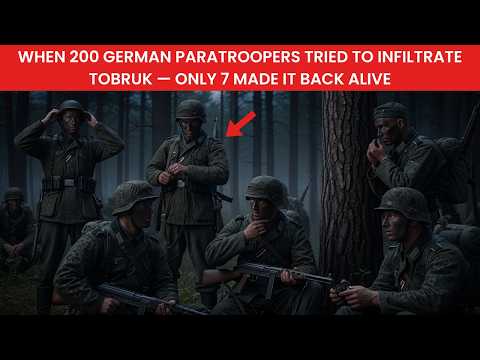
The mission is codenamed Midsummer Night’s Dream. Ironic, since it will become a nightmare. The raid is scheduled for the night of September 13th to 14th, 1941. The force consists of 200 Fallschirmjäger from various units organized into small teams of 8 to 12 men each. Each team has specific targets: fuel dumps, ammunition stockpiles, artillery positions, command posts. They’re equipped with submachine guns, MP40s for close combat, demolition charges and time-delay fuses, grenades, wire cutters, compasses and maps showing Australian positions based on intelligence, dark uniforms, and blackened faces for camouflage.
The plan seems sound. Intelligence reports suggest the Australians are exhausted after five months of siege. Their defenses stretched thin, their vigilance degraded by routine. A fast, violent raid should be able to penetrate, destroy key targets, and withdraw before the defenders can organize a response.
But the intelligence is catastrophically wrong. What German intelligence doesn’t know—or has drastically underestimated—is that the Australians have turned Tobruk into a death trap for exactly this kind of infiltration. After months of constant German probing attacks and raids, the Australian 9th Division has developed sophisticated counter-infiltration tactics. The Australians conduct aggressive nightly patrols throughout no man’s land. They’ve seeded the approaches with mines and trip wires. They’ve established listening posts and observation points covering every possible infiltration route. Most importantly, they’ve trained their troops to respond instantly and violently to any incursion.
The Australian soldiers defending Tobruk aren’t garrison troops sitting passively in bunkers. They’re aggressive, experienced, and absolutely furious. After five months of being shelled, bombed, and attacked, they’re looking for any excuse to kill Germans. The German paratroopers are walking into a meat grinder, and they don’t know it.
On the evening of September 13th, 1941, the 200 Fallschirmjäger assemble at their jumping-off points along the German siege lines. Officers give final briefings. Maps are studied one last time. Watches are synchronized. Demolition charges are distributed. One young German paratrooper, 19-year-old Gefreiter Klaus Becker, will later describe the mood. “We were confident. We were Fallschirmjäger. We had dropped into Norway, Holland, Crete. We had conquered wherever we landed. This was just another mission. We didn’t fear the Australians. We should have.”
At 11:45 p.m., the teams begin moving out. They advance in small groups, maintaining interval, moving quietly through the darkness. The plan is to infiltrate through gaps in the Australian defensive line, reach their targets around 2:00 a.m., plant charges set to detonate at 4:00 a.m., and withdraw before dawn. For the first hour, everything goes according to plan. The teams slip through no man’s land, navigate around known Australian positions, cut through wire obstacles, and penetrate deeper into the defensive perimeter. They’re professional, quiet, disciplined. This is what they’ve trained for.
Then at approximately 1:25 a.m., an Australian sentry on routine patrol spots movement—and hell breaks loose. The first Australian to detect the German infiltration is Private Jacko Morrison, a 24-year-old from Brisbane serving with the 2/13th Battalion. He’s on listening post duty, a two-man position about 200 yards forward of the main defensive line designed to detect exactly this kind of incursion. Morrison later describes what happened. “I heard something. Not much, just a scrape of boot on rock, maybe a whispered German word, but after five months at Tobruk, you develop a sixth sense. Something was wrong.”
Instead of immediately opening fire, which would reveal his position, Morrison uses the field telephone to alert his company headquarters. “Movement. Multiple contacts. Sector 7. Standby.” Within 60 seconds, the Australian defensive network activates. Company commanders alert platoons. Platoons alert sections. Machine gun crews stand to. Mortars prepare fire missions. Artillery forward observers calculate target coordinates. The Australians have practiced this drill hundreds of times. They can go from sleeping to combat-ready in under two minutes.
Meanwhile, the German paratroopers continue infiltrating, unaware they’ve been detected. They’re moving in small groups, spreading out to hit multiple targets simultaneously. This dispersal—tactically sound for avoiding concentrated defensive fire—will prove catastrophic because it prevents them from massing firepower when the Australians strike.
At 1:55 a.m., an Australian officer makes the decision. “Illuminate and engage.” Flares shoot into the night sky. Magnesium parachute flares that turn night into day, casting harsh white light across hundreds of yards of desert. The German paratroopers are caught in the open.
What happens next is described in Australian after-action reports as “systematic destruction of enemy infiltrators.” What it really means is slaughter. Australian machine guns open fire from prepared positions. Vickers guns, Bren guns, captured Italian weapons—all firing simultaneously into the illuminated kill zones. The Germans, caught in the open with no cover, are cut down in groups. One German team, 12 men advancing towards a fuel dump, is caught by a Vickers machine gun at 80 yards range. All 12 are killed in approximately 15 seconds. The machine gunner later said, “They were bunched up. I just traversed left to right. They fell like dominoes.”
Other German teams try to fight back. They’re well-trained, experienced soldiers. They return fire with their MP40 submachine guns, throw grenades, try to maneuver to cover—but they’re fighting on the Australians’ ground. Every rock, every fold in the ground, every firing position has been mapped and registered. The Australians aren’t firing blind. They’re firing at pre-calculated coordinates where they know infiltrators will be.
German Oberfeldwebel Hans Meyer leads a team trying to reach a fuel dump. They make it within 100 yards of their target when an Australian patrol intercepts them. Meyer describes the encounter in his POW interrogation. “They came from nowhere. We heard nothing until they were on top of us. They fought like madmen. Bayonets, grenades, even fists. We killed two of them, but they killed eight of my men. I surrendered because I…”
…I surrendered because I wanted to live. The Australians didn’t shoot me. They just smiled and took my pistol. That smile was worse than any bullet.”
By 3:00 a.m., the raid has collapsed into a series of desperate, isolated firefights. German teams that haven’t been wiped out are pinned down, unable to advance or retreat. The illumination flares keep coming, one after another, turning the battlefield into a strobe-lit abattoir. Every time the light fades, the Australians launch another flare and another volley.
“We were the hunters who became the hunted,” Becker later recalled. “I saw men I’d known for years—men who had jumped into Crete and laughed at death—crawling on their bellies, crying for their mothers. The Australians didn’t just kill us. They broke us.”
At 3:30 a.m., the surviving German officers make the only decision left: abort and withdraw. But withdrawal means running back through the same kill zones they’d crossed hours earlier—only now every route is registered, every gap covered. The Australians have anticipated this. They’ve shifted machine guns to block the escape routes. Mortars drop shells on the likely withdrawal corridors.
Becker’s team of nine men tries to slip back through a wadi they’d used on the way in. An Australian standing patrol is waiting. “They let us get halfway across, then opened fire. I dove into a ditch and played dead. I lay there for two hours, listening to my friends die one by one. When the sun came up, I stood and raised my hands. I was the only one left.”
By dawn on September 14th, the desert around Tobruk is littered with German bodies. Australian patrols move methodically through the killing ground, counting corpses, collecting intelligence, and rounding up the wounded. The final tally is devastating: 193 Fallschirmjäger dead or captured. Only seven will make it back to German lines.
Rommel’s planned breakthrough assault is postponed indefinitely. The raid that was supposed to weaken the Australian defenses has instead destroyed one of Germany’s most elite units. When Hitler receives the report, he reportedly flies into a rage, demanding to know how 200 of his best soldiers could be annihilated by a garrison he’d been told was on the verge of collapse.
The answer is simple. The Australians at Tobruk weren’t on the verge of collapse. They were waiting. As one Australian officer later wrote: “They came expecting a dream. We gave them a nightmare they’ll never wake up from.”
The seven survivors never spoke publicly about Operation Midsummer Night’s Dream. Their after-action reports were sealed. But in the postwar years, one of them—Klaus Becker—finally broke his silence. “I learned something at Tobruk that no amount of training could teach. There are soldiers, and then there are hunters. The Australians were hunters. We were just prey who didn’t know it yet.”
What do you think—was Operation Midsummer Night’s Dream doomed from the start by faulty intelligence, or did the Australians simply prove they were the deadliest troops in the desert? Let us know in the comments below.
Report this article
Select a reason for reporting:






