The desert sun beat down like a hammer, and the sandstorm clawed at their eyes, but the men of the 18th Brigade knew there was no turning back. Ahead lay Fortress Giarabub, a seemingly impregnable Italian stronghold that had dominated the Libyan Desert for over fifteen years. Behind them, nothing but the vast, unforgiving Sahara. They were 400 Australians, outnumbered nearly five to one, with no tanks, no air support, and machine guns that jammed with every gust of wind.
Yet Brigadier George Wootten’s men were not there to surrender. They were there to shatter an illusion.
The Italians had transformed this remote oasis into a fortress of trenches, barbed wire, and artillery, commanded by Colonel Salvatore Castagna—a hardened veteran of World War I with a reputation for ruthlessness. His garrison of 2,000 troops, including 750 Libyan soldiers, bristled with anti-aircraft and anti-tank guns. “Giarabub is impregnable,” the Italian High Command had boasted. The Australians were about to prove them catastrophically wrong.
But this was no reckless charge. Wootten, a meticulous planner, had spent days reconnoitering the terrain, discovering a gap in the frontier wire and a track through the marshes south of the oasis. His plan was audacious: a night approach through the soft sand, a dawn assault on the southern redoubt, and a rapid push into the town before the defenders could regroup.
The operation began on March 17, 1940, when B Squadron of the 6th Australian Cavalry captured Wootten House, a key outpost, and seized prisoners who revealed the Italian defenses. Two days later, two companies of the 2/9th Battalion advanced toward Dally House, but they were pinned down by artillery fire. “We need those guns silenced,” Major Gahan ordered, and two 25-pounders were dragged through the marshes by sheer grit.
By nightfall on March 19, Captain Barry’s company had reached the southeastern corner of the Italian defenses, discovering a gap where sand had buried the wire. “We’re inside,” Barry whispered, and his men slipped through, capturing Post 42 and turning a 44mm gun on its former owners. But an Italian counterattack at 2 a.m. forced them to withdraw, leaving one dead and eight wounded.
The setback only hardened Wootten’s resolve. He now knew exactly where to strike. The main assault would hit the southern redoubt at dawn on March 21, supported by artillery, mortars, and machine guns on Ship Hill. A diversionary attack would sweep down Pipsqueak Valley to keep the Italians guessing.
As the first light crept over the desert, a fierce sandstorm erupted, clogging weapons and blinding gunners. “Fix bayonets!” Captain Rei shouted, leading A Company within 50 meters of the Italian wire. But the artillery barrage fell short, shells landing among their own men. Twelve were killed in an instant, including Rei, and twenty more wounded. The attack teetered on the brink of disaster.
Yet the Australians did not break. Corporal Calvert rallied a small team and charged through the wire, while Lieutenant Noyes’s platoon pushed forward unscathed. “Keep moving!” Barry yelled, despite his own injury, and the men surged toward the first line of defenses. The Italians, stunned by the ferocity of the assault, offered little resistance. By 7:26 a.m., the four northern posts were in Australian hands.
But the fight was far from over. A mountain gun opened fire from the final redoubt, and Italian positions near the fort poured machine-gun fire into the advancing Australians. Barry tried to cross open ground and was driven back. “Bring up the mortars!” he ordered, and with support from Ship Hill, the last resistance was crushed. By 9 a.m., the southern redoubt had fallen.
On the northern front, the cavalry swept down Pipsqueak Valley, capturing Eggbert and completing their objectives with light resistance. The Italians were crumbling. Captain Martin sent D Company through the cultivated area toward the town, clearing a minefield spotted by an RAF Lysander. At 11:25 a.m., the 2/9th Battalion began its general advance into Giarabub.
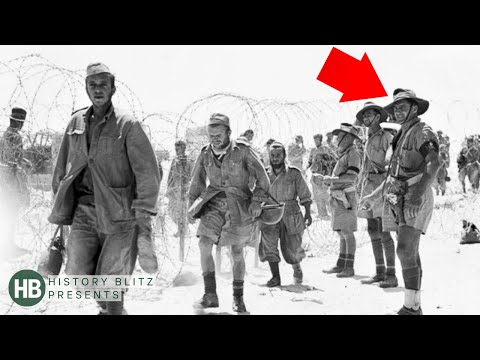
At midday, the Australian flag replaced the Italian tricolor over the fort. The siege was over. Seventeen Australians lay dead, seventy-seven wounded. But they had captured 50 officers and 1,250 men, including Colonel Castagna himself, wounded and humiliated. The fortress that was supposed to hold for months had fallen in hours.
The victory at Giarabub shattered the myth of Italian invincibility in North Africa. It was a triumph of planning, courage, and sheer Australian grit—a story that would echo through the deserts of Libya and beyond. But for the men who fought there, it was just another day in a war that was only beginning to test their limits.
The prisoners were marched out in long, weary columns, their boots kicking up thin veils of dust that hung in the still air. Castagna, his arm bound in a rough field dressing, walked among his officers with his head high, refusing to look at the men who had bested him. “You fought well,” he said through an interpreter to Major Abbott, and there was no mockery in his voice—only the flat, exhausted acknowledgment of a soldier who knew the game was lost.
But Wootten had no time for ceremony. Even as the flag rose over the fort, his mind was already turning north, toward Bardia, toward Tobruk, toward the great armored clashes that would decide the fate of the entire campaign. Giarabub had been a necessary victory, but it was a small one—a stepping stone, not a destination.
The men of the 2/9th, though, allowed themselves a few hours of something close to joy. They boiled water for tea in captured Italian kettles, pried open tins of bully beef and hard biscuit, and sat in the shade of the fort’s walls, too tired to speak. Private Rickards, still trembling from the wire patrol, wrote in his diary: “We took a fortress today. I keep thinking about the ones who didn’t make it.”
The wounded were loaded onto trucks for the long journey back to the railhead, and the dead were buried in shallow graves marked by simple wooden crosses. Chaplain Halloran read the burial service over them as the sun sank, and the sand hissed against the canvas of the tents.
What the Australians did not yet know was that their victory had consequences far beyond the Libyan Desert. In Rome, Mussolini’s propagandists scrambled to explain how an oasis fortress, trumpeted for years as an impregnable bastion of Italian colonial power, had fallen to a force a fraction of its size. The news was suppressed for days, then released in a heavily edited form that blamed the defeat on a lack of supplies and the treachery of Libyan auxiliaries.
But the truth traveled faster than any communiqué. In Cairo, British headquarters staff pored over Wootten’s after-action report with growing excitement. “This is the template,” one colonel noted in the margins. “Speed, surprise, and the willingness to close with the enemy. The Italians will break if we hit them hard enough.”
That lesson would be tested within weeks, as the Western Desert Force prepared for Operation Compass—the great offensive that would sweep the Italians out of Egypt and across Cyrenaica. And Wootten’s men, their ranks thinned but their confidence forged in the fires of Giarabub, would be at the spearhead.
Yet for all the accolades, a quieter story unfolded in the days after the battle. Australian patrols combing the oasis found evidence of the garrison’s slow unraveling—diaries half-buried in the sand, letters home that would never be sent, the skeletal remains of pack animals that had starved weeks before the final assault. “They were beaten before we fired a shot,” Captain Brown of the cavalry observed. “We just finished the job.”
It was a sobering thought, and one that tempered the celebrations. War in the desert was not merely a contest of firepower; it was a test of endurance, of supply lines, of the will to keep going when the water ran low and the sandstorms never seemed to end. The Australians had passed that test. The Italians, for all their guns and concrete, had not.
As the brigade prepared to move out, Wootten gathered his officers one last time beneath the captured walls. “Remember this place,” he told them quietly. “Not for the victory—for what it cost, and for what it taught us. The next fight will be harder.” He did not need to say what they all knew: the Germans were coming.
The trucks began to roll at first light, carrying the men of the 18th Brigade north toward new horizons. Behind them, the fort of Giarabub stood silent and empty, its trenches filling slowly with drifting sand, its guns turned to scrap. In the vast ledger of the desert war, one small entry had been written in Australian blood—and the pages ahead were still blank.
The road to Bardia was a ribbon of dust and heat, and the men of the 2/9th rode it with eyes half-closed, their thoughts still tangled in the wire and the sand of Giarabub. They had taken a fortress, but the desert did not care. It offered no shade and no rest, only the next mile and the next.
At a crossroads, a dispatch rider flagged them down with news that crackled through the column like a live wire: the Italians were falling back everywhere, and the British were preparing a great offensive. “We’re not stopping at Bardia,” Major Abbott told his company commanders. “We’re going all the way to Tobruk.” The men cheered, though their voices were hoarse and their canteens nearly empty.
Wootten walked among them that evening, his face shadowed by the brim of his slouch hat. He had received a message from headquarters praising the brigade’s action, but he read it without expression and folded it away. “A fortress is just a place,” he said to no one in particular. “What matters is what you do after you take it.”
In the weeks that followed, Operation Compass tore through the Italian lines, and the lessons of Giarabub were written into every attack: the night approach, the dawn strike, the refusal to pause. But the Australians who had been there carried something else with them—a quiet knowledge that they had faced the worst the desert could offer and had not broken.
Years later, long after the war, an old soldier named Rickards returned to the oasis with a small camera and a notebook. The fort was a ruin, its walls half-buried, its wire rusted into red dust. He stood where the flag had risen and remembered the faces of the men who had fallen, and he wrote in his notebook: “We were young, and we thought we were invincible. We were wrong. But for one morning, we were enough.”
He left the notebook on a stone and walked back to his car, and the desert wind began to turn the pages, one by one, until the writing faded into the sand.
What do you think—was Giarabub a turning point in the desert war, or just a footnote in a much larger story? Share your thoughts in the comments below.
Report this article
Select a reason for reporting:






