The rain hammered against the windows of Harvard Divinity School’s archives as Dr. Rebecca Collins examined a donated photograph from 1908. Most were ordinary, but one image of St. Michael’s Episcopal Church in Brookline seized her attention. The altar carvings were wrong—subtly, chillingly wrong.
She called her colleague, Dr. James Winters, who confirmed her suspicion: the symbols weren’t Christian. “Those are not episcopal symbols. They’re a modified version of the Eye of Providence, with elements from Hermetic or occult traditions.” He pointed to a seam. “This isn’t decorative. It’s functional—a hidden compartment.”
A cold shiver ran down Rebecca’s spine despite the climate-controlled room. What started as routine architectural research had unearthed something deeply unsettling. What was a hidden chamber doing inside a 1908 Episcopal altar?
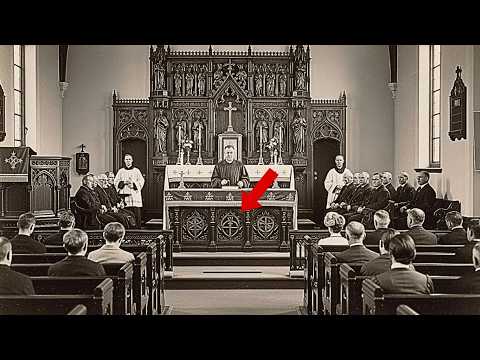
The next morning, they stood before St. Michael’s, its Gothic stone facade unchanged since the photograph. The heavy wooden doors opened to a sunlit interior, but Rebecca’s eyes went straight to the front—where the altar should be. It was gone. Only a plain marble table remained.
“The original altar was removed during 1960s renovations,” explained Reverend Sarah Mitchell, the current pastor, after they introduced themselves. “But it’s preserved in our basement museum. Would you like to see it?”
She led them down a narrow staircase to a small museum. Against the far wall stood the altar from the photograph—smaller than it appeared, but unmistakable with its ornate carvings. “It was quite controversial when they replaced it,” Reverend Mitchell said. “Some older parishioners were deeply attached, despite its unusual design elements.”
Rebecca and James exchanged glances and approached cautiously. Up close, the symbols were even more clearly distinct from traditional Christian iconography—subtle modifications that significantly altered their meaning.
“Do you know anything about Reverend Thomas Aldridge, who led the church in 1908?” Rebecca asked.
“Only that he served here nearly 30 years before leaving suddenly in 1911. There was some sort of controversy, though church records are frustratingly vague. Local historical rumors suggest he developed unorthodox theological interests that concerned the diocese.”
After Reverend Mitchell was called away, Rebecca and James examined the altar closely. The seam from the photograph was real—a thin line indicating a hidden compartment built into the structure. “We need permission to examine this more thoroughly,” James whispered. “If there’s really a hidden chamber, we can’t just start tampering with a historical church artifact.”
Rebecca nodded, already drafting their request to the church council. Whatever secrets this altar held had remained hidden for over a century. A few more days of following official procedures wouldn’t hurt. What she didn’t know was how profoundly the contents of that cavity would challenge their understanding of early 20th-century religious life in Brookline.
Three days later, they returned with official permission. Dr. Helena Martinez, a restoration expert, accompanied them to ensure no damage to the artifact. “The church council was surprisingly enthusiastic about our research,” Rebecca noted as they set up equipment in the basement museum. “Apparently, there have been longstanding questions about this altar among church historians.”
Dr. Martinez performed a preliminary non-invasive scan with a specialized device. “There’s definitely a void behind this panel,” she confirmed. “Based on these readings, I believe the opening mechanism is triggered by pressing these two decorative elements simultaneously.”
Following her direction, James gently pressed the carved roses. After a moment of resistance, they heard a soft click, and a seam widened slightly. Dr. Martinez carefully inserted restoration tools to widen the opening without causing damage. The panel slid to reveal a hidden cavity roughly 12 inches square and 8 inches deep. Inside were several carefully wrapped packages tied with frayed silk and protected by wax seals.
“This is extraordinary,” Dr. Martinez murmured, photographing everything before removal. “These items were specifically preserved for long-term concealment.”
Following conservation protocols, they transferred the packages to an examination table. The first contained a leather-bound journal inscribed with Reverend Aldridge’s name, its pages filled with dense, precise handwriting. The second revealed something far stranger—a collection of occult texts including a worn copy of the Book of Abramelin, a 15th-century grimoire of ritual magic, and several ciphered manuscripts. These weren’t common spiritualist tracts from the era’s occult revival, but serious esoteric works that would have caused significant scandal in an Episcopal context.
The third package contained the most disturbing items—ritual implements including a silver ceremonial knife with engravings, a small chalice, and vials containing dried substances labeled in the same handwriting as the journal.
“This isn’t what I expected to find in an Episcopal church altar,” Reverend Mitchell said, looking visibly disturbed.
Rebecca had already begun examining the journal, her expression growing more troubled as she read. “Oh, according to these entries, Reverend Aldridge was leading two congregations: his public Episcopal flock and a private occult group that met secretly in the church after hours. He refers to them as the ‘Inner Covenant.'”
James carefully examined one of the ciphered manuscripts. “This appears to be a modified Trithemius cipher. It’ll take time to decode, but some recurring symbols suggest it contains ritual instructions. But why hide these things inside the altar itself?” he asked Reverend Mitchell.
Rebecca flipped to a later journal entry. “According to this, Aldridge believed the altar was positioned at a specific ley line convergence. He designed it not just to hide these items, but to amplify certain energies by placing them inside.” She looked at her colleagues. “He was using the altar itself as an active component in whatever rituals he was conducting here.”
The implication hung heavy in the room. A respected Episcopal priest had embedded occult symbols into a hidden chamber for ritual implements directly inside his church’s most sacred feature, conducting secret ceremonies for years without detection by church authorities or his conventional congregation. Whatever happened at St. Michael’s in the early 1900s was far stranger than mere architectural curiosity.
Back at her university office, Rebecca carefully transcribed Aldridge’s journal, its fragile pages requiring delicate handling despite their relative preservation inside the altar. The narrative that emerged was both fascinating and disturbing—the spiritual journey of a conventional clergyman into increasingly esoteric practices.
The earliest entries from 1899 showed Aldridge as a traditional Episcopal priest with intellectual curiosity but conventional beliefs. His transformation toward alternative spirituality began after a personal tragedy.
April 16, 1900. Emily’s death has left a void that no traditional faith seems able to fill. The church’s platitudes about God’s will feel hollow as my four-year-old daughter lies in the ground. There must be more direct means of understanding the divine plan, perhaps even communication across the veil that separates us.
Over subsequent entries, Aldridge documented his exploration of spiritualism, then increasingly esoteric traditions. By 1904, he had formed his “Inner Covenant” with seven parishioners who shared his interests.
November 8, 1904. Our circle now includes eight seekers, each committed to the higher work. Mrs. Westerly, Dr. Hammond, Professor Burke, Miss Calloway, Mr. and Mrs. Thornton, Mr. Pierce, and myself. All respectable members of the congregation outwardly, all inwardly seeking truths beyond conventional religion. We meet monthly under the guise of a parish committee, but our real work begins after the church empties.
The most troubling entries concerned Aldridge’s plans for the 1906 church renovation, when the original altar was to be replaced.
March 3, 1906. The opportunity I have awaited has arrived. The church committee approved funding for a new altar, with the design left ostensibly to my discretion as rector. They will not realize the symbols I have incorporated are subtle modifications that transform Christian iconography into keys for our work. Even better, the carpenter agreed—for a substantial additional payment from my personal funds—to incorporate a hidden chamber according to my specifications. The altar will stand precisely at the convergence point I have identified through careful measurement.
Rebecca paused, struck by the calculated deception. Aldridge had deliberately exploited his trusted position to embed occult elements into the church’s most sacred furniture, while his congregation funded work whose true purpose would have horrified them.
Entries following the altar’s installation described escalating ritual activity.
October 31, 1907. Tonight’s work exceeded all previous attempts. With the elements properly positioned inside the altar for a complete lunar cycle, the veil thinned exactly as the old texts promised. The manifestation was brief but unmistakable. Hammond’s skepticism is finally silenced. Mrs. Thornton wept at what it might mean. What we touched cannot be reconciled with Episcopal doctrine, yet it felt more divine than anything in seminary teachings.
Most alarming were the final entries from early 1911, where Aldridge’s writings became increasingly erratic.
February 14, 1911. The entity we contacted is not what we initially believed. Certain inconsistencies in its communications have become apparent. Pierce noticed it first—subtle contradictions, gaps in knowledge where omniscience should be. I fear we may have opened a door to something neither divine nor benevolent. Mrs. Westerly has withdrawn from our covenant after her disturbing experience last week. I cannot blame her.
The journal ended abruptly with an entry dated March 22, 1911.
They are coming for me tomorrow. Bishop Harrington has summoned me to answer for grave irregularities in my ministry. Someone has talked. I have sealed our materials inside the altar one final time. They may remove me from St. Michael’s, but the work we began continues through the vessel we consecrated. It will remain active long after I am gone, waiting for those who know how to access its power.
Rebecca sat back, absorbing the implications. According to diocesan records, Reverend Aldridge resigned his position in April 1911, ostensibly for health reasons, and moved to Europe. There was no record of his ever returning to the United States. Whatever happened at St. Michael’s between 1906 and 1911, both Aldridge and church authorities had deliberately concealed it—likely to avoid scandal. But according to Aldridge’s final entry, he believed their work had created something that would remain active inside the church itself, something that seemed centered on or within the altar, and it had remained undisturbed in the church basement for decades.
Rebecca and James spent the following week researching the members of Aldridge’s Inner Covenant. As prominent church members in early 1900s Brookline, most had left sufficient historical traces to reconstruct their biographies.
“They were all respected community figures,” James noted as they compiled their findings. Dr. William Hammond was chief of medicine at Brooklyn Hospital. Elizabeth Westerly was a prominent socialite widow who funded several charities. Thomas and Margaret Thornton owned one of Boston’s largest department stores. They weren’t marginalized occultists—they were pillars of society.
Rebecca was tracing Professor Arthur Burke, a physics instructor at MIT. Burke was particularly interesting. His early research papers addressed conventional electrical phenomena, but after 1907, his work shifted dramatically toward theories about etheric energies and vibrational resonance between material and non-material realms. His academic career effectively ended in 1910 when MIT declined to renew his contract.
The most disturbing pattern emerged when they investigated what happened to the group after Aldridge’s departure. Dr. Hammond committed suicide in July 1911, leaving a cryptic note about unbearable knowledge. Elizabeth Westerly sold her Brookline mansion suddenly in April 1911 and moved to Arizona, where she lived in seclusion until her death in 1932. The Thorntons divorced in late 1911—scandalous for the era—with Margaret entering a sanatorium for what records delicately termed nervous exhaustion.
“Something traumatic happened to this group,” James observed. “Their lives all fell apart in the months following Aldridge’s removal from St. Michael’s.”
Only two members of the covenant appeared to have escaped obvious tragedy. Sophia Calloway, an unmarried teacher, continued teaching in Brookline until her retirement in 1931. Former students described her as deeply withdrawn and haunted. Harold Pierce fared best, moving to New York and establishing a rare bookstore specializing in esoteric texts, which still operated under family management.
Most surprising was what Rebecca discovered in Pierce’s private papers, accessed through his granddaughter who now ran the bookstore. A 1935 journal excerpt from a visit to Boston read:
“I stood outside St. Michael’s today but couldn’t bring myself to enter. The altar is still within those walls, though it’s likely been forgotten or repurposed now. Better that it remain forgotten. What we awakened there should never be disturbed again. I seem to be the only one who survived the worst consequences of our folly, perhaps because I was the first to realize what we were truly responding to. Not divine beings, not benevolent ones, but something ancient and patient and hungry. Sometimes I still feel its attention turn toward me across the years, like a predator that has tasted blood and waits only for opportunity.”
Rebecca shared Pierce’s entry with James, who was translating the ciphered manuscript found in the altar. “This aligns with what I’m finding in the ritual texts,” he said grimly. “Aldridge thought they were contacting angelic intelligences, but the ritual structure he built was fundamentally flawed. The protective elements were insufficient for the forces he was invoking.”
“Are you suggesting they actually contacted something?” Rebecca asked, skepticism in her tone.
James chose his words carefully. “I’m suggesting that Aldridge and his group believed they established contact with a non-human intelligence. Whether that was objectively real or a shared psychological phenomenon, it clearly traumatized them all. And Aldridge seems to have believed whatever they experienced remained connected to the altar itself.”
Their research shifted from historical curiosity to something more urgent. A respected church leader had turned his altar into a magical device, conducted secret rituals with prominent community members, and possibly experienced something so disturbing it shattered their group and prompted deliberate concealment by church authorities. And the altar at the center of it all still sat in St. Michael’s basement, recently opened after more than a century of isolation.
Rebecca closed the journal. “We have to rebind it. All of it—the texts, the implements, the seals—exactly as Aldridge left them.” James nodded grimly. “The containment was never broken. We broke it.”
That evening, Reverend Mitchell led them in a liturgy of sealing—Episcopal prayer woven with older words from Eleanor Jenkins’s papers. As the altar’s panel clicked shut, the cold in the basement lifted like a held breath released.
Months later, Rebecca returned alone to photograph the restored cavity for her archive. The wax seals were unbroken. Everything was in place. But on the inner panel, faint scratches formed words that had not been there before: You closed the door. I remember the ones who opened it.
She locked the museum and did not look back. Some doors, she understood now, are never truly shut—only guarded.
What would you have done—seal the altar, or destroy it?
Report this article
Select a reason for reporting:






