December 19, 1944. A 50-year-old German general named Fritz Bayerlein personally led his tanks toward a small Belgian road junction called Nef, confident he could take it. By mid-morning, fire from a lightly dug-in American parachute regiment had stopped him cold. Years later, describing that hour to US Army historians, he summed it up in five words: “We were stopped before we could begin.”
That’s not a sentence a man like Bayerlein says lightly. And when asked what had surprised him most about the whole campaign, he didn’t talk about tanks or artillery or the weather. He talked about the brave determination of the US 101st Airborne.
This isn’t a story about heroes standing in slow motion while the music swells. It’s closer to an audit. A handful of German officers—some of the most experienced men the Wehrmacht had left—sitting down after the war and explaining carefully, often reluctantly, exactly how their own math failed them.
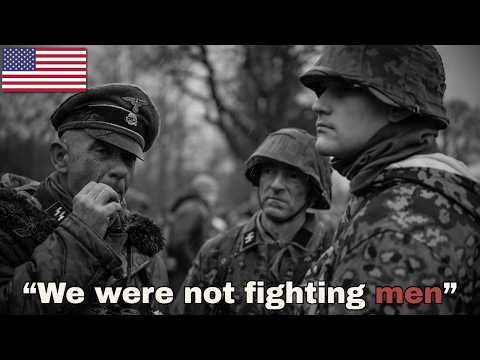
And here’s the detail almost nobody gets right: it wasn’t the SS. It wasn’t Hitler’s ideological shock troops who ran into this wall outside Bastogne. It was regular Wehrmacht Panzer Lehr, one of the best-equipped divisions Germany had left, built specifically to spearhead breakthroughs like this one. The 2nd Panzer Division, veterans of nearly every front of the war. And a newly rebuilt infantry division, the 26th Volksgrenadier, thrown together that same autumn.
The actual SS divisions in this offensive—the 1st and the 12th—were fighting a hundred kilometers north at Elsenborn Ridge. They never came near Bastogne. Which, if anything, makes this a stranger story than the one on most thumbnails. This wasn’t Germany’s fanatics failing. It was some of its most competent, most experienced conventional soldiers, led by men who’d fought from the Western Desert to Kursk to Normandy, running directly into a division that had never once fought this kind of battle before—and losing.
Because that’s the other half of the underdog math nobody mentions. The 101st Airborne didn’t specialize in this. They jumped into fights: Normandy, then Holland during Market Garden, hit hard, and got relieved fast. Bastogne would be the first time in the division’s short existence it had to dig in, hold a static perimeter, and simply outlast an enemy with more men, more armor, and more artillery than it could ever hope to match.
They hadn’t trained for a siege. They’d never fought one. They were about to fight one anyway.
The 101st activated on August 16, 1942, at Camp Claiborne, Louisiana. Built out of farm towns, factory floors, and fishing villages the Army had never asked much of before. The training that followed wasn’t conventional. It was closer to a deliberate search for the exact point where a man gives up—and then a systematic effort to move that point further out.
There’s a phrase that ends up defining this division at its worst hour. You’re going to hear the man who actually said it, almost word for word, a little later. Remember that.
By December 1944, the division was resting outside Reims, still recovering from Market Garden, when a very different kind of commander began setting the board against them. General Heinrich von Lüttwitz was 58, an old-fashioned cavalry man who wore a monocle and had, according to officers who knew him, an odd reputation: gruff in manner but genuinely well-liked by the troops under his command.
On December 12, he gathered his division commanders and told them plainly that Bastogne had to fall or it would remain an abscess on our lines of communication. Four days later, Operation Wacht am Rhein tore into the Ardennes. Von Lüttwitz’s corps was moving fast enough that by December 17, he’d intercepted American radio traffic revealing the 101st had been alerted for a rapid move to the front.
He understood immediately what that meant. Not that the airborne was coming to stop him in open country—that the American army had nothing else left in reserve to send. He calculated he could reach Bastogne before they did.
The 101st got about eighteen hours’ notice. For a division that had jumped into every fight it had fought so far, this one would be different. There was no time to plan a drop. So they drove—crammed into open trucks, most without winter gear, into a night where the temperature was already sliding toward minus twenty Celsius. More than a few hadn’t eaten anything substantial in days.
Farther up the road, they started overtaking trucks heading the other way. Other Americans, already pulling back from whatever lay ahead, with nothing good to say about it.
Here’s what they were driving into. The 101st itself numbered roughly 11,000 enlisted men and 800 officers. Add the attached armor, artillery, and tank destroyer units already fighting outside Bastogne, and the total defending the town came to somewhere near 22,800 men. Facing them: von Lüttwitz’s 47th Panzer Corps, roughly 54,000 men, with the 26th Volksgrenadier Division alone fielding around 17,000.
December 19 was the day the numbers started to matter.
At Noville, north of Bastogne, Lieutenant Colonel James LaPrade led a counterattack against the leading edge of von Lüttwitz’s 2nd Panzer Division and was killed almost immediately by an 88mm shell outside his own command post. His fellow commander at Noville, Major William Desobry, was wounded in the same fighting. Neither of them held the village.
That wasn’t really the point. Every hour they spent forcing the German tanks to fight for a crossroads north of the real objective was an hour the rest of the perimeter got to dig in a little deeper.
This is the moment Bayerlein was talking about. That same morning, his task force—infantry, fifteen tanks, one artillery battery, Bayerlein himself riding in one of the lead vehicles—pushed toward Nef, hoping to reach Bastogne before serious resistance could organize. He paused for nearly an hour outside the town for no clear tactical reason his own account ever fully explains.
When he finally gave the order to advance, dug-in troops from Colonel Julian Ewell’s 501st Parachute Infantry met his lead tanks with fire. About an hour later, an American artillery battery under Captain McClone caught his stalled column in the open. By the time it was over, roughly eighty of Bayerlein’s men were dead or wounded, and one of the Wehrmacht’s most capable panzer commanders had retreated to a cave near the Nef station to reconsider his options.
Not every story from these days is an American victory. At Longvilly, a column of American armor trying to break out toward Bastogne got trapped on a single road and for a few hours on the afternoon of the 19th found itself caught in the crossfire of three German divisions converging on the same position at once. It’s one of the strangest moments in the US Army’s own account of the siege: a force that had essentially already lost, simply looking for a way out, absorbing the heaviest concentration of German firepower produced anywhere in the battle’s opening days.
It isn’t a clean story. War rarely gives you one. But even that chaos bought something—hours the rest of the perimeter spent finishing its foxholes.
By December 20, with both panzer divisions ordered to keep pushing west toward the Meuse regardless of whether Bastogne fell, the job of actually taking the town passed to Kokott’s 26th Volksgrenadier Division alone. That same morning, an American artillery shell hit Kokott’s own command truck at Wardin, killed the men riding with him, and threw the general against the wall of the village church. He was badly stunned. By his own account, it was the closest call of his war. He kept going anyway.
By nightfall on the 20th, his forces had pushed a reconnaissance battalion and one infantry regiment through Sibret, and the ring around Bastogne was almost solid—with one gap left near Champs that Colonel Harper’s 327th Glider Infantry was already working to close on the American side. The ring closed for good on the night of December 20 into the 21st. The pocket the 101st was now defending stretched roughly eight kilometers across. Nobody was coming to get them.
On December 22, von Lüttwitz sent officers under a white flag with a formal ultimatum: surrender or face annihilation. It reached Brigadier General Anthony McAuliffe. His answer, when his staff asked what to put in writing, was one word: “Nuts.”
The typed reply read: “To the German commander: Nuts. The American commander.” Colonel Joseph Harper delivered it personally, and when the confused German officers asked what it meant, he told them roughly to go to hell.
Remember that phrase from earlier? Here it is. Before the Germans ever showed up with a white flag, McAuliffe had reportedly already told his own men something close to it: “We are surrounded by the enemy. We can attack in any direction.” Nuts wasn’t a joke. It was consistent with what he already believed.
Among von Lüttwitz’s own staff, the ultimatum quickly became something close to an embarrassment. According to the US Army’s own official history, the other German commanders came to regard it as a military faux pas, and von Lüttwitz himself grew visibly chagrined about having sent it at all. They apparently believed he’d kept the actual Nuts note hidden away somewhere as a kind of grim souvenir.
December 23 brought the first clear skies of the siege, and with them, resupply. Watching American transport planes drop supplies over the perimeter, Kokott and his officers initially mistook the parachutes for reinforcements. In his own words, “the effect was to increase the disorder in the ranks of the attackers.”
That same night, his forces attacked Marvie on the southeastern edge of the perimeter. His troops reported capturing the village. They hadn’t. They’d taken a handful of houses and stopped. Kokott’s own comment on it, recorded years afterward, was almost self-deprecating: it was, he said, “a very common type of error in our operations.”
That night, with attacks stalling everywhere along his front, Kokott was visited in person at his command post by General Hasso von Manteuffel, commander of the entire Fifth Panzer Army. Manteuffel’s order was simple: Bastogne must be taken at all cost. He committed an entire fresh division, the 15th Panzer Grenadier, to Kokott’s command for one more attempt—planned for Christmas morning.
Before that attempt could even launch, Luftwaffe bombers hit Bastogne itself on the night of December 24. The aid station on the Rue de Neufchâteau took a direct hit. It killed a Belgian volunteer nurse named Renée Lemaire along with roughly thirty wounded men she’d been treating. She’d reportedly been saving silk from a resupply parachute, hoping to make a wedding dress out of it. It became her burial shroud instead.
A second nurse, a young Congolese Belgian volunteer named Augusta Chiwy, survived the same blast and kept working through the wounded for days afterward without stopping. The US Army wouldn’t formally recognize what she’d done until 2011—sixty-seven years later.
Kokott’s plan called for his freshest regiment, reinforced by the newly arrived 15th Panzer Grenadier, to attack through the villages of Champs and Hemroulle, northwest of Bastogne. He’d reasoned the Americans would be weakest there. He was wrong. The forces waiting for him were the freshest and best supplied in the entire perimeter, under Lieutenant Colonel Steve Chappuis and the 502nd Parachute Infantry, backed by tank destroyers from the 705th Battalion.
The attack went in at 3:00 a.m., aiming to reach Bastogne by 8. By 10 that morning, Kokott knew it had failed completely. At noon, he asked his corps commander for permission to stop and reorganize. He was refused—and ordered to keep attacking a position he already knew he couldn’t take, purely to buy time elsewhere on the front.
That same day, McAuliffe sent his own men a different kind of message: “We have stopped cold everything that has been thrown at us.”
On the afternoon of December 26, tanks from the 4th Armored Division under Lieutenant Colonel Creighton Abrams broke through the German lines near Assenois and reached the perimeter. It’s tempting to call this the rescue—the cavalry arriving in the final act. The men who’d spent eight days holding that ring generally didn’t see it that way. The siege was over. The division hadn’t needed saving. It had needed resupply. And now it had a road.
For its defense of Bastogne, the 101st Airborne received the Distinguished Unit Citation—the first time in American military history the award had gone to an entire division rather than a smaller unit within one.
Here’s the reason we know so much of this in the Germans’ own words. In November and December of 1945, US Army historians sat von Lüttwitz, Bayerlein, and Kokott down together for ten separate conferences. Because, as the official record put it, if the truth of Bastogne was going to be measured accurately, the witnesses must speak from the opposing camp.
What emerged wasn’t three interchangeable enemy officers. It was three very different men. Von Lüttwitz, once he had a map in front of him, would talk for hours, laying pencils down to represent his regiments—windy, according to the historian who interviewed him, but strangely fixated on the movements of individual squads rather than divisions. Bayerlein, sharp and impatient, made no secret of his contempt for him. When von Lüttwitz rambled, Bayerlein would wave a hand in his face and snap, “Not important. Not important.”
Kokott sat apart from both of them—quiet, scholarly, the only one of the three the historians described as strictly objective about his own mistakes. He’d known even at the time that continuing the original plan past December 19 had stopped making sense. He was also, by nature, an optimist. He kept expecting to win anyway.
Then the American historians brought in Colonel Harry Kinnard, who had actually planned the 101st’s defense from inside the perimeter as the division’s operations officer. Seeing him seemed to genuinely unsettle von Lüttwitz. He asked more than once whether they were certain this young, almost boyish-looking officer had really been the one running things. He had been. The whole time.
Here’s the number we promised you at the start. You’ll see the figure 19,000 casualties attached to the 101st online—more than almost any other statistic about this battle. That’s not this division’s losses. That’s the number of Americans killed across the entire six-week Battle of the Bulge: 19,276 dead out of 89,987 total casualties. The 101st’s own losses defending Bastogne from December 19 through January 6 were 341 killed, 1,691 wounded, and 516 missing—2,548 men out of roughly 22,800 who held the line.
So go back to Bayerlein sitting across a table from American historians in 1945, choosing his words carefully about a division of American paratroopers who’d never fought a siege before and somehow held one anyway. He wasn’t being generous. Officers like Bayerlein didn’t hand out compliments to make themselves look better. If anything, admitting the Americans had outfought him made his own failures harder to explain. He said it because it was true—and because four years and three fronts into the war, it was the first time he genuinely hadn’t seen it coming.
That’s the story underneath the myths. Not the SS breaking against fanatics who wouldn’t quit. Some of the most experienced soldiers Germany had left—well-armed, well-led, doing everything their own doctrine said should work—against a division that had never fought this exact kind of fight before in its life. And it still wasn’t enough.
If you want the version of history nobody’s cleaning up for you, subscribe and tell me in the comments: which battle should we take apart like this next?
Report this article
Select a reason for reporting:






