The battle that would become the climax of an Oscar-winning film was not fiction. It happened on the night of January 12, 1968, at Firebase Burt in Tay Ninh Province, seven miles from the Cambodian border. No American TV crew was there. No network reporter covered it. The Tet Offensive, 29 days later, would overshadow everything. But what happened that night—a battle that destroyed two Viet Cong regiments in six hours—left one American soldier in a trench wondering for years if he had imagined the whole thing. You will learn who he is at the end. Not now.
Shortly after midnight, a signal rose above the firebase. It meant: infantry, get down into the bottom of your trenches. The artillery was about to fire across our perimeter because the Viet Cong had already breached the wire, entered the defensive line, close enough to toss a grenade over the sandbags. So the Americans did something unmatched in conventional warfare. They pointed their guns inward, aimed them across their own base, and opened fire.
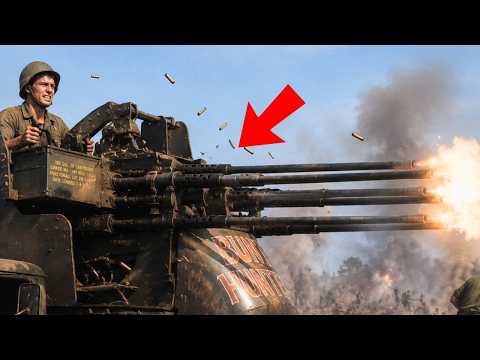
Eleven 105mm howitzers lowered their barrels to horizontal. Two M42 Duster anti-aircraft guns began firing. Along the perimeter, four quad-50 machine gun turrets rotated. A weapon designed in 1943 to shoot down aircraft was now leveled flat, firing tracer rounds at waist height through gaps in the wire. On one turret, a gunner worked the controls with his partially amputated hand. A man lying on the dirt beside him pressed his face to the ground and watched.
By dawn, the U.S. Army Center of Military History counted 379 Viet Cong dead and eight prisoners. Twenty-three Americans were killed. The kill ratio was 16.5 to 1. Three men will carry this night forward. None of them knows how it ends.
The first weapon, built by the W.L. Maxson Corporation in New York for the U.S. Army, was designed to solve a specific problem. Propeller-driven aircraft were getting faster, and the single .50-caliber Browning machine gun couldn’t fire fast enough to hit them accurately. The solution was mounting four .50-caliber Browning M2s on a single powered turret, with one gunner in the center using two control handles and two assistants feeding ammunition boxes behind him, because the four guns consumed ammo belts faster than any man could load them. The total rate of fire was about 2,000 rounds per minute. The turret could rotate a full 360 degrees and elevate up to 90 degrees vertically if needed. The four gun barrels could be adjusted to converge at a single point at any range the gunner chose, tightening into one steel fist as distance increased. They called it the “Meat Chopper.” Not in Vietnam—the name was older than that. It was inspired by the Battle of the Bulge, the bridges at Remagen, and every European battlefield where infantry in the open learned what four converging .50-calibers could do from one man at 500 yards. The Americans didn’t invent the name.
By the time the turret reached Vietnam, the aircraft it was designed for no longer existed in the war zone’s skies. The North Vietnamese had no significant air force in the south. So the crew did what crews did in Europe when Allied forces controlled the air: they tilted the gun barrels flat. The exposed steel seat was a weak point. Quarter-inch steel plates, the kind a Kalashnikov round easily penetrates. The men called the position “the mortar magnet.” The gunner sat in the open under the glow of his own tracers, firing. Every fifth round glowed. The enemy always knew exactly where to aim.
In river valleys and on Route 19 from Quan Loi to Bu Prang, quad-50 gun trucks had rewritten the rules of convoy ambushes. The enemy adapted, learning to target the lead vehicle first and avoid the gun truck’s fire. A weapon capable of turning a kilometer of jungle into a wall of fire was a weapon to be planned around. That lesson had not yet reached the 271st and 272nd Regiments of the 9th Viet Cong Division, who were moving through War Zone C in the darkness of December 31, 1967, toward a firebase that hadn’t existed five days earlier.
The firebase was placed there deliberately, north of Tay Ninh Province, War Zone C, near coordinates XT49 9806, about 90 kilometers northwest of Saigon and 11 kilometers from the Cambodian border, across a line American forces could not cross. The Black Virgin Mountain, known as Nui Ba Den, was visible from every angle of the base, a known Viet Cong observation point. A road ran through the center and connected directly to the 9th Division’s infiltration corridor, used to move troops and supplies toward Saigon. Firebase Burt was built in late December 1967 under Operation Yellowstone, roughly one kilometer east to west and 500 meters north to south. The 3rd Battalion, 22nd Infantry Regiment, 25th Infantry Division—regular army—held the eastern half, where 40 freshly dug bunkers were fortified in hard laterite soil. The 2nd Battalion, 22nd Mechanized Infantry held the western half with its M113 armored personnel carriers. Two 155mm self-propelled howitzers covered the north. Two M42 Dusters and quad-50 mounts from Battery D, 71st Artillery, were also deployed. The base was bait. That’s the term veterans used, and the most fitting one.
The 9th Division’s infiltration corridor ran straight through the ground. Firebase Burt now sat on it. To prepare their men for what was coming, 29 days later, the regiment would either have to go around it or through it. Going around added days. Going through required removing the obstacle, and the obstacle in front of men planning to attack in the jungle six miles away looked new, hastily dug, and weak. They sent a reconnaissance team to measure it. The team moved in the darkness of December 31. The commanding officer carried the documents his mission required: firing tables for 82mm mortars. The calculations that would allow his mortars to cover that perimeter accurately once he reported the distances and gaps. On his hip, a Russian-made pistol, a mark of his rank in the Viet Cong. He got close enough to hear the Americans in their bunkers. A flare popped with a white sound. Claymores exploded. The darkness filled with the sounds of contact, then silence. On the morning of January 1, an American sweep team found his body 200 meters outside the wire. The Russian pistol was recovered. The firing tables were red. Someone on the American side realized immediately. A forward observer had been here to register mortar coordinates on this firebase. The documents identified elements of the 271st and 272nd Viet Cong Regiments, 9th Division. The base went to maximum alert. Christmas mail that had just arrived piled up in the dust as men checked their weapons, reset their claymores, and refined their sight adjustments.
At 6:45 that evening, an ambush patrol 200 meters east took fire. Two Americans were killed. At 8:00, 1560mm mortar rounds fell inside the perimeter in sporadic shots. At 11:30 PM, all listening posts around the perimeter reported movement in the tree line. Sustained, widespread movement. In the jungle, two regiments were assembling. The regimental commander, unnamed in the records, and the commander of the knife unit in this particular attack, whose identity was never revealed in any available source, had a plan built on tried logic. The human wave attack plan on a firebase had succeeded by pushing enough men through the wire fast enough to make American artillery and air support too dangerous to use without killing American soldiers. At Firebase Gold, Suoi Tre, in March 1967, the 272nd Regiment had breached the perimeter. The Americans had been able to seal it using directed howitzers and a mechanized battalion. But the tactic was about to succeed. So more men were committed, better coordination, two regiments instead of one, three waves, and a coordinated two-axis assault north and south simultaneously on both sides of the road that ran through the center of the base.
At 11:30 PM, 260mm mortar rounds fell on Firebase Burt within 15 minutes. The plan was professionally rehearsed. The man who carried the firing tables through the wire to bring them back didn’t survive, but the coordinates were recorded by other means, or perhaps the tables were copied because the rounds landed with the accuracy of pre-registered fire. When the barrage stopped, the first wave rose from the grass. You are in a trench not deep enough. The ground is laterite, red clay compressed, almost as hard as concrete. You’ve been digging since you arrived, and it’s not deep enough. Your rifle is in your hands. The noise around you is everything at once. Mortar thuds, the crack of Kalashnikovs, the pop of flares along the wire, men screaming in a language you don’t understand. You cannot see the attackers. The night is black. The only light is the flares. Something terrifying falls from above. Then the rivers of glowing bullets begin. One in five rounds glows red, and a veteran beside you says it looks like rivers of blood falling from the sky. You don’t fire your rifle. There is nothing visible to shoot at. You press your face into Vietnam and listen to the war.
At 12:01 AM on January 2, the main attack struck the northern perimeter. The heaviest fire concentrated on the western side of the road toward the mechanized battalion. Simultaneously, RPGs and machine guns poured from the south along the road trenches toward Charlie Company in the east. The 16-man ambush patrol from Charlie Company was overrun in the first minutes. One was killed by enemy fire, 11 others wounded, and a third killed by close air support when the airstrikes came too close to his position. Thirteen of sixteen men fell. The survivors who made it back came without most of their gear.
RPGs found their targets. One destroyed an M113. Another destroyed one of the two gun trucks. Viet Cong fighters breached the wire at several points simultaneously. At the command post, the artillerymen received the order. They lowered the 105mm howitzers to horizontal and loaded them with beehive rounds. Each beehive contained 8,000 steel flechettes inside its casing. The finned fragments, the size of finishing nails, were ejected by a mechanical time fuze. Each round turned the howitzer into something like a shotgun the size of a car. The artillerymen aimed flat along Charlie Company’s perimeter and fired.
Soldiers near the guns heard the flechettes passing directly overhead and buried their faces in the ground. One platoon leader, lying on his back with a fragment piercing his body after a 105mm round landed three meters from his position, survived the fire of the same gun at the same moment. When the beehive rounds ran out, they loaded high-explosive with minimal powder and kept firing at extremely close range. The 155mm self-propelled howitzers opened fire on Alpha Company’s front. The remaining artillery protected the southern perimeter. Quad-50s fired bursts through gaps in the wire.
Above, an AC-47 gunship circled on station, its General Electric 7.62mm miniguns firing through SUU-11A pods. Every fifth round was a tracer. Any Viet Cong commander still in position watching from the tree line saw something doctrine hadn’t accounted for. Not indirect fire from behind the base, inaccurate at close range and dangerous to the defenders who would have to call it in on their own positions. Direct fire. Howitzers aimed straight at attacking infantry at ranges where every round hit its target. The attack’s geometry was built around one type of weapon, but they ran into another. The quad-50s sealed the gaps.
When the signal rose—whether a red flare or a radio order, depending on which account you read—the infantry flattened in the bottoms of their trenches, and the guns turned inward, firing across the base perimeter, hitting the men who had entered the wire. On the turret, the gunner worked with part of his hand gone. A man lying on the dirt beside the turret watched him. That moment doesn’t fade from memory. His name is not in the after-action report. Not in the records of Battery D, 71st Artillery. Not in any veteran’s testimony on any site that collected accounts from men of the 22nd Infantry. A careful search of every available primary source yielded nothing. No name, no medal, no mention.
The Distinguished Service Cross awarded to Firebase Burt went to an infantry platoon leader, Gordon F. Kelly, for his actions that night. It was not awarded to any member of the quad-50 crew. Not to the man in the seat. His name is not in the historical record. This is not a research limitation. It is the truth. He kept working, kept firing, kept loading despite the amputation, while Kalashnikov rounds pierced the thin steel plates around him. No one recorded his name. No medal was hung on him. He appears in the history of the battle in a single sentence from an unknown man who lay on the dirt beside him.
Around 5:00 AM, the Viet Cong began to withdraw, leaving their dead and wounded in the wire. By 6:30, only sniper fire remained. The man climbed from the trench at first light. He walked through what was left of Firebase Burt. The wire was full of bodies. In front of the bunkers, in the trenches beside the road, in the gaps where the fire had found them: hundreds. Some still in rigor, frozen where they fell; some burned, white chemical ash covering their faces; some nailed to trees, upright, pinned there by flechettes the wind had carried. He stood in that scene and felt something he would spend decades trying to describe.
Full daylight revealed charred bodies, thick dust, gray trees. He would write about men who died in agony in frozen positions. Some still standing or kneeling in rigor. White chemical death on their faces. Dead. Truly dead. And soldiers might say it was hell, but I saw it as divine. The closest a man can come to the Holy Spirit is to witness that much destructive energy and survive it. A bulldozer was already working. The base was fixed in place, and the bodies couldn’t stay. They were pushed into trenches. Attempts to burn them with diesel failed. The earth covered them.
This was Oliver Stone. He arrived in Vietnam on September 16, 1967. He served in Bravo Company, 3rd Battalion, 22nd Infantry, 25th Infantry Division. He was 21 years old. He was an ordinary soldier who spent the worst night of his service in a trench too shallow for him, listening to a battle he couldn’t see, without firing a single round. After the war, he came home to find that the New Year’s attack on Firebase Burt had received almost no media coverage. Tet overshadowed everything before it: the intelligence failure, the ceasefire violation, the training no one noticed. For years, Stone wondered if he had imagined the whole night, until he attended a reunion of the 25th Infantry Division. Other men who were there confirmed what happened. Yes, that night happened. You were there. It was real.
He wrote a screenplay. The film he directed was called Platoon. It won the Academy Award for Best Picture in 1987. The climactic battle takes place at Firebase Burt. Stone himself appears in the film as a battalion commander whose bunker is blown by an engineer. The mass graves at the end of the film, where bodies are bulldozed into a trench in the morning light, are not fiction. Most who watched believed the ending was the director’s ultimate exaggeration. They were watching something that already happened. Stone watched it too.
The U.S. Army Center of Military History recorded 379 Viet Cong killed and eight captured at Firebase Burt. Other sources range from 348 to over 401. Against 23 American dead, the ratio was 16.5 to 1. The 9th Division had to reorganize before it could fight again, and that took four months. The tragedy of that night repeated everywhere. Dense direct fire at extremely close range. The quad-50 system sweeping the wire until a mass assault on an equipped American base became a loss. No order was given to stop—only a body count. The quad-50 was replaced starting in 1969 by the M163 Vulcan air defense system, a 20mm closed-turret system firing 3,000 rounds per minute. No seat in the dark. The man who reloaded the weapon with his ruined hand was replaced by a weapon that didn’t require him to sit in the open. His name was never recorded.
Oliver Stone won the Oscar for Best Picture for Platoon in 1987. The men who built the mass graves he filmed are still buried in the earth near the Black Virgin Mountain. And the gunner on the quad-50, the one whose name no record preserves—was he a hero the Army forgot, or a ghost the war simply refused to count?
Report this article
Select a reason for reporting:






