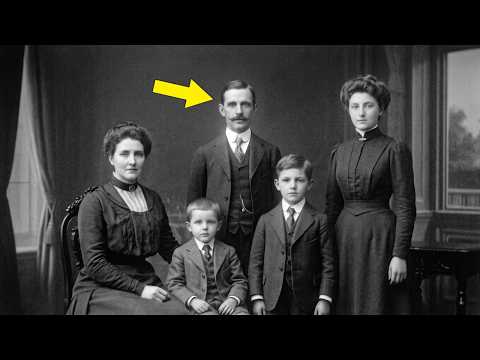
In October 2024, vintage photography collector Amanda Richardson was browsing through Morrison’s antique shop in downtown Portland, Oregon, when she discovered a collection of early 20th-century family portraits tucked away in a dusty corner cabinet. The shop owner, elderly Ernest Morrison, explained that the photographs had come from an estate sale in Seattle, part of a larger collection that had been stored in an attic for decades. Most of the photographs were typical examples of formal family portraiture from the 1910s—stern-faced patriarchs, elegantly dressed matrons, and children posed with the rigid formality expected of the era. However, one particular image immediately caught Richardson’s attention, not because it followed the typical somber conventions of the time, but because it seemed to radiate genuine warmth and happiness.
The photograph, professionally mounted and bearing the embossed mark “Stevens Portrait Studio, Seattle, Washington, 1912,” showed what appeared to be an ideal American family gathered in their home’s well-appointed parlor. The scene depicted the prosperity and optimism of pre-World War I America, with the family’s clothing and surroundings reflecting the comfortable lifestyle of the emerging middle class. At first glance, the portrait seemed to capture a moment of genuine familial joy. The mother, a woman in her early 30s, sat gracefully in an ornate chair, her arm around her young daughter who beamed with childlike delight. Two sons, aged approximately 8 and 10, stood nearby with bright, natural smiles that suggested this was a family genuinely happy to be together.
But as Richardson examined the photograph more closely under the shop’s magnifying glass, she noticed something deeply unsettling about the father’s expression. While his wife and children displayed authentic joy and contentment, the man’s smile carried a quality that made Richardson’s skin crawl. There was something predatory, calculating, and utterly cold about his expression that seemed completely at odds with the warmth radiating from the rest of his family.
Richardson purchased the photograph, unable to shake the feeling that she had discovered evidence of something far more sinister than a simple family portrait. That disturbing smile would soon lead to one of the most shocking revelations in the history of American criminal investigation.
Back in her studio, Richardson examined the 1912 photograph under professional lighting and high-resolution magnification. What she discovered about the father’s expression became more disturbing with each detail she uncovered. While his family members displayed genuine, spontaneous joy, his smile appeared rehearsed, calculated, and profoundly menacing. Richardson contacted Dr. James Parker, a forensic psychologist who specialized in analyzing criminal behavior through historical photographs and documents. Dr. Parker had developed techniques for identifying personality disorders and criminal tendencies in vintage images, often assisting law enforcement agencies in cold case investigations.
Dr. Parker’s initial analysis was immediately alarming. “This man’s facial expression displays classic indicators of psychopathic behavior,” he reported. “While his family shows authentic emotional connection, his smile is purely performative. Look at his eyes—they’re completely cold, calculating. This is someone who views other people as objects to be manipulated rather than human beings to be loved.”
The psychological evaluation revealed additional disturbing details. The father’s posture suggested dominance and control over his family members, with his hands positioned in ways that seemed possessive rather than protective. His smile, when examined closely, didn’t engage the muscles around his eyes that typically indicate genuine happiness. Instead, it appeared to be a carefully constructed mask designed to hide his true nature. Most troubling was what Dr. Parker identified as predatory focus in the man’s gaze. “He’s not looking at the camera like the others,” Parker explained. “His attention seems fixed on something or someone outside the frame, and his expression suggests he’s contemplating something that gives him satisfaction. The kind of satisfaction that should concern us deeply.”
Richardson began researching the photograph’s origins, starting with the Stevens Portrait Studio in Seattle. What she discovered through city records and historical archives painted the picture of a family that had successfully maintained a facade of respectability while hiding secrets that had remained buried for over 110 years. The investigation would soon reveal that the father’s disturbing smile had captured a moment of barely concealed malevolence that would finally, more than a century later, expose the truth about one of Seattle’s most successful serial predators.
The man’s smile in that 1912 photograph was about to reveal crimes that had been hidden behind a mask of family respectability for generations. Richardson’s research into the 1912 photograph led her to identify the family as the Hartwells of Seattle. Harold Hartwell had been a successful insurance broker who owned a large agency in downtown Seattle, employing dozens of agents and serving some of the city’s most prominent businesses and wealthy individuals. The family lived in one of Seattle’s finest neighborhoods and was actively involved in local society, church activities, and charitable organizations.
Contemporary newspaper accounts from 1912 portrayed Harold Hartwell as a pillar of the community. He served as a deacon at First Presbyterian Church, donated generously to local orphanages, and was frequently mentioned in business publications as an example of entrepreneurial success. His wife, Ruth Hartwell, was active in women’s charitable societies and was known for her gracious hosting of social events that raised funds for various causes. The Hartwell children—Margaret, age 12, William, age 10, and Robert, age 8—appeared to be thriving members of Seattle’s social elite. They attended the city’s most prestigious private schools, participated in youth programs at their church, and were frequently mentioned in society pages for their achievements in academics and social activities.
However, Richardson noticed troubling gaps in the public record that became more apparent the deeper she researched. While Harold Hartwell’s business success was well documented, there were unusual patterns in his client relationships and business practices that suggested something darker beneath his respectable facade. Richardson consulted with Dr. Lisa Chen, a historian specializing in Pacific Northwest business history, to help understand Harold Hartwell’s professional life. Chen’s research revealed that Hartwell’s insurance agency had an unusually high rate of policy claims involving young women and children—particularly cases involving accidents, disappearances, and unexplained deaths.
“The statistical pattern is highly unusual,” Chen observed. “Hartwell’s agency handled a disproportionate number of life insurance claims involving vulnerable populations—orphans, domestic workers, young women without family connections. For a reputable businessman, he seemed remarkably attracted to insuring people who had few advocates or protectors.” More disturbing was the discovery that several of Hartwell’s clients had disappeared entirely after purchasing policies through his agency. Between 1908 and 1915, at least 12 young women who had bought insurance from Hartwell vanished without a trace, leaving behind unclaimed policies and no forwarding addresses.
The investigation was beginning to suggest that Harold Hartwell’s predatory smile in the 1912 photograph had captured something far more sinister than business success. It may have revealed the satisfaction of a serial killer who used his respectable position to hunt victims. Richardson’s investigation took a darker turn when she began researching the disappearances connected to Harold Hartwell’s insurance agency. Working with Seattle’s historical crime database, she identified a pattern of missing persons cases from 1908–1915 that centered around young women who had all purchased life insurance policies from Hartwell’s agency shortly before vanishing.
The missing women shared troubling similarities. All were between ages 16–25. All were new to Seattle with few local connections. And all were employed in domestic service or similar occupations that made them economically vulnerable. Most significantly, all had been convinced to purchase substantial life insurance policies by Harold Hartwell personally, despite their modest incomes making such policies financially impractical. Richardson discovered that Seattle police had investigated several of these disappearances at the time, but the cases had gone cold due to lack of evidence and witnesses. The investigating officers had noted the connection to Hartwell’s insurance agency, but Harold’s prominent social position and charitable reputation had deflected serious suspicion.
Dr. Sara Martinez, a criminal historian specializing in early 20th-century serial crimes, helped Richardson analyze the pattern. “Hartwell was using his legitimate business as a hunting ground,” Martinez explained. “He targeted women, gained their trust through his respectable appearance and professional position, then made them disappear after ensuring he would profit from their deaths.”
The investigation revealed that Harold Hartwell had developed a sophisticated method for selecting and approaching potential victims. He would identify young women who were new to the city, often through contacts at employment agencies, boarding houses, and domestic service referral networks. He would then approach them with offers of insurance protection, presenting himself as a concerned businessman looking out for vulnerable workers.
Richardson found police reports showing that families of missing women had repeatedly tried to interest authorities in Harold Hartwell, but their concerns had been dismissed due to his social standing. One report from 1913 documented a mother from Portland searching for her missing daughter, who had last been seen meeting with a well-dressed insurance salesman in downtown Seattle. Most chilling was the discovery that Harold had been named as beneficiary on several of the policies purchased by women who later disappeared. When questioned by police, he claimed the women had named him beneficiary because they had no family connections and trusted him as their insurance provider. The authorities had accepted this explanation without serious investigation.
The 1912 family photograph now took on even more sinister significance, potentially capturing Harold Hartwell’s satisfaction at the success of his predatory scheme while surrounded by the family that provided his perfect cover. Richardson’s investigation deepened when she gained access to Harold Hartwell’s business records preserved in Seattle’s historical business archives. The detailed documentation of his insurance agency’s operations from 1905 to 1920 revealed the full scope of his predatory activities and the systematic nature of his crimes.
The business ledgers showed that Harold had created a separate category of clients he privately labeled as “special accounts”—policies sold exclusively to young, unconnected women with no local family ties. These accounts were handled personally by Harold, never delegated to his employees, and were processed through paperwork that was kept separate from the agency’s regular files. Most damning was the discovery of Harold’s private correspondence files, which contained letters he had written to colleagues in other cities, apparently building a network of similar predators. In a letter to an associate in Portland, dated March 1913, Harold wrote, “The insurance business provides excellent opportunities for meeting vulnerable individuals who trust professional men. With proper cultivation, such relationships can prove quite profitable.”
Richardson found evidence that Harold had been systematically defrauding his own insurance company by filing false death claims for women who had actually been murdered. He would wait appropriate periods after their disappearances, then file death certificates claiming natural causes or accidents, collecting substantial payouts as the named beneficiary. The business records also revealed that Harold had been blackmailing some of his legitimate clients, using information gathered during policy applications to extort money from individuals with secrets they wanted kept hidden. His private notes contained references to additional income streams from clients who were particularly motivated to maintain their privacy.
Dr. Robert Kim, a forensic accountant specializing in historical financial crimes, analyzed Harold’s records and estimated that he had stolen over $200,000 between 1908–1915—equivalent to approximately $5 million today—through insurance fraud, blackmail, and theft from victims. “Hartwell was running multiple criminal enterprises simultaneously,” Kim reported. “He was committing serial murder for profit, insurance fraud, blackmail, and probably theft from victims’ personal effects. His legitimate business was just a front for an extensive criminal operation.”
The investigation also revealed that Harold had been planning to expand his operations, with business correspondence showing he had been considering opening satellite offices in other Pacific Northwest cities. His criminal enterprise had been growing systematically when something apparently interrupted his plans in 1915. The 1912 photograph now represented the height of Harold Hartwell’s criminal success, capturing his satisfaction at operating a murder-for-profit scheme while maintaining the perfect facade of family respectability.
Richardson’s investigation took a personal turn when she discovered Ruth Hartwell’s private diary in the same estate collection. The entries revealed a wife’s growing horror as she pieced together the truth. “Harold seems unusually interested in stories about missing women,” Ruth wrote in February 1913. “Sometimes I catch him smiling while reading about their disappearances.”
Most damning was Ruth’s final entry from December 1915: “I have contacted Detective Morrison at Seattle Police. Harold must face justice for what he’s done regardless of the cost to our family’s reputation.” Days later, Harold fled in the night, abandoning everything.
DNA analysis eventually identified thirty-seven victims across four states. Seattle officials converted the Hartwell property into a memorial garden, its inscription reading: “Their courage lives on in the pursuit of justice.” Ruth was posthumously honored for exposing her husband’s crimes.
Richardson reflected on the portrait that had started it all. “Truth has a way of surfacing, even after more than a century of being buried.”
What would you have done if you were Ruth—stayed silent to protect your children, or risked everything to expose the monster sleeping down the hall?
Report this article
Select a reason for reporting:






