Martin Rhodes had seen thousands of old photographs in his years as senior curator at the Richmond Historical Archives. But the moment he held the 1891 class portrait under his examination lamp, something felt different. Twenty boys in identical dark suits stood on the steps of a grand brick building, their faces frozen in the stern expressions typical of long-exposure photography. Yet one boy in the second row broke the pattern. His eyes were cast downward, and his right hand was pressed awkwardly against his jacket pocket—a gesture that seemed protective, almost defiant.
Martin leaned closer. The boy’s fingers were splayed over the fabric as if guarding something precious. A faint rectangular bulge was visible through the wool. “What are you hiding, son?” Martin murmured to himself.
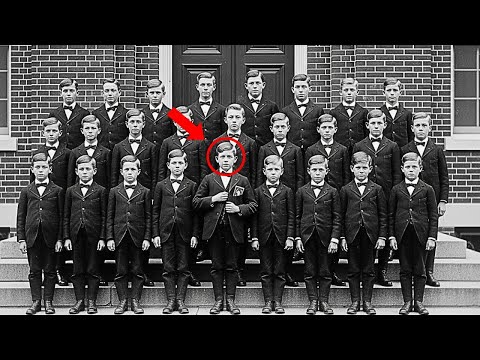
He flipped the photograph over. On the back, in faded ink, someone had written: “Ashford Academy, Richmond, Virginia. Class of 1891, spring term.” Below that, in a different hand, a cryptic message that sent a chill down his spine: “Thomas, may God forgive us for what we did.”
Martin had processed countless donations from the estate of a deceased collector, but this one felt like a warning from the past. He decided to use the archive’s new digital enhancement equipment to examine the image more closely—particularly that boy Thomas and whatever he was protecting.
What he found would expose a friendship that violated every social boundary of Jim Crow Virginia, reveal the courage of children who refused to accept the racial hatred of their time, and ultimately document a tragedy that had been deliberately forgotten for over a century.
The next morning, Martin began the painstaking process of digital enhancement. He started with the overall composition, noting architectural details that might confirm the location, then moved to individual faces. When he focused on Thomas and adjusted the contrast, something unexpected emerged. A tiny corner of paper or cardstock protruded slightly from the pocket’s edge—so small it would have been invisible without magnification.
After nearly two hours of pixel-by-pixel work, Martin could make out the edge of another photograph, smaller than the class picture, tucked into Thomas’s pocket. Why would a boy carry another photograph to a formal class portrait session? And why hold it so protectively, as if afraid someone might confiscate it?
Martin called Dr. Angela Freeman, a historian at Virginia Commonwealth University who specialized in post-Reconstruction Virginia. When he described the hidden image, her response was immediate. “Monument Avenue in 1891 was the heart of Richmond’s white elite,” she explained. “If this boy was hiding something related to crossing racial boundaries, he was taking an enormous risk.”
They met at the archives that afternoon. Angela examined the enhanced images and urged Martin to push further. “If we can see even a fragment of what’s pictured, it might tell us what he was hiding and why.”
Three more days of digital reconstruction followed. Gradually, details emerged from the tiny visible corner: part of a cheek and jaw, distinctly darker in tone than would be expected for a white child. The photographic style matched the formal portrait conventions of the period.
Angela’s voice was barely a whisper. “Martin, I think this boy was carrying a photograph of a black child in his pocket.” To a formal class portrait at one of Richmond’s most elite white schools in 1891—just as Jim Crow laws were being aggressively implemented throughout Virginia.
The implications were staggering. For a white boy from a wealthy family to not only know a black child well enough to possess his photograph, but to carry that photograph openly—albeit hidden—was an act of profound rebellion against the social order his family and school represented.
Martin and Angela dove into research. A society page announcement from the Richmond Dispatch dated September 1890 gave them a name: “Young Thomas Whitfield, son of prominent attorney Harrison Whitfield, has enrolled at the prestigious Ashford Academy.” The Whitfields lived in a mansion on Franklin Street, employed numerous servants, and moved in the highest circles of Richmond society.
Then came a breakthrough in census records from 1890. The Whitfield household included five servants living in quarters behind the main house. Among them was a child named Daniel, listed as “servant’s son, age 11”—exactly the same age as Thomas.
“There,” Angela said, pointing to Daniel’s entry. “If Daniel was living in the household, the boys would have had opportunities to interact, despite the social barriers designed to prevent exactly that kind of contact.”
But proximity didn’t guarantee friendship. White children were typically taught to view black servants as fundamentally different and inferior. Yet somehow, Thomas and Daniel had formed a bond strong enough that Thomas risked social disgrace by carrying Daniel’s photograph.
How had that friendship developed? And how had they maintained it in a world determined to prevent such connections?
The answers would lie in a diary, a ledger, and a long-forgotten scandal that would soon come to light.
Martin found the first thread in the business ledgers of Morrison and Sons Photography, donated to the Virginia Historical Society decades earlier and never thoroughly cataloged. He and Angela spent a long day sifting through boxes of negative logs and correspondence until they found the entry for the Ashford Academy class portrait: 22 students, commissioned by headmaster, payment $25, delivered June 1891.
But in a separate ledger recording individual commissions, they found something that made both researchers freeze. An entry dated March 1891, just two months before the class photograph: “Youth portrait, Daniel, no surname provided, commissioned by Whitfield, payment $2.50.”
“Whitfield,” Angela whispered. “Margaret Whitfield—Thomas’s mother. She commissioned a portrait of Daniel, the groundskeeper’s son.”
The photograph Thomas carried wasn’t something he had obtained secretly or against his family’s wishes. His own mother had paid for it. Margaret Whitfield had commissioned a formal portrait of a black child and ensured it ended up in her son’s possession.
“Why would a wealthy white woman in 1891 Richmond do that?” Martin asked.
“Maybe she understood the friendship,” Angela suggested. “Maybe she even supported it—at least at first.”
But something must have changed dramatically between March, when she commissioned the portrait, and May, when Thomas felt he needed to hide it during the class photograph. They needed to find out what had happened in those two months.
Angela located a diary kept by Margaret Whitfield, portions of which had been preserved by a descendant and donated to a private archive at a women’s college in Virginia. The entries were revelatory.
In January 1891, Margaret had written: “Thomas and Daniel have grown so close over the years. I watch them in the garden and my heart both swells and breaks. Thomas teaches Daniel letters and numbers. Daniel shows Thomas how to identify birds and plants. It is beautiful and innocent, the kind of friendship that exists before the world teaches children to hate. But I know it cannot last. Harrison has begun to notice and disapprove.”
In March, around the time she commissioned Daniel’s portrait, she wrote: “I have done something perhaps foolish, perhaps brave. I commissioned a portrait of Daniel from Morrison’s studio. I told the photographer he was my godson, visiting from out of town—a lie that shames me, but necessary. I want Thomas to have this image, something to remember that for a few brief years, before the world imposed its cruel divisions, he had a true friend.”
But by late April, the tone had shifted dramatically. “Disaster. The headmaster at Ashford discovered Thomas and Daniel together last week in the alley behind our house. Someone—I suspect one of the other mothers—reported seeing them. Harrison is furious. He says I have been too permissive. The headmaster has warned that Thomas will be expelled unless we take immediate action. Harrison has forbidden Thomas from speaking to Daniel under any circumstances. He has threatened to dismiss Joseph and Mary, to turn the entire family out without references, if the friendship continues. I am trapped between my son’s happiness and our family’s survival.”
Martin spent two full days reviewing digitized newspapers from spring 1891. On April 28th, he found a brief item buried on page five of the Richmond Dispatch: “Controversy at Ashford Academy. Several prominent families have expressed concern regarding alleged inappropriate associations between students and servants’ children on school grounds. Headmaster Cornelius Ashford has assured patrons that strict measures will be implemented to maintain proper social distinctions. One family has reportedly withdrawn their son from the academy over the incident.”
The timing was significant—just one month after Margaret commissioned Daniel’s portrait, and one month before the class photograph was taken. Then came a letter to the editor published May 15th, written by a “concerned mother”: “A single student who refuses to maintain proper distance from inferior races can poison the moral atmosphere for all students. Families who cannot control their children should remove them from institutions that serve Richmond’s finest families.”
The class photograph had been taken in late May, just days after that letter appeared. Thomas had been under enormous pressure—from the school, from other families, probably from his own father. Yet he had carried Daniel’s photograph to that formal portrait, holding it against his chest in a gesture of protection and defiance.
Angela found one more piece: a letter from Headmaster Ashford to Harrison Whitfield, dated May 20th, 1891. “I write to confirm the arrangements for our annual class portrait scheduled for May 27th. I trust that young Thomas understands the importance of this occasion and will conduct himself in a manner befitting his family’s distinguished reputation. The recent unfortunate incident has been addressed, and I am confident that no further disciplinary action will be necessary.”
The portrait had been scheduled deliberately, Martin realized—a public test. Thomas would be photographed with his classmates, demonstrating that he had been brought back into conformity. But Thomas had brought Daniel’s photograph with him that day, hidden in his pocket.
Margaret’s diary entry from May 26th, the day before the portrait, made the gesture even more poignant: “This evening, I found Thomas in his room, and we spoke, truly spoke, for the first time since this horrible situation began. He told me he understands why we had to separate him from Daniel. But he said, ‘Mother, they can control my actions, but they cannot control my heart. They can prevent me from seeing Daniel, but they cannot make me stop caring about him.’ He showed me Daniel’s portrait, which he plans to carry tomorrow. I should have forbidden it, but I could not. Let him have this small act of defiance.”
Martin and Angela now had the full story of the photograph. But they still needed to know what happened to both boys after 1891—and whether their friendship had left any trace in the decades that followed.
Angela traced Thomas through Philadelphia census records from 1900. He worked as a clerk in a modest boarding house—a dramatic fall from his family’s social position. He never married, dying in 1923 at age 44. His obituary described a quiet man known for generous donations to educational charities serving Negro children.
Daniel’s fate was harder to trace. Angela eventually found the family in Pennsylvania in 1900. Daniel, now 21, was listed as a teacher at a school for black children. He had become the educated man his friend had believed he could be, spending forty years teaching before his death in 1945.
Martin and Angela organized an exhibition titled Hidden Friendship: Thomas and Daniel, 1891. On opening day, three descendants of Daniel attended, including his great-granddaughter Patricia, who stood quietly crying before the enlarged portrait.
“My great-grandfather never talked about his childhood in Richmond,” she said softly, holding a small formal portrait of a young black boy. “This has been in our family for generations. Now I understand. Someone valued my great-grandfather enough to have this portrait made—someone saw him as equal, as worthy, as human. That someone was Thomas.”
Martin arranged for both portraits to be displayed side by side. Together, they told the story of a friendship society had tried to erase, but that had refused to be completely forgotten.
A young black girl studying Daniel’s portrait asked if it mattered that we know about them now. Martin smiled through unexpected tears. “Yes. That matters very much. That’s why we preserve these photographs—so that people like Thomas and Daniel are not forgotten.”
The exhibition would run for six months and thousands would see it. But more importantly, Thomas and Daniel’s story would enter the historical record permanently—proof that even in the darkest periods of American racial history, there were children who refused to accept hatred as inevitable.
What forgotten stories might be hiding in your own family’s old photographs, waiting for someone to finally see what has been there all along?
Report this article
Select a reason for reporting:






